Responding to some relevant points in the discussion that unfolded since I was last here:
1.
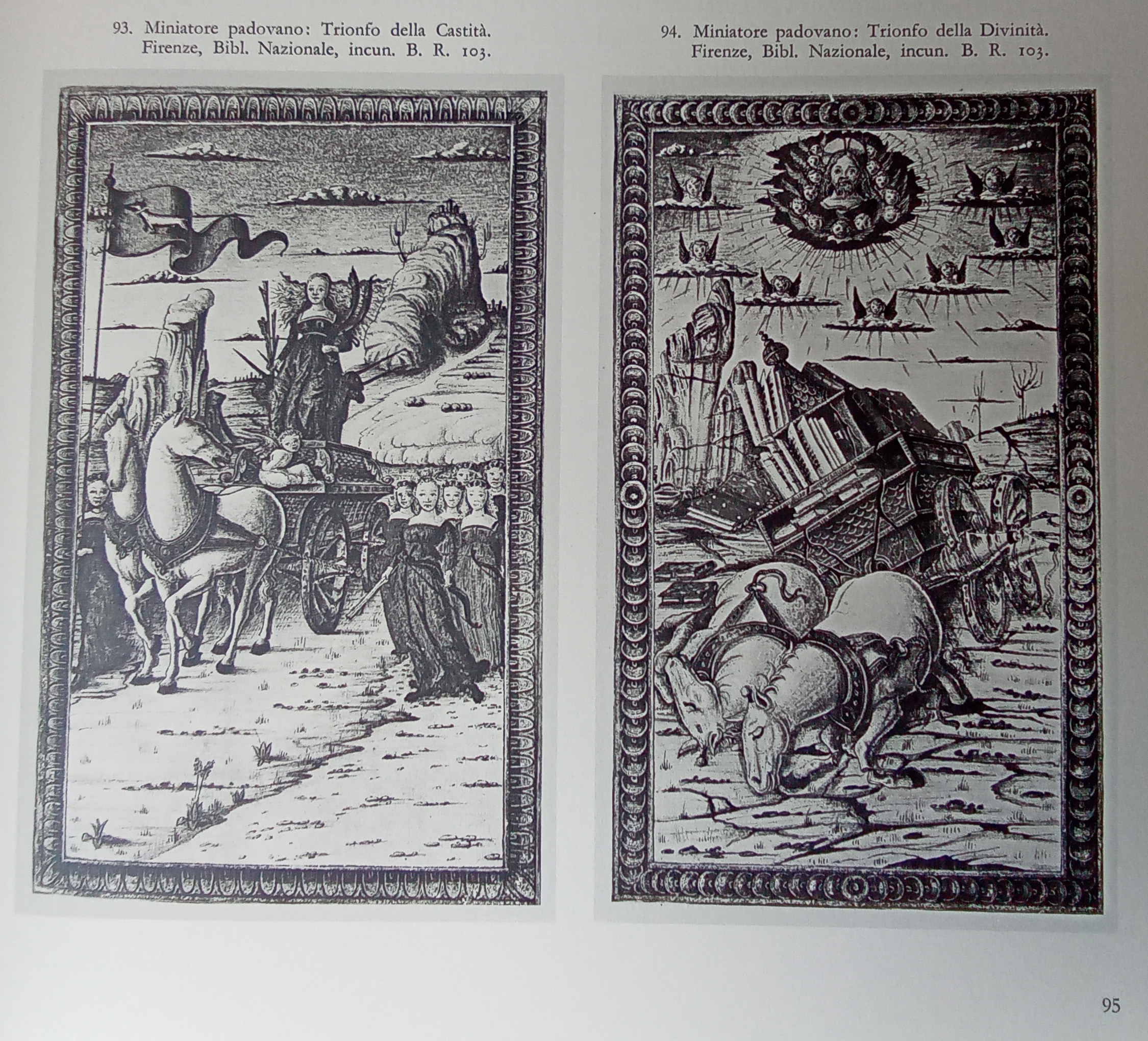
Mike, you really need to get away from this notion that the "new world" of heaven had to be totally immobile and motionless. It is taking Petrarch's meaning far too far, and it is absurd. You seem to be suggesting that the eternal world of heaven would be populated by statues: people and animals incapable of the slightest movement. When Petrarch says he has a vision of a
mondo novo, in etate immobile ed eterna, he simply means that this new world is unchanging—each day in that world would be just like the previous day, and nothing would ever pass away or perish. He doesn't mean that nothing would ever physically move! The VdM World isn't the only early depiction of Petrarch's Eternity that showed ships moving on waterways—several of the earliest Florentine illustrations of Eternity also showed ships moving on the seas of the eternal new world. There is nothing strange or inconsistent about this at all.
2.
Cohen's information in the appendix to
Transformations of Time and Temporality is not entirely reliable. I have found several errors in it, which were mostly carried over from earlier sources. Ms. Barb.Lat.3943 was attributed to the Master of the Vitae Imperatorum (or at least his workshop) not only by Samek Ludovici and Trapp, but also by Carandente in
I Trionfi nel primo Rinascimento (Turin: ERI, 1963), p. 52.
3.
Ross Caldwell wrote: 05 Aug 2023, 10:03
For what it's worth, my view of the relationship of Petrarch
Trionfi imagery and Tarot trump imagery is (and has long been) that the same artists, miniaturists, worked on both, so it is natural that sometimes they would conflate the subjects where they overlapped.
[...] I take this striking coincidence to be evidence that the same artists and intellectuals invented both the game and the Petrarchan allegories.
Yet the "coincidences" extend well beyond the imagery used. Most notably, they include the very name of the game:
Trionfi. For a game already known to have included the subjects of Love, Death, and Time, and in at least some instances also Chastity and/or Fame, it would be a very extraordinary coincidence indeed if that game were not at least partly based on Petrarch's poem cycle.
A further "coincidence" is the fact that the interest in illustrating the Trionfi cycle arose at the same time that the game became popular. Remember that the illuminated manuscripts containing Petrarch's Trionfi poems frequently also included his sonnets to Laura (his
rerum vulgarium fragmenta, a.k.a.
Rime or
Canzioniere), but the latter were almost never illustrated at all, except sometimes for a single illumination at the start. This practice was unchanged from previous decades. It is only the Trionfi poems which suddenly began to be given a complete set of six illustrations, at precisely the time when the Trionfi game emerges in the historical record. Another extraordinary coincidence.
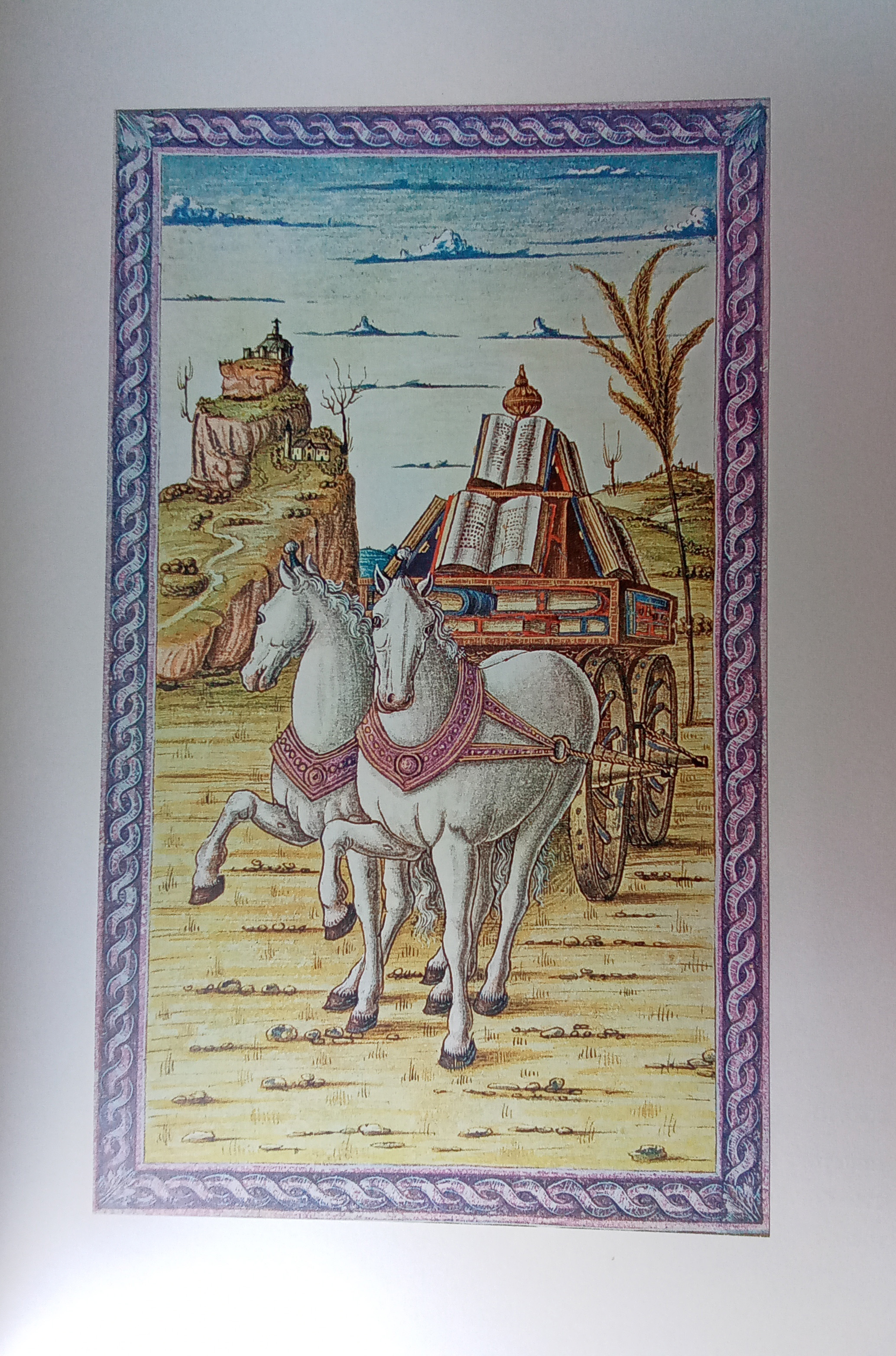
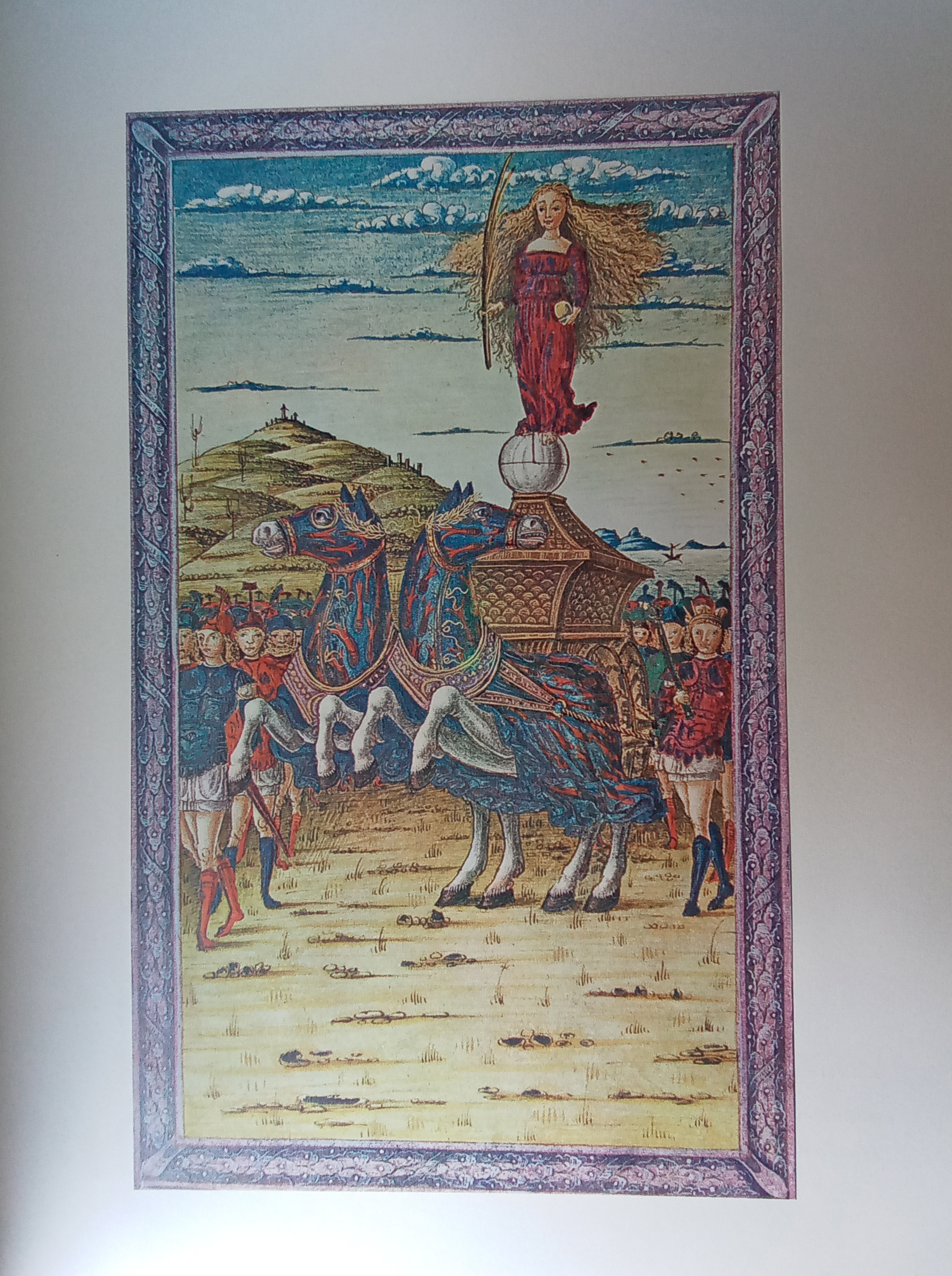
Finally, there is the "coincidence" that the illustrations took the form of just one image for each of the six poems, an image that depicted the subject of the poem as an allegorical figure (with the exception of Eternity, where the allegorical figure was usually replaced by the real figure of the Divinity). Think about that: there are many other illustrative schemas that could have been adopted, including some that would have been rather more "natural" than this. For instance, there could easily have been more than one image per poem, as indeed became the case in some later manuscripts and printed editions of the poems. Yet there almost never was. Or the images could have shown the actual scenes that Petrarch described in the text, rather than being abstract representations of each of the titular subjects, disconnected from Petrarch's words.
But neither of those approaches would have worked in the context of a card game where each Triumph had to be depicted on a card in a way that would make it quickly and easily recognizable. This is one of the most compelling reasons why I think the Trionfi game/deck was the origin of the mid-15th century trend for Trionfi illustration: the manner in which the Trionfi were depicted in those early illustrations is most easily explained if the whole trend began with the Trionfi deck, where each Triumph was depicted by a fairly simple allegorical figure on a card.
(As for the Rosenwald deck, yes, I think it does constitute a general simplification of earlier (Florentine) designs. That simplification is apparent in several of its trumps, perhaps most strikingly the Pope, deprived of his attribute objects except for a small, sparsely sketched key, held in a single, barely visible hand.
If you want to try to reconstruct the earliest version of a given tarot trump, you need to make a comparison of all the early instances known, whether those are surviving cards, or documents that tell us something about the appearance of the trumps at the time. On that basis, we have no good reason to think that the first Old Man card represented anything other than Time: all the surviving early cards except the Rosenwald either clearly show Time, or they show the old man with the lantern that was clearly a modification of the earlier hourglass of Time. The earliest meaningful descriptions also indicate that the card depicted Time, even in cases where it was known by the name of Vecchio or Gobbo.)
4.
As I have already made clear, I do not share Mike's excitement about ms. Barb.lat.3954. Yes, it's true that its Eternity shares a couple of elements with the Visconti-Sforza Judgment/Angel card, but certainly nothing so unusual as to indicate an important link between them. The Time illumination in Barb.lat.3954 is somewhat similar to the Old Man card, and Death has the uncommon bow and arrow of the Visconti-Sforza image, but there is nothing of any real significance beyond that. In this case, just as in the case of Barb.lat.3943, I am essentially in agreement with Ross: these features are not compelling enough to indicate anything more than the fact that the illuminations come from the same place and roughly the same era as the Lombard cards, and consequently sometimes make use of similar iconography for the same or similar subjects. Crucially, they don't mean that the Visconti-Sforza Judgment card was necessarily thought to represent Eternity. I would not rule out that possibility completely, but it seems very unlikely that all six Petrarchan Trionfi were ever present in that deck, as there is no surviving card that plausibly corresponds to Chastity. So even if the cards retained some lingering associations with Petrarch's poem cycle at that stage, it seems unlikely that the poems were still considered important or central to the game by those who designed that particular deck, and their Judgment card may simply have been a depiction of the Last Judgment, with no further meaning intended.
The same cannot be said for the VdM World, however, because of the Robertet Eternity image. What makes the Robertet Eternity so significant is how unusual the image is, and how rare the features are that it shares with the VdM image. The same applies to the unusual features that three of the other Robertet images share with tarot cards. When taken together, they are compelling evidence of an iconographic association between the images in that manuscript and the Milanese tradition of tarot trump design.
Please note that I am not suggesting that the Robertet images were copied directly from tarot cards, or even that their creator was aware that the tarot deck/game had originally been based on Petrarch's Trionfi. Rather, my interpretation is that the four Robertet images of Eternity, Time, Love, and the Wheel of Fortune must have been derived from the same general source from which the corresponding tarot cards of the Milanese tradition were derived, and that the VdM World image was therefore designed as a depiction of the Triumph of Eternity.
This is the important conclusion: the "subjects" that "overlapped" (to use Ross's terminology) between the tarot cards on the one hand and the Trionfi illustrations in manuscripts and cassoni paintings on the other, thus include not only Love, Death, Time, Chastity, and Fame, but also Eternity, with the VdM World card being a depiction of it. Coupled with a reconstruction of the evolution of the World card showing that all later World cards must have been descended from something very much like that VdM card, this leads inevitably to the conclusion that the first proto-tarot deck must have been based on Petrarch's Trionfi cycle.
5.
mikeh wrote: 02 Aug 2023, 08:39
As far as the Robertet's Eternity lady's pose being similar to that of the VdM World lady's, crowning and palm leaves are symbolic of victory, as on the Tarot de Marseille Ace of Swords, taken from a Visconti device, and only secondarily of eternity. Think of the palms of Palm Sunday. Victory fits Fame as well as Eternity. Not exactly coincidence, since we are dealing with an inherited tradition, but not necessarily copying something from the 1440s.
Your discounting of Petrarch illustrations from 1440s and 1450s Milan, precisely the time and place of two tarots there, and instead exalting as truer to Milan of that epoch a set of illustrations from ca. 1500 France, seems to me to need a lot more argument.
You are of course quite right that more argument is needed, especially in regard to the age and place of origin of the Robertet images. I admitted that in my
initial post, and I plan to provide the full argument when I have the time to present it properly. But nevertheless, I think that if you read my original post carefully, and follow the links in it (which are in the form of underlined text in bold print) and look very carefully at all the images I referred to, you should be able to see the same things I have seen, and have the same insights that I had, without me having to take you through every step of it now—providing you assume for the moment that my assertion is correct, that the Robertet images were copied virtually unchanged from an Italian manuscript from the 1440s.
Consider how unusual that Robertet Eternity image is for that place and time. Consider how similar its overall appearance is to the VdM World. But consider, too, that the other early illustrations of Eternity likewise showed a seated figure with arms outstretched on either side (although normally with nothing in his hands) enthroned above a set of concentric semicircular arcs, over a landscape representing the world. Consider that it is possible to see a link extending from these conventional Eternity images to the Robertet Eternity image (with its enthroned figure with arms outstretched above a set of concentric semicircular arcs), through to the VdM World image (with its figure with arms outstretched above a semicircular arc, over a landscape representing the world). Remember also that the World card must surely have been either the highest trump or the second highest, in the earliest decks: it is very hard to explain why worldly Fame would ever occupy such a position, but very easy to see why Eternity would.
Consider also the unusual similarities between the Robertet Love, Time, and Wheel of Fortune images and the early tarot cards of the Milanese tradition. In the case of the Wheel of Fortune, I think these should be obvious. In the case of Love, the most significant feature is that he holds a long arrow like a javelin instead of firing it from his bow. As for Time, he not only holds an hourglass and walking stick (already a highly unusual way of representing Time in this period) but also wears a head covering (something virtually never present in depictions of the Triumph of Time, except those on tarot cards, where it is almost
always present) and has a large object hanging from his belt in about the same position as the similarly-sized pouch of the BnF and Bolognese Old Man figures.
Consider also how very fitting is the symbolism on the VdM World card, if it depicts Eternity. It is beautifully consistent with the symbolism in all the rest of that deck, which was clearly intended to glorify Filippo Maria Visconti: it is full of his insignia and his mottoes. The Love card depicts his marriage quite literally (and quite outrageously) as the archetype of loving union. The Eternity card takes this lavish homage to its final apotheosis: in the center of the world below the arc, we see the Visconti emblem of the
biscione, before a landscape that probably depicted Filippo Maria's territories, centered on Milan. The objects held by the figure of Eternity can therefore be viewed as the rewards that Filippo Maria would receive in heaven: not only eternal life (the crown), but also heavenly fame (the trumpet). In other words, Filippo Maria's fame would not perish, destroyed by Time like that of ordinary mortals, but would resound throughout heaven for all eternity.
It is breathtakingly outrageous flattery, of just the kind that Renaissance courtiers were accustomed to heaping upon their lords and masters. The lord himself could not have commissioned such a work without exposing himself to accusations of unseemly pride and arrogance, but courtiers, on the contrary, were positively expected to flatter their lord in exactly this sort of excessive manner (and regularly did so if they knew what was good for them).
Incidentally, this also helps to explain why Decembrio did not credit Filippo Maria with the invention of the Trionfi deck: because he did not invent it. If the original Eternity card was like that of the VdM deck (and this can be presumed to have been the case), then the deck could not possibly have been created by him, but rather for him, as a gift. This is made clear not only by the Eternity card but also by the Love card: it seems extremely unlikely that Filippo Maria would ever have paid good money to present his marriage as an image of perfect love, given what Decembrio tells us, but it would nevertheless have been entirely appropriate and even expected for courtiers to portray it publicly in that way. For his part, Filippo Maria would no doubt have acknowledged and accepted the flattery as his rightful due, regardless of the reality.
6.
Ross Caldwell wrote: 05 Aug 2023, 09:20
That sounds right. Eternity could be missing, whether removed or never there, but that is odd. Interesting they title the first Fama "Virtue", when it is a typical triumph of Glory, enthroned woman with Boccaccio's "homo d'oro" in her left hand (every writer on this subject mentions Dorothy Shorr's 1938 (?) explanation for this: it began as a misreading of Boccaccio's "pomo d'oro" in Glory's hand), while the second, which they label "Glory" (Ruhmes), is atypical, with a flame in her hand.
I need to make a small but important correction to what Ross said here: it is actually the first Fame image in this manuscript which is the atypical one with the flame. It is folio 33v, at the start of the text entitled "Triumphus Virtutis" (the title is at the bottom of the previous page). The second is the normal-looking one, on folio 37v, at the start of the text entitled "Triumphus Fam[a]e". The "Triumphus Virtutis" text is simply Petrarch's early incomplete draft of the Fame poem, which was often included in Trionfi manuscripts before his final version (which is presented in this ms. as the "Triumphus Fam[a]e") but it was never normally presented as a separate triumph as it is here. It is always simply the first "chapter" (
capitolo) of the Fame section.
This Pesaro ms. at the ÖNB (Cod. 2649) is very interesting, but I deliberately did not mention it, because it was (and is!) liable to cause confusion... I think that this manuscript, plus some other apparently related ones (especially
Mscr.Dresd.Ob.26 at the Sächsische Landesbibliothek, which was made just one year later at the same workshop as Cod. 2649, and likewise has no image for Eternity but instead a second Fame image, again presented as "Triumphus Virtutis" before the main Fame section) testifies to a confusion in the mid-15th century of essentially exactly the same nature as the one Mike has fallen prey to in our own time: I think that someone saw a Robertet-style illustration of Eternity that looked like the VdM World card, and thought that it must have been meant to represent Fame, not Eternity. So they repurposed it as an illustration of the Triumph of Fame, even though they kept the other illustration of Fame too. As a result, they ended up with two pictures for Fame and no picture for Eternity at all.
The second "Fame" image in the Dresden manuscript looks even more like it was derived from an earlier Eternity image than the ÖNB one: the supposed "Fame" figure has her right hand raised in a gesture like a religious blessing, exactly like the enthroned Christ in several early Eternity images, while in her left hand she holds what looks like the flame-in-a-vessel attribute of the theological virtue of Charity (whose association with Eternity is attested by some other early Eternity illustrations where the three theological virtues appear as minor auxiliary figures).
A couple of other manuscripts also survive that have similar surplus "Fame" images, all looking like they were derived from something like the Robertet Eternity, just like the ÖNB and Dresden ones do.
Given the presence of the winged trumpet on the VdM version of the Robertet-type Eternity, it doesn't surprise me that these Eternity images could have been confused with Fame, and Mike can take comfort from the fact that some mid-15th century Italians appear to have made the same mistake that he has made. It's an entirely understandable mistake. What
does surprise me is that the allegorical figures in the Pesaro manuscripts (and also in the other manuscripts with these seemingly Eternity-based "Fame" images) do not actually bear that winged trumpet, or any other object that would unequivocally suggest Fame—and as noted above, the Dresden example actually looks much more like Eternity than Fame! This genuinely puzzles me. It looks as if the winged trumpet in one Eternity image caused someone to conclude that the Robertet-type Eternity was actually a representation of Fame, and then they went on to apply the same categorization to
all other Eternity images of that type, i.e. all those that showed Eternity as a female allegorical figure seated in the sky over a landscape, with an attribute in each hand,
even when those attributes no longer included a winged trumpet or anything else that would normally suggest Fame. This is the only plausible explanation for those Pesaro images that I have been able to come up with so far. And with Mike already confusing the VdM Eternity with Fame, you can probably see why I was reluctant to mention them at this stage...