
Codex 2581
https://digital.onb.ac.at/RepViewer/vie ... iew=SINGLE
.... somehow a very strange work
Re: Petrarca Trionfi poem motifs in early Trionfi decks
102Excellent, Ross and Huck. I was trying to find those two, without success. Here is what Cohen says about them (p. 313).
Besides 2581, there should be a 2582. Her description of 2581 is rather different from the Nationalbibliothek's.
On Ms. Barb. Lat 3943 and 3954, on Jstor is J. B. Trapp, in "Petrarch's Laura: The Portraiture of an Imaginary Beloved," Journal of the Warburg and Courtauld Institutes, Vol. 64 (2001), pp. 55-192, on p. 152. (I had researched this earlier but not seen the mss. themselves.)
Above, Vattasso is M. Vattaso, I codici petrarcheschi della Biblioteca Vaticana, Citti del Vatican, 1908. The Florentine codex is actually a pair of them, given in Trapp's note 341:
"Samek Ludovici" is I Trionfi illustrati nella miniatura da codici precedenti del secolo XIII al secolo XIV. Studio con note esplicativi del poema, 2 vols, Rome 1978.
Trapp (p. 168) dates Vat.lat. 3157 to "about 1470" (p. 168).
Again on 3943: Stanko Kokole dates it to 1445-1450, on p. xi at https://books.google.com/books?id=8TkrD ... &q&f=false (erroneously calling it 3493 but with the same f. 177 for the Triumph of Time, and the same Master of the Vitae Imperatorum), citing again Vattasso, 1908 (p. 29 of note 58, this time calling it 3943). He gives another reference, entry 121, pp. 304-5, in the book Il Potere, le arti, la guerra (Donati, 2001), Google Books has a snippet view of p. 304: the reference is to the same Vattasso.
For Vind. 2649, the folio number that she has for Eternity would be 39r, which is not one of the Nationalbibliothek's chosen pages. Instead, they have 33r, which she doesn't even list. "Nel cuor pien" is discussed by Stanko Kokole at https://books.google.com/books?id=8TkrD ... &q&f=false, p. 29, note 58, and someone else in more detail in Italian at https://books.google.com/books?id=KIwZA ... hl=en&sa=X&. Apparently it began the "Triumph of Fame" in some versions by mistake.1 Vienna, Österreichische Nationalbibliothek, Vind. 2649, 1459, North Italian. fig. 48.
The codex includes miniatures of the six Trionfi (fols. 4, 19r, 25r, 37r, 46r, 39r) and one frontispiece. It is attributed to the scribe and illuminator Jacobus Veronensis (Giacomo da Verona), who probably executed the codex for Borso d’Este at Pesaro. Broad margins of white vine scrolls, populated by birds, animals and putti, frame the Trionfi. the Trionfo del Tempo is represented by an elderly man holding an hourglass and a minute figure of Apollo on his chariot tracing his heavenly orbit.
2 Vienna, Österreichische Nationalbibliothek, MSS. 2581 & 2582, early 16th c., Parisian.
French translation. Eighty-six miniatures in vol. I and sixty-five in vol. II include illuminations of the six Triomphes as well as scenes of persons and episodes referred to in the text. the miniatures are attributed to the same Parisian workshop as Paris mss. 12424, 5065 and 223, all closely related to the first french edition of the Triomphes (Verard, Paris, 1514).
Besides 2581, there should be a 2582. Her description of 2581 is rather different from the Nationalbibliothek's.
On Ms. Barb. Lat 3943 and 3954, on Jstor is J. B. Trapp, in "Petrarch's Laura: The Portraiture of an Imaginary Beloved," Journal of the Warburg and Courtauld Institutes, Vol. 64 (2001), pp. 55-192, on p. 152. (I had researched this earlier but not seen the mss. themselves.)
Rather different from Cohen's 1460s and different suggestions for illuminator. Elsewhere in the article Trapp gives "c. 1440" (p. 168) and "before 1447" (p. 72) for 3943.A tomb for Laura makes its first appearance in manuscript illuminations in two Lombard codices, almost exactly contemporary with the Florentine codex just mentioned, one of them illustrated on vellum in the 1440s by the Master of the Vitae Imperatorum, within his circle, and one its poor relation on paper (Fig. 121) (342).
_____________
342. Biblioteca Apostolica Vaticana MSS Barb. lat. 3943, fol. 115v and Barb. lat. 3954, fol. 100. Vattasso,
Vaticana, nos 156, 158.
Above, Vattasso is M. Vattaso, I codici petrarcheschi della Biblioteca Vaticana, Citti del Vatican, 1908. The Florentine codex is actually a pair of them, given in Trapp's note 341:
Trapp, "Iconography," is 'The Iconography of Petrarch in The Age of Humanism', II Petrarca latino e le origini dell'umanesimo, ed. M. Feo, Florence 1996, pp. 11-56, pls I-XXXIV (= Quaderni Petrarcheschi, Ix-x, 1992-3).341. Florence, Biblioteca Medicea Laurenziana MS Strozzi 172, fol. 103; Samek Ludovici, pl. 22; Florence,
Biblioteca Nazionale Centrale MS Pal. 184, fol. 105; Trapp, 'Iconography', pl. XXI.
"Samek Ludovici" is I Trionfi illustrati nella miniatura da codici precedenti del secolo XIII al secolo XIV. Studio con note esplicativi del poema, 2 vols, Rome 1978.
Trapp (p. 168) dates Vat.lat. 3157 to "about 1470" (p. 168).
Again on 3943: Stanko Kokole dates it to 1445-1450, on p. xi at https://books.google.com/books?id=8TkrD ... &q&f=false (erroneously calling it 3493 but with the same f. 177 for the Triumph of Time, and the same Master of the Vitae Imperatorum), citing again Vattasso, 1908 (p. 29 of note 58, this time calling it 3943). He gives another reference, entry 121, pp. 304-5, in the book Il Potere, le arti, la guerra (Donati, 2001), Google Books has a snippet view of p. 304: the reference is to the same Vattasso.
Re: Petrarca Trionfi poem motifs in early Trionfi decks
103Codex 2581
https://digital.onb.ac.at/RepViewer/vie ... iew=SINGLE
.... somehow a very strange work
Codex 2582
https://digital.onb.ac.at/RepViewer/vie ... iew=SINGLE
.... is also strange
codex 2649, not really good material
https://www.omnia.ie/index.php?navigati ... 07&repid=1
 one can enlarge the picture at the website
I think, that I've seen something of this picture somewhere in color and with other pictures, but I don't remember, where. Actually I feel sure, that I saw it recently.
https://manuscripta.at/wienonb/noe/kattab1.htm#2649
https://digital.onb.ac.at/RepViewer/vie ... iew=SINGLE
.... somehow a very strange work
***************Trionfi
Petrarca, Francesco, 1304-1374 [VerfasserIn]; Glicino, Bernardo [KommentatorIn] et al.
Schule von Rouen: 1500. - 325 x 210 mm. - Handschrift; 295 Bll.
Codex 2582
https://digital.onb.ac.at/RepViewer/vie ... iew=SINGLE
.... is also strange
****************Trionfi gallice cum explicationibus
Petrarca, Francesco, 1304-1374 [VerfasserIn]; Glicino, Bernardo [KommentatorIn] et al.
Schule von Rouen: 1500. - 325 x 210 mm. - Handschrift; 302 Bll.
codex 2649, not really good material
https://www.omnia.ie/index.php?navigati ... 07&repid=1
I think, that I've seen something of this picture somewhere in color and with other pictures, but I don't remember, where. Actually I feel sure, that I saw it recently.
https://manuscripta.at/wienonb/noe/kattab1.htm#2649
Last edited by Huck on 05 Aug 2023, 10:52, edited 1 time in total.
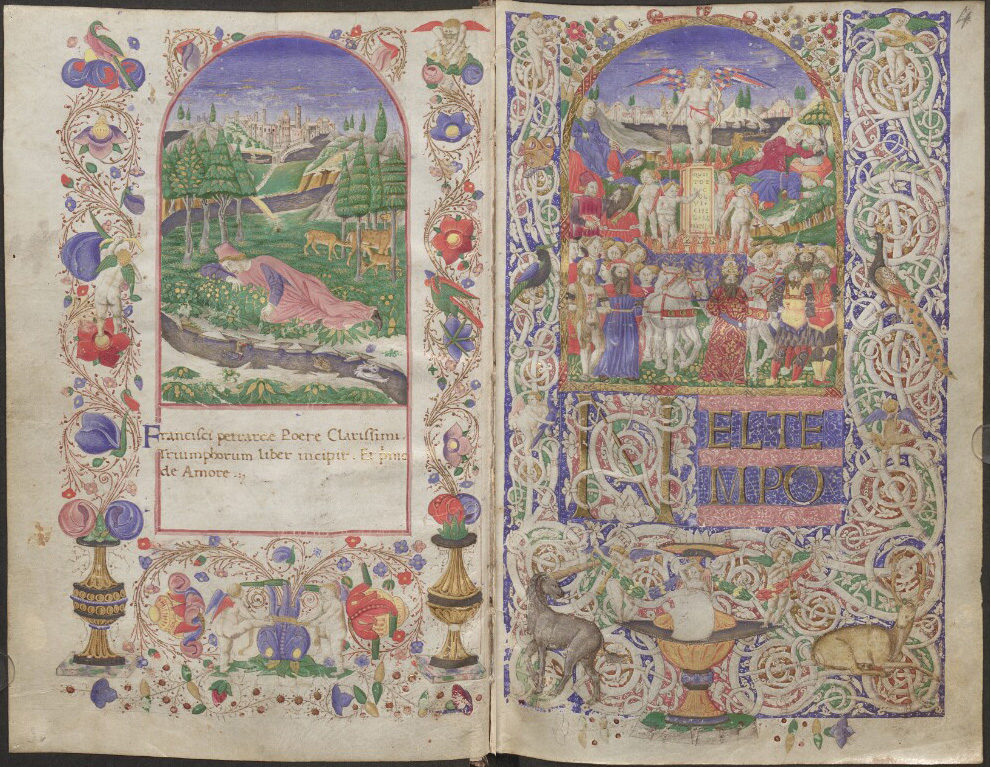
Re: Petrarca Trionfi poem motifs in early Trionfi decks
105Cohen's information is strange - Time is folio 46r, so why is Eternity before it, at 39r?mikeh wrote: 05 Aug 2023, 02:131 Vienna, Österreichische Nationalbibliothek, Vind. 2649, 1459, North Italian. fig. 48.
The codex includes miniatures of the six Trionfi (fols. 4, 19r, 25r, 37r, 46r, 39r) and one frontispiece. It is attributed to the scribe and illuminator Jacobus Veronensis (Giacomo da Verona), who probably executed the codex for Borso d’Este at Pesaro. Broad margins of white vine scrolls, populated by birds, animals and putti, frame the Trionfi. the Trionfo del Tempo is represented by an elderly man holding an hourglass and a minute figure of Apollo on his chariot tracing his heavenly orbit.
The information page on Vind. 2649 says there are 55 folios, so there is plenty of room for Eternity to come after Time. Maybe it was taken out at some point. It is an unusual arrangement, to have to two Fames.
http://data.onb.ac.at/rec/AC13947006
Re: Petrarca Trionfi poem motifs in early Trionfi decks
106Thanks Ross for the clarification about 2649..
Here is the German text of https://manuscripta.at/wienonb/noe/kattab1.htm#2649
Here is the German text of https://manuscripta.at/wienonb/noe/kattab1.htm#2649
There is a "Triumph der Tugend (= virtue)" between Death and Fama in this descripton.. And Eternity is missing.Cod. 2649
FRANCESCO PETRARCA
Perg. II 55 ff. (gez. 54), 212X135. Verona, 1459.
B: Text einspaltig, 24 Z. Auf fol. 52v signiert von Giacomo da Verona (Jacobus Veronensis), Verona 18. Juni 1459. Goldene Überschriften. Acht großen und sieben kleine Zierinitialen; sieben Miniaturen: fol. 3v Petrarca in einer Landschaft träumend; fol. 4r Triumph Amors; fol. 19v Triumph der Keuschheit; fol. 25r Triumph des Todes; fol. 33r Triumph der Tugend; fol. 37v Triumph des Ruhmes; fol. 46r Triumph der Zeit.
S: Humanistica formata.
E: Rotbrauner Maroquinband über Pappdeckel, mit Blind- und Golddruck (Italien, 18. Jahrhundert); Lilienstempel in Rautenmuster; Rückentitel in Golddruck. Auf dem Vorderdeckel Auszug des Begleitbriefes von Kardinal Alessandro Albani vom 7.Juli 1725.
G: 1725 als Geschenk an Prinz Eugen gekommen. Alte Signatur P. E. Mscrpt LXXXIV.
Re: Petrarca Trionfi poem motifs in early Trionfi decks
107That sounds right. Eternity could be missing, whether removed or never there, but that is odd. Interesting they title the first Fama "Virtue", when it is a typical triumph of Glory, enthroned woman with Boccaccio's "homo d'oro" in her left hand (every writer on this subject mentions Dorothy Shorr's 1938 (?) explanation for this: it began as a misreading of Boccaccio's "pomo d'oro" in Glory's hand), while the second, which they label "Glory" (Ruhmes), is atypical, with a flame in her hand.Huck wrote: 05 Aug 2023, 09:11 Thanks Ross for the clarification about 2649..
Here is the German text of https://manuscripta.at/wienonb/noe/kattab1.htm#2649There is a "Triumph der Tugend (= virtue)" between Death and Fama in this descripton.. And Eternity is missing.Cod. 2649
FRANCESCO PETRARCA
Perg. II 55 ff. (gez. 54), 212X135. Verona, 1459.
B: Text einspaltig, 24 Z. Auf fol. 52v signiert von Giacomo da Verona (Jacobus Veronensis), Verona 18. Juni 1459. Goldene Überschriften. Acht großen und sieben kleine Zierinitialen; sieben Miniaturen: fol. 3v Petrarca in einer Landschaft träumend; fol. 4r Triumph Amors; fol. 19v Triumph der Keuschheit; fol. 25r Triumph des Todes; fol. 33r Triumph der Tugend; fol. 37v Triumph des Ruhmes; fol. 46r Triumph der Zeit.
S: Humanistica formata.
E: Rotbrauner Maroquinband über Pappdeckel, mit Blind- und Golddruck (Italien, 18. Jahrhundert); Lilienstempel in Rautenmuster; Rückentitel in Golddruck. Auf dem Vorderdeckel Auszug des Begleitbriefes von Kardinal Alessandro Albani vom 7.Juli 1725.
G: 1725 als Geschenk an Prinz Eugen gekommen. Alte Signatur P. E. Mscrpt LXXXIV.
Re: Petrarca Trionfi poem motifs in early Trionfi decks
108For what it's worth, my view of the relationship of Petrarch Trionfi imagery and Tarot trump imagery is (and has long been) that the same artists, miniaturists, worked on both, so it is natural that sometimes they would conflate the subjects where they overlapped.
This is particulary the case with Time, which in Tarot images is always a version of the then newly-invented allegory, either the old hunchback with crutches and wings, sometimes with a pillar or hourglass (e.g. BAR, Bologna), or the apparently later old man with an hourglass wandering in the wilderness (Charles VI/Catania, PMB, and later “Hermits”). I take this striking coincidence to be evidence that the same artists and intellectuals invented both the game and the Petrarchan allegories.
But in my view, the game came first, so it isn't clear to me that the Vecchio in the game of Triumphs was intended originally to represent an allegory of Time. Like in Rosenwald, which has none of the distinctly allegorical features, it could be that he merely represented the debilities of old age.
On the other hand, Rosenwald could represent the development going the other way, since cardmakers are not usually also miniature painters. That is, Rosenwald's Vecchio is a development away from an earlier, more complex allegory. The simplifications of the iconography in the Star, Moon, and Sun might suggest that the direction was this way, rather than Rosenwald representing the earliest meaning.
I have in mind the old man on crutches at the far left of this 1460s Triumph of Death engraving -
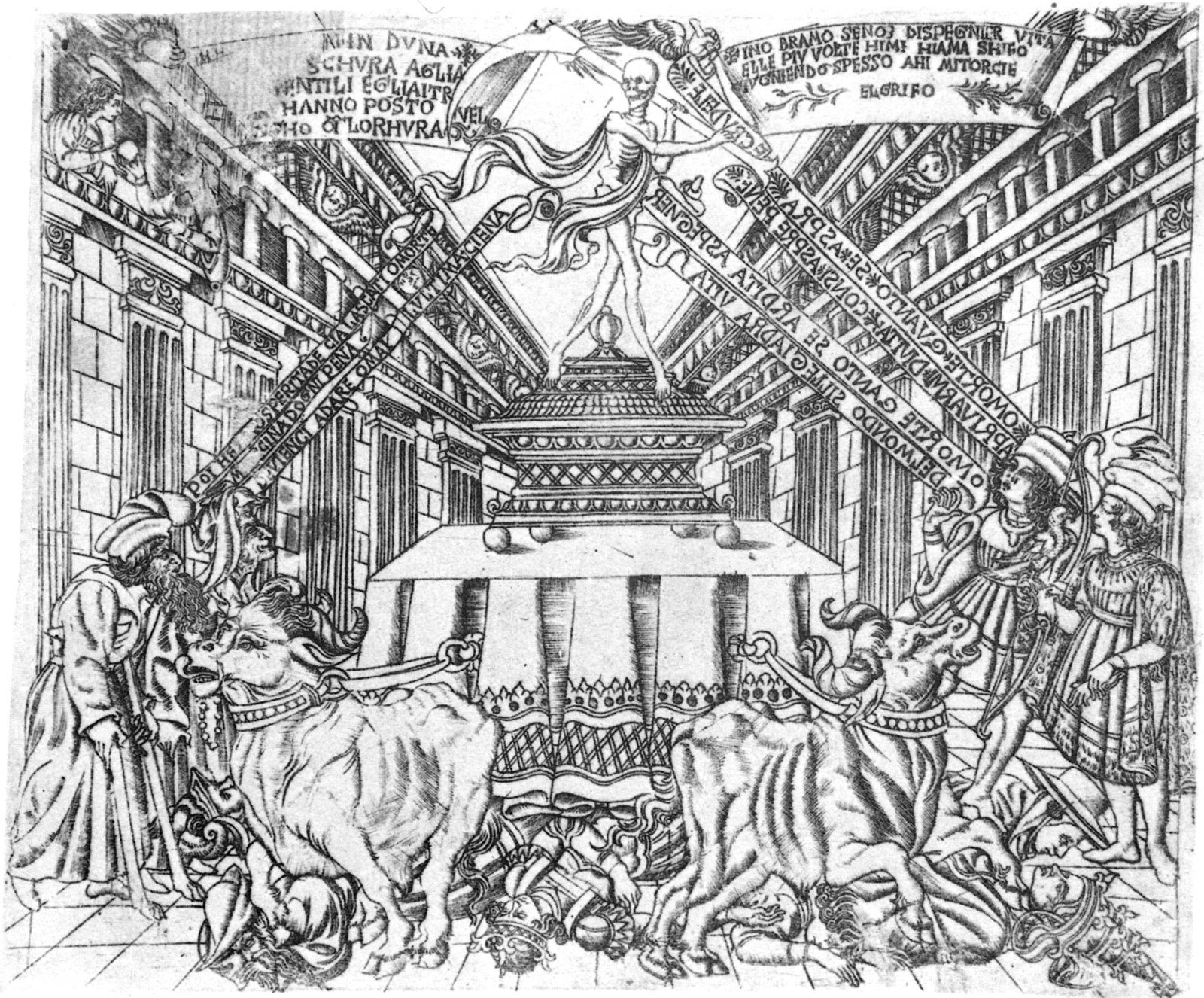
This is particulary the case with Time, which in Tarot images is always a version of the then newly-invented allegory, either the old hunchback with crutches and wings, sometimes with a pillar or hourglass (e.g. BAR, Bologna), or the apparently later old man with an hourglass wandering in the wilderness (Charles VI/Catania, PMB, and later “Hermits”). I take this striking coincidence to be evidence that the same artists and intellectuals invented both the game and the Petrarchan allegories.
But in my view, the game came first, so it isn't clear to me that the Vecchio in the game of Triumphs was intended originally to represent an allegory of Time. Like in Rosenwald, which has none of the distinctly allegorical features, it could be that he merely represented the debilities of old age.
On the other hand, Rosenwald could represent the development going the other way, since cardmakers are not usually also miniature painters. That is, Rosenwald's Vecchio is a development away from an earlier, more complex allegory. The simplifications of the iconography in the Star, Moon, and Sun might suggest that the direction was this way, rather than Rosenwald representing the earliest meaning.
I have in mind the old man on crutches at the far left of this 1460s Triumph of Death engraving -
Vienna Cod. 2649, 2581
109Vienna Cod. 2649, produced 1459
3v .... https://digital.onb.ac.at/rep/osd/?111E48BE .... = sleeping Petrarca
4r .... https://digital.onb.ac.at/rep/osd/?111E48C7 .... = Love
19v .... https://digital.onb.ac.at/rep/osd/?1129152B .... = Chastity
25r ..... https://digital.onb.ac.at/rep/osd/?11291534 .... = Death
33v .... https://digital.onb.ac.at/rep/osd/?1129154D .... = "Virtue"
37v .... https://digital.onb.ac.at/rep/osd/?11291556 ..... = Fame
46r .... https://digital.onb.ac.at/rep/osd/?1129156F ...... = Time
................................................................. missing Eternity ...................
Vienna Cod. 2581
The book has many pictures, often with cruel and murderous topics. I give the most pictures only with the page-number. All pictures fill a complete page.
10 .... https://digital.onb.ac.at/RepViewer/vie ... iew=SINGLE .... sleeping Petrarca, dreaming of Amor
17 .... https://digital.onb.ac.at/RepViewer/vie ... iew=SINGLE
20 .... https://digital.onb.ac.at/RepViewer/vie ... iew=SINGLE
27 .... https://digital.onb.ac.at/RepViewer/vie ... iew=SINGLE .... sleeping woman, dreaming of Amor
32 .... https://digital.onb.ac.at/RepViewer/vie ... iew=SINGLE .... Amor, Love
37 .... https://digital.onb.ac.at/RepViewer/vie ... iew=SINGLE .... Poet with Amor
41 .... https://digital.onb.ac.at/RepViewer/vie ... iew=SINGLE .... scene with ship
44 .... https://digital.onb.ac.at/RepViewer/vie ... iew=SINGLE .... murder
Page numbers of pictures: 47 51 57 63 66 68 73 77 80 84 88 92 95 102 110 116 120 128 135 143 148 152 157
160 .. https://digital.onb.ac.at/RepViewer/vie ... iew=SINGLE .... Amor reappears
166 .. https://digital.onb.ac.at/RepViewer/vie ... iew=SINGLE .... Chastity captures Amor
Page numbers of pictures: 174 179 183 194 202 211 219 225 235 243 248 257
266 .. https://digital.onb.ac.at/RepViewer/vie ... iew=SINGLE .... Death appears
276 .. https://digital.onb.ac.at/RepViewer/vie ... iew=SINGLE .... Death captures chastity
Page numbers of pictures:282 287 298 308 314 322 332 338 348 352
360 .. https://digital.onb.ac.at/RepViewer/vie ... iew=SINGLE .... big fighting scene, in the background a very big man dies at an island
366 .. https://digital.onb.ac.at/RepViewer/vie ... iew=SINGLE .... Fame appears
Page numbers of pictures: 380 387 395 404 410 420 427 434 444 452 460 466 476 482 490 498 507 515 522 532 538 546 556 564 572 579
594 .. https://digital.onb.ac.at/RepViewer/vie ... iew=SINGLE .... last picture
Vienna Cod. 2582
10 .... https://digital.onb.ac.at/RepViewer/vie ... iew=SINGLE .... old King .. Pages 35 39
47 .... https://digital.onb.ac.at/RepViewer/vie ... iew=SINGLE .... Hercules and Chiron (?) .. Pages 55 64 70 80 86 94
99 .... https://digital.onb.ac.at/RepViewer/vie ... iew=SINGLE .... Tired war elephant inside an army (Fama association ?)... Pages 112 120
127 .. https://digital.onb.ac.at/RepViewer/vie ... iew=SINGLE .... Moses and the drowning Egyptians (?) .. Pages 135 144 151 160 166 176 184 192 199 208 214 224 232 240 247 256 264 272 279 288 295 303 312 319 327 336 343 351 360 367 375 384 392 400 408 416 422 432 440 446 454
458 .. https://digital.onb.ac.at/RepViewer/vie ... iew=SINGLE .... Father Time
470 .. https://digital.onb.ac.at/RepViewer/vie ... iew=SINGLE .... A young man (Apollo ?) points to heaven, where 4 horses and a chariot are shown (Helios ? Phaethon ?)
481 .. https://digital.onb.ac.at/RepViewer/vie ... iew=SINGLE .... Sun and Moon and Earth in the middle
488 .. https://digital.onb.ac.at/RepViewer/vie ... iew=SINGLE .... ?????
496 .. https://digital.onb.ac.at/RepViewer/vie ... iew=SINGLE .... Man and boy with a tool (a sort of clock ?) and the sun
504 .. https://digital.onb.ac.at/RepViewer/vie ... iew=SINGLE .... Man and dead persons and Death in the background (is Death now captured ?)
513 .. https://digital.onb.ac.at/RepViewer/vie ... iew=SINGLE .... peaceful scene
519 .. https://digital.onb.ac.at/RepViewer/vie ... iew=SINGLE .... ship with an army
527 .. https://digital.onb.ac.at/RepViewer/vie ... iew=SINGLE .... this should be the start of Eternity ... nude man (Adam, Jesus ?) sitting with standing godfather
536 .. https://digital.onb.ac.at/RepViewer/vie ... iew=SINGLE .... difficult to interpret
548 .. https://digital.onb.ac.at/RepViewer/vie ... LE....Pope or godfather with Jesus-figure (?) with 4 church fathers (?) and 4 evangelists ... this is the last picture
My commentaries are only provisional, based only on the impressions by the used pictures, not on the text, which is too complicated to read for me.
Last edited by Huck on 06 Aug 2023, 04:38, edited 2 times in total.
Re: Petrarca Trionfi poem motifs in early Trionfi decks
110Thanks for those links and summaries, Huck. The summaries are helpful.
Ross: About Cohen's ordering of the pages in 2649, Eternity before Time, notice that not only are there two Fames, but Time is last. In 3943, without Cohen's f. 39 we have no idea whether it is Cohen who is strange or the codex. Or how strange.
The flame is reminiscent of the Modrone/CY's and Minchiate's Charity, which on God's part allows Eternal Life. I will keep my eye out for other flames in Petrarch illuminations.
The issue of how Petrarch's poems influenced the structure of the earliest Trionfi decks, it seems to me, is mainly whether it can plausibly maintained that the six motifs provided the impetus for six (or more) cards of the game, even if the game was first. That is to say, do we have a card or cards on the themes of Love, Pudicizia, Death, Fame, Time, and Eternity, perhaps even with some respect for that order, while also allowing for creative license? Moakley and a few others thought that it was groups of cards that correlated to these themes. Nathaniel and I think it was individual cards, although it is conceivable that there might have been two for Fame or two for Eternity.
And it is not that Petrarch is the only source: creative license is allowed to draw in other traditions and works; what is important is that we think trecento, not quattrocento. So we have Boccaccio for the orb, the golden apple (Amorosa Visione VI.60). I think he is one source for the image of a large circle, or semi-circle, to represent the World: in the same chapter he describes Fame as enclosed in a circle, from below her feet to above her head (VI.64-72)
For Time, a major trecento image, and Petrarch's, was the sun. His Triumph of Time starts:
The sun is also personified in some Eternity illustrations, as Cohen emphasizes (see previous quotes in this thread). They show the Chariot of the Sun, or of Apollo as Sun-god (for Cohen). Maybe there was no old man in the game originally. There is also a Sun card.
Time for Petrarch was primarily cosmic time, as opposed to that of an individual life. But he also mentions old age in his "Triumph of Time":
If an old man was not associated with Time, why did the early Florentine illustrations of Petrarch use him so much? They didn't have to take everything from the cards, and often didn't. But an old man is like ruins for showing perishability. And it was not just him. He was holding something, an armillary sphere or an hourglass. Both were symbols of Time, the armillary sphere of cosmic cyclical time and the hourglass of human time. On the armillary sphere, here is Cohen (p. 133):
Besides that, there is the classical Chronos/Cronos identification emphasized by Panofsky, which Cohen rejects as not influential in the trecento; I am not convinced, but I have not researched the topic well enough. Wikipedia says:
For Saturn, of course, there was a plethora of medieval images, all as an old man. Other traditions supplement Petrarch.
Once you have an old man as your image, it makes sense to put him before Death in the sequence, since he is not yet but almost.
In the Triumph of Pudicizia, the shield she holds against Cupid is quite a vivid image in Petrarch, and which she holds in the CY/Modrone, as well being as part of the old psychomachia tradition.
There is some contention about how the World card is one of the six, and which one. Here again Florence misleads us, portraying the Triumph of Eternity as Christ standing over the curvature of the world. The lower part, to which we associate "World," is not Petrarch's conception of Eternity. Most importantly, in order to defeat Time, Eternity has a lack of motion or change, which can take place only in Time:
Later World cards are ambiguous about motion and change (which require Time). The personifications above the globes are depicted frontally, suggesting their timelessness, but that may or may not apply to the world below. The Bolognese World card has thefour elements: they tend to mix and produce change, but on the card they are separate. Other World cards have castles but no bustle. Eternal Fame, Eternal World; ambiguity in art is a virtue, and we are far from the CY, despite the curve or circle with a figure on top that connects them.
Ross: About Cohen's ordering of the pages in 2649, Eternity before Time, notice that not only are there two Fames, but Time is last. In 3943, without Cohen's f. 39 we have no idea whether it is Cohen who is strange or the codex. Or how strange.
The flame is reminiscent of the Modrone/CY's and Minchiate's Charity, which on God's part allows Eternal Life. I will keep my eye out for other flames in Petrarch illuminations.
The issue of how Petrarch's poems influenced the structure of the earliest Trionfi decks, it seems to me, is mainly whether it can plausibly maintained that the six motifs provided the impetus for six (or more) cards of the game, even if the game was first. That is to say, do we have a card or cards on the themes of Love, Pudicizia, Death, Fame, Time, and Eternity, perhaps even with some respect for that order, while also allowing for creative license? Moakley and a few others thought that it was groups of cards that correlated to these themes. Nathaniel and I think it was individual cards, although it is conceivable that there might have been two for Fame or two for Eternity.
And it is not that Petrarch is the only source: creative license is allowed to draw in other traditions and works; what is important is that we think trecento, not quattrocento. So we have Boccaccio for the orb, the golden apple (Amorosa Visione VI.60). I think he is one source for the image of a large circle, or semi-circle, to represent the World: in the same chapter he describes Fame as enclosed in a circle, from below her feet to above her head (VI.64-72)
Unfortunately, Amorosa Visione does not seem to be online in English, or this would be better appreciated.And among other the things which I noticed there
around about this supreme
lady, in her magnanimous breast
the enemy of death, was a perfect circle
rotating lofty and round,
from beneath her feet and over her head.
I do not believe that there can be anything
in the whole world, town or country, domestic or foreign,
which would not appear within that circle.
For Time, a major trecento image, and Petrarch's, was the sun. His Triumph of Time starts:
And so on, the Sun speaking for many lines.FORTH FROM his golden palace, after the dawn,
So swiftly rose the Sun, begirt with rays,
Thou wouldst have said: "Yet hardly had it set."
Risen a little, he looked round about
As wise men do, and to himself he said:
"What thinkest thou? Thou shouldst take greater care.
For if a man who had been famed in life
Continues in his fame in spite of death,
What will become of the law that heaven made?
If mortal fame, that soon should fade away,
Increases after death, then I foresee
Our excellence at an end, wherefore I grieve.
https://petrarch.petersadlon.com/read_t ... age=V-I.en
The sun is also personified in some Eternity illustrations, as Cohen emphasizes (see previous quotes in this thread). They show the Chariot of the Sun, or of Apollo as Sun-god (for Cohen). Maybe there was no old man in the game originally. There is also a Sun card.
Time for Petrarch was primarily cosmic time, as opposed to that of an individual life. But he also mentions old age in his "Triumph of Time":
His main concern is perishability caused by Time, that is how it defeats Fame, through its long passage.This morn I was a child, and now am old.
Here is Cohen (p. 306).And then I heard a voice, and, listening, wrote:
"What dark abyss of blind oblivion
Awaits these slight and tender human flowers!
For years, for lustra, and for centuries
The Sun, victorious o'er the human mind,
Will still revolve, and Fame will fade away.
So an old man is perfectly natural as an expression of Petrarch, especially shown stooped and with a cane or crutches, both emblems of decline. Even the Rosenwald has those characteristics.The image of the elder with its connotations of suffering and decline was naturally associated with speculations on time in all periods.
If an old man was not associated with Time, why did the early Florentine illustrations of Petrarch use him so much? They didn't have to take everything from the cards, and often didn't. But an old man is like ruins for showing perishability. And it was not just him. He was holding something, an armillary sphere or an hourglass. Both were symbols of Time, the armillary sphere of cosmic cyclical time and the hourglass of human time. On the armillary sphere, here is Cohen (p. 133):
However, cyclical time does not convey only decline, but also renewal, which Petrarch does not allow for Fame; an hourglass is better, although even that can easily be renewed, by turning it over. A stooped back and crutches are better yet.The globe and armillary sphere held by Time were alternative symbols
of his cosmic control. As an archaic symbol of the cosmocrator, the globe
had been assigned to Apollo and then to Christ. The geocentric armil-
lary sphere, on the other hand, had been used primarily as an attribute
of astronomy and learning in general, rather than as a symbol of the cos-
mos, in medieval miniatures of the thirteenth and fourteenth centuries.
Petrarch’s illustrators adopted it to reiterate the traditional association
of planetary movements and time computation, once more emphasizing
that time is defined by means of motion.(29)
_________________
29. C.f. Aristotle, Physics, IV, xiv, 223a and xi, 219a, and Plato, Timaeus, 37d–8B. Boccac-
cio in the Geneologia degli dei, wrote that the numbers of the stars are divided so that we
can distinguish time by sidereal motions. Between 1348–64 Giovanni de’ dondi created his
giant astronomical clock, which recorded the movements of the planets on seven separate
dials and represented the solar and lunar cycles.
Besides that, there is the classical Chronos/Cronos identification emphasized by Panofsky, which Cohen rejects as not influential in the trecento; I am not convinced, but I have not researched the topic well enough. Wikipedia says:
Their reference in note 6 is to Cicero, On the Nature of the Gods, 2.64, which was certainly known in the trecento and early quattrocento:Chronos is frequently confused with, or perhaps consciously identified with, the Titan, Cronus, in antiquity, due to the similarity in names.[2] The identification became more widespread during the Renaissance, giving rise to the iconography of Father Time wielding the harvesting scythe.[3]
Greco-Roman mosaics depicted Chronos as a man turning the zodiac wheel.[4] He is comparable to the deity Aion as a symbol of cyclical time.[5] He is usually portrayed as an old callous man with a thick grey beard, personifying the destructive and stifling aspects of time.[6]
In the Judeo-Christian tradition, however, time's cyclical nature is only temporary: it has a definite beginning and end.By Saturn they mean that which comprehends the course and revolution of times and seasons; the Greek name for which Deity implies as much, for he is called Κρόνος, which is the same with Χρόνος, that is, a "space of time." But he is called Saturn, because he is filled (saturatur) with years; and he is usually feigned to have devoured his children, because time, ever insatiable, consumes the rolling years; but to restrain him from immoderate haste, Jupiter has confined him to the course of the stars, which are as chains to him.
https://topostext.org/work.php?work_id=137
For Saturn, of course, there was a plethora of medieval images, all as an old man. Other traditions supplement Petrarch.
Once you have an old man as your image, it makes sense to put him before Death in the sequence, since he is not yet but almost.
In the Triumph of Pudicizia, the shield she holds against Cupid is quite a vivid image in Petrarch, and which she holds in the CY/Modrone, as well being as part of the old psychomachia tradition.
And there is no reason why the card makers have to stick to this formula, whether in images or in order, and the further from the beginning, the more the variations. The boom in Petrarch illustrations after 1440, and especially after 1450, with much similarity to their local cards, just shows that people made the connections themselves, once the game was fashionable, and not just in Florence.She wore, that day, a gown of white, and held
The shield that brought Medusa to her death.
https://petrarch.petersadlon.com/read_t ... ge=II-I.en
There is some contention about how the World card is one of the six, and which one. Here again Florence misleads us, portraying the Triumph of Eternity as Christ standing over the curvature of the world. The lower part, to which we associate "World," is not Petrarch's conception of Eternity. Most importantly, in order to defeat Time, Eternity has a lack of motion or change, which can take place only in Time:
Cohen observes (p. 133):Greatly I marveled, seeing time itself
Come to an end, that ne'er before had ceased,
But had been wont in its course to change all things.
Past, present, future: these I saw combined
In a single term, and that unchangeable:
...
All that encumbers us and weighs us down,
.Yesterday. and .tomorrow, .morn. and .eve.,
"Before" and "soon," will pass like fleeting shadows.
"Has been., .shall be,. and .was. exist no more,
But .is. and .now., the .present. and .today.,
"Eternity" alone, one and complete.
https://petrarch.petersadlon.com/read_t ... ge=VI-I.en
The CY World card has a bustling world below, with figures shown in profile, as well as a personification above shown frontally (but all gods and goddesses are eternal) with two suggestions of fame: the trumpet, already well-established for Fame, and the crown, for which think of the three crowns of Florence; Petrarch famously did not think his fame would be immortal in this world. Rather, it is the CY card with "Rise to Judgment" on it that connotes Eternity, also referenced by Petrarch:Whereas the Trionfo dell’Eternità was always depicted frontally,
a position indicating immobility, Time was shown in profile to indicate
motion.
Yet in the Bible the world does not go away after the Last Judgment: there is a new world. Ignoring Petrarch, who thought that world would not be in time, who knows whether time would have been abolished? How otherwise can souls sing praises to God? If not, then it is only its power to destroy that will be defeated.I think the day is coming near when gains,
Both good and evil, will be judged at last,
As clearly seen as through a spider's web.
Later World cards are ambiguous about motion and change (which require Time). The personifications above the globes are depicted frontally, suggesting their timelessness, but that may or may not apply to the world below. The Bolognese World card has thefour elements: they tend to mix and produce change, but on the card they are separate. Other World cards have castles but no bustle. Eternal Fame, Eternal World; ambiguity in art is a virtue, and we are far from the CY, despite the curve or circle with a figure on top that connects them.