You are to be congratulated on your endurance, mmfilesi! Well, the thread sputters on...
This post is a continuation of an earlier one, the last on the previous page (
viewtopic.php?f=11&t=365&start=120#p6422), where I quoted Bauer-Eberhardt on Franco dei Russi's "Adam and Eve." I repeat this quote as follows. (Please ignore the part about Dummett, which has received sufficient attention already. I include it only to give the context):
Es war Michael Dummett, der schliesslich die ferraresische Komponente im Stil der ergaenzten Tarocchi erkannt hat und die Karten nunmehr einem anonymen Künstler aus Ferrara, um 1470, zuwies. Damit ist er bereits der richtegen Loesung nahegekommen; denn die enge Stilverwandtschaft der sechs spaeteren Karten in Bergamo und New York mit Werken von Franco dei Russi - beispielweise die "stella" oder "luna" Kartre (abb.27, 28) mit der Adam-und-Eva-Miniatur der Biblia Italica in Wolfenbüttel (Herzog August-Bibliothek, Slg.2 151, Bd. I, fol.1a) - macht deutlich, wer hier Hand angelegt hat: Franco dei Russi, Genaugenommen ein Wahl-Ferrarese, hat die lückenhaften Bembo-Tarocchi ergaenzt.
It was Michael Dummett who has finally recognized the Ferrarese component in the style of the added Tarocchi and assigned the cards now to an anonymous artist from Ferrara, around 1470. Thereby he has already come close to the correct solution; the close stylistic relationship of the six later cards) in Bergamo and New York with works of Franco dei Russi - for example "stella" or "luna" cards (ill. 27, 28) with the Adam and Eve miniature of the Biblia Italica in Wolfenbüttel (Duke August library, Slg.2 151, Vol. I, fol.1a) - makes it clear who has put their hand here: Franco dei Russi, strictly speaking a Ferrarese by choice, has supplemented the incomplete Bembo-Tarocchi.
I was finally able to get a copy of Mariani Canova's
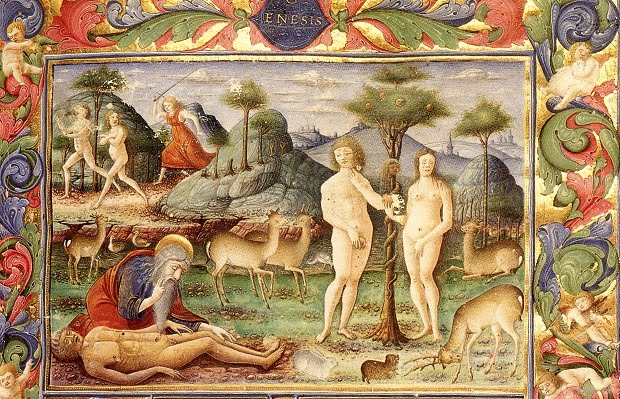
La Miniatura Veneta del Rinascimento, Venice 1969, to see the "Adam and Eve" illumination Bauer-Eberhardt was referring to, indicated in her footnote as Mariani Canova's Fig. 23. It is a frontispiece to a Bible printed in Venice by Vindelinus de Spera, dated 1 August 1471. Since Mariani Canova's reproduction is in black and white, I post here the full-color reproduction in
The Painted Page, p. 170, which appeared after Bauer-Eberhardt's article. I include the putti in the margins, which are generic but do resemble the putti in the PMB World card.
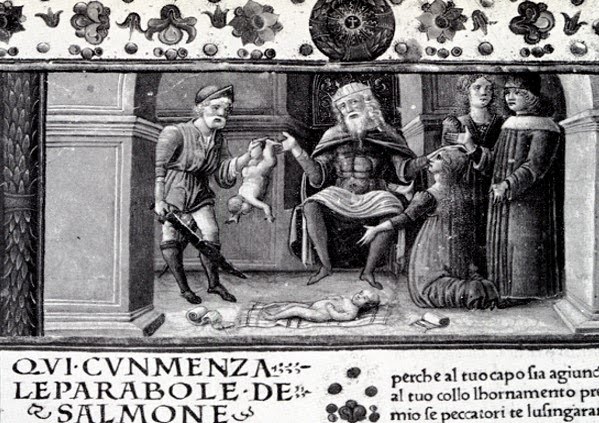
Bauer-Eberhardt also indicates in her footnote a comparison with another illumination in the same Bible, Mariana Canova's Fig. 22. It illustrates the Judgment of Solomon Mariani Canova identifies the artist, on stylistic grounds, as the same Franco dei Russi:
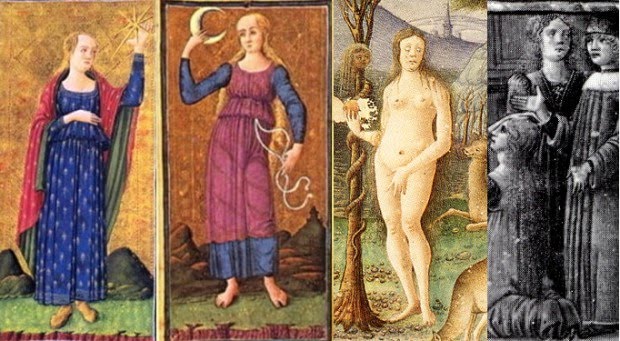
Comparing the two figures in these illustrations with the lady in the Star and Moon cards, there is indeed a resemblance.
The similar depictions of the faces are rather singular; in fact I know of no others so similar. The only ones close to it are the ones I posted earlier, in altarpieces by Benedetto Bembo and Bernardino Butinoni (
viewtopic.php?f=11&t=365&start=60#p4912, near the end). The emotions depicted in the illuminations, I think, are anxiety and regret, regarding actions the women have taken: eating a forbidden fruit, and laying false claim to an infant. Such emotions may, as if suggesting some unknown mystery, fit the two cards. (They also fit emotions that Galeazzo Maria Sforza might have attributed to his sister Elisabetta after her marriage.) The hairline on dei Russi's lady is lower than on the cards, and the eyes further up; to that extent the faces reflects the Lombard style, of which I gave examples in the post just referred to (including the ladies in the altarpieces). But this may simply be a case of an artist adjusting himself to the style of another region.
Could the same artist have done the man on the "Strength" card? Looking at dei Russi's depictions of Adam, I find that difficult to say.
Dei Russi's earlier illuminations, of which there are several, do not depict their women in the way he does in this Bible. (Compare, for example, the same scene done by him and Crivelli for Borso's Bible, which I posted somewhere.) If he is the artist of the six added cards, we can say that he probably did the cards later rather than earlier, within a few years of 1471. Since dei Russi was known to be in Padua in the period 1461-1471 (documented in
The Painted Page and in Bauer-Eberhardt), closely associated with Venice, he would not likely have done them during that period. In 1474 we find him in Urbino. His whereabouts from the end of 1471 through 1473 are unaccounted for, with no known datable illuminations. If he did the cards, it would likely have been in that period.
Elisabetta Maria Sforza died in 1472. Her brother was an impatient man; he could easily have insisted that the cards be done in time for her memorial service in Milan. Here are some quotes from Lubkin,
A Renaissance Court;, partially in Google Books, with their documentation.
...In 1472, Sforza Maria and Ludovico traveled to Montferrat to celebrate the birth of their sister Elisabetta's first child. Elisabetta died while they were en route, and they returned immediately (194). (Lubkin p. 118)
Chapter 4, Footnote 194, Lubkin p. 333: Galeazzo to Sforza Maria and Ludovico, 2 Sep. 1472 (ASMi, RM no. 107, fo. 231(r).)
...As the head of his own lineage, the duke concerned himself particularly with the deaths of persons who belonged by blood or marriage, such as his sister Elisabetta or Giovanni Maurizzi da Tolentino, his half-sister Isolta's husband. Many persons of both genders were honored by the court at their deaths...If they died in another state, their passing was acknowledged with a memorial service...A massive service was held for the duke's sister Elisabetta when she died in 1472, even though she had been living with her husband in Montferrat (190). (Lubkin p. 159f.)
Chapter 5, Footnote 190, Lubkin p. 333: Galeazzo to A. Anguissola, 4 Sep. 1472, Pavia (ASMi, AS, c. 908), and expense list dated 9 Sep., Milan (ASMi, AS, c. 906).
ASMi = Archivio di Stato, Milan. AS = Archivio (Ducale Sforzesco (c: cartella number). RM = Registri delle Missive. (Lubkin p. xxiii).
As you can see, the memorial's expenses were submitted a week after Galeazzo received the news of Elisabetta's death. It might be of interest to see that expense sheet. Galeazzo's itinerary for September of 1472 shows him in Pavia Aug. 18-Sept. 16, and not in Milan until Oct. 8 (Lubkin p. 262f), so perhaps the memorial was held in Pavia. If dei Russi was in Lombardy then, Pavia would be the right place, with both the university and the ducal library there, as well, sometimes, as the court.

 .