Banner

Tarot History Forum

Tarot History Forum - 600 years of history in 78 cards

Re: "The 5x14 Theory: An Investigation" part II

131
mikeh wrote: Personally, it seems to me that the similarity of the putti could just as well be generic. The similarities she observes characterize putti by numerous artists of this time and part of Italy. ...

However my first choice for artist of the 6 cards remains Benedetto Bembo, for the reasons indicated earlier in this thread.
I agree, that the similarity between the both putti is not very striking.

Dummett's notes to Benedetto Bembo were connected to the idea, that the whole deck was made at one time around 1462-68 in a commission, which was parted by Bonifacio Bembo and Benedetto, if I remember correctly, which is contradicted by many observations made on the base of the 5x14-theory and also contradicting Dummett's own and others theories, that the Tarot found to a standard form in ca. 1450.

My earlier report:

http://tarotforum.net/showthread.php?p= ... ost1339626
Michael Dummett published in artibus et historie Nr. 56 (2007) ...

http://www.artibusethistoriae.org/?...ibusIssue&id=57

"Six XV-Century Tarot Cards: Who Painted Them? " (pp.15 - 26)

an essay about the "six added" (trionfi.com terminology) cards in the Pierpont-Morgan-Bergamo Tarocchi.

In his usual excellent manner he explores the evolution and errors about the statement of Leopoldo Cicognara, who presented a document, which couldn't be found. This takes most of the article.

In the final statement of the essay (about 1/3 of a page) he suggests as most probable for the painter of the six cards Benedetto Bembo, brother of Bonifacio, who was first mentioned 1462 and is suggested to have painted in a Ferrarese style.

Dummett than offers the suggestion, that the whole deck was produced in the range of the years 1462 - 1468. No replacement (as earlier suggested), no adding process (as the 5x14-thesis suggested), just as a unique cooperation of two brothers to fulfill a commission of Bianca Maria Visconti.

1/3 of a page in an article of 11 pages.
Dummett's major aim in this article is to solve the Cicognara case and this part is excellent. However, in our eyes the Cicognara hypothesis is a dead cow long ago, the really remarkable novelty was, that he killed his own theory of standard Tarot ca. 1450 with light hand (the PMB "from 1452" was the only real object, which gave evidence for this assumption). Considering, that this theory spread very far, was defended with long articles especially by Michael Hurst and has a long tradition, and was heavily attacked by the 5x14-theory, this was really surprising.
1/3 page ... no words about the 5x14-theory.

I don't see, that Benedetto has much preference against other possibilities for the artist of the 6 cards. Yes, he's the brother of Bonifacio Bembo.

Re: "The 5x14 Theory: An Investigation" part II

132
Hi friends!!!

Well, after a couple of days I managed to read the fourteen pages of the thread (I read English very slowly). First of all, I would like to congratulate Huck, Mikeh, Ross, Bernard and Marco for this thread. Analysis, documentation, good humor ... Well, it's really good!!!! It is a pleasure for me to share this forum with you. Now, with permission, I am join in the conversation :) .

There are many ideas in these fourteen pages. I would start with something small. A possible proof of the PMB was making in 1450.

The Death of PMB is very strange. Its stands and has a bow.
08_per_muerte.jpg 08_per_muerte.jpg Viewed 14509 times 41.04 KiB
Since ancient times, Black Death is associated with the arrows. For example, in Canto I of the Iliad, Apollo launches Black Death against the Achaeans, fever for 9 days, throwing arrows.

(For this reason, San Sebastian, is a saint against black plague:
san_sebastian.jpg san_sebastian.jpg Viewed 14509 times 43.5 KiB
Josse Lieferinxe. San Sebastián and the black Death (1497))

Well... We have just a big epidemy of black death in Milan in 1450:
La peste che afflisse Milano con meno riflessibile strage era comparsa ivi nell'autunno 1450, e si accrebbe di molto nel seguente anno e giunse al colmo nell' estale, in cui ogni giorno si contavano dugento morti e durò per tutto quell'anno, ed avendo il duca Francesco fatte le maggiori diligenze trovò che per quel morbo erano periti in Milano trentamila persone (30.000 death), ed il Corio non fece che riprodurre il Simonetta. Sembra molto strano che il Sannuto abbia lasciato scritto che solamente in Milano erano morte dalla peste sessantamila persone, e ad egual somma fa ascendere i periti anche Donato Bosso nella sua cronaca ; la costoro asserzione potrebbe esser vera in tutto il ducato, la popolazione del quale a quell'epoca si computava del doppio di quella della città. Anche Pavia fu afflitta dalla peste e si leggono i decreti con uno dei quali si nominava a leggere metafìsica nell' università certo Giovanni Ghirinchelli, perchè la cattedra era vacante Causa Pestis, e l'altro parla dell' istituzione dei tredici deputati sopra la peste.
Storia di Milano. Bernardino Corio.

http://books.google.es/books?pg=PA235&d ... 50&f=false

Regards!

Re: "The 5x14 Theory: An Investigation" part II

133
Well, the plague of 1450 in Milan is known ... but naturally there's by this circumstance no guarantee, that it its presentation was influenced the date of the deck. But anyway it's plausible by man reasons, that the deck was made 1452, so your argument may be right:

March 1450: In some haste signore Leonello of Ferrara ordered 3 Trionfi decks of cheap quality by Trionfi card painter Sagramoro (the time is probably not given to produce worthful decks) likely as a present for the new duke of Milan Francesco Sforza - this after we have long 8 year long no note of Trionfi card production in Ferrara. Sforza had his triumphal entry at 25th of March in Milan and Leonello was present.
http://trionfi.com/0/e/04/

December 1450: Francesco orders from Lodi (likely he avoided to be in Milan ... plague) Trionfi decks, if "they are reachable" (likely for the Christmas days, which were at the court of Milan (and likely also at the some other places) a time for gaming and gambling. He wasn't successful, and this seems to say, that a functioning Trionfi card production didn't exist in his regions.
http://trionfi.com/0/e/06/

August 1451: Borso produces a Trionfi deck, possibly to celebrate his becoming the heir of Leonello (died October 1450), possibly to prepare his festivity in 1452, when he intended to become duke of Reggio and Modena by the emperor.
http://trionfi.com/0/e/07/

1452: The Emperor visits Ferrara on his way to his bride, which he meets in Siena. Probably he has opportunity to see this new Trionfi cards. In Siena the production of Trionfi decks is recorded in 1452, made for unknown reasons. But it seems likely, that it was made for the Emperor visit. It's the only recorded appearance of Trionfi decks in Siena for the whole 15th century.
http://trionfi.com/0/e/07b/

Spring 1452: The boy Galeazzo Maria (8 years) meets the Emperor in Ferrara (likely during the journey back from Naples) - also the 12-years old Ladislaus posthumus, king of Bohemia, who will a few years later get for his 15 birthday the Hofämterspiel.

There is later a strange similarity between Hofämterspiel and the 14 Bembo cards.
See ... somewhere between this djungle ... viewtopic.php?f=12&t=426&start=20 ... also referred to at the end of this page viewtopic.php?f=11&t=460&start=10


1452: Malatesta - Bianca Maria exchange about Trionfi decks, by which it becomes apparent, that Trionfi cards are produced in Cremona, likely by Bembo. Bianca Maria seems not really interested to part "their own" Trionfi deck with Malatesta - to one part it seems, that she didn't like Malatesta and to the part she seems to regard the Trionfi card production as a private matter.
http://trionfi.com/0/e/08/

1452: Borso has triumphal festivities in Reggio and Modena cause he got the duke title for a lot of money.

Re: "The 5x14 Theory: An Investigation" part II

134
Thanks Huck.

Another small argument.

Please look at this monster.
08_per_fortaleza.jpg 08_per_fortaleza.jpg Viewed 14485 times 31.53 KiB
Its Heracles or giant? Its a lion or a cricket? That is, a picture is really bad.

The six cards of the PMB not Bembo, in general, are ugly. And they are designed for a luxury deck really beautiful. The Sforza, like all Renaissance princes, have good taste.
They would have accepted this six ugly cards if they order this cards? I don’t know, but if I were a Sforza, I would have asked the artist to repeat, at least that Heracles with the cricket.
Then, perhaps, we can assume that:

a) The buyer was in a hurry, so don’t order the artist to do others of better quality.
b) They were a gift, so they had no choice but to incorporate them into the beautiful deck (courtesy).

Well, Lorenzo was in a hurry and needed bring a gift.

Re: "The 5x14 Theory: An Investigation" part II

135
Hi dear friends!

Another argument small.

In the Roman de la Rose, the lover tries win resistance from her lady's love with his army of courtly love.

Arround 1400, Evart Country wrote his encyclopedia, Libre des Eechecs Amoreux. I have not read. I have only one book with a comment made by Antoine Rollin, to 1485 (BNF, 1991), responsible for an illustrated edition that is displayed on line in the BNF.

http://classes.bnf.fr/echecs/feuille/amour/index.htm

In Roman de la Rose, and Libre des Eschecs Amoreux, and in the poem spanish "Scachs d'amor" (1475), we have a one topical idea of courtly love. The lady, a virgin, resists with his army (Shame, Modesty, Beauty ...) the army of burning man (sweet look, sweet think, Hope).

In the Eschecs Amoreux and Scachs d'amor we have gods with courtly love. It is a good mix.

In Michelino Deck we have gods.

In Trionfi/Autorbis.com's theory, the key is a virgin (Daphne), which will be capture, and a crazy love (as in the courtly love: the Love is a force that makes us fool).

The gods of Michelino are not the same gods of Exchex (i' am sure. Its Boccaccio Deorum), but the idea is the same. A mix between the game to catch the virgin and Daphne. It's brilliant. Thanks Autorbis.

Now the birds are interesting. Les Exchecs (in the version I know, version BNF, 1485), the turtledoves are the king of the Beloved. That is, Athena, Diana, Vesta, Dafne.
Regards!

Re: "The 5x14 Theory: An Investigation" part II

136
In the Trionfi-Autorbis reconstruction of the Cary Trionfi Yale, they propose two cards in the row of figures, Pope and Papis. This seems consistent with the logic of the deck, where the human characters are duplicated by gender. However, I have a doubt. The fool like a very old cards (we have four narr in the Hofämterspiel) and he was in the PMB of Bembo.

When the arabic bishops, elephants, arrived in Europe, there was confusion. Sometimes became bishops but others minstrels (fool). For example, in Les Excheaux, the bishops of the Actor are two fools (Le fous): Désir (Love that crazy), and Esperance (hope).

Well ... I am a little confused. I think its very reasonable that the pawns are the seven virtues. But I dont know if the pope and the papis are also, instead of fool.

What do you think, friends?

Re: "The 5x14 Theory: An Investigation" part II

137
mmfilesi wrote:In the Trionfi-Autorbis reconstruction of the Cary Trionfi Yale, they propose two cards in the row of figures, Pope and Papis. This seems consistent with the logic of the deck, where the human characters are duplicated by gender. However, I have a doubt. The fool like a very old cards (we have four narr in the Hofämterspiel) and he was in the PMB of Bembo.

When the arabic bishops, elephants, arrived in Europe, there was confusion. Sometimes became bishops but others minstrels (fool). For example, in Les Excheaux, the bishops of the Actor are two fools (Le fous): Désir (Love that crazy), and Esperance (hope).

Well ... I am a little confused. I think its very reasonable that the pawns are the seven virtues. But I dont know if the pope and the papis are also, instead of fool.

What do you think, friends?
The reconstruction ...
http://trionfi.com/0/c/35/
... is rather old (from 2003). According the current state of research it might be better to leave the places of the bishops free and unanswered, as there are simply more than 1 plausible possibility.

Re: "The 5x14 Theory: An Investigation" part II

139
You are to be congratulated on your endurance, mmfilesi! Well, the thread sputters on...

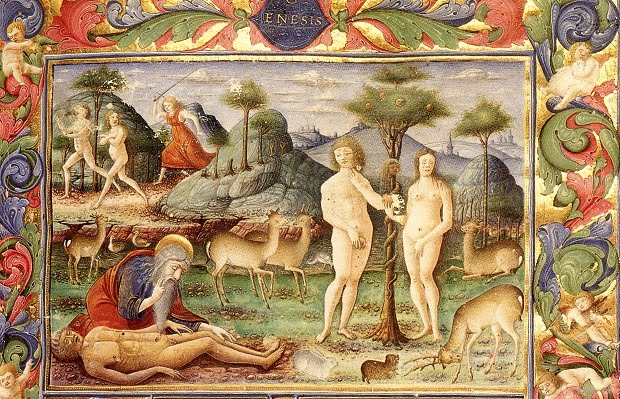
This post is a continuation of an earlier one, the last on the previous page (viewtopic.php?f=11&t=365&start=120#p6422), where I quoted Bauer-Eberhardt on Franco dei Russi's "Adam and Eve." I repeat this quote as follows. (Please ignore the part about Dummett, which has received sufficient attention already. I include it only to give the context):
Es war Michael Dummett, der schliesslich die ferraresische Komponente im Stil der ergaenzten Tarocchi erkannt hat und die Karten nunmehr einem anonymen Künstler aus Ferrara, um 1470, zuwies. Damit ist er bereits der richtegen Loesung nahegekommen; denn die enge Stilverwandtschaft der sechs spaeteren Karten in Bergamo und New York mit Werken von Franco dei Russi - beispielweise die "stella" oder "luna" Kartre (abb.27, 28) mit der Adam-und-Eva-Miniatur der Biblia Italica in Wolfenbüttel (Herzog August-Bibliothek, Slg.2 151, Bd. I, fol.1a) - macht deutlich, wer hier Hand angelegt hat: Franco dei Russi, Genaugenommen ein Wahl-Ferrarese, hat die lückenhaften Bembo-Tarocchi ergaenzt.

It was Michael Dummett who has finally recognized the Ferrarese component in the style of the added Tarocchi and assigned the cards now to an anonymous artist from Ferrara, around 1470. Thereby he has already come close to the correct solution; the close stylistic relationship of the six later cards) in Bergamo and New York with works of Franco dei Russi - for example "stella" or "luna" cards (ill. 27, 28) with the Adam and Eve miniature of the Biblia Italica in Wolfenbüttel (Duke August library, Slg.2 151, Vol. I, fol.1a) - makes it clear who has put their hand here: Franco dei Russi, strictly speaking a Ferrarese by choice, has supplemented the incomplete Bembo-Tarocchi.
I was finally able to get a copy of Mariani Canova's La Miniatura Veneta del Rinascimento, Venice 1969, to see the "Adam and Eve" illumination Bauer-Eberhardt was referring to, indicated in her footnote as Mariani Canova's Fig. 23. It is a frontispiece to a Bible printed in Venice by Vindelinus de Spera, dated 1 August 1471. Since Mariani Canova's reproduction is in black and white, I post here the full-color reproduction in The Painted Page, p. 170, which appeared after Bauer-Eberhardt's article. I include the putti in the margins, which are generic but do resemble the putti in the PMB World card.

Image


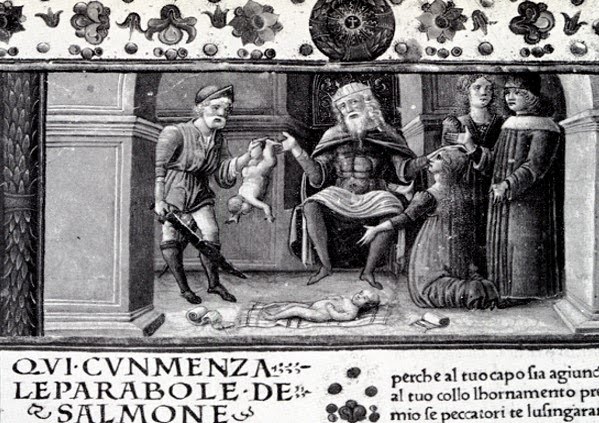
Bauer-Eberhardt also indicates in her footnote a comparison with another illumination in the same Bible, Mariana Canova's Fig. 22. It illustrates the Judgment of Solomon Mariani Canova identifies the artist, on stylistic grounds, as the same Franco dei Russi:

Image


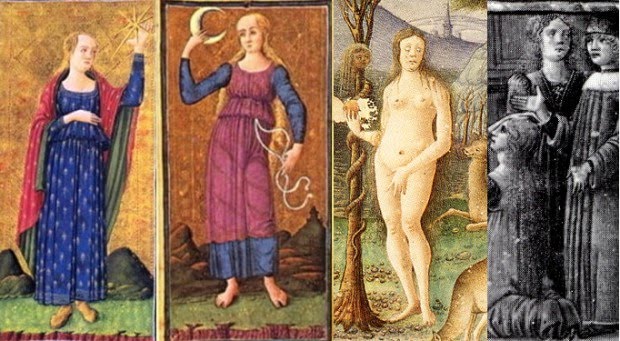
Comparing the two figures in these illustrations with the lady in the Star and Moon cards, there is indeed a resemblance.

Image


The similar depictions of the faces are rather singular; in fact I know of no others so similar. The only ones close to it are the ones I posted earlier, in altarpieces by Benedetto Bembo and Bernardino Butinoni (viewtopic.php?f=11&t=365&start=60#p4912, near the end). The emotions depicted in the illuminations, I think, are anxiety and regret, regarding actions the women have taken: eating a forbidden fruit, and laying false claim to an infant. Such emotions may, as if suggesting some unknown mystery, fit the two cards. (They also fit emotions that Galeazzo Maria Sforza might have attributed to his sister Elisabetta after her marriage.) The hairline on dei Russi's lady is lower than on the cards, and the eyes further up; to that extent the faces reflects the Lombard style, of which I gave examples in the post just referred to (including the ladies in the altarpieces). But this may simply be a case of an artist adjusting himself to the style of another region.

Could the same artist have done the man on the "Strength" card? Looking at dei Russi's depictions of Adam, I find that difficult to say.

Dei Russi's earlier illuminations, of which there are several, do not depict their women in the way he does in this Bible. (Compare, for example, the same scene done by him and Crivelli for Borso's Bible, which I posted somewhere.) If he is the artist of the six added cards, we can say that he probably did the cards later rather than earlier, within a few years of 1471. Since dei Russi was known to be in Padua in the period 1461-1471 (documented in The Painted Page and in Bauer-Eberhardt), closely associated with Venice, he would not likely have done them during that period. In 1474 we find him in Urbino. His whereabouts from the end of 1471 through 1473 are unaccounted for, with no known datable illuminations. If he did the cards, it would likely have been in that period.

Elisabetta Maria Sforza died in 1472. Her brother was an impatient man; he could easily have insisted that the cards be done in time for her memorial service in Milan. Here are some quotes from Lubkin, A Renaissance Court;, partially in Google Books, with their documentation.
...In 1472, Sforza Maria and Ludovico traveled to Montferrat to celebrate the birth of their sister Elisabetta's first child. Elisabetta died while they were en route, and they returned immediately (194). (Lubkin p. 118)
Chapter 4, Footnote 194, Lubkin p. 333: Galeazzo to Sforza Maria and Ludovico, 2 Sep. 1472 (ASMi, RM no. 107, fo. 231(r).)

...As the head of his own lineage, the duke concerned himself particularly with the deaths of persons who belonged by blood or marriage, such as his sister Elisabetta or Giovanni Maurizzi da Tolentino, his half-sister Isolta's husband. Many persons of both genders were honored by the court at their deaths...If they died in another state, their passing was acknowledged with a memorial service...A massive service was held for the duke's sister Elisabetta when she died in 1472, even though she had been living with her husband in Montferrat (190). (Lubkin p. 159f.)
Chapter 5, Footnote 190, Lubkin p. 333: Galeazzo to A. Anguissola, 4 Sep. 1472, Pavia (ASMi, AS, c. 908), and expense list dated 9 Sep., Milan (ASMi, AS, c. 906).

ASMi = Archivio di Stato, Milan. AS = Archivio (Ducale Sforzesco (c: cartella number). RM = Registri delle Missive. (Lubkin p. xxiii).
As you can see, the memorial's expenses were submitted a week after Galeazzo received the news of Elisabetta's death. It might be of interest to see that expense sheet. Galeazzo's itinerary for September of 1472 shows him in Pavia Aug. 18-Sept. 16, and not in Milan until Oct. 8 (Lubkin p. 262f), so perhaps the memorial was held in Pavia. If dei Russi was in Lombardy then, Pavia would be the right place, with both the university and the ducal library there, as well, sometimes, as the court.

Re: "The 5x14 Theory: An Investigation" part II

140
mmfilesi wrote:Hi dear friends!

Another argument small.

In the Roman de la Rose, the lover tries win resistance from her lady's love with his army of courtly love.

Arround 1400, Evart Country wrote his encyclopedia, Libre des Eechecs Amoreux. I have not read. I have only one book with a comment made by Antoine Rollin, to 1485 (BNF, 1991), responsible for an illustrated edition that is displayed on line in the BNF.

http://classes.bnf.fr/echecs/feuille/amour/index.htm

In Roman de la Rose, and Libre des Eschecs Amoreux, and in the poem spanish "Scachs d'amor" (1475), we have a one topical idea of courtly love. The lady, a virgin, resists with his army (Shame, Modesty, Beauty ...) the army of burning man (sweet look, sweet think, Hope).

In the Eschecs Amoreux and Scachs d'amor we have gods with courtly love. It is a good mix.

In Michelino Deck we have gods.

In Trionfi/Autorbis.com's theory, the key is a virgin (Daphne), which will be capture, and a crazy love (as in the courtly love: the Love is a force that makes us fool).

The gods of Michelino are not the same gods of Exchex (i' am sure. Its Boccaccio Deorum), but the idea is the same. A mix between the game to catch the virgin and Daphne. It's brilliant. Thanks Autorbis.

Now the birds are interesting. Les Exchecs (in the version I know, version BNF, 1485), the turtledoves are the king of the Beloved. That is, Athena, Diana, Vesta, Dafne.
Regards!
I've something like 1467 in my memory for the production of the echecs amoureux edition made by the "Master of Antoine Rolin".

According this ...
http://membres.multimania.fr/dcarpentie ... n/type.htm
... Antoine Rolin, son of the more famous
http://en.wikipedia.org/wiki/Nicolas_Rolin, chancellor of Philip the Good of Burgundy, died ca. 1470 - 1475.

However, this text knows the date 1497-98 as time of death ...
http://www.r3.org/bookcase/de_commynes/decom_4.html
.. in a footnote

This source states, that the text was prepared 1490 - 95 ...
http://books.google.com/books?id=h74u5N ... dy&f=false