Banner

Tarot History Forum

Tarot History Forum - 600 years of history in 78 cards

Re: ferè OR serè

361
SteveM wrote: 13 May 2025, 02:12
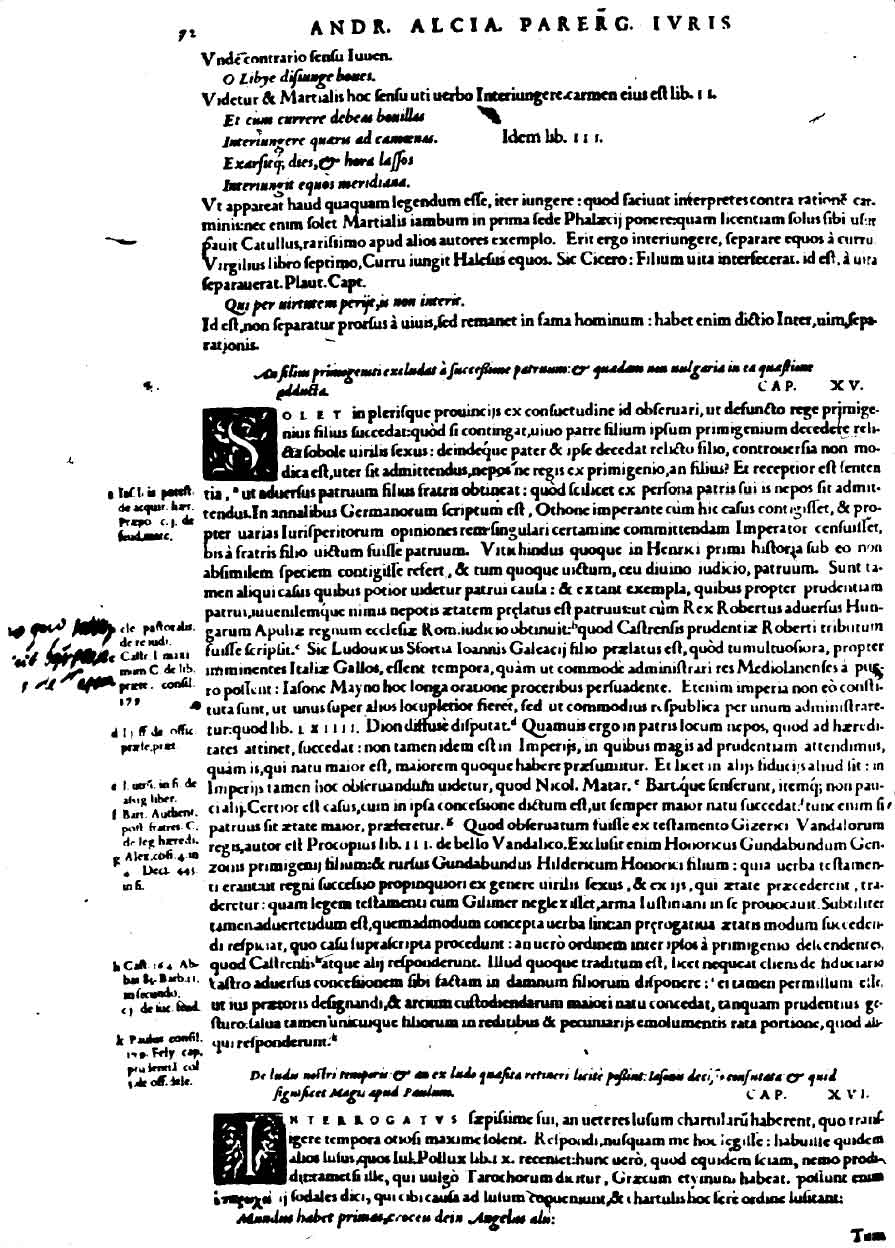
But as for this one — so far as I know — no one ever reported it. Even though the game commonly called Tarochi seems to have a Greek etymology, for the word ταρώχοι (tarōchoi) could mean “companions” who gather for food and play, and they tend to play with cards in this typical sort of order:
Wherefore the typical sort ?

This is based on my transcription of the text :

qui cibi causa ad lusum conveniunt, & chartulas hoc ferè ordine lusitant:

ferè = limits a generalization

But I see Ross in another thread has transcribed it as:

qui cibi causa ad lusum conveniunt, & chartulis hoc serè ordine lusitant:

serè

Alciato's use of "ferè” suggests to me that he is aware of variation - as it was commonly used to soften an assertion, signaling that what follows is typical, but not fixed. So hoc ferè ordine implies a recognizable structure, but one that is flexible and open to variation. i.e., usually (commonly/typically), but not always, in this order.

ferè
almost, nearly
commonly, generally
typically, as a rule
For the most part, more or less

But before going into that - can we agree whether it is an s or an f ?

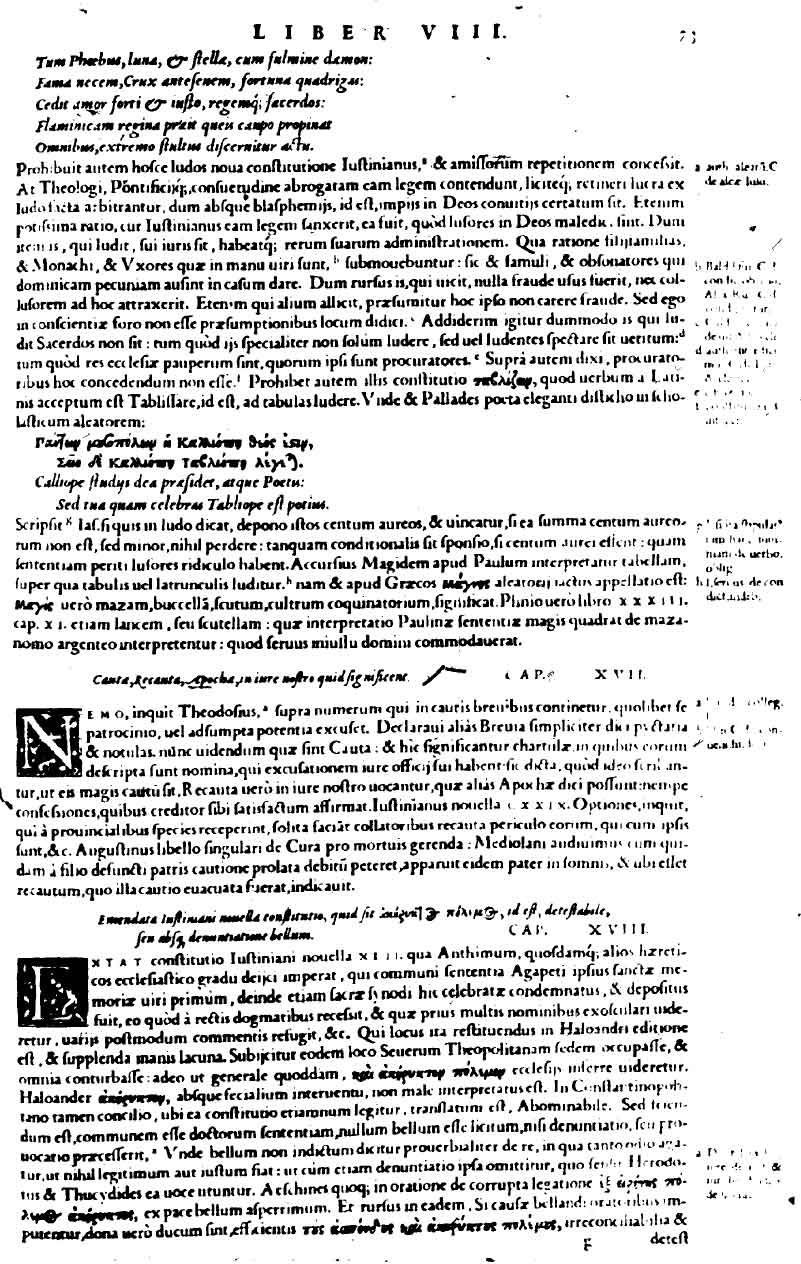
Here is an image of the text - I have included a larger section for comparative purposes, check ferè for example with sibi factum, or saepissime fui, or salua... filiorum
Attachments
feresere.png feresere.png Viewed 2462 times 1.04 MiB

Re: ferè OR serè

362
SteveM wrote: 13 May 2025, 15:12
ferè
almost, nearly
commonly, generally
typically, as a rule
For the most part, more or less

Alciato's use of "ferè” suggests to me that he is aware of variation - as it was commonly used to soften an assertion, signaling that what follows is typical, but not fixed. So hoc ferè ordine implies a recognizable structure, but one that is flexible and open to variation. i.e., usually (commonly/typically), but not always, in this order.
Edited to add : ah, I see this Pratesi has transcribed it the same, and translated it 'generally in this order".

viewtopic.php?p=10681#p10681

During the period this verse was published Alciati was in Milan, so perhaps we can take that as evidence of its common use in Milan, where he also associated with the Sforza family. He has also spent a lot of time in France, at Avignon & Bourge. So, a lot of time in places where we expect something like this Type C order to have been a common ordering. But he was a highly travelled man, making it likely that he was aware of varations :

His main places of residence, study & work during his life were:

Milan 1492–1507, 1539–46 Birthplace; early education; later legal work
Pavia 1507–1516, 1533–39, 1546–50 Student; professor; final years
Bologna ca. 1514–1516, 1529 Legal training; brief teaching period
Avignon 1518–1521 First professorship
Bourges 1521–1529, 1533–1535 Humanist legal teaching, major influence
Last edited by SteveM on 13 May 2025, 19:24, edited 1 time in total.

Re: Bolognese sequence

363
It's definitely an "f". Don't rely on my 2005 or subsequent repostings of that transcription, done in 2005 and posted at TarotL. I couldn't make sense of the word, so I ignored it, since my main interest was the list of trumps.
https://groups.io/g/TarotL/topic/alciat ... e/58126619

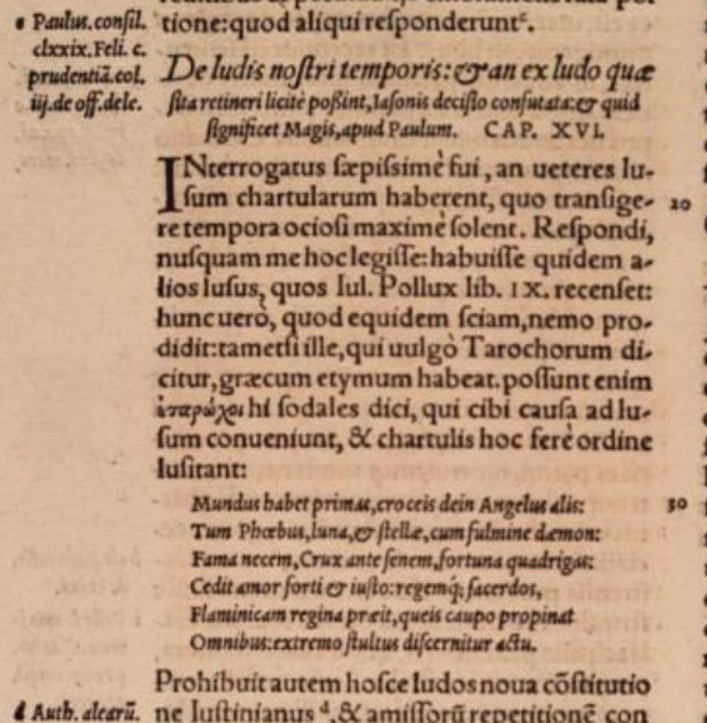
Here is the Gallica PDF I had to work with:
Image
Image

On the other point you've been discussing, the punctuation is wrong in the first edition.

"Cedit amor forti & iusto, regemque sacerdos:"

The verb governing "regemque sacerdos" can only be praeeo, -ire, (as I even recognized in 2005): if cedo, -ere governed the clause, as the faulty punctuation would suggest, we would expect rex in the dative like the forms iusto and forti, i.e."Amor cedit forti et iusto, regique sacerdos".

Alciato republished Παρέργων Juris in 1546, in the collection D. Andreae Alciati Mediolanensis, Iurisconsulti clariss. lucubrationum in Ius ciuile, vol. 2 col. 401, this time with the correct punctuation:

"Cedit amor forti & iusto: regemque sacerdos,"
Image
https://books.google.fr/books?id=RIkNij ... &q&f=false

Re: ferè OR serè

364
SteveM wrote: 13 May 2025, 17:23 During the period this verse was published Alciati was in Milan, so perhaps we can take that as evidence of its common use in Milan, where he also associated with the Sforza family. He has also spent a lot of time in France, at Avignon & Bourge. So, a lot of time in places where we expect something like this Type C order to have been a common ordering. But he was a highly travelled man, making it likely that he was aware of varations :
This was also Pratesi's interpretation of Alciato's ferè in his article "Le tarot de Marseille: retour à Milan," L'As de Trèfle 47-48 (1992), pp. 10-12,http://naibi.net/A/40-MARSMIL-Z.pdf :
Le terme fere est important car il s'applique à l'ordre des atouts. Les séjours d'Alciat dans de multiples villes l'avaient peut-être rendu conscient de plusieurs séquences possibles.

[The term fere is important because it applies to the order of the trumps. Alciat's stays in many cities had perhaps made him aware of several possible sequences.]
However, this interpretation seems rather dubious to me.

As you have noted, fere here must mean either "commonly, as a rule, usually" or "for the most part, approximately". Either he means that this order is the one usually used but a minority of players use some other order(s), or he means that tarot is played with this trump order or a trump order very similar to it.

In either case, it doesn't really make a lot of sense for him to be referring to players in various other cities.

It doesn't make sense if we interpret the word as "usually" because he would have been aware that there were many other cities where the order in his poem was not used. So he would not have said that this order is the one "usually" used.

The second interpretation – that tarot was played with trump orders that were largely the same as the one in the poem – is more plausible, but only if we assume that he was thinking only of players in Lombardy or France. Yet he is very likely to have been also aware of the trump orders used in Bologna and Ferrara, having spent a lot of time in both of those cities. Both of those orders were significantly different from the one in his poem.

So I think he must have been referring to his local region only. We know from the "Susio" poem that a slightly different trump order was used by players in nearby Pavia at roughly the same time as he was writing this work. But he could even have just been thinking of other players in Milan: as I have argued in other recent posts, tarot trumps in Milan seem to have been unnumbered at this time (and also throughout the entire 16th and 17th centuries), so it is very likely that some tarot players in the city were using trump orders that also differed at least slightly from the one that he and his friends were using.

Re: Bolognese sequence

365
Hello

Thanks, Ross, for the explanation about the need for the omitted verb to be the one from the following verse and not the previous verb (cedit). Indeed, it seems they are verbs accompanied by different types of complements. I hadn't noticed that detail.

Steve,
you mentioned the Berscia text, supposedly from 1502, where the Tarocho game is mentioned. You linked to articles by Pratesi and Depaulis here:
viewtopic.php?p=27146#p27146

I've been reading both articles, with language difficulties understanding some details. Pratesi didn't yet know of an edition of the poem prior to 1528, which he estimates as the first edition, which was published in Venice. It seems that an older book of the same poem, printed in Brescia, has since been located. It seems that the place Berscia is noted, but the date is not. Sander thought it was a poem printed in 1500, and later Ennio Sandal said it was a book from around 1502. That book was published by Misinta, who lived in Brescia from 1501 and was active until 1509. I don't see Depaulis explaining Sandal's motives for estimating the year 1502, choosing between 1501 and 1509 for reasons unknown to me. This detail is important. If the book were after 1505, then it wouldn't be the earliest reference to the Tarot game, since there are two documents from 1505 (Ferrara and Avignon). In any case, it seems that the 1528 edition wasn't really the first, since there was another one earlier in Brescia. Depaulis says that one edition has a defect because it is missing a verse that appears in later sections. That leads you to think there was an earlier edition than the one with that defect. I don't know which edition has the blank verse. Sometimes I feel like Depaulis writes less precisely than Dummett and Pratesi. For whatever reason, I get a bit lost reading that Depaulis article.

By the way, Depaulis writes: Sorrento, Sander. Mikeh mention Sander in a thread about Strambotto.
viewtopic.php?p=14909#p14909
There's also a mystery surrounding the dating of Strambotto, which I haven't yet studied. Is Sander's surname Sorrento? Was he born in Sorrento, Italy? I imagine Sander is an older scholar, historian, or writer than Sandal. I've had more luck finding information about Sandal. Well, the important thing is to see why 1502.

Re: Bolognese sequence

366
Hello

A few weeks ago, Huck proposed a structure of correspondences between the Sola Busca deck and the Lucca Tarot, leaving the rest (9 heroes) without specific correspondences. Mikeh said that the Lucca Tarot matches the two BAR sheets, except that the Fool is not preserved in BAR. I've had this in mind since I studied the Lucca Tarot, but Mikeh helped me realize that Sylvia Mann didn't actually say that BAR matches the Lucca Tarot. Steve partially agreed with Huck's proposal but proposed different correspondences for some trumps. Based on Huck's proposal, I observed that his two quintets observed in the Sola Busca match the two groups of six cards I then discovered in BAR: six cards in the top row of both sheets and six cards in the bottom row.

I looked at Huck's structure for the nine uncorrelated trumps in the Lucca Tarot and thought that apparently all the heroes in the Sola Busca deck were created based on a tarot sequence that had Love under the Chariot and the three virtues above the Chariot. That sequence coincides with the one in the Tarocchino Bolognese from a certain point, between 1602 (Croce's poem) and 1663 (Mitelli's tarot). The world is in the highest position in SolaBusca and perhaps also in BAR, where the world is in the superior group and the angel just below the world. It seems that bar disorder is not a total disorder.

I thought that this order (on which the SolaBusca deck were based) had existed in Milan. Alciato shows two virtues together and it could be the transition from the order of Boloñes to the order of Piedmont. Mikeh helped me think that this might not be true. Then, I thought that perhaps the Sola Busca deck was created based on the Bologna sequence, with the peculiarity that perhaps the World was above the Angel in Bologna around the years 1490 and 1500. I later realized that I forgot a reason I had for locating a Bolognese sequence in Milan that would have inspired the structure of all the heroes in the Sola Busca deck. That's why Huck believes Falco is based on a Falconer trump, like those we later see in decks from the Visconti Sforza group. I don't know if we have evidence that this Falconer existed in Milan in 1491 (Sola Busca and Marriage of a Sister Este, related to cards from the Visconti Sforza group) or if the oldest falconers we know of are from decks whose creation we estimate to be around 1504 or even 1512. This would need to be studied in detail, but I don't have exact measurements for the Rosenthall cards, which possibly imitate older cards. Rosenthall has cards of different sizes, and I hope they have measurements faithful to the originals. What year was the falconer imitated in Rosenthall?

All this invites us to study the order of Tarot cards in Milan and Piedmont, which is complex. Are there any theories about the origin of the exact order of the Vieville? In another thread, I proposed that perhaps the Vieville order existed in Milan after Alciato (1538-1546) but before the Marseille order. Since when was the Marseille order used in the Milan game? I also thought maybe Vieville originated in Avignon, but I think it's less likely.
My suggestion about Milan:
viewtopic.php?p=27193#p27193

The oldest document mentioning the Tarot deck is from Brescia (Venice) in 1502, according to a scholar named Sandal, whom we may not have read. We know that the complete Tarot structure existed in 1502, but we don't know from what year that structure existed, which also included the Tower, the Devil, the Popese, the Magician, and especially the Fool.

I suspect that perhaps the Devil is one of the last cards added to the sequence. I think Huck also thinks something similar, but I don't know the details of his opinion. I think the Devil was possibly added between 1481 and 1495. The Fool already existed in some decks (Visconti Pierpont, Charles VI, Hercole d'Este), but I don't think there was a Fool in the Initial Minchiate (Florence, 1466-1500). After the Devil was inserted into the BAR dozen trump cards (Bologna), the Fool was accepted as a main card for the new trump card game, which was initially called Tarocho or Taraux (tarot). Incidentally, I don't know the earliest record of the French name: Tarot.

The Falconer resembles a Fantasia and the Fool. I don't know if we have any indication that he occupied the Devil's position, but Huck's suggestion seemed interesting to me and I think it might be correct. If it were true, I wonder if the Falconer existed before the Devil or if it was the other way around.

Huck, do you have an opinion on the year in which The Falconer and the Demon were created? I'd like to accurately date BAR. I've read that it could be between 1490 and 1500. I suspect it could be later than Sola Busca (1491), around 1495, but I don't know. Any suspicions about a date for BAR? I'll have to find a thread about that on this THF forum.

We're used to discussing where the trump deck originated around 1440. Nowadays, we tend to think that trumps originated in Florence or Bologna. I wonder if perhaps the Pope was added (to the 14 triumphs) in Milan or Florence. Later, more cards were added, according to the 5x14 theory. Were the four luminaries added in Florence? that's how the Initial Minchiate already existed in 1466. That's possible. Perhaps the Minchiate already existed in 1464, and Lorenzo Medici explained it to the Visconti Sforza family, as Huck suggests. However, if it was a deck given to a Venetian family, then Lorenzo's visit to Milan in 1465 isn't enough to explain why six trumps, including the luminaries, were added in Venice.

I think we should next ask: Where did this deck evolve into the 78-card Tarot? Perhaps in Brescia or Ferrara? I don't think the Tarot (with 21+Fool) would consolidate in Florence or Bologna, even though most of the trumps originated there. The exact structure of the tarot (21+ Fool) existed in Brescia (Venecia) in 1502. But did it exist before 1499 (French invasion of Milan and Piedmont)? Did it exist in 1491 (Sola Busca)? Did it exist in 1487 (estimated year for the poem Boiardo)?

Ludos cum Aliis (sermom found by Steele) could be written between 1490 and 1500. Right? Probably, this is not older than 1500 aprox.

Re: Bolognese sequence

367
In work ,,,,

Magic Moon wrote ...
Huck, do you have an opinion on the year in which The Falconer and the Demon were created? I'd like to accurately date BAR. I've read that it could be between 1490 and 1500. I suspect it could be later than Sola Busca (1491), around 1495, but I don't know. Any suspicions about a date for BAR? I'll have to find a thread about that on this THF forum.
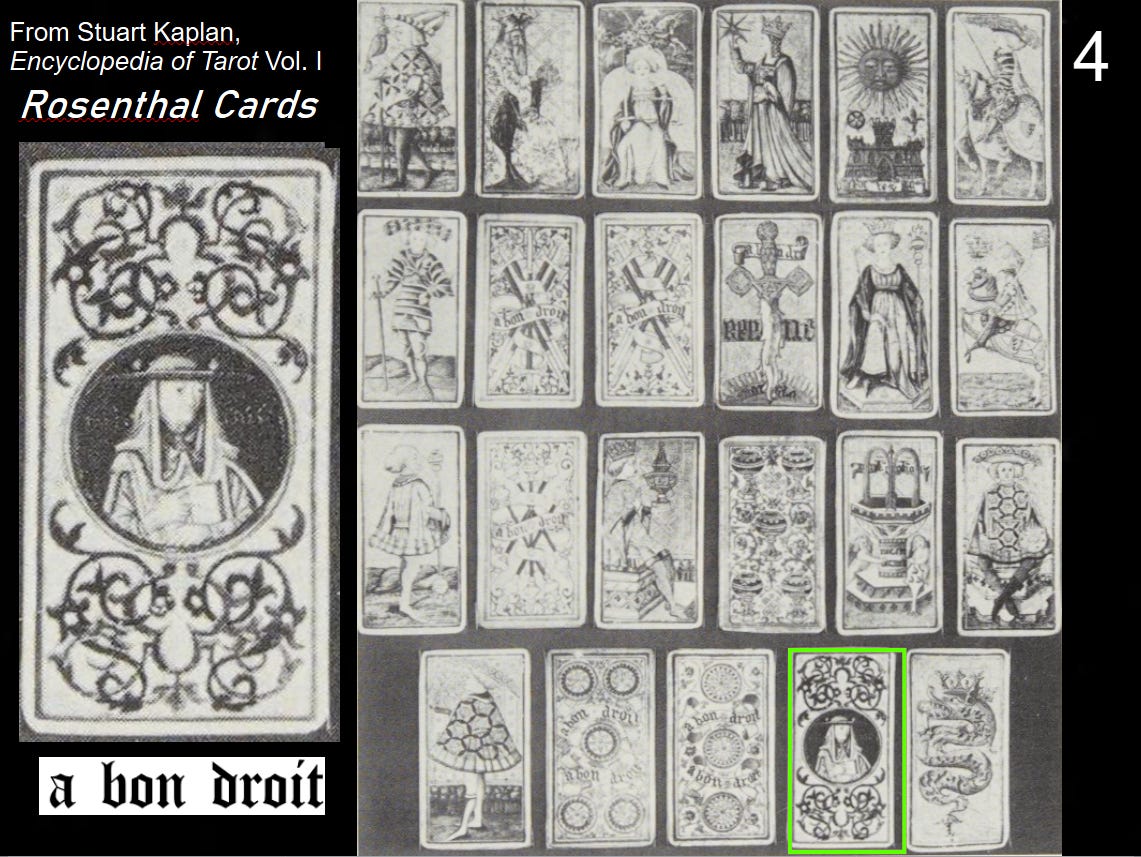
The Falconer was an old motif in the very early German hunting decks. As part of Trionfi or Tarot decks I would assume it happened later.

... Tarot with a Falconer / Rosenthal Tarocchi
https://substackcdn.com/image/fetch/f_a ... 41x857.png

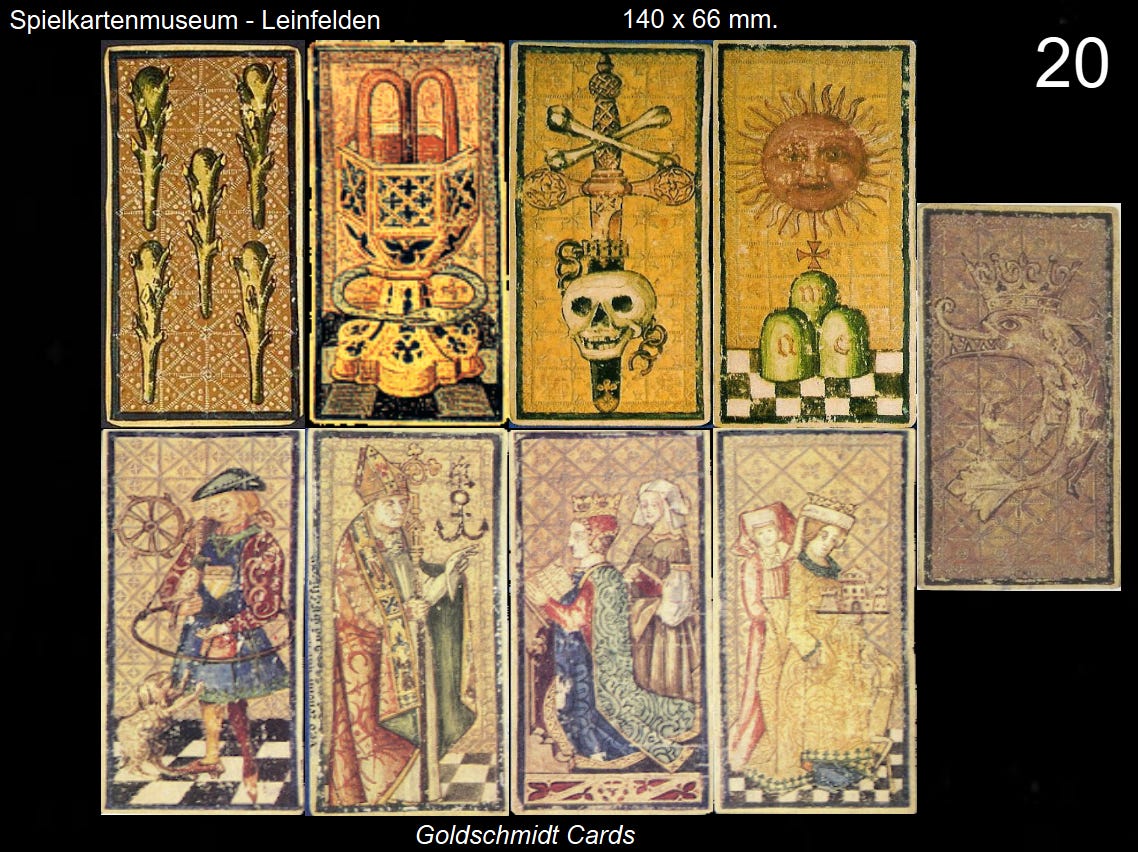
... Tarot with a Falconer / Goldschmidt
https://substackcdn.com/image/fetch/f_a ... 38x852.png

Both falconers are likely presented as a Fool and both groups have a sign, which might be understood as a heraldic device of the Sforza. The Visconti-Viper. Or it was the Devil. Or it was interpreted as the devil.

My general feeling about the Sola-Busca Tarocchi is, that the author is very clever and very provocative. Possibly the famous Accademia Romana had something to do with this.

https://de.wikipedia.org/wiki/Accademia ... 0Romana%20(lateinisch%20Academia%20Romana,Jahrhundert%20tätig%20war.
translated to English
https://de-m-wikipedia-org.translate.go ... 0Romana%20(lateinisch%20Academia%20Romana,Jahrhundert%20tätig%20war.

I got a wikipedia-shock. Only 3 languages know something about the Accademia Romana. It seems, that there are persons, who don't like the Accademia. No English article, no French article, no Italian article. Spain has one, but it is short.

see also ....
https://en.wikipedia.org/wiki/Julius_Pomponius_Laetus
... has 14 languages

22 Roman Heroes
-----------------
Mato 0
Panfilio I
Postumio II .... 9 Roman Heroes
Lenpio III .... 9 Roman Heroes
Mario IIII
Catulo V
Sesto VI .... 9 Roman Heroes
Deo Tauro VII .... CHARIOT
Nerone VIII
Falco VIIII
Venturio X .... 9 Roman Heroes
Tulio XI .... 9 Roman Heroes
Carbone XII
Catone XIII
Bocho XIIII .... 9 Roman Heroes
Metelo XV .... 9 Roman Heroes
Olivo XVI
Ipeo XVII
Lentulo XVIII .... 9 Roman Heroes
Sabino XVIIII .... 9 Roman Heroes
Nenbroto XX
Nabuchodenasor XXI
--------------
..... there is no Julius, also not Augustus

There are 9 other Heroes, who developed in the North of Europe, regions of Netherlands, Belgium, Germany, England, France participated .... Italy came rather late to this show.
Emperor Heinrich VII and his grandson Emperor Karl IV were involved.

9 Helden (German)
9 Worthies
neuve preux

3 Pagan Heroes .... Hector (Troja, also related to France) , Alexander (Greece), Julius Caesar (Rom)
3 Jewish Heroes ... Josua, Judas Makkabeus, King David
3 Christian Heroes ... King Arthur (England), Emperor Karl the Great (Germany, France), Gottfried of Bouillon (Belgium, Netherlands)

For Hector and its relation to France
... https://en.wikipedia.org/wiki/Astyanax
There are also stories from the Middle Ages and Renaissance that have Astyanax survive the destruction of Troy:

Astyanax, in Andromache's lap, reaches to touch his father's helmet before his duel with Achilles (Apulian red-figure column-crater, ca. 370–360 BC).
In one version[which?], either Talthybius finds he cannot bear to kill him or else kills a slave's child in his place. Astyanax survives to found settlements in Corsica and Sardinia.
The Chronicle of Fredegar contains the oldest mention of a medieval legend linking the Franks to the Trojans.[10] One legend, as further elaborated through the Middle Ages, established Astyanax, renamed "Francus", as the founder of the Merovingian dynasty and forefather of Charlemagne.
In Geoffrey of Monmouth's Historia Regum Britanniae, "the sons of Hector" reigned in Troy after the expulsion of Antenor and his followers.[11]
In Matteo Maria Boiardo's Orlando innamorato (1495), Andromache saves Astyanax by hiding him in a tomb, replacing him with another child who is killed along with her by the Greeks. Taken to Sicily, Astyanax becomes the ruler of Messina, killing the giant-king of Agrigento (named Agranor) and marries the queen of Syracuse. He is killed treacherously by Aegisthus, but his wife escapes to Reggio and bears a son (Polidoro), from whom the epic hero Ruggiero is descended (III, v, 18-27). In this tradition, the epic hero Roland's sword Durendal is the very sword used by Hector, and Roland wins the sword by defeating a Saracen knight (Almonte, the son of Agolant) who had defeated Ruggiero II.
In Ludovico Ariosto's Orlando Furioso, a continuation of Boiardo's poem, Astyanax is saved from Odysseus (36.70) by substituting another boy of his age for himself. Astyanax arrives in Sicily, eventually becomes King of Messina, and his heirs later rule over Calabria (36.70–73). From these rulers is descended Ruggiero II, father of the hero Ruggiero, legendary founder of the house of Este.
Based on the medieval legend, Jean Lemaire de Belges's Illustrations de Gaule et Singularités de Troie (1510–12) has Astyanax survive the fall of Troy and arrive in Western Europe. He changes his name to Francus and becomes King of Celtic Gaul (while, at the same time, Bavo, cousin of Priam, comes to the city of Trier) and founds the dynasty leading to Pepin and Charlemagne.
]Lemaire de Belges' work inspired Pierre de Ronsard's epic poem La Franciade (1572). In this poem, Jupiter saves Astyanax (renamed Francus). The young hero arrives in Crete and falls in love with the princess Hyanthe with whom he is destined to found the royal dynasty of France.

In Jean Racine's play Andromaque (1667), Astyanax has narrowly escaped death at the hands of Odysseus, who has unknowingly been tricked into killing another child in his place. Andromache has been taken prisoner in Epirus by Neoptolemus (Pyrrhus) who is due to be married to Hermione, the only daughter of the Spartan king Menelaus and Helen of Troy. Orestes, son of Agamemnon and Clytemnestra, brother to Electra and Iphigenia, and by now absolved of the crime of matricide prophesied by the Delphic oracle, has come to the court of Pyrrhus to plead on behalf of the Greeks for the return of Astyanax.
...

Last edited by Huck on 20 May 2025, 08:57, edited 1 time in total.

Re: Bolognese sequence

368
Huck, it's true that some German hunting and animal decks had one or more bird suits. Please, specifically, which German decks do you consider to have a falconer? (Then, we will know a date aprox)

Re: Bolognese sequence

369
https://www.wopc.co.uk/germany/the-prin ... ack-c.1440
.... for instance, Also here ...
https://commons.wikimedia.org/wiki/Cate ... 231200.jpg
https://de.wikipedia.org/wiki/Stuttgarter_Kartenspiel

This is judged as the oldest Minchiate card
http://trionfi.com/0/j/d/Minchiate-Ship/

Beaux Art and Rothchilde might be from the same deck. They might be simply part of a Minchiate deck. It has a devil. if it is really from the 1490s, then it is the oldest devil card, I think. But I would think, that Minchiate is very troublesome for beginners in the game, if it has no numbers.

Re: Bolognese sequence

370
Thanks, Huck, for the response.
It offers some thoughts on the topic. The question is interesting, and I accept the German influence, but I think the dating of those German decks doesn't help us much to know what year or decade falconers began appearing in Visconti Sforza cards.

Indeed, the Stuttgart deck (1430) has a falcon suit figure that resembles the falconer we see later in the group of late Visconti Sforza-type decks because it has the falcon resting on one arm. I've included below the image.

It seems that the Ambras deck (circa 1445) has a falcon suit but doesn't have a falconer with a falcon on his arm. I think the card most similar to a falconer in that deck is a fantasia with a falcon flying at the bottom of the card.

I don't know if there are many German falconers similar to Visconti Sforza's Falconier, but it seems that the theme of birds and falcons influenced that card. Also, I've read that Galeazo Maria received falcons from Burgundy in Milan around 1470. Someone suggested on THF (this forum) that the falconer on the Visconti Sforza cards could represent the French king Charles VIII. I don't remember the reason for that association. I suppose he also had falcons.

************

Taking advantage of the fact that Huck commented on Minchiate and showed the early ship card, I want to reflect.

Huck, you're suggesting that it would be difficult to play Minchiate if it had many unnumbered trumps. I agree with you. I thought your thinking was similar to mine because I was inspired by reading Trionfi.com and some not very detailed article that made me imagine my own details. Now I don't know if anyone else thinks like me, but I'm surprised by what you say. So I'll take this opportunity to say what I think on this matter. I think what I'm going to say is consistent with some comments from different scholars. The ship card SEEMS to be from the Minchiate, and there are RUMORS that it's a 15th-century card, perhaps created around 1490. On the other hand, it's accepted that there's no evidence that the extensive Minchiate that we know existed in the 15th century. I've read this comment at least twice. I think I once read it in a text by Pratesi. It's true that there's no evidence of the existence of 41 allegorical Minchiate maps in the 15th century. The name Minchiate existed but I think that the deck in 15 century was not so big as later.

This ship card could be the only indication that the Minchiate had 40 triumphs in the 15th century. It's a very slight clue. I don't think that this ship card belonged to a Minchiate. The design resembles certain cards from the Visconti Sforza group. I don't think that this card is from the late 15th century but from the early 16th century. Otherwise, if it this ship card was created in 1490, then I think the ship theme is a coincidence or probably the Minchiate Germini of Florence in 1506 was inspired by it to illustrate the element of water.

Definitively, I'm trying to say that the 15th-century Minchiate had no more than 20 allegorical cards. The 40 special cards didnt exist before Germini that was created in 1506 aprox. What do you all think about this? Sorry if some topics should be discussed in another thread. I don't know.

---------o----------

Regarding the two sheets called BAR, it seems obvious that they belong to the same deck. The design is very similar to the Bolognese Tarocchino that existed later. I'm surprised you say it could be a Minchiate. That design doesn't seem to be from Florence, and I don't think that deck had 40 allegorical cards. I don't even think it was a complete tarot, as we've recently debated. I think it's an early example of the Lucca Tarot. I thought you had this same idea because you suggest that perhaps the Lucca Tarot is ancient. If I'm not mistaken, you say the Lucca Tarot was created in 1369. I don't think the Lucca Tarot cards existed as early as 1369, but I think that perhaps before 1420 there was an antecedent, embryonic game that led to the Emperors' game or the Trumps' game. I think that perhaps that game in Lucca was a tribute commemorating the year 1369. This is all I can admit regarding your observation about the 13 allegorical cards and the total number of 69 cards (year: 13•69). It could also be a coincidence that only you have observed. In any case, I thought you admit BAR as an early example of Lucca Tarot. If that game existed since 1369 (as you sometimes suspect), then it seems logical that it existed at the time of BAR (around 1490-1500?).

**************

The interesting linguistic study you did in recent posts addresses an interesting topic. You're trying to find out if Alciato, in his poem, suggests that there was a tradition in Milan other than the order of triumphs he presents in his poem. I haven't studied the linguistic details in depth (it's a bit complex), but I've read your reflections. If there was no other order in Milan at that time, then I suppose the Vieville order arrived in France through another place. Perhaps Bergamo. Avignon and Pavia don't seem like very perfect options to me. I'm a bit lost.
Attachments
stuttgart-2.jpg stuttgart-2.jpg Viewed 2016 times 157.17 KiB