In work ,,,,
Magic Moon wrote ...
Huck, do you have an opinion on the year in which The Falconer and the Demon were created? I'd like to accurately date BAR. I've read that it could be between 1490 and 1500. I suspect it could be later than Sola Busca (1491), around 1495, but I don't know. Any suspicions about a date for BAR? I'll have to find a thread about that on this THF forum.
The Falconer was an old motif in the very early German hunting decks. As part of Trionfi or Tarot decks I would assume it happened later.
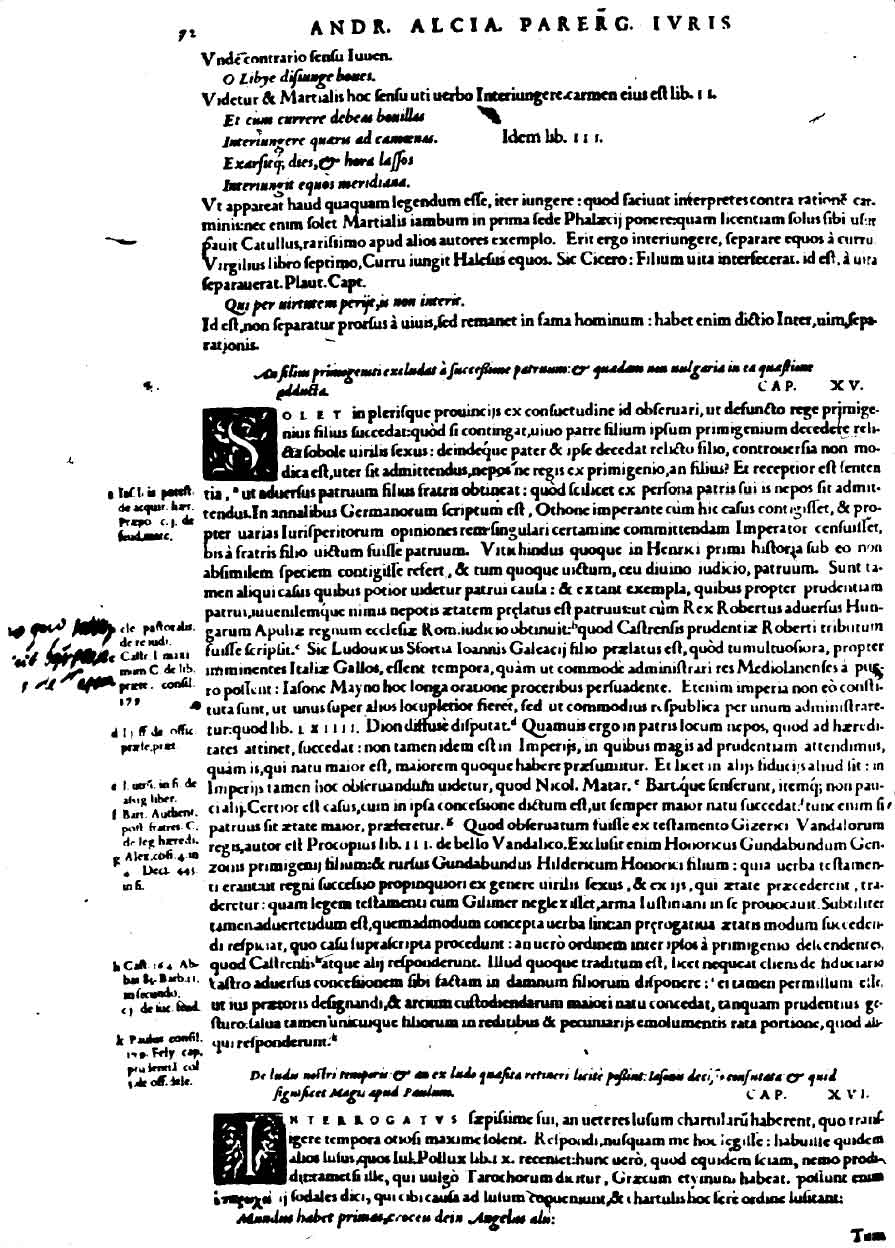
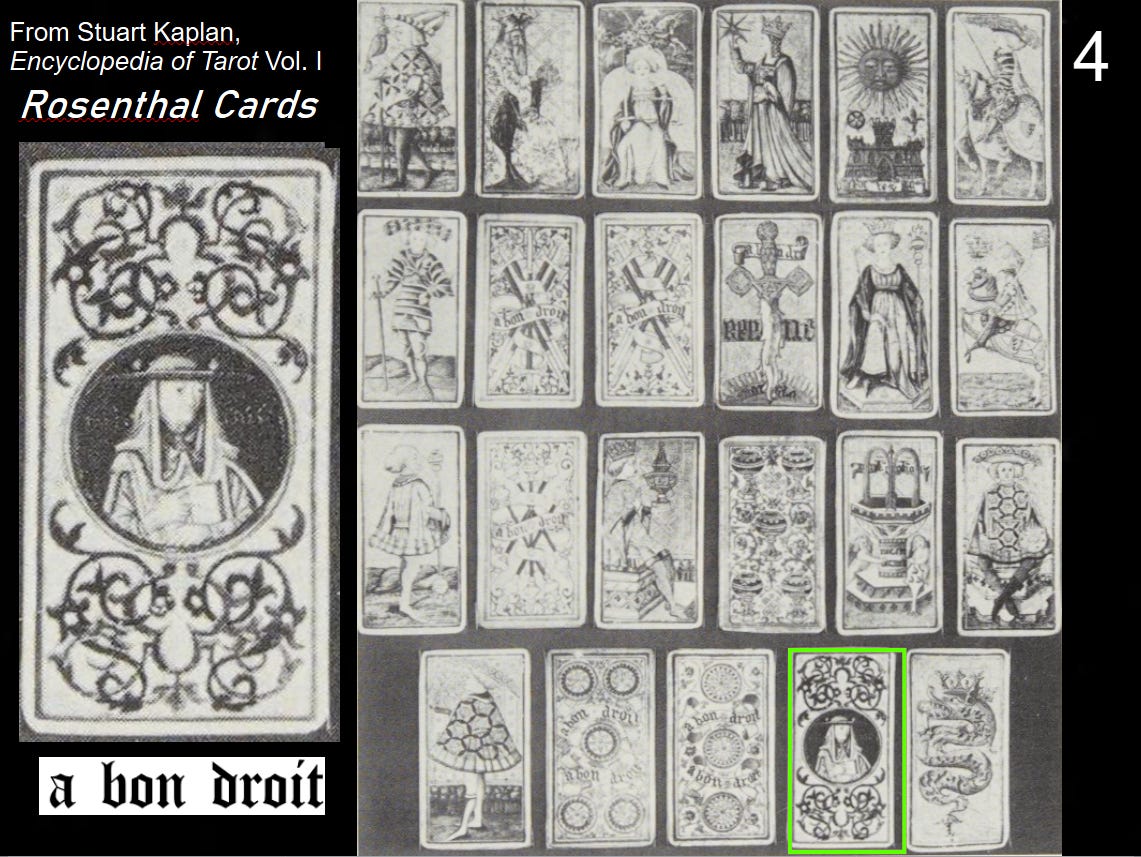
... Tarot with a Falconer / Rosenthal Tarocchi
https://substackcdn.com/image/fetch/f_a ... 41x857.png
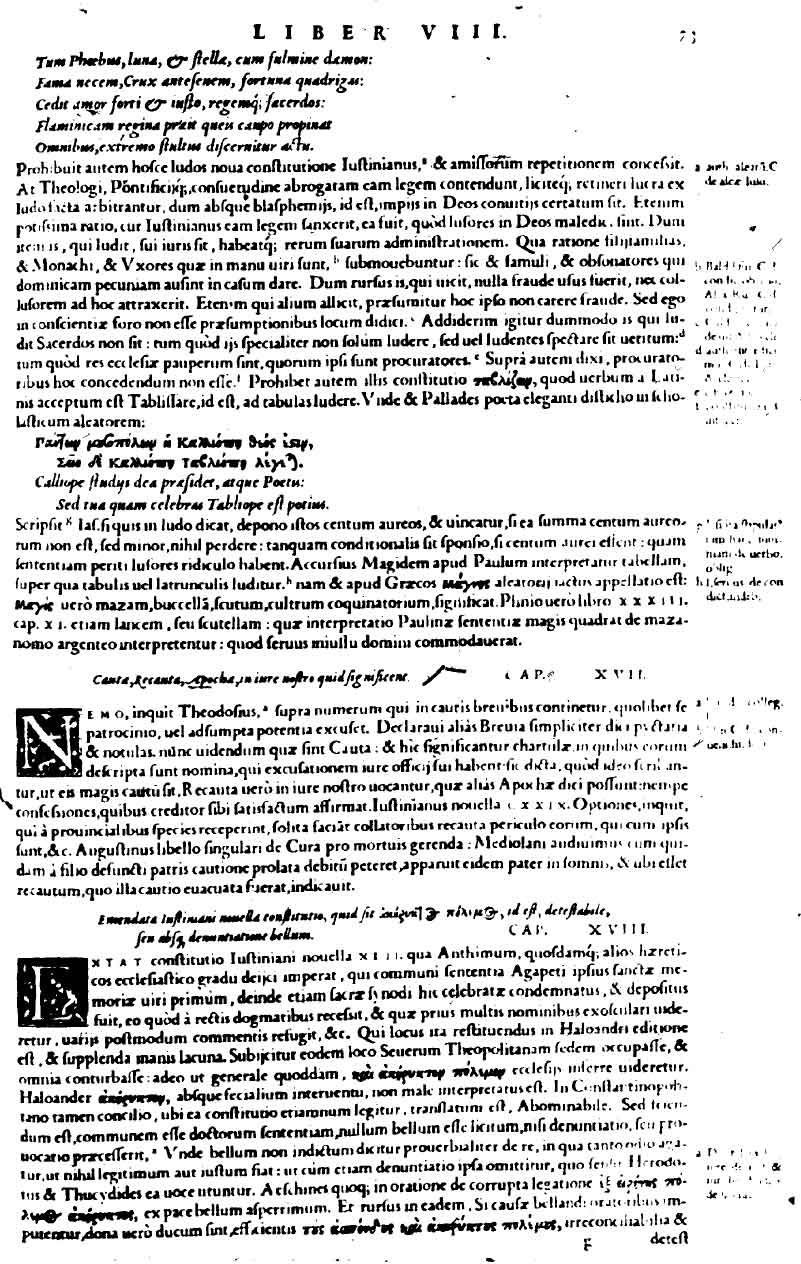
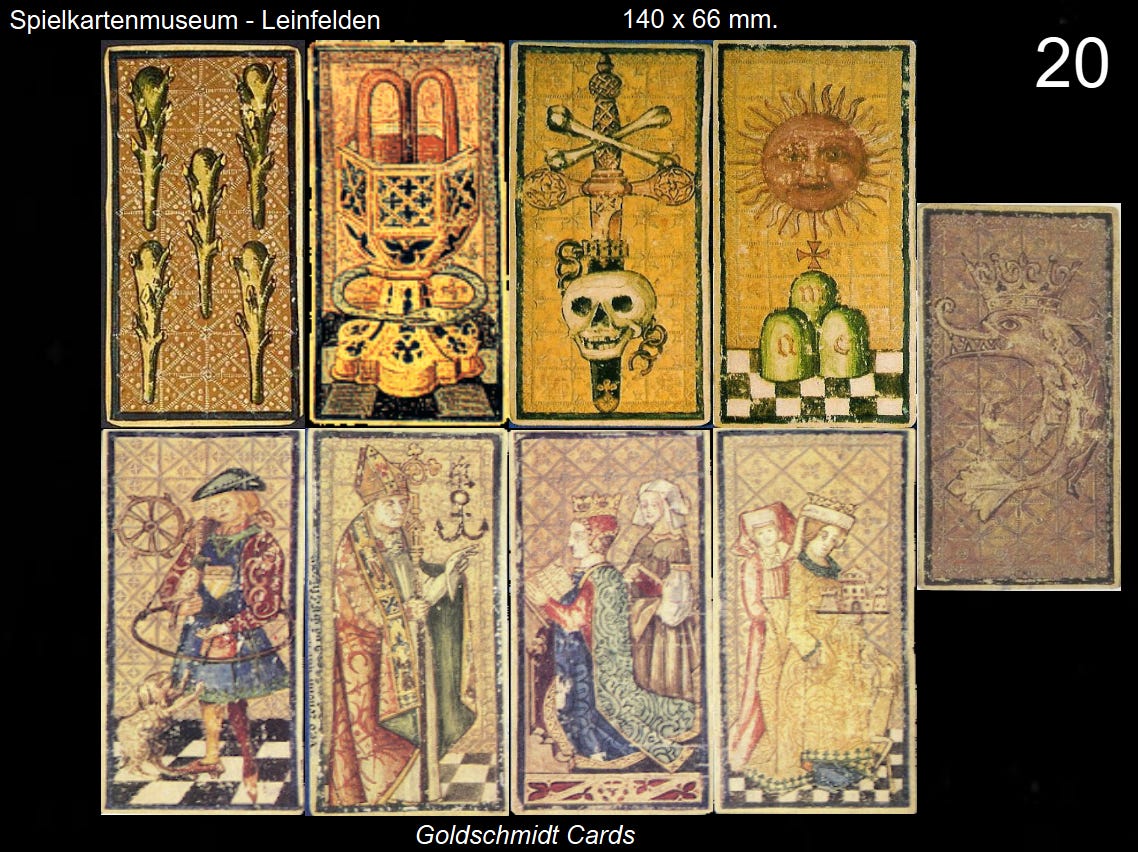
... Tarot with a Falconer / Goldschmidt
https://substackcdn.com/image/fetch/f_a ... 38x852.png
Both falconers are likely presented as a Fool and both groups have a sign, which might be understood as a heraldic device of the Sforza. The Visconti-Viper. Or it was the Devil. Or it was interpreted as the devil.
My general feeling about the Sola-Busca Tarocchi is, that the author is very clever and very provocative. Possibly the famous Accademia Romana had something to do with this.
https://de.wikipedia.org/wiki/Accademia ... 0Romana%20(lateinisch%20Academia%20Romana,Jahrhundert%20tätig%20war.
translated to English
https://de-m-wikipedia-org.translate.go ... 0Romana%20(lateinisch%20Academia%20Romana,Jahrhundert%20tätig%20war.
I got a wikipedia-shock. Only 3 languages know something about the Accademia Romana. It seems, that there are persons, who don't like the Accademia. No English article, no French article, no Italian article. Spain has one, but it is short.
see also ....
https://en.wikipedia.org/wiki/Julius_Pomponius_Laetus
... has 14 languages
22 Roman Heroes
-----------------
Mato 0
Panfilio I
Postumio II .... 9 Roman Heroes
Lenpio III .... 9 Roman Heroes
Mario IIII
Catulo V
Sesto VI .... 9 Roman Heroes
Deo Tauro VII .... CHARIOT
Nerone VIII
Falco VIIII
Venturio X .... 9 Roman Heroes
Tulio XI .... 9 Roman Heroes
Carbone XII
Catone XIII
Bocho XIIII .... 9 Roman Heroes
Metelo XV .... 9 Roman Heroes
Olivo XVI
Ipeo XVII
Lentulo XVIII .... 9 Roman Heroes
Sabino XVIIII .... 9 Roman Heroes
Nenbroto XX
Nabuchodenasor XXI
--------------
..... there is no Julius, also not Augustus
There are 9 other Heroes, who developed in the North of Europe, regions of Netherlands, Belgium, Germany, England, France participated .... Italy came rather late to this show.
Emperor Heinrich VII and his grandson Emperor Karl IV were involved.
9 Helden (German)
9 Worthies
neuve preux
3 Pagan Heroes .... Hector (Troja, also related to France) , Alexander (Greece), Julius Caesar (Rom)
3 Jewish Heroes ... Josua, Judas Makkabeus, King David
3 Christian Heroes ... King Arthur (England), Emperor Karl the Great (Germany, France), Gottfried of Bouillon (Belgium, Netherlands)
For Hector and its relation to France
...
https://en.wikipedia.org/wiki/Astyanax
There are also stories from the Middle Ages and Renaissance that have Astyanax survive the destruction of Troy:
Astyanax, in Andromache's lap, reaches to touch his father's helmet before his duel with Achilles (Apulian red-figure column-crater, ca. 370–360 BC).
In one version[which?], either Talthybius finds he cannot bear to kill him or else kills a slave's child in his place. Astyanax survives to found settlements in Corsica and Sardinia.
The Chronicle of Fredegar contains the oldest mention of a medieval legend linking the Franks to the Trojans.[10] One legend, as further elaborated through the Middle Ages, established Astyanax, renamed "Francus", as the founder of the Merovingian dynasty and forefather of Charlemagne.
In Geoffrey of Monmouth's Historia Regum Britanniae, "the sons of Hector" reigned in Troy after the expulsion of Antenor and his followers.[11]
In Matteo Maria Boiardo's Orlando innamorato (1495), Andromache saves Astyanax by hiding him in a tomb, replacing him with another child who is killed along with her by the Greeks. Taken to Sicily, Astyanax becomes the ruler of Messina, killing the giant-king of Agrigento (named Agranor) and marries the queen of Syracuse. He is killed treacherously by Aegisthus, but his wife escapes to Reggio and bears a son (Polidoro), from whom the epic hero Ruggiero is descended (III, v, 18-27). In this tradition, the epic hero Roland's sword Durendal is the very sword used by Hector, and Roland wins the sword by defeating a Saracen knight (Almonte, the son of Agolant) who had defeated Ruggiero II.
In Ludovico Ariosto's Orlando Furioso, a continuation of Boiardo's poem, Astyanax is saved from Odysseus (36.70) by substituting another boy of his age for himself. Astyanax arrives in Sicily, eventually becomes King of Messina, and his heirs later rule over Calabria (36.70–73). From these rulers is descended Ruggiero II, father of the hero Ruggiero, legendary founder of the house of Este.
Based on the medieval legend, Jean Lemaire de Belges's Illustrations de Gaule et Singularités de Troie (1510–12) has Astyanax survive the fall of Troy and arrive in Western Europe. He changes his name to Francus and becomes King of Celtic Gaul (while, at the same time, Bavo, cousin of Priam, comes to the city of Trier) and founds the dynasty leading to Pepin and Charlemagne.
]Lemaire de Belges' work inspired Pierre de Ronsard's epic poem La Franciade (1572). In this poem, Jupiter saves Astyanax (renamed Francus). The young hero arrives in Crete and falls in love with the princess Hyanthe with whom he is destined to found the royal dynasty of France.
In Jean Racine's play Andromaque (1667), Astyanax has narrowly escaped death at the hands of Odysseus, who has unknowingly been tricked into killing another child in his place. Andromache has been taken prisoner in Epirus by Neoptolemus (Pyrrhus) who is due to be married to Hermione, the only daughter of the Spartan king Menelaus and Helen of Troy. Orestes, son of Agamemnon and Clytemnestra, brother to Electra and Iphigenia, and by now absolved of the crime of matricide prophesied by the Delphic oracle, has come to the court of Pyrrhus to plead on behalf of the Greeks for the return of Astyanax.
...