
Banner

Tarot History Forum

Tarot History Forum - 600 years of history in 78 cards

Re: Bolognese sequence

261
INTRODUCTION
A few days ago ...
Magic Moon wrote,
By the way, I do not think that early (1440-1460 approx) there were 22 allegories in the triumph game but less, as the two Rothschild leaves and the Tarot of Lucca (Orpheus) that I suppose is the inspiration for Mikeh when he mentions a brief sequence of 13 wins suggest.
MikeH answered ...
I did not understand the relevance of the two Rothschild sheets (actually, one Rothschild and one Beaux Arts) sheets and the Lucca. Huck thinks the Orfeo decks are relevant, but I think they are too late to use for any origin theory. I think the two sheets in Paris are the last 12 triumphs of a Bolognese deck, not all of them. Another two sheets could have been like the Rosenwald, with three Queens, or two and a Fool.
"Huck thinks the Orfeo decks are relevant, but I think they are too late to use for any origin theory."
I remember, that MikeH wrote about the date 1722-25 for the Orfeo decks.

The following text below is somehow from Jan 8, 2017. It's a part of the thread "Sola Busca riddles" with 109 posts, which started Aug 31, 2014 and the last post is from 2020. The thread is "living research" and possibly somehow a little bit confusing .
The central part is this ...
(40) 20 World (in Sola-Busca 21)
(39) 19 Angel (in Sola-Busca 17)
(38) 18 Sol (in Sola-Busca 16)
(37) 17 Moon (in Sola-Busca 17)
(36) 16 Star (in Sola-Busca 4)
15 Tower (in Sola-Busca 20)
14 Falconer (in Sola-Busca 9) ... somehow later replaced as devil
13 Death (in Sola-Busca 13)
12 Hanging Man (in Sola-Busca 8)
11 Father Time (in Sola-Busca 5)
...
1 Panfilio (in Sola-Busca 1)
0 Mato (in Sola-Busca 0)
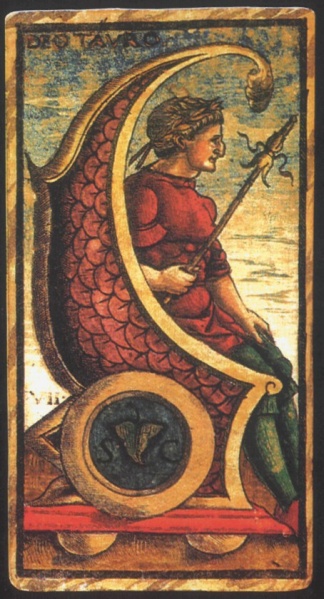
12 cards ... with a 13th, Chariot, in the background
You see here 13 special cards (12 trumps /1 Fool) of the Sola Busca and they are in their meaning the same as they are used in the Lucca Tarot (but they look rather different). The Sola Busca has 22 special cards, but the other 9 trumps look not like the standard motifs of Tarot, they are best addressed as "9 Heroes".
T he Orfeo/Lucca Tarot has totally 69 cards, the "9 Heroes" are missing. The identification of the Sola Tarocchi with standard Tarot trumps is occasionally rather difficult, this is as it is.
The Sola Busca is dated to 1491 or at least around this time. It contained the Orfeo Tarot of Lucca. So the Lucca Tarot is somehow older than 1722-25. There are even some details, which make me assume, that it is possible, that the Lucca Tarot (or another Trionfi card model) appeared in Lucca in the year 1369. And these details are not only a Prince Fibbia, who had reason to leave the Lucca region for Bologna.

The number of the post is 39 and direct link is ....
viewtopic.php?p=18572#p18572
Here are the pictures of the Sola-Busca cards, if necessary.
https://web.archive.org/web/20180112133 ... usca_Tarot
Here are pictures of a 66 cards Orfeo deck in the British Museum with the possibility to enlarge the pictures.
https://www.britishmuseum.org/collectio ... 1611444001

SOLA BUSCA RIDDLES 2017
My researches to the Sola-Busca Tarocchi had arrived at something rather complicated ...
Sola-Busca riddles
http://forum.tarothistory.com/viewtopic.php?f=11&t=1041

This was a state between many difficult questions ...
Image
http://a-tarot.eu/7/z34.jpg
I came to the conclusion, that one group of cards could be related to standard trumps (with insecurities), another group not. When I arranged a table in the above given manner (0 and 21 embedding 1-20 with numbers running from the left bottom corner up to the right top), then the 9 cards with no chance to be identified gathered in the two middle groups (blue ground). One card in these middle groups was, however, very clear: The Chariot.
Image
http://www.tarotpedia.com/w/images/thum ... _Busca.jpg
I remember ...
I made a pause and recovered a bit.

I couldn't avoid to think about the Lucca Tarocchi. I hope everybody knows, what this is. It's a strange reduced Tarocchi with 69 cards, from which 13 belong to the category "special cards" (1 Fool and 12 others)

not numbered Fool
9 Wheel
10 Chariot
11 Hermit
12 Hanging Man
13 Death
14 Devil
15 Tower
not numbered Star
not numbered Moon
not numbered Sun
not numbered World
not numbered Fame

So I make now a short summary of all that, what I found out by trial and error
Somehow I arrived at ...
(40) 20 World (in Sola-Busca 21)
(39) 19 Angel (in Sola-Busca 17)
(38) 18 Sol (in Sola-Busca 16)
(37) 17 Moon (in Sola-Busca 17)
(36) 16 Star (in Sola-Busca 4)
15 Tower (in Sola-Busca 20)
14 Falconer (in Sola-Busca 9) ... somehow later replaced as devil
13 Death (in Sola-Busca 13)
12 Hanging Man (in Sola-Busca 8)
11 Father Time (in Sola-Busca 5)
...
1 Panfilio (in Sola-Busca 1)
0 Mato (in Sola-Busca 0)
12 cards ... with a 13th, Chariot, in the background

Lucca Tarocchi:
Image
http://a-tarot.eu/p/2016/lucca.jpg
I recognized, that 1, Panfilio took the role of Wheel card, which in Minchiate is below the Chariot. Panfilio would be the Magician in normal Tarocchi (important cause its 5 point in the game), but in the Lucca Tarocchi the Wheel would have the lowest rank of the trumps.

The function of the Chariot became clear: he was the 10 to the 9 heroes, which couldn't be identified.

*****************

Since then I got the clear opinion, that the Lucca Tarocchi rules with 69 had older roots, reaching back to 15th century. Actually a suspicion since I've learned about its existence. 69 cards, that looked like a memory on the 5x14-theory.

Re: Bolognese sequence

262
I'm thinking that the emperor cards from 1434 were perhaps the Rothschild cards. The document mentions two people who, along with other companions, bought two decks of emperors in Florence, and mentions Alberto Bonaccossi, whom we know worked in some way at the Este court. I imagine he kept the accounts or wrote documents, but he wasn't an artist. What I mean is, the 1434 document doesn't mention the creator of the two decks that were purchased. In other words, they were already made and weren't commissioned as custom work. So is there any problem with suspecting that those 1434 cards are the Rothschild cards? Has anyone proposed this option? 1434 is very close to 1437. If that 1434 document refers to the Rothschild cards, then perhaps the author was Giovanni di Marco (1385-1438) also called dal Ponte or they were painted by his disciple Antonio di Dino who sold playing cards (1439) and painted luxury cards (1441) because these two artists are considered as possible authors of the Rothschild cards.

-------‐-------

Note edited from my last publication, where this part is deleted:
I thought you mentioned Juego Imperial in 1434 or 1440 or somewhere else, but I can't find it. Maybe I misread it. I see that in 1434 the document mentions emperors. I remember that in 1475 there's a text that mentions an Imperial Game played by Beatrice d'Este (a different person and older than Ludovico Sforza's wife with the same name). The name Emperor Cards is similar to Imperial Game, but we don't know if it was the same deck. If there's a reference to Imperial Cards in 1440, that would be interesting
Last edited by Magic Moon on 24 Mar 2025, 17:16, edited 1 time in total.

Re: Bolognese sequence

263
As far I know, this Imperial means a game.
This Beatrice d'Este should be a daughter of the duke of Ferrara Niccolò III. 1393–1441, a man with many children. She was a little younger than Bianca Maria Visconti, when Bianca had a 1/2 year stay in Ferrara as a young girl. Bianka got at 1st January 1441 the gift of 14 pictures of the painter Sagramoro, who is known also for playing card production. So there is the suspicion, that these pictures were a set of 14 Trionfi cards (or models for a Trionfi deck). Bianca Maria and Beatrice became friends, Beatrice married Tristano Sforza, an elder son of Francesco Sforza (then husband of Bianca Maria) and appeared at the court of Milan, where she stayed till the 1490s.

Re: Bolognese sequence

264
Huck: So you are saying that trumps 2-9 in the Florentine (?) order (where Chariot follows Wheel) are not represented in the Sola-Busca, being somehow "nine heroes"? That there is no Popess, Empress, Emperor, Love, Fortitude, Justice, Temperance, Wheel. That is 8. I would guess that the Bagatto would be ninth, since I see no Bagatto on the British Museum site, just a Fool. Well, SB's number 8, Neron, roasting a baby in a fire, seems like antitype of Justice. A young man holding a torch, SB 6, might be Love. A man with wings on his helmet, SB 4, could be an Emperor. How these SB cards qualify as "heroes", except for four as "papi", escapes me. Probably you have discussed this aspect somewhere. If so, I would appreciate a link. Also, what is your proposed causal connection between 14th century Lucca and 1491 Venice or Ferrara? And why are the SB cards so out of order, on your proposal?

Magic Moon: Yes, I see the problem with Emperors carrying suit-symbols: they typically, at least in Florence, held both a baton and an orb. While both Huck and I have contemplated the idea that the Rothschild cards were part of an Imperatori deck (see for example my post at https://rothschildcards.blogspot.com/20 ... s-1-2.html, which is derived from posts on THF), that the Rothschild Emperor has both an orb and a baton and no other suit identification for me presents a problem in identifying the Rothschild cards with Imperatori. The Emperor of Coins would have had a gold orb; that the Rothschild Emperor also has such an orb, as opposed to the trisected orb often seen on Emperor cards (Africa-Asia-Europe), suggests that the Rothschild Emperor might be a kind of amalgamation of two previous Imperatori cards in Batons and Coins.

For Imperatori cards, what I was thinking of was just one suit-symbol for each imperatore, as we see with the king, queen, knight, and page. This does not have to exclude them all having a baton and/or orb; however, you are right to wonder how, from my description, they would be distingished in such a case. In the Modrone, each king and queen is being offered a large example of the suit sign by a smaller figure, presumably a child or young person. Then in the Emperor and Empress cards, the figure is surrounded by four such smaller figures, one of which, at the lower right, offers a symbol of the Empire to the imperial figure: a shield with the imperial eagle on it in the case of the Empress, a crown (the iron crown of Lombardy?) in the case of the Emperor. We can imagine something similar for Imperatori cards, but in these cases the young person would simply offer a symbol of the suit; that there are four, or even two attendants, as in the "Alessandro Sforza" Empress and the Rothschild Emperor, https://4.bp.blogspot.com/-8NWi7gr6-Gc/ ... atania.jpg and (with the Charles VI) http://2.bp.blogspot.com/-CNly6whjDyE/U ... hVIEmp.jpg, would be enough to identify them as imperial/papal, along with the usual fleur-de-lys staff (connecting them with Charlemagne) and perhaps an orb in the case of the imperials. (On the symbolism of the fleur-de-lys staff, see "New Insights into the So-called Alessandro Sforza Deck", by Emilia Maggio, which is in academia.edu.)

Being clean-shaven would identify a male trans-national as papal (popes didn't wear beards then). Of course female trans-nationals would also be clean-shaven. In that case hair-length might also help, but not necessarily. Having a different staff could help, or a different colored key, or attendants in a different posture. The problem is further complicated by the fact that young men were often depicted quite similarly to young women, with similar gentle features and long hair. That the Pope, or at least the highest "papa", was depicted as young in the A-region seems clear from the Rosenwald. That might even have been done deliberately in Bologna, to encourage people to treat them as equal. But even in the pre-1725 Dalla Torre it is clear which would have been which, if someone wanted to differentiate them: the Pope would be the one with the keys and giving the blessing; the Popess, if that is what it once was, would be the one with the cross-staff and stigmata (both reflecting the Church, e.g. St. Francis).

On minchiate: that minchiate in the early 15th century had an Empress, Emperor, and Pope, is suggested by a poem by Bronzini, thought to have been written 1530-1535 and reported by Renzoni in a note in The Playing-Card, which I cited earlier. It is not a matter of what they may have looked like to anybody now, based on 18th-century images (although I have to say that Papa IIII's clothes and waistline seem to me more masculine than Papa II's; it may also be significant that Papa IIII's orb is usually not trisected, unlike the others, but at most bisected (heaven and earth?). See for example https://www.archiviodellacomunicazione. ... EB=MuseiVE. Another thing is that most Bolognese examples of Papa II have the outlines of female breasts, but not Papa IIII. The British Museum site has some good Bolognese examples.

For the early 16th century titles, you have to read Renzoni, in "Ask Alexander". In general, the database "Ask Alexander" is a research tool impossible to do without, because what is there is typically not picked up by Google, unless the author has made a special effort elsewhere.

In the meantime, here are the pages for Renzoni.

Re: Bolognese sequence

265
Hi Huck.
Thanks for adding details about Beatrice d'Este, a friend of Bianca Maria.

Do you mean that Imperial Game was a game played with the Emperor deck or with a four-suit deck without special overlay cards?

By the way, I'm wondering about Alberto Bonaccossi's specific work. I don't know if he worked for the Estes as treasurer or if he was a merchant in Florence who sold those decks, or even if he was a card painter.

Regarding your interesting recent post on the Lucca Tarot, I'm studying it. It's interesting and complex. I've read two articles by Pratesi on Notturno published on the Trionfi website, but I can't find an image or literal text of the part of Notturno where the ten trumps are mentioned. I'd like to see the numbering (Arabic or Roman) and the literary context. It seems that these are cards mentioned during a conversation between the characters, who decide before playing whether the sequence will be in ascending or descending order. It's curious that they don't mention more cards. It seems we don't know how many cards were in the deck they used to play. Perhaps they played with the whole deck but just had doubts about the hierarchical direction of the lower fragment of the sequence?

Huck equivalences:
(40) 20 Mundo (en Sola-Busca 21)
(39) 19 Ángel (en Sola-Busca 17)
(38) 18 Sol (en Sola-Busca 16)
(37) 17 Luna (en Sola-Busca 17)
(36) 16 Estrella (en Sola-Busca 4)
15 Torre (en Sola-Busca 20)
14 Falconer (en Sola-Busca 9) ... de alguna manera luego reemplazado como diablo
13 Muerte (en Sola-Busca 13)
12 Ahorcado (en Sola-Busca 8)
11 Padre Tiempo (en Sola-Busca 5)
...
1 Panfilio (en Sola-Busca 1)
0 Mato (en Sola-Busca 0)

In these equivalences that you propose between Minchiate and Sola Busca, you write Panfilio but do you mean Bagatto card? I thought than your first world is from usual tarot. Panfilio is not in tarot but in Sola Busca.
I have similar problem with Falconer. It is listed as the Minchiate or Tarot card corresponding to the Devil... probably I dont understand exactly what you think about that. This card in Sola Busca is called Falco, which I can't find as a historical or mythological figure, except for a modern invention by the writer Lindsey Davis, who apparently isn't inspired by a real character, although she even invented the year of birth, 41 AD. I'm surprised that your list of equivalences says Falco when referring to Minchiate. Do you think Minchiate had a falconer, that is, a man with a falcon, as in Goldschmidt and Mantegna? Perhaps you've explained it somewhere, but I can't find it.

I also don't understand the tarot numbering of your list of correspondences. The order you use is Marseilles, but the numbers are one step lower than in the Marseilles: the world is numbered XX instead of XXI, the angel is numbered XIX in that list instead of XX, etc. I see another strange detail. You relate two common tarot cards to the 17 of Sola Seek instead of just one: the Angel and the World. Therefore, the list doesn't have twelve Sola Seek cards, but only eleven.

--‐---------------

Thanks, Mikeh, for the answers. You mention Ask Alexander, and I don't know him. I thought it was a search engine, but when I Google it, I get a deck related to magicians. Are you talking about a location or a website to search for information? Perhaps you have a link.

I read scholar Renzoni's article about a poem by Bronzino that mentions the Pope's card. It's interesting. It seems that people called that card "Pope." It's a shame that the design of that XVI century card doesn't survive, so we can see if the figure's appearance in Germini was as masculine as in Rosenwald or as feminine as in Minchiate Anterior (XVIII century) and Tarocchino. It's also interesting to see that some people still accept that the card in Minchiate Anterior could be perceived as male, if I understood you correctly. This perception is common. The 1643 Minchiate poem calls Papi the three cards and two more, as is common in Minchiate. Is there a rule in Minchiate of equal papi (5 cards) from Bagatto to Amor? This makes it difficult to find texts that call Pope (masculine) the card IV of the Earlier Minchiate (18th century). Thank you.

PD: sometimes I write "letter" when I want to write: card. This is a problem with spanish translator. Sorry if I dont see this mistake some time.

Re: Bolognese sequence

266
Magic Moon wrote,
You mention Ask Alexander, and I don't know him. I thought it was a search engine, but when I Google it, I get a deck related to magicians. Are you talking about a location or a website to search for information? Perhaps you have a link.
Try https://askalexander.org/.

Magic Moon wrote,
Is there a rule in Minchiate of equal papi (5 cards) from Bagatto to Amor?
No - they are hierarchical, as far as trick-taking. At https://www.pagat.com/tarot/minchiate.html, you will find no reference to any "equal papi" rule. A papa's power is according to its number in the sequence. What unites them is that extra points accrue for having 3 or more. On the above site:
A regular versicola is a sequence of 3 or more consecutive trumps in the range 28 to 40 or in the range 1 to 5.

Magic Moon wrote,
This card in Sola Busca is called Falco, which I can't find as a historical or mythological figure, except for a modern invention by the writer Lindsey Davis, who apparently isn't inspired by a real character, although she even invented the year of birth, 41 AD.
There is a Quintus Sosius Falco, consul of Rome in 193 c.e., https://en.wikipedia.org/wiki/Quintus_P ... sius_Falco. Whether he has anything to do with what Huck is talking about I don't know.

If it is of any interest, I have made some changes (highlighted in red) to my post at viewtopic.php?p=26768#p26768, my explanation of why I think the Beinecke's former suit assignments are still of interest. Hopefully my presentation there is now easier to follow and more persuasive.
+

Re: Bolognese sequence

267
IN WORK

Magic,
Alberto Bonacossi was somehow of importance at the Ferrarese court. A son Federico produced or had a Trionfi deck, which he sold to the Ferrarese court. The Bonacossi were known later as trader of art objects.
We researched all Trionfi documents, with which we became acquainted. With an article of Ortalli we had about 35 or so, with the cooperation with Franco Pratesi we reached about 100 and then came a short article of a German professor, who worked in Rome and the short article had about 100 new documents. This was a rather successful period, which was finished end of 2013. So neither Alberto or Federico were not very interesting, as far I remember.
http://trionfi.com/0/e/06/ .... and search for the word bonacossi

The English word falconer is in Italian falconieri. The shortened name Falco might relate to this profession.
In the research of the early Trionfi time and especially the 5x14-theory was observed, that the expanded PMB had 20 trumps/Fool hadn't the Tower and hadn't the Devil. And for the early development these both cards didn't exist. But there was a falconer in the Rosenthal and somewehere else was another.

http://a-tarot.eu/p/jan-11/rosenthal.jpg
Image
I took the picture from this page .... viewtopic.php?t=691&start=10

In the Rosenthal the falconieri looks like a replacement for the Fool. The Visconti Viper can possibly be interpreted as a forerunner of the devil, but it is a heradi card and heraldic cards appeared also in other decks.
Image
http://a-tarot.eu/p/2012/deu/falconer-01.jpg
I took the picture from this page .... viewtopic.php?t=624&start=60

Here is also a falconer ...
Image
http://3.bp.blogspot.com/-a9xTS5mMhuw/V ... hmidt1.jpg

I took the picture from this page: viewtopic.php?t=691&start=10

Re: Bolognese sequence

268
Hello.

Bots take up our energy. The topic is complex and I could get lost in every detail. Bots invite me to simplify a bit.

Huck, I'd read about the biscione as a possible Devil card: some time ago, I were reading youy Ur-Tarot theory, with Biscione card in the Devil place. Besides, now I read that you say the falconer in the Post-Visconti decks looks like the Fool. So, I dont know if you think that the Devil is equivalent to the falconer or to the biscione? Goldschmidt seems to have been created years after than the Rosenthal falconer. A chronology could be drawn up. Perhaps, in Lombardy: first Biscione, later Falconer, finaly Devil. What do you think? How do you mix both ideas?

Personally, I think the biscione could be the Ace of Wands. I don't know what the falconer is. It looks like a fante. By the way, in the Rosenthal photo, there's a strange fante under the card falconer. Is it a fante of clubs? Maybe there were four strange fante. I don't know if you chose biscione or falconer for the Devil. I suspect the Devil was inserted into the trionfi sequence around 1482. When do you think that Devil arrived to A and B tradition? So it seems possible that in Lombardy they opted for a falconer or another card for the Devil. Indeed, it seems the Visconti-Sforza family didn't like the Devil. So you think the Devil was already in some deck when Sola Busca was created with a falconer?

I read the structure for Sola Busca that you emailed me while this forum was inaccessible. Thanks, now I understand better. I think there was an error in the two tarot card assignments to the same Sola Busca card, according to the summary correspondence you posted on this forum. In the mail I had not this problem.

Pamphylia could be the Wheel because he has a large round shield. Well, now I understand your suggestion better. So you think the nine heroes of Sola Busca (which are not equivalent to the Lucca Tarot) could come from the Eight Emperors (1423-1452)? Thanks, Huck. You're doing a good job.

By the way, does anyone know the measurements and back colors of the Rosenthal playing cards? They reappeared in 2016. The sizes can help differentiate decks and periods, assuming the forger was meticulous and faithful when cutting the cards.
I asked that here:
viewtopic.php?p=26755#p26755

**********

I noticed I was confused about the Imperial game. The document isn't from 1475 but from 1493. The Beatrice who played Imperial in that document wasn't Bianca Maria's friend but Ludovico's wife. Right? I was confused. However, Bianca Maria's friend named Beatrice is important for understanding genealogy because she was the mother of the poet Niccolo Correggio, who was the father of Borso, who wrote that document (letter) for Isabella d'Este. I find it strange that those two Beatrice d'Estes died the same year, 1497. I thought it was a Wikipedia error, but they died in different months, so now I think it might be correct. Beatrice (Bianca Maria's friend) lived quite a few years, although she died in 1493. However, she isn't mentioned in that document. Beatrice (married to Ludovico), who was the niece of Bianca Maria's friend Beatrice, is mentioned. The Dukes of Bari were Ludovico and therefore his wife Beatrice because they were regents of Milan, but they had to wait until 1494 to officially become Dukes of Milan, although the document later also says that Ludovico is Duke of Milan. You say that Beatrice (a friend of Bianca Maria) was at the court of Milan in the 1490s. That is possible, but I don't think this document mentions this Beatrice, who apparently lived many longer than Bianca Maria.

Re: Bolognese sequence

269
This post is a response to Huck in the TEST thread,

viewtopic.php?f=11&t=2751

and also here, at viewtopic.php?p=26793#p26793

Huck, the idea that "Falco" in the Sola-Busca is as in the Italian word for falcon strikes me as at variance with the rest of the trumps. They are all people's names, except “Mato”; they are all “heroes”in one way or another. Most of them are ancient Romans, and there is a perfectly adequate Roman named Falco. And what either a Falconer or what is actually on the Falco card connects it to the Devil you have yet to reveal.

Likewise, your attempt to connect the Sola-Busca to the Lucca “Tarocchi”, with the "9 heroes" tradition looks to me too contrived. All 21 are "heroes" in some sense. Otherwise, all you have is the number 9. The "9 heroes" tradition also names the heroes they have in mind. Your 9 have no relation to any of them that I can see.

Then, to make the decks parallel, you take the SB cards in a completely different order from that of the Orfeo: the only similarity is the Fool at 0. Perhaps you aren't done; but I can't see how it can go anywhere if it continues to ignore the order without good reason. Finding a Star at 4 in the SB and fifth from the top in the Orfeo isn’t very parallel.

Finally, except for the Knights, the Orfeo cards look precisely like 17th-18th century minchiate cards, including the numbers or lack of them. We have no way of knowing whether these decks are minchiates from which someone has removed a bunch of cards or a tarocchi. But clearly some cards have been removed, or never printed, perhaps to play a game that didn’t use them, because the numbers start at VIIII. Also, Pratesi searched the records of Lucca and found no mention of tarocchi, as Monzali reports in his Playing-Card article on this question.

However, I can offer a way of answering most of these objections. Perhaps it has been said before (although I can’t recall it). What does correspond to the Lucca trumps are the two sheets of Bologna trumps in Paris, in the Louvre and Ecole des Beaux Arts. Except that those two sheets lack a Fool, the correspondence with Lucca is exact, and the cards on the sheets are precisely the last 12 trumps of the Bolognese sequence (remembering that early on, the Chariot was above the virtues there, as shown in Croce’s Lotto Festevole in Villa, 1602; also, if 11 of the cards on the sheets are of the last 12, probably so is the 12th). In this case, there are no numbers on the sheets to miscorrespond with Lucca's order, nor additional cards to explain away. This may show a connection between Lucca and Bologna, that they played a similar game (in addition to a more standard one) using just the trumps on the two Bologna woodblocks, attained by removing the others. Such a shortened trump suit might have gone along with a similar shortening of the number cards in Bologna. 21 (trumps):10 (number cards) is roughly equivalent to 12 (trumps):6 (number cards).

In that case, a connection between the two cities Lucca and Bologna is more plausible than a direct connection between Lucca and wherever the SB was designed, Venice or Ferrara, because of the Fibbias, who may have maintained ties with people in Lucca (at any time prior to the sheets). Then a connection from Bologna to Venice/Ferrara is plausible because they are in the same general region, northeastern Italy, and the difference in order is explained by the fact that the cards that inspired them, those on the two sheets, had no numbers on them. I have no explanation for why they would have used just those sheets, as opposed to a full set, which would have been readily available by 1491 in those places.

Re: Falcco

270
I think, in context of the theme, Falco is most likely a historical figure, during the period of the Punic wars, Falco is possibly Q. Valerius Falto,
"Gaius Lutatius Catulus, the first of his lineage to achieve the consulship (242 bce), concluded the First *Punic War by boldly confronting a Punic naval force off the Aegates Islands (10 March 241). A wound forced him to cede direction of the battle to Q. Valerius Falto but he was awarded a *triumph and took a leading role in the peace negotiations.the first of his lineage to achieve the consulship (242 bce)."

source: https://doi.org/10.1093/acrefore/9780199381135.013.3801
According to Orosius, Catulus wound was to his thigh, as with our figure of Catulus in the SB. In Orosius we also have an example of the name Falto being spelt Falco, albeit in connection with another Falto family member, Quintus brother Publicus Valerius Falto, who succeeded him as consul with Tiberius Sempronius Grachhus:

"Seven Books of History Against the Pagans by Paulus Orosius" , Book 4:


In the consulate of Tiberius Sempronius Gracchus and Gaius Valerius Falco (sic), the Romans waged war on the Faliscians of whom 15,000 fell in the ensuing battle.


So another more probable figure is Publicus Valerius Falto [Gaius Valerius Falco in Orosius] :

"The Falisci took advantage of the First Punic War to declare their independence, but their revolt ended in 241 BC with the death of 15,000 Falisci and the destruction of Falerii; the survivors were moved to a new city, Falerii Novi."

source wiki.

Last edited by SteveM on 01 Apr 2025, 09:37, edited 3 times in total.