
Banner

Tarot History Forum

Tarot History Forum - 600 years of history in 78 cards

Dating the Pavia tarocchi appropriati poem (a.k.a. the "Susio" poem)

1
(Part 1 of 3)

This is a discussion of the evidence for dating the tarocchi appropriati work entitled Motti alle signore di Pavia sotto il titolo de i Tarocchi, sometimes called “the Susio poem” after Giovan Battista Susio, who was for some time believed to be its author, although this has now been disproven. For transcripts and some images of the manuscript, see Mike’s post here: viewtopic.php?p=23758#p23758

Bibliography of works mentioned below:

Bianchi, Dante. “G.B. Susio e le dame pavesi del sec. XVI.” Bollettino della Società pavese di storia patria 15, no. 1 (1963): 89-94.

Cordone, Lina. “A proposito di Rime ed Imprese dedicate a dame pavesi del secolo XVI.” Bollettino della Società pavese di storia patria 22, nos. 3-4 (1922): 189-191. This is viewable at Hathi Trust.

Marsilli, Pietro. “I Tarocchi nella vita di società, la vita di società nei Tarocchi.” In Le carte di corte. I Tarocchi. Gioco e magia alla corte degli Estensi, edited by Giordano Berti and Andrea Vitali, 95–110. Bologna: Nuova Alfa Editoriale, 1987.

Pratesi, Franco. “Addenda.” L'As de Trèfle 49 (1992): 2.

Renier, Rodolfo. “Tarocchi di Matteo Maria Boiardo.” In Il Libro Ritrovato, edited by Clara Allasia, Laura Nay, Alessandro Vitale Brovarone, and Chiara Tavella, 63–81. Turin: Università degli
Studi di Torino, 2018.

Sorbelli, Albano. “Rime inedite di Gio. Batt. Susio della Mirandola.” L'Indicatore Mirandolese 2 (1901): 9 ff., and reprinted in Atti e Memorie della Società storica, letteraria ed artistica della Mirandola 2 (1903): 29-40.

Toldo, Pietro and Pietro Moiraghi, “Rime ed imprese dedicate alle dame pavese del sec. XVI.” Memorie e documenti per la storia di Pavia e suo principato 2, no. 3 (October 1897): 37-75.

---

The poem is not dated in the manuscript. Pietro Moiraghi dated it to 1525 to 1540, which Pietro Marsilli followed, and others have dated it to around 1570, but neither of those date ranges are consistent with the available evidence.

Two other works survive that are closely related to this poem. One of these immediately precedes it in the Paris manuscript, under the title Rime et imprese donate alle gentildonne de Pavia la pasqua di genaio sotto 'l nome de gli Indonati, composte da messer Giovan Battista Susio dalla Mirandola, che tra loro l'Invogliato s'appella. Unlike the Motti work, this one appears to have been genuinely written by Susio, but likewise bears no date. Franco Pratesi helpfully included it in his transcription and it can be viewed there, and it is also included the Toldo-Moiraghi and Sorbelli transcriptions (although I have not seen the latter). There is another, defective copy of this work in the Biblioteca Trivulziana in Milan, which omits more than a third of it and contains various errors; it is transcribed in Studi in onore di Alberto Chiari, volume 1 (Brescia: Paideia, 1973), pp. 210-11.

The other work is an anonymous poem in a manuscript in the Biblioteca Ambrosiana in Milan (MS. O 129 sup., u.c. 15, ff. 36r-38r). It has not yet been made available online in digital form by that library, but it was transcribed in full by Lina Cordone in her article cited above. It is called Poesie donate alle signore di Pavia nell'Epifania del 1543 and as the title indicates, it dates from Epiphany (January 6), 1543. I will refer to the three works as the Motti, the Rime, and the Poesie, respectively.

All three works are evidently closely related. They all have the same basic structure, each being a list of about two dozen Pavian ladies, each of whom receives a stanza of poetic tribute, preceded by a brief dedication: e.g. “Alla signora Alda Lonata” (in the Motti and the Rime), “Alla leggiadra et vertuosissima Alda Lonata” (in the Poesie). Several of the women appear in more than one of the works, and five or six of them appear in all three (see the table below). The Motti and the Poesie are especially similar.

Another interesting similiarity is that both the Rime and the Poesie were written for the occasion of Epiphany, because that is what “pasqua di genaio” means in the title of the Rime. It seems we are dealing with a kind of annual poetic tradition. It is therefore possible that the Motti were also written for an Epiphany, and it is extremely likely that all three works were written within a few years of each other.

Cordone believed, largely on the basis of Moiraghi’s dating of the Motti and Rime, that the Motti were the earliest of the three and had inspired the Poesie, which was then followed by the Rime (p. 191). She was probably right. The Poesie have a very similar structure to the Motti, but the Motti dedications have simpler and less uniform wording—it looks like their structure was “tidied up” in the Poesie. A much more striking difference is that the Poesie do not make use of the tarocchi: They are simply a series of brief verses in praise of the ladies, without ranking them in any way or associating them with any metaphorical subject. This was possibly motivated by a desire to eliminate the competitive aspect of the tarocchi appropriati ranking—and it is considerably easier to imagine this little poetic tradition being initially inspired by the widespread fashion for tarocchi appropriati, and then people deciding to remove that competitive aspect, rather than the reverse. This hypothesis is reinforced by the numbers of individuals mentioned: 22 in the Motti (with each of the 21 trumps dedicated to a lady and the Fool to the author) and 22 ladies in the Poesie, while the Rime expanded the number to include 29. The fact that 22 ladies are honored in the Poesie, not 21 as in the Motti, suggests that the Poesie were preceded by at least one other tarocchi appropriati poem which followed the more frequent practice of assigning the Fool to a lady as well.

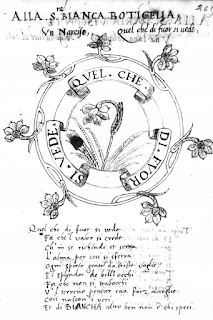
So it looks like the Poesie were based very closely on the Motti and probably also another, very similar tarocchi appropriati poem from around the same time, but the author removed the competitive tarocchi ranking and tidied up the dedications. The Rime, by contrast, moved further away from the Motti model. The same basic idea of a poetic tribute to a selected group of ladies is still there, but the number of ladies has been enlarged even more, and the genre of the work is now markedly different: The Rime assign to each lady not a tarot trump, but rather an impresa, a heraldic device, complete with motto. This was another fairly popular practice at the time, like the tarocchi appropriati. It usually involved making an actual drawing or painting of each impresa, and such images do indeed seem to have accompanied the text of the Rime when it was originally presented. Only one of these impresa drawings has been preserved in the surviving manuscript copy, namely the one for Bianca Bottigella; on the pages for the other ladies, there is simply a large blank space where the impresa would have been in the original. But the motto that was written around each impresa is still given at the top of every page (the motto is, in each case, the first line of the stanza below).
Image
.
The page for Bianca Bottigella in the Rime manuscript

Of course, these imprese perform the same kind of metaphorical function as the tarot trumps: They use an emblematic subject to describe the character of each of the ladies. The Rime therefore look like they too took inspiration from the tarocchi appropriati model. The imprese even include some of the same subjects as the tarot cards, such as the moon, the sun, a bolt of lightning, a chariot, and Cupid. So, like the Poesie, the Rime look like they came after and were partly inspired by poems like the Motti. What may have happened here is that people regretted the loss of the emblematic element in the Poesie, so they wanted to restore it in the Rime, while still keeping the competitive tarocchi appropriati aspect out of it.

It should also be noted that Susio was born in 1519, so he was more likely to be writing something like the Rime after the Poesie of 1543 than before.

(continued below)

Re: Dating the Pavia tarocchi appropriati poem (a.k.a. the "Susio" poem)

2
(Part 2 of 3)

As additional evidence that the order of the works was Motti, then Poesie, then Rime, one can observe that the Poesie contain the fewest unique names, both proportionally and absolutely. About half the names in the Motti and Rime are not found in the other two works, but this is true of no more than 40.9% in the Poesie—only 8 or 9 out of 22, versus about 10 or 11 out of 21 in Motti (depending on who the unnamed Chariot lady was) and 14 out of 29 in the Rime. This is consistent with the Poesie coming between the other two in time, resulting in more overlap with both of them.

So on that basis, the likely date range for the Motti is from about 1539 to 1542. One could argue that it could be a few years earlier than 1539 or even slightly later than the Poesie (as there was probably at least one other tarocchi appropriati poem preceding the Poesie) but both of those possibilities seem less likely.

This date range is corroborated by the names in the text, which point independently to that same span of years. The most useful ladies in the Motti for the purposes of dating the work are “la consorte del S.r Giulio Delfino Mantoano” and “la consorte del S.r Gentile Beccaria,” and to a lesser extent Bianca Bottigella.

Giulio Delfino was, as the dedication above indicates, originally from Mantua, but moved to Pavia to pursue his academic career in medicine at the city's venerable university. He is first mentioned in the university records as a lecturer in 1546/1547. Delfino's exact arrival date seems to be unknown, so we can't be entirely sure when he and his wife would first have become sufficiently integrated into Pavian society to appear in a poem like the Motti, but it seems unlikely that it would have happened much more than seven or eight years before he appears in the university records.

The consort of Signor Gentile Beccaria, on the other hand—the lady given the highest honor in the Motti—must have been the same Daria Beccaria who was also honored in the Poesie and the Rime. The wives of no less than three Gentile Beccarias are known to have been living in the region of Pavia around this time. One, Gentile Beccaria della Pieve del Cairo, can be ruled out as his wife Maddalena seems to have been too old at this time to have been awarded the top rank in a tarocchi appropriati work. Such works normally involved an element of “beauty contest” (even if it was not the sole criterion for the ranking) and consequently the ladies who appeared were usually relatively young, especially those in the top positions. Maddalena was from the wrong generation: Her mother, Franchina Crivelli, died in 1496; she had a brother Matteo who died in 1547 after fathering at least three children, so he presumably did not die at an unusually young age; and she herself must have been bearing children by about 1515 at the latest, because one of the other two Gentile Beccarias was her son, who married before dying by 1531.[1] So Maddalena would have been at least 44 years old in 1540, and could well have been considerably older.

The widow of Gentile Beccaria della Pieve the younger, Eleonora del Carretto, probably was young enough to receive top ranking in the Motti—she remarried later in the 1540s and had at least seven children after that—but it would be extremely odd for the poet to have designated her solely by reference to her long-dead husband, especially as they had no surviving children and were probably not married long. Eleanora remarried into the Visconti family, so one might suspect her of being the “Leonora Visconte” who appears in the Poesie and Rime, but this would appear to be ruled out by dowry payments for her in the Visconti family archives in 1544 and 1547, which still record her name as “Eleonora del Carretto, moglie di Gentile Beccaria.”

Daria Beccaria is thus the only candidate remaining, and she certainly seems to have been admired sufficiently to win the highest rank in a tarocchi appropriati poem, as she is one of the handful of ladies (including two or three of the others in the Motti’s top six) to be honored in all three poems. A daughter of Francesco Bellisomi, she was married to the third Gentile Beccaria (son of Ottaviano Beccaria), who was probably still alive in the 1540s (I have seen no evidence to the contrary).[2] Their union is recorded by a dowry document dated December 14, 1520 (see Giuseppe Robolini, Notizie appartenenti alla storia della sua patria, volume 5, part 2 (Pavia: Fusi, 1834), p. 244). Even if she was very young at the time of her wedding, she is still likely to have been at least in her mid-30s after 1543. Given the importance of youthful beauty in the ranking of the women in tarocchi appropriati poems, Daria is more likely to have received the top honor if the poem was written a few years before 1543, and considerably less likely if it was written after 1545. This is another indication that the Motti were written before the Poesie and the Rime, and gives us another terminus ante quem for the work.

To these two we can add Bianca Bottigella, who, according to Moiraghi, married Francesco de Giorgi on January 13, 1540 (see his footnote 1 on p. 53). Moiraghi argued that, because the author of the Motti normally referred to married women with the surname of their husband, this makes it likely that the Motti were written before her marriage. So on that basis, the work could be from the Epihpany of 1540, or from an earlier year. However, this conjecture is weakened somewhat by the fact that she continued to be referred to as Bianca Bottigella in both of the other two works.

On the basis of all of the above, we can conclude that the Motti alle signore di Pavia sotto il titolo de i Tarocchi was probably written in 1539 or 1540. The possible date range could be pushed out to 1535 to 1545 for a safer, more conservative estimate, but any further than that is implausible.[3]
Last edited by Nathaniel on 22 Jun 2021, 11:40, edited 1 time in total.

Re: Dating the Pavia tarocchi appropriati poem (a.k.a. the "Susio" poem)

3
(Part 3 of 3)

[media]https://drive.google.com/file/d/17-RZgl ... sp=sharing[/media]

Footnotes:

1 - Moiraghi believed that it was not the son, but the father, Gentile Beccaria della Pieve del Cairo the elder—the husband of Maddalena—who had died by 1531 (p. 63, note 1). Moiraghi based this on a record dated November 24, 1531, in which Maddalena’s name appears as the guardian (“tutrice”) of an infant son born after the death of his father Gentile Beccaria, and who was then given his late father’s name. Moiraghi concluded that it was Maddalena’s husband who had died, leaving her a widow, but it seems from his description of it that the record of 1531 did not explicitly name her as widow, and other information indicates that her husband did not die at this time: The manuscript Vat. Lat. 5642 in the Vatican Library contains correspondence in 1545 between the poet Niccolò Franco and one Gentile Beccaria who was writing from Pieve del Cairo. The latter’s letters are evidently written by a mature adult who writes in a sophisticated style, and mentions the everyday stress of running a household (“i fastidi delle cure famegliari”): These cannot be the letters of a boy aged 14, as the younger Gentile would have been if born in 1531. They can only be the work of the elder Gentile, still alive in 1545. This is supported by the dowry payment records from 1544 and 1547 for Eleonora del Carretto, the younger Gentile’s widow (see above), indicating that the younger Gentile was already dead by 1544. The only possible conclusion is that it was the younger Gentile Beccaria who died, and the posthumous infant boy recorded in 1531 must have been his son, who was given his father’s name, just like his father before him. His grandmother Maddalena presumbaly became his legal guardian due to his mother Eleonora being too young at the time (she could well have been as young as 13 or 14) [Correction: it seems that it was the norm at the time for the children of a widow to remain in the care of her husband's family, regardless of her age, so while Eleonora probably was indeed very young at this time, the child's guardianship would have passed to her parents-in-law in any case]. This child must have died in infancy because the marriage between the younger Gentile and Eleonora is recorded as being without progeny. Obviously it would be preferable to verify this interpretation by checking the wording of the 1531 record cited by Moiraghi, but it nevertheless seems the only possible explanation.

2 - Moiraghi was evidently not only unaware of this marriage, but also of the entire existence of this Daria, as he makes no mention of her, neither in his footnote regarding the consort of Gentile Beccaria in the Motti, nor in his footnote for Daria Beccaria in the Rime, in which he discusses two other Darias: one of them was a spinster, and the other was born too late to have been honored in either poem.

3 - Dante Bianchi believed that the Motti must date from 1553 or later, because he thought Alda Lonata (née Torella) was married in that year (p. 92). I do not know where he found that date (perhaps his source was Sorbelli?) but I am amazed that he believed it, because he had read the Poesie, which names her as Alda Lonata in 1543. However, the best evidence to contradict him comes from Alda herself. This lady was greatly admired not just for her charms, beauty, and virtue, but also for her formidable talents as a writer. There is an essay by her, published in 1550 and addressed to two friends (the contessa di Langosca, who is also in the Rime, and Bianca Bottigella, who appears in all three works, like Alda herself), which argues the benefits of a life of solitude. It contains the following fascinating lines, which make one wonder how sincere the rest of her argument was:
Io per me, non mi sento mai il cuor quieto, salvo, quando solettaria mi ritrovo nella piu riposta villa, che m'habbia, ne trovo piu larga, ne piu spedita via per contemplar le celestiali bellezze. La onde il mio consorte fra il giorno, & la notte, piu di mille volte ringratio, che tenuta mi ci habbi nove anni del continuo, senza mai veder pur di lontano le mura della città nostra.

As far as I am concerned, my heart never feels at peace, except when I find myself alone in the most secluded villa that I could have, nor do I find any more ample or expeditious way to contemplate the celestial beauties. Whence, my consort, day and night I thank you more than a thousand times, that you kept me there for nine years continuously without ever seeing, even from afar, the walls of our city.
So she was evidently married to her husband (Giovanni Maria Lonati) by 1541 at the latest, and probably a lot earlier than that, as it is likely that this sequestration (an episode also confirmed by another book) came to an end some time before 1543, thus allowing her to rejoin the social life of Pavia by the time of the Poesie. Moreover, we have a sonnet by Laudomia Forteguerri that has been dated to 1535-1540 and is dedicated to “Alda Torella Lunata” (using the alternate spelling of her married name which, incidentally, is the reason she was assigned the Moon in the Motti poem).
Last edited by Nathaniel on 25 Jun 2021, 06:49, edited 1 time in total.

Re: Dating the Pavia tarocchi appropriati poem (a.k.a. the "Susio" poem)

4
Very nice job, Nathaniel, well thought out and written. I would like to have seen more argument for why the ranking would follow the conventions of a beauty contest. That seems more of an assumption than an evidence-based position. I vaguely remember reading that in one case, where the women at the top were really flattered, it may have had to do with the relationship of the author to the women put at the top. It also could be to honor a "grande dame" of local society. Or whoever paid the bills. Etc. But I really don't know. It's a question I hadn't thought about. Actually, the verse for the World card is not very flattering, compared to some of the others. It says that people might think she was proud, having no thought for those who love her, but really it's just that she has a lot of strange stuff going on in her head, i.e. she's in a world of her own. Weird. Who among your candidates would that fit best?

Re: Dating the Pavia tarocchi appropriati poem (a.k.a. the "Susio" poem)

5
mikeh wrote: 23 Jun 2021, 12:40 I would like to have seen more argument for why the ranking would follow the conventions of a beauty contest. That seems more of an assumption than an evidence-based position. I vaguely remember reading that in one case, where the women at the top were really flattered, it may have had to do with the relationship of the author to the women put at the top. It also could be to honor a "grande dame" of local society. Or whoever paid the bills. Etc.
First, I should stress that I wasn't quite saying "the ranking would follow the conventions of a beauty contest" but rather that the ranking in such poems involved an element of beauty contest. Certainly there were other considerations that affected the poet's choice of who to assign to the higher positions, including qualities such as virtue, piety, intellect, and personal charm, and probably also those considerations you mentioned here. But if we look at the 16th century tarocchi appropriati poems dedicated to a series of ladies, we do see that beauty is the quality that is praised most frequently, almost to the point of monotony, especially for the ladies higher up in the ranking. We see this in the works from Pomeran, Stefano Magno, Martelli, Bertoni, Colombino, and so on.

As for Daria, her beauty is praised more unequivocally in the Poesie than in the Mondo tercet of the Motti, but even there we find more than a hint of it. It mentions her being the object of love—more likely romantic than familial—and, as you say, it says that people might think her proud because she does not appear to give much thought to the poor individual(s) who love her. If she were not beautiful and did not inspire ardour in others, her preoccupation with her own thoughts might be deemed self-absorption or unworldliness, but instead she is said to seem proud, superba, which could also be translated as disdainful, arrogant, or haughty. The connotation is that she has some quality that could give her grounds to think herself above others, to think others unworthy of her attention, and when taken together with the reference to her being the object of love, it seems like this quality would be beauty. The picture painted by the tercet is thus one of an attractive woman surrounded by hapless lovers to whom she appears to give scant regard.

Re: Dating the Pavia tarocchi appropriati poem (a.k.a. the "Susio" poem)

6
The reason I brought up the issue is in relation to whether physical beauty, defined as a possession of the young, and not someone of age 44, is enough to justify excluding certain women from the top spots and therefore narrow down the date range for the poem's composition. I didn't get the impression from the description of the Mondo lady that "those who love her" were even probably frustrated lovers, as there is no suggestion of their yearning torment, etc, that we see in other verses. It might just as well be family and friends, who mistake her turn toward introversion for pride. The descriptions for some of the other ladies are different. Many do refer to would-be lovers, and seem to imply an age less than 44. The angel lady, for example, has a "bel viso," a beautiful face and is compared to a cherub. The Devil lady, on the other hand, has silver hair, but even she is accused of looking too youthfully attractive, hence "dell' infernal coro," of the infernal choir. But they do not get more beautiful the higher the number. The chariot lady, for example, has no equal in love, beauty, or chastity. I do not see how they are being ranked, at least in this poem: it is a matter of fitting the title of the card to the person to whom that title is assigned, appropriati.

Re: Dating the Pavia tarocchi appropriati poem (a.k.a. the "Susio" poem)

7
I think the difference in our approaches is that I'm considering all the tarocchi appropriati poems of the entire period, not just this one, because the brief tercets of the Motti give us only a very limited amount of information about the criteria that contributed to the ranking here. That's why I have referred more than once to the genre in general and the other poems of this kind that were written at the time, and why I have also considered the content of the Poesie verses as well. It's the general impression created by all of them that makes me think that beauty was an important criterion here, an impression which I think is consistent with the little pieces of information in the Motti verses. And in a place and time where women were viewed as past marragiable age by their mid-twenties, it does seem very unlikely that a woman in her forties or even her late thirties would be assigned the top rank in a tarocchi appropriati work. I wouldn't say it was impossible, and there may have been exceptional cases, but nevertheless it seems extremely unlikely. Hence my reasoning.

Re: Dating the Pavia tarocchi appropriati poem (a.k.a. the "Susio" poem)

8
Hello

To study the origin of Vieville, it's very useful to analyze the designs as done in another thread:
viewtopic.php?t=68&hilit=Vieville&start=90
On the other hand, I'm interested in commenting on and studying the origin of Vieville, specifically looking at the order of trumps. I thought perhaps this issue could be addressed in this thread, although I believe there are brief comments on it scattered throughout other threads. It might be more appropriate to choose another thread, but I don't know all the threads. I used the internal search engine, which is indeed useful!

The order we call Susio (Pavia, 1460-1470) is almost the same as the Vieville order, with the only difference being that Susio has the Popess above the Empress, which apparently could have been due to Venetian influence. Do you agree that it could be a Venetian influence, or is there another acceptable hypothesis? The order called Susio is identical to an order recorded in Venice and another in Rome (Paolo Giovio, 1559). In Venice, they followed the Type B tradition of Ferrara since 1502, since Brescia belonged to Venice and the 1502 poem mentions Justice as a special card in an elevated position, but even Justice was later omitted in the Bolognese edition of the poem. There are records of the Type B order in Venice and they have the Popess over the Empress. It seems that besides this Type B tradition from Venice, there was also a Type C tradition in Venice, which is identical to the one from Pavia called Susio, as I said. It's strange to note that the same sequence was present in Pavia, Venice, and Rome (three places with different traditions that were also separated by quite a few kilometers), but the era is the same... Well, a few years earlier in Venice. That's why I think it was a fad. By the way, I don't know of any other lists in Rome, but there's surely information I don't know about the order of the Roman Tarot.

The topic of Lombardy and Piedmont in the 16th century is complex because it requires resolving doubts about difficult issues that seem to converge on that theme: the Cary sheet, the cards from the Castello Sforzesco, the order of trumps in various poets, and the mysterious origin of the Marseilles numbering of trumps. I've read some reflections by Dummett, Mikeh, Ross, and other scholars from the forum. I'd like to present an idea that someone has possibly already proposed. This way, we can see if you think it's correct or if there are other options. I think perhaps the Vieville order existed in Milan from around 1550. From that perspective, let's say that the order reflected by Alciato in his poem (Milan, 1538-1546) evolved into the order later preserved in Vieville (France, 1650). I have developed this theory to explain that the Piedmont order reflected in the Piscina text (1565) and the order called Susio (Pavia, 1560-1570) could have originated from the Vieville order, which hypothetically existed in Milan later than Alciato. I arrived at this assumption by studying the slight differences in the trump sequence. The World is above the Angel in Vieville, but both cards are interchanged in Piedmont. On the other hand, the Pavia order has the World above the Angel like Vieville but has the Popess above the Empress, while in Vieville the Empress is above the Popess.

On the other hand, I don't know if the Marseille order arose as a variant of the Vieville order reflected in Piscina and Susio (also in Venice and Rome) or if the Marseille order was older and arrived early in France (approximately around 1500), but I don't know of any evidence to support this latter hypothesis. The oldest Marseille order I know of is that of the Geofroy Tarot, manufactured in Lyon. Do you think that the Alciato order was being used in Milan at that time? My hypothesis is that Milan had recently undergone a transition to the Vieville order. What is the earliest evidence that the Marseille order was used in Milan? We know that in Piedmont and later Milan, they used the Marseilles deck, even with modernized Italian designs. In Piedmont, they used that deck but followed the traditional Piedmont order, with four identical Popes and the Angel above the World. I suppose we all think that in Milan, the Marseilles deck was used with the same Marseilles order, printed with French numbers. There are two questions that are not the same. We know that the Marseilles design was used in Milan from the end of the 16th century, as suggested by Dummett's study of the Castello Sforzesco cards, when he states that the number was hidden in the Italian production of the French design. We also know that the Marseilles design made in France existed in 1639, manufactured by Vachier in Marseille. Do we know when the Italians stopped covering up the printed number on the Marseilles trump cards? Do we know since when the Marseilles tarot was imported from France for Milanese players?

Thank you, family.

Re: Dating the Pavia tarocchi appropriati poem (a.k.a. the "Susio" poem)

9
Nathaniel. I just reread this entire thread. I find it difficult to understand, but I wanted to see the reasons for dating the poem called Susio around 1540 (between 1435 and 1445, I think that was your suggestion). I also don't know what the reasons were for dating it around 1560-1570. Ross said 1560-1570 and you ask that it is not correct but I dont find Ross answer, it is, I dont know if now Ross agree with your date for Pavia list. The Spanish popularizer Filesi noted 1525, I don't know why.

Sorry for interrupting the thread with my reflection on Vieville and Susio. I really find it strange that in Pavia there was a Susio order with the four Papi in the order of Venice. That same Susio sequence of Pavia also existed in Venice and Rome. Has anyone explained it? Why did a type C order exist in Venice? Why were the Papi arranged in Pavia as they were in Venice? Perhaps there's another thread on this whole matter.

As for the ages of the ladies, I think it's interesting to take that into account when dating the poem. This is the little I understand of the entire argument, but I've assimilated little information, so I don't know exactly what data we have. If we have the birth year of all the ladies, then the study could be interesting. I imagine that perhaps the women associated with high trumps could be more beautiful (as you say) or perhaps older, since a higher age could mean wisdom, respect, admiration, or appreciation. Perhaps the ages gradually increase as one ascends the trump hierarchy. This is a small objection to your proposal, but I insist I have no information. If the ladies of the high trumps were more beautiful or younger, great for your argument. So, the women's ages could be a good guideline. If we only know the age of the lady associated with the highest trump, then perhaps we need to find out other ages of the ladies to strengthen the argument. Well, these are ideas. Perhaps I just need to understand. Thanks

Re: Dating the Pavia tarocchi appropriati poem (a.k.a. the "Susio" poem)

10
In Italy, the variation in the order of the papi was always solely in the position of the Popess. There were only three possible places where she could be, so there were only three possible orders for the papi. Nearly every town or region in Italy had its own trump order at that time – there must have been dozens of different trump orders in Italy. They could not all have their own different order for the papi, they had to have one of those three possibilities. Therefore, it is inevitable that the same papi order would have appeared in several different places, purely by coincidence.

The Vieville order was probably copied directly from some Milanese order, yes. There was probably more than one order in use in Milan at the same time, at least when Alciato was writing. See my post here:
viewtopic.php?p=27191#p27191

The Milanese seem to have been hiding the French numbers on the trumps until the end of the 17th century. See
viewtopic.php?p=27075#p27075
So they probably didn't start using the Tarot de Marseille order until about 1700 at the earliest.

As for Piscina's order, his text gives me the impression that his trump order was the result of people in Piedmont importing French cards that were numbered with the Vieville order, and unlike the people in Milan, they did NOT try to hide or remove the numbers. But they did ignore the numbers on the papi and the top two trumps (just as they continued to do later when they started importing the Tarot de Marseille).
Reasons why Piscina's text gives me this impression:

- The trump order is exactly the same as Vieville except for the papi and the top two trumps

- He lists all the trumps in order from lowest to highest except for the top two: he mentions the Angel before he mentions the World. This sometimes confuses readers into thinking that the Angel ranks below the World. I think he may have done this because the actual numbers were written on the trumps in that order, Angel below World. In other words, I suspect that this confusing aspect of his text reflected a confusing aspect of the Piedmontese deck, namely that the top two cards were numbered in the opposite order of their ranking in the game.

- He describes the Hanged Man as having committed suicide by hanging himself. This could be because the card showed the Hanged Man upside down, as in the Vieville deck.
(Liguria was part of the same card market as Piedmont – i.e. cardmakers in Liguria often also sold cards to Piedmont and Piedmontese cardmakers often sold cards to Liguria – and Minchiate decks produced in Liguria in later centuries also showed the Hanged Man upside down like this. But that could just be a coincidence.)