Banner

Tarot History Forum

Tarot History Forum - 600 years of history in 78 cards

Re: What's With the Concentration on Florence and Tarot?

21
Yes I was joking about the Unicorns :p
I read you
There is the same problem with the theory that the celestials replace the theologicals (which I think iconographically they do). There has to be more to the story, celestials pre-existing somewhere.
Well I used to think Sforza changing the Theologicals was something to do with the Council of Florence and the main subject of the split between the Eastern and Western churches- the ongoing debate about the Filioque/Trinity. A long subject that is better read about from other sources.
Now I am not so sure.
I think it is a more direct reasoning.
Humanists in their search for marrying the classical thought with Christianity, sought how God perpetually revealed himself. 'I show myself' in fact -it is called Vestigial Trinitatis Triplism is expressing the Divine or a Divinity in a threefold way. Classical Litrature has The Horai- the Seasons or the Charites or Gratiae of Splendour, Mirth and Good Cheer- there are many more like Neoplatorism of Thought, Soul and The One etc etc. Christianity also took this ancient allegorical way with the Gifts of God or the three Gifts of Grace = Faith, Hope and Charity. It was used in a reciprocal way- God revealed himself freely Sun, Moon and Stars and with our Gifts of the Theologicals- we reveal ourselves freely- but even more for Milan was this idea of Rulership and Divine right and dynasty, as an echo
of this more ancient Tripilism- Father Mother and Children or the ancient idea of the function of Three states- Sovereign/King, Protector(Mother and Military), Producer...
Or it just could be a reminder for card players to show their hand at the end of the game :ymsmug:
~Lorredan

Re: What's With the Concentration on Florence and Tarot?

22
But why the Sun, Moon, and Star (or Stars), of all the triplicities one could change the theologicals to? Is there some precedent for that particular trinity, before the tarot? Even in the the book of Revelation, which does mention all three, that is not a trinity stated as such. You have to read it with a certain atunement to find it. Is there evidence of such atunement, in the right time and place?

Re: What's With the Concentration on Florence and Tarot?

23
Mikeh wrote:
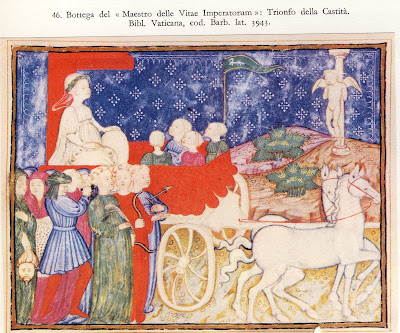
But here is a Milanese Chastity, It is contained in a Milanese manuscript of the Canzoniere and Triumphs, done by an illuminator that some say is "second quarter of the fifteenth century" (Trapp, Studies of Petrarch and his Influence, 2003, p. 28), while others (e.g. Mirella Levi d'Ancona, 1970, following Toesca, 1912) see his first work as 1413 and his last as 1459--a phenomenally long time, of course. Trapp dates another of his illuminations in the same manuscript to "c. 1440" (p. 73).
Image

In the above, You will notice the chariot, the canopy over the chariot, the beautiful young lady therein, and the two white horses. That's several clear-cut features in common with the CY Chariot card. The scalloped fringe is something that turns up in the Charles VI Chariot and several of the triumphal chariots of the Schifanoia (Venus, Mercury at least), as well as the Marseille Chariot card later: so probably it's a common feature of triumphal chariots generally. And notice the round object Chastity is steadying with her hand, whatever it is, not dissimilar to the coin of the card. There is no bound Cupid on the card, to be sure. But that is understandable in a deck commemorating a marriage. Chastity and Love are in such cases not incompatible.
Certainly interesting Mike. When I said Petrarch had no influence I meant his text - the only chariot he describes is Love's after all. The key here is what are those objects on either side of her? Is that a rabbit on the near side, a symbol of Venus kept under control? Perhaps the same theme of (self)control then on the far side of her, the reckless unstable wheel - something that would have been well known via Giotto's vice of Inconstancy painted opposite Fortitude in the Scrovegni:
Image

The CY is clearly a coin, however, the PMB coins showing the same sunburst motif.

I don't rule out a secondary meaning that the bride is in fact chaste, but the gesture is everything - the figure on the chariot in the CY holds the coin out; something Chastity does not do anywhere. It signfies her dowry, IMO, soemthing made more explicit in the "World" card.

Phaeded

Re: What's With the Concentration on Florence and Tarot?

25
mikeh wrote:Well, yes, mutual misunderstanding, Phaeded. So for the moment I will hold off criticizing and merely ask questions in an effort to understand you. Could you say again what the 7 antitypes or examplars are and which virtue each corresponds to, in your Angieri deck, which I assume has 14 special cards, and is repeated in Ferrara Jan. 1441, carried back to Milan by Bianca Maria, to be repeated with heraldics in a marriage deck? Then say again what Sforza changed in c. 1450--additions as well as subtractions--why the additions, and where he gets them from.
My schema:
7 Virtues: Faith…Hope…Charity…Prudence("World")…Fortitude…Justice (missing)…Temperance (missing).

3 Theo. replacements in PMB:
“Papess”(Maifreda) for Faith [assuming you've read the Maifrada rationale before, but link here: http://www.thefreelibrary.com/The+heret ... 0130970823; Ross has probably spent the most time on that identificaiton of the Papess]
Hanged Man (opposite Hope in Scrovegni)
Pope for Charity (the Popes controlled the benefices and charitable works of the Church)

7 Exempla/Antitypes: Empress…Emperor…Love…Chariot…Wheel of Fortune (missing in CY but in Brambilla; vice opposite Fortitude in Scrovegni)…Judgement…Death.

Of the 14 original cards - and note the 7 virtues would relate to the 7 Exempla - only three are missing and easily explained by the completion of the Virtue series (Justice and Temperance) or by the presence in a contemporary deck (the Wheel). The remaining 7 + Fool were added in the PMB; none of these 7 are in the CY and Brambilla.

There is a literary source that would explain all of this and a humanist tied to its implementation that makes all of this crystal clear, but I'd rather tidy that up instead of addressing it haphazzardly (like I do everything else). Give me another month to clean that up. In the meantime, poke away...

Phaeded

Re: What's With the Concentration on Florence and Tarot?

26
mikeh wrote:Good job, identifying the rabbit. Rabbits also appear on the Venetian 1488 Chastity Triumph I posted earlier (http://upload.wikimedia.org/wikipedia/c ... astity.jpg), and also on works designed to promote fertility, such as Titian's Sacred and Profane Love.
I was also thinking of the plethora of rabbits in the Allegory of April: Triumph of Venus, 1476-84. Fresco, Palazzo Schifanoia, Ferrara.
Image

Mike wrote:
But can't you accept that an image in Renaissance art, like a text for Augustine, can be intended with more than one meaning at the same time?
Of course, although I'm always on guard for the slippery slope of "polyvalent" meanings where you get to the point where everything is connected to everything - a truism, but the cards here must have had primary meanings (I particulary focus on gestures after having read Baxandall).

The permutations of a given card-playing hand - especially if one were using these allegorically - could inflect a meaning one way or another. I do think a given artistocratic court's use of the tarot (not to deny a parallel card-playing use by the general public) - and the 1442 trionfi decks painted for the d'Este princelings http://trionfi.com/0/e/15/is evidence enough for this conjecture - was possibly a game in which random arrangements of the cards (drawn "hands" of cards) could have been used as an imaginative game in which the encyclopaedic realm of forces in one's domnion, represented by the cards, could have been turned into hypothetical situations by a tutor beckoning responses/outcomes from the princelings in question. Vita Activa, or in a word, prudence(confused with "World" as the highest virtue that is practically synonymous with that mental faculty used to direct the "active life").

Presently digesting this article in context of the above: "Ekphrasis and the Generation of Images"
David Rosand
Arion: A Journal of Humanities and the Classics
Third Series, Vol. 1, No. 1 (Winter, 1990), pp. 61-105
http://www.jstor.org/discover/10.2307/2 ... 1689090077

Phaeded

Re: What's With the Concentration on Florence and Tarot?

27
mikeh wrote:But why the Sun, Moon, and Star (or Stars), of all the triplicities one could change the theologicals to? Is there some precedent for that particular trinity, before the tarot? Even in the the book of Revelation, which does mention all three, that is not a trinity stated as such. You have to read it with a certain atunement to find it. Is there evidence of such atunement, in the right time and place?
Dante's Divine Comedy and the Neo-platonic Universe for example
how to live in order to reach the intellectual and spiritual good that was the aim of earthly life, and the guarantee of salvation and redemption in the afterlife.
In Paradiso The Sphere of The Moon is that of FAITH
The Sphere of Mercury close to the Sun and ruled by Gemini is HOPE
The Sphere of Venus is that of LOVE.
~Lorredan

Re: What's With the Concentration on Florence and Tarot?

28
Thanks, Phaeded. I'll think about your schema, in relation to Florence and more generally. It's close to what I've been putting out, although I use Giotto more for his vices and for the PMB, and Petrarch plus Visconti manuscripts for the CY. But I will try to see it from your point of view, and "poke away" when I can't. I agree that the World card should be called World. However I think that the lady is Fama in the CY and not Prudence until the Charles VI, which I see as a later improvement, to which what you say is very appropriate. (I did a post on that today, at viewtopic.php?f=11&t=906&start=70#p13457, because the World card had been discussed on that thread a lot.) So I end up with 2 more cards than you do in the CY (Prudence and a card for Time, probably represented by the Hermit).

Phaeded, there is still the question of why put in Celestials at all, of all things. What do they have to do with the others? Or with the Sforza? The same is true for Fool, Bataleur, Hermit. Where do they come from? If you have a literary source, great. I've got one, too, for these same cards, supplemented by pictures--mine is Petrarchan, of course, but not one anyone has used much. I should have it ready in a few days, in two parts. I'm not sure which threads to put them in, because the source I have in mind was well known just about everywhere, and so doesn't relate much to the topic of this thread. And it will take a lot of space to explain, because unlike the Divine Comedy or the Trionfi, nobody today knows it, even though it was extremely popular then.

It seems to me that Ross does not support the Papess = Manfreda theory, even though he has an essay on it. At least he disagreed with me when I endorsed it as a valid association to the card and a reason for thinking that it was introduced by Bianca Maria in the PMB.

Thanks for the article reference. I'll look at it. Also Baxandall: Painting and Experience in Fifteenth-Century Italy: A Primer in the Social History of Pictorial Style, 1988: 70, right?

Lorredan. I will have to brush up on my Dante before I can get back to you. Interesting idea, and the kind of rationale I had in mind, a source. I'm just not sure yet how close Dante fits. I'll check.

Re: What's With the Concentration on Florence and Tarot?

29
Mikeh,
That's the Baxandall book - small work but dense. You'll like it. I also like Charles Dempsey's art scholarship but he tends to focus more on the Lorenzo Magnificent era, but touches on the earlier precedents (and I've come to realize he has borrowed heavily from Richard Trexler's scholarship, particularly his Public Life in Renaissance Florence).

As for the papess as Maifreda/Manfreda (is the "i" just an electronic scanner's bad reading of "n" in Newman's article?) - I think Bianca's involvement in her "cult" is a clincher. And consider the timing of this tidbit:
After a century of silence, St. Guglielma suddenly reemerges from the shadows around 1425, with a full-length hagiographic vita that bears only the faintest resemblance to her actual story. Her latter-day legend was the work of Antonio Bonfadini, a friar of Ferrara (d. 1428), as we learn from a contemporary's list of Franciscan writers. (83) Nothing is known of this author except that he also produced a collection of sermons and one other vernacular saint's life.
Guess who is born in 1425? Bianca Visconti. Is it too much to conjecture that a birth gift from the allied d'Este to the more powerful Filippo Visconti would have been in the form of a manuscript that flattered his family tree, given on the occasion of the birth of Filippo's only offspring via his his beloved Agnese (Guglielma was of course at the center of Manfreda's "cult")? If so, Bianca would have eventually come to know this work and explains her being a patron later in life of this obscure Visconti ancestor's "cult".

As for the celestials...the church was ambivalent about astrology so you wouldn't expect them there (in a deck with the theologicals), especially in the first half of the quattrocento. On the other hand, Sforza, like most condottiere, relied on it. My forthcoming bombshell - there are actually 7 celestials in the PMB. :ymdevil:

Phaeded

Re: What's With the Concentration on Florence and Tarot?

30
Lorredan wrote, in reference to Dante's Divine Comedy
In Paradiso The Sphere of The Moon is that of FAITH
The Sphere of Mercury close to the Sun and ruled by Gemini is HOPE
The Sphere of Venus is that of LOVE.
According to Wikipedia (http://en.wikipedia.org/wiki/Paradiso_(Dante)), (1) the Moon is associated with lack of Fortitude and the vice of Inconstancy. Faith is in the 8th sphere. (2) In Dante's universe, taken from Ptolemy, Mercury is not next to the Sun. Venus is in between. And the Gemini aren't associated with the Sun in 15th century tarot that we know of. Mercury is associated with the desire for fame, and deficiency in Justice. Hope is in the 8th sphere. The Sun is associated with Prudence. (3) The sphere of Venus is associated with romantic love, i.e. Eros, and deficiency in Temperance. Charitas, disinterested care or charity, is something else. Charity is in the 8th sphere (Wikipedia uses the word "Love", but Dante is more specific, Caritas).

So I would say the Paradiso does not provide a good match between the Theologicals and the Celestials.