Banner

Tarot History Forum

Tarot History Forum - 600 years of history in 78 cards

Re: Giotto's Madonna with Saints and Virtues

23
marco wrote:Hello Phaeded,
Andrea Pisano was linked in my first post in this thread, together with the Franciscan Virtues by Giotto's workshop in Assisi.

Marco,
I did miss that - thank you for reposting. But that humilitas attribute clearly shows a lit spiral candle (by Giotto himself in Assisi), which is not what is shown in the devotional piece.

Phaeded

Re: Giotto's Madonna with Saints and Virtues

24
Phaeded wrote:
marco wrote:Hello Phaeded,
Andrea Pisano was linked in my first post in this thread, together with the Franciscan Virtues by Giotto's workshop in Assisi.
Marco,
I did miss that - thank you for reposting. But that humilitas attribute clearly shows a lit spiral candle (by Giotto himself in Assisi), which is not what is shown in the devotional piece.

Phaeded
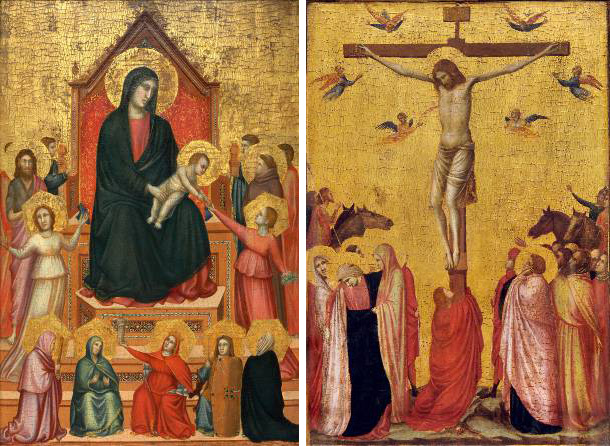
Hello Phaeded, I think what is shown in the devotional piece is a lit candle. As pointed out by Michael, photographs, even the excellent image he has found for us, are "not adequate substitutes for seeing the picture first hand". And the lower part of this small painting (26 centimeters wide) is not in good shape: many of the attributes of the virtues, that were painted as a thin layer of colour, are not as sharp as other details. So, yes, the attribute is harder to read than in the well preserved Assisi fresco and Andrea Pisano's sculpture.

I have posted two images by artists related to Giotto that represent Humility as a woman holding a lit candle. My theory is that the painting we are discussing represents Humility in the same way. I am not sure, but this seems to make sense to me. Do you have a better interpretation? Please, share it with us. What is the attribute? Which virtue does it identify? Could you please link at least one image from the "early trecento that suggests that idea would have even occured to Giotto"?

Please also note that the Assisi fresco includes, next to Humility, Obedience, dressed as a nun in black with a white veil, as we see in the Madonna with saints and virtues. So I take the woman dressed as a nun in black and white to represent Obedience. If you can propose Giotto related paintings supporting a different explanation, I will be very interested.
Attachments
a_candle_or_what.jpg a_candle_or_what.jpg Viewed 9518 times 39.18 KiB

Re: Giotto's Madonna with Saints and Virtues

25
Marco posted:
Image

The detail you provided certainly makes a claim to being a candle, but why would Giotto deviate from depicting Humility's candle as shorter, held by one hand and spiraled as he himself had done and Pisano as well? The strongest evidence is of course Giotto’s own oeuvre and he painted the spiral candle in the Franciscan Allegories in Assisi sometime between 1306 and 1311; the devotional painting in question came right after this, c. 1315-1320. If both works are Franciscan-commissioned then what is the reason for deviating in the way this attribute was depicted? While the topmost fleck of paint is ostensibly the wick/flame (but as you say there is paint loss here, so who knows), what is the hemispherical pommel at the top of the candle? If it were upturned I could imagine it being a device for catching wax, but it is downturned where it could catch a slipping gripped hand…such as a pommel one finds on a sword (Giotto's Temperance in the Scrovegni chapel):
Image

These possibly irreconcilable minor issues aside (perhaps the pommel is a vestige, signifying the transformation of Temperance’s sword attribute into the truly peaceful symbol of the candle?), I’m still willing to concede the object is a candle; however my answer as to why the spiral candle was reconfigured was because Giotto was grappling with the problem of humility being a cognate of temperance, which it was. I think Mjhurst’s suggestion that the figure is a pilgrim warrants further consideration here so that the figure is not the Virtue herself (with spiral candle) but an exemplar - an actual pilgrim displaying humility with a more homely candle (than the expensive one usually held by the heavenly virtue). But’s let return to your full objection before continuing…
Marco wrote:
Please also note that the Assisi fresco includes, next to Humility, Obedience, dressed as a nun in black with a white veil, as I think we see in the Madonna with saints and virtues. So I take the woman dressed as a nun in black and white to represent Obedience. If you can propose Giotto related paintings supporting a different explanation, I will be very interested.
The context here is seven virtues which begs the question as to why two of the 7 standard virtues are supposedly replaced; I’ve already hinted that an exemplar might have replaced the Virtue herself for Temperance so the same may hold true for Faith/Obedience. But first let’s review the unsubstantiated misattribution by the Getty author: Justice, which the Getty author calls “Faith”. I don’t think anyone can dispute that Justice is precisely in the center of the virtues just as she is in the Scrovegni series and has the exact same attributes forgiven/condemned on either side of her and has the same crown. Both I and the Getty call the red figure reaching up to infant Jesus as Charity, and given that Charity’s theological virtue color is red this is fairly clear-cut. But the Getty calls the figure on the far left “Hope” even though she has no attributes other than being clothed in white, the theological color of Faith. Given Charity is appropriately colored one would expect the flanking theological Virtue of Mary/Jesus to also be appropriately colored – and she is. The Getty is simply wrong here about Faith – she is not what I call Justice (even if “divine Justice” of the final Judgement) and is the white robed figure instead. If the three theological virtues then are wearing their traditional colors (such as we find in the contemporary Aquinas fresco) then where is green Hope? If the Virtue was replaced by an exemplar – perhaps the commissioner him/herself – then it would have been inappropriate to have this figure explicitly equated to a heavenly Virtue.

Who was the commissioner? A Franciscan, yes, but was it a monk…or a nun? It was typical to place the patrons at the lower left and right corners of the painting, such as we find in Masaccio’s Trinity, where the male patron is traditionally on the left and the female on the right:
Image

Of all the five virtues on the lower row only the one on the far right looks upwards directly at Christ along with Charity and St. Francis (both directly above her), thus distinguishing her from the cardinal virtues, and signifying her association with St. Francis.
What then are the lower left and right persons in my revised theory, after taking in all of the input here? The Temperance exemplar of humility is a neophyte/applicant (a special kind of "pilgrim") to the order, head bowed; the Hope exemplar of Obedience is a full-fledged nun of the Franciscan order, able to look directly at Mary/Jesus. This also explains Faith above the pilgrim-supplicant – Faith’s arms open to receive the woman pledging herself to the Order (John the Baptist above Faith appropriate in baptizing/admitting one into the faith). On the other side the obedient nun/Hope gives her heart to Jesus just as Charity above her (and will of course carry out the Charitable works of the Franciscans). Such a devotional piece would not be out of character for a convent, perhaps in the monastic cell where the sisterhood received new charges.

Phaeded

PS I'm still confused about the nun's habit - the Poor Clares of the Franciscans wore a dark veil, not a white one. Was there another order of Franciscan nuns in the trecento?
Last edited by Phaeded on 14 Jan 2013, 17:27, edited 3 times in total.

Re: Giotto's Madonna with Saints and Virtues

26
Hi, Marco,
marco wrote:I think what is shown in the devotional piece is a lit candle. As pointed out by Michael, photographs, even the excellent image he has found for us, are "not adequate substitutes for seeing the picture first hand". And the lower part of this small painting (26 centimeters wide) is not in good shape: many of the attributes of the virtues, that were painted as a thin layer of colour, are not as sharp as other details. So, yes, the attribute is harder to read than in the well preserved Assisi fresco and Andrea Pisano's sculpture.

I have posted two images by artists related to Giotto that represent Humility as a woman holding a lit candle. My theory is that the painting we are discussing represents Humility in the same way.
You are undoubtedly correct. Your cognate examples and the detail image, combined with the identification provided by the Getty, are conclusive. Thanks for making it clear.

Best regards,
Michael

Re: Florence at the Dawn of the Renaissance: Painting and Il

27
AlthoughI know Phaeded is concentrating on Giotto- but I thought I might add some facts about Medieval Nuns and Virtues.
Some orders of Nuns thought Virtue was only two- Love of God and of Reason and thought the Cardinal Virtues were properties of these two Virtues, considering them internal not external; therefore they were Diligence, Obedience, Justice and Humility.
Other Orders thought that Humility had 12 degrees(Ha!) and the 12th was exterior Humility; or how you were outside to express the other 11.
If for example a woman came to the convent, and part of her Dowry to the Order, was a comissioned work- you may well see Obedience in a white Veil (as Postulant or Novice) or maybe Diligence portrayed, depending on the Order.
Charity Orders were often Characterised by a white Habit,Scapular and Veil. Penetient orders- a black habit, or brown, sometimes blue or Grey. This is where Art Historians have difficulty in deducing whom is who, and what is what. For example in the original work with the disputed article in hand- Art Historians do not know if it is a Franciscan in general, or maybe it is Saint Anthony of Padua being depicted. They have no doubt it is Saint John the Baptist.
I look at the fresco now, and see Humility is carrying a Liturgical candle(which is different to smaller hand held) and wonder what part of Liturgy is this comment on Humility. Liturgical candles are large and non- freestanding.
So another problem is who was the Commissioner and where was it going- and so much has been lost that we may never know for example what part of the liturgy, this was specifically alluding to. It maybe one particular Sunday in ordinary time, or the Sunday the Commissioner directed the artist to depict like the Patron Saint that showed Strength in Humility- Like Saint Humilitas for example. Or maybe it was someone with absolute Faith as it is the central Virtue.
I believe the Getty Institute- because the rigour of research is with them.
~Lorredan

Re: Giotto's Madonna with Saints and Virtues

28
I wrote:
What then are the lower left and right persons in my revised theory, after taking in all of the input here? The Temperance exemplar of humility is a neophyte/applicant (a special kind of "pilgrim") to the order, head bowed; the Hope exemplar of Obedience is a full-fledged nun of the Franciscan order, able to look directly at Mary/Jesus. This also explains Faith above the pilgrim-supplicant – Faith’s arms open to receive the woman pledging herself to the Order (John the Baptist above Faith appropriate in baptizing/admitting one into the faith). On the other side the obedient nun/Hope gives her heart to Jesus just as Charity above her (and will of course carry out the Charitable works of the Franciscans). Such a devotional piece would not be out of character for a convent, perhaps in the monastic cell where the sisterhood received new charges.
A somewhat later comparable of a nun commissioner in a devotional work featuring Madonna/Child, but placed in the left position of the male donor (not being married, of course, she could assume this position); Venetian c. 1465:
Image

The Met's on-line text:
The Vivarini were a family of Venetian painters whose prolific workshop was rivaled only by the Bellini family. Unlike the numerous large-scale altarpieces for which the Vivarini family were renowned, this small triptych was probably intended for private devotion. The kneeling nun, dressed as a member of the Dominican Order, probably represents a donor. Her diminutive size and the discrepancy in the scale of the figures in the central panel are examples of the archaizing features sometimes found in the work of the Vivarini. Bartolomeo’s debt to Andrea Mantegna is evident in the rendering of the landscape and the figure of the Madonna in the Nativity scene. Although the frame is not original, it conveys the decorative ornamentation typical of the Vivarini workshop.

Another devotional example, c. 1350, with 7 saints (in the predella) - instead of 7 virtues - and with John the Baptist and Francis flanking Madonna/child, but no patron in painting; interesting full catalogue entry in link here: http://metmuseum.org/Collections/search ... mmo)&pos=2

Moving beyond the attribute of the candle in the lower left virtue (for which we have lost sight of the forest for a tree), why are Obedience and Humility included with the other 5 standard Virtues, if they are not in fact Exemplar-Virtues portraying the nun patrons as Humility/Temperance and Obedience/Hope? Keep in mind that the helpful Assisi’s Humility is not matched by an equally clarifying Assisi Obedience which has a square halo (vs polygonal), is male, is winged and places a finger to his mouth as his prime attribute. A praying person with pressed hands before oneself is the prime attribute of Hope, a pose paralleled by the patron-nun in the Venetian example above.

Phaeded

Re: Florence at the Dawn of the Renaissance: Painting and Il

29
The Getty book arrived - and what a doorstop of a tome it is; so large that the Giotto panel is reproduced at least on a 2/3rds scale in the book (I feel slightly less guilty on having spent $50 on this now - and that was via a deal on Amazon versus the listed price of $65). The Giotto diptych (the matching pair is a crucifixion) appears in a larger chapter on Devotional Art, "Religious Panel paintings: Types, Functions, and Spatial Contexts" (116-119, but two of those pages are plates), by Victor Schmidt, Assistant Professor, Department of History and Art History, University of Utrect.

The commentary on the Giotto is disappointly sparse - a single parapgraph on the allegory portion - and aside from making a convincing case that the diptych is a pair there is much nuanced doubt in Schmidt's analysis of the virtues. What the Getty webpage clearly identified as St. Francis is now "a Franciscan saint who might be Saint Francis of Assisi or Saint Anthony of Padua. The allegory with outstretched arms "in a prayerful gesture" is identified as Hope without reason; the virtue that generated the most discussion here is identified as holding a candle in her hand "who probably represents Humility"; the figure in green robes is "likely Prudence"; "Faith, who holds the figure of an angel in her extended right hand [why?] and who dominates the foreground with her striking red robes" [why is she wearing red robes instead of the white associated with that theological virtue?]; Fortitude is obvious; however "the figure who kneels on the right side of the scene is diffiuclt to identify, but may be Obedience" ("Meiss, 1951" - nothing more in this footnote); Charity is desribed as wearing a "pink" robe, no doubt in a dubious attempt to distinguish her from supposed fellow Theological virtue "Faith" wearing red (whom I call Justice) - Charity's robe is clearly also red and the only robe that can be called pink in this ensemble is on "humility." Schmidt does go on to comment that the motif of flowers and heart held out with the other hand by Charity "is the earliest known example of this iconography, which enjoyed some popularity in Florence through the fourteenth century."

All and all, Schmidt seems most concerned with reiterating the case for this being a Giotto (once in doubt) and that the diptych, now separated panels, is in fact one connected piece. Otherwise the analysis of the "allegories" seems like an afterthought, with nearly every identification preceded by a qualification (bolded above). Hardly an over-riding reason to defer to Prof. Schmidt here on the virtues. The Giotto panel again for ease of reference:
Image


Phaeded