Banner

Tarot History Forum

Tarot History Forum - 600 years of history in 78 cards

Florence at the Dawn of the Renaissance: Painting and Illumi

1
Still kicking myself for missing this over Xmas break (was in the doghouse with my girlfriend and couldn't talk her into the 4 hour round trip drive from Palm Springs), but it runs through Feb so if anyone will be in S. California try to swing by the Getty Museum to catch this exhibit: http://www.getty.edu/art/exhibitions/fl ... index.html

Click on the bullets to the upper left of their webpage for various snippet articles and images. What caught my eye on-line was this:
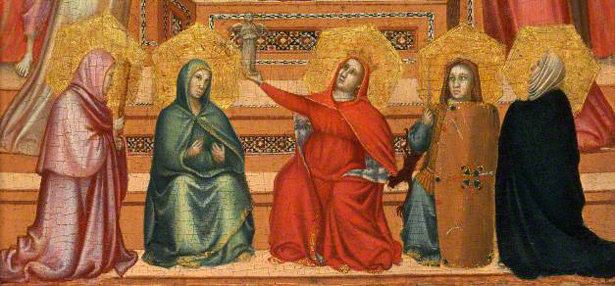
The Virgin and Child Enthroned with Saints and Allegorical Figures, about 1315–20, Giotto di Bondone. Private Collection. Image courtesy of Wildenstein & Co., Inc., New York

What is fascinating is Mary and Jesus essentially crowning the seven virtues and even interacting with one of them (Charity), but what is frustrating is the lack of attributes for some of the virtues. My identifications based on comparison with Giotto's Virtues in the Scrovegni chapel http://www.christusrex.org/www1/giotto/virtues.html; left to right:
1. Faith (no attributes so purely a guess as a theological virtue would need to flank Mary and in the Scrovegni Faith's arms are also held out, but clutching a cross and scroll - I suppose with Jesus present a cross would be inappropriate here)
2. Temperance (the Scrovegni virtue holds a sheathed sword dowwards and it makes sense to not have this virtue look at the divine pair as a sword is essentially negative)
3. Prudence (no attributes unless that rectangular{?} dark spot to which both hands appear to clutch is a book; Scrovegni virtue holds a quill with a book before her as well a mirror)
4. Justice (Scrovegni Justice is in the middle of the Virtue series just as this one is and also has a miniature winged angel on one of the scales)
5. Fortitude (the only virtue that is essentially the same in both works of art)
6. Hope (no attributes but the Scrovegni Hope looks upwards as does this one, which makes sense for a theological virtue to look at Christ himself; I suppose it also distinguishes her from the other cardinal virtues she is otherwise in a row with)
7. Charity (Scrovegni offers her heart to God, replaced by infant Jesus here, and holds similar fruits/flowers with other hand)
Image


Edit: I just found on the Getty's webpage a different identification of the virtues:
At left, the Virgin and Child are surrounded by saints (with round halos), including John the Baptist and Francis, and seven female figures (with hexagonal halos) who represent the virtues. The figure at right presenting her heart to Christ is Charity, followed clockwise by Obedience, Fortitude, Faith, Prudence, Humility, and Hope.
Were the canonical Seven Virtues not established enough at this point that Obedience and Humility could be mixed in as replacements rather than just additions? And how is a woman throwing her arms open equal to Hope? As a matter of fact the CY Hope looks quite close to the Virtue that the Getty identifies as "Obedience" (the bottom right Virtue):
Image


Phaeded

Re: Florence at the Dawn of the Renaissance: Painting and Il

2
I am sorry you missed the exhibition.
You asked if the Virtues were not established enough so that there maybe were replacements?
I think that Painting as probably for a Convent or Priory not a chapel.
The Virtues are divided into three groups Theological or Supernatural (because they are infused by God)
Faith Hope and Charity....
Moral or soul Virtues because they are of the senses, Justice/Fortitude and Temperance.
Intellectual = Prudence and Art (Yes Art :-o Not talked about often)
Also there is a further subdivision- Virtues are integral, potential, or subjective and therefore annexed to each;
So for example Temperance has annexed to it Humility, Meekness, Modesty and Concupiscence.
So they are all Virtues- not replacements and cover every possible scenario. :D
Obedience is the Virtue under Justice......not any less important.
So Hope is unshaken confidence -not as seen today as "when you wish upon a star......wishful thinking"
~Lorredan
Edited to add- Unshaken confidence like a child about to jump to parent arms open wide, confident the parent will catch them- not hoping the parent will catch them. Sometimes Hope is dashed and confidence is tested.

Re: Florence at the Dawn of the Renaissance: Painting and Il

3
Lorredan wrote:I am sorry you missed the exhibition.
You asked if the Virtues were not established enough so that there maybe were replacements?
I think that Painting as probably for a Convent or Priory not a chapel.
The Virtues are divided into three groups Theological or Supernatural (because they are infused by God)
Faith Hope and Charity....
Moral or soul Virtues because they are of the senses, Justice/Fortitude and Temperance.
Intellectual = Prudence and Art (Yes Art :-o Not talked about often)
Also there is a further subdivision- Virtues are integral, potential, or subjective and therefore annexed to each;
So for example Temperance has annexed to it Humility, Meekness, Modesty and Concupiscence.
So they are all Virtues- not replacements and cover every possible scenario. :D
Obedience is the Virtue under Justice......not any less important.
So Hope is unshaken confidence -not as seen today as "when you wish upon a star......wishful thinking"
~Lorredan
Lorredan,
I get that there are subgroups of virtues but by which rationale do you get this specific group of seven identified by the Getty? None of what you wrote above explains the source for Giotto's devotional painting of seven virtues where Obedience and Humility supposedly replace Temperance and Justice.

When a work of art clearly shows 7 virtues and the seven had already become canonical via Aquinas, furthermore, there are near contemporary monumental depictions of the same (e.g., Florence's baptistry doors where Humility was added as an eigth virtue, for symetry in that case), then why only show 5 of the known 7? Either the Getty is wrong and these are the seven canonical Virtues per my comparison with Giotto's depiction of the same in the Scrovegni chapel (with variations in deference to the presence of Mary/Jesus in the same ensemble) or there is some specific rationale or precedent that shows the Getty's 7 virtues. Giotto did pioneer the way the Vices and Virtues were depicted (even which Vices), but he did not make up a new 7 Virtues which Aquinas had established just decades before. See the following article for clarification on these last points: "Giotto in Padua: A New Geography of the Human Soul," Douglas P. Lackey, The Journal of Ethics, Vol. 9, No. 3/4, (2005), pp. 551-572.

BTW: If the Getty painting was completed 1315-20, some 10-15 years after Giotto completed the Scrovegni Chapel, why would he be playing around with a small devotional panel with the series/subject of Virtues he had already famously painted? The main difference is including Mary/Jesus with the ensemble of Virtues (vs. having them bookend the Virtues at either end of the chapel).

Phaeded

Re: Florence at the Dawn of the Renaissance: Painting and Il

4
I believe this painting was for a convent and the Virtues would be specific to the convent.
Example giving the Heart to Mary as Charity.
Obedience as a vow etc.
If the commission was for a military man- Fortitude and Temperance would hold central place.
Who was the devotional work commissioned by?
Prudence would not be there as that belonged to the Pope.
Chastity is not there- so it might be a charity order where Chastity was not a vow.
I see no problem with it not matching the Padua Chapel/Church.
~Lorredan

Re: Florence at the Dawn of the Renaissance: Painting and Il

5
Good questions, Phaeded. True, there's nothing wrong with it being those seven virtues. But the issue is, how standard were the seven in art, and when, and with what imagery? Was your painting done for Florence? (I couldn't tell on the website.) If you look at the Spanish Chapel at Santa Maria Novella (a Dominican church), painted 1365-67, the seven are all there, just as the great Dominican said, but in ways that don't resemble the cards (http://www.amblesideonline.org/triumph.shtml). How often are they grouped all together in Florence with all the right imagery? I don't know about Florence. If the cards started there, then that question needs to be answered, and not taken for granted.

I hope you get to the exhibit. I noticed that it was there, and also that there was a catalog one could buy for $65. That's cheaper than going to LA, but still a bit much. They also have lots of interesting books you can look at for free (and not only that, but if you arrange ahead of time to go to the library, they waive the rather steep parking fee, or at least they did the last time I was there, 3 or 4 years ago).

Re: Florence at the Dawn of the Renaissance: Painting and Il

6
I looked very carefully at the painting- a devotional work most likely for a cell or private altar; much like the expensive work on Cosimo Medici's private cell in a monastery later.
If that is Saint Anthony of Padua opposite Saint John the Baptist -He thought Humility the first Virtue.
He also valued Chastity -Purity and the figure next to Humility (whilst I do not want to argue with the Getty) in Blue, they call Prudence might well be Chastity. She wears Blue- appears to be indicating a blue heart symbolising Purity at Heart position and wears a Fibula (Brooch) a traditional Italian gift for a Virgin or a to -be married girl. It has an element of Protection about it- holding a cloak closed.
~Lorredan

Re: Florence at the Dawn of the Renaissance: Painting and Il

7
The bottom line is this devotional piece was by Giotto and he had already painted the seven virtues in Padua - famously so (the Scrovegni chapel); and so in this painting why deviate just two of the virtues? There is no over-riding rationale to do so with just the two virtues in question, virtues that have almost no attributes (one has a "staff"), and so the onus is on the Getty's claim to explain why this is a non-standard 7 virtues.

An interesting point from Wiki (not sure how reliable): "Madonna of humility: Catholic texts view humility as annexed to the cardinal virtue of temperance.[3] It is viewed as a potential part of temperance because temperance includes all those virtues that restrain or express the inordinate movements of our desires or appetites....Humility was a virtue extolled by Saint Francis of Assisi, and this form of Franciscan piety led to the artistic development of the Madonna of humility first used by them for contemplation.[4][5] The Virgin of humility sits on the ground, or upon a low cushion, unlike the Enthroned Madonna representations.[6] This style of painting spread quickly through Italy and by 1375 examples began to appear in Spain, France and Germany and it became the most popular among the styles of the early Trecento artistic period." http://en.wikipedia.org/wiki/Humility

The genre of Madonna of Humility postdates the devotional work of Giotto and the Madonna here is enthroned, so not a prototype of humility. However, the virtue of Temperance could also suggest the virtue of humility (perhaps what threw the Getty interpretation off), but the primary meaning of the Giotto virtue is its context within the series of the other 7 virtues which I take to be the 7 Virtues; ergo, the disputed virtue's primary meaning is Temperance. Most importantly, what is the disputed virtue holding in her hands - a staff? Temperance however often has a downward pointing sheathed or wrapped sword, the wrapping being that which I take for the irregular shape of the "staff". Otherwise what is its significance?

Phaeded

Re: Florence at the Dawn of the Renaissance: Painting and Il

8
Hi Phaeded!
Humility holds a bulrush.
It is associated with Moses and points to the wetlands as a place of salvation by Baptism.
The point I was making that depending on who asked for the commission, or more importantly, where it was to be placed, would neccesitate different Virtues.
~Lorredan

Re: Florence at the Dawn of the Renaissance: Painting and Il

9
Lorredan wrote:Hi Phaeded!
Humility holds a bulrush.
It is associated with Moses and points to the wetlands as a place of salvation by Baptism.
The point I was making that depending on who asked for the commission, or more importantly, where it was to be placed, would neccesitate different Virtues.
~Lorredan
Lorredan,
That thick "stick" hardly suggests a reed (the object in the painting is brown) or cattail (the latter would have a thinner stalk below it). But is there an image of humility holding a bulrush in the early trecento that suggests that idea would have even occured to Giotto?

Point taken on the commissioner, however; I would think it a Franciscan as that is the saint that the Getty ID's on the right (presumably because of his monk's habit). To quote again the relevant passage from the Wiki entry on Humility:
...humility annexed to the cardinal virtue of temperance....Humility was a virtue extolled by Saint Francis of Assisi, and this form of Franciscan piety led to the artistic development of the Madonna of humility first used by them for contemplation
Therefore: Temperance slightly modified (bowed head) to suggest the cognate virtue of humility to satisfy the Franciscan patron.

Also note that the angle of the "stick" held by temperance/humility is inclined at the same angle as the spear(?) held by the miniature of winged divine justice held up by the central virtue. Thus instead of an inverted sword (such as one finds in the Visconti Hours) an inverted spear would connote the same thing. The clinching attribute that dispels Getty's misattribution ("Faith") of the central virtue is its crown - only Giotto's Justice in his Scrogni chapel wears the exact same crown.
Phaeded

PS a more detailed image of the bottom rows of virtues (temperance/humility on the left) and Giotto's Justice from the Scrogeni chapel (the winged miniature "justice enforcer" on the left has been elevated in the devotional painting):
Image

Image

Giotto's Madonna with Saints and Virtues

10
Good call.
Lorredan wrote:Humility holds a bulrush.
It is associated with Moses and points to the wetlands as a place of salvation by Baptism.
That corresponds to the virtue directly beneath the Baptist, and Obedience is appropriate beneath St. Francis. Reeds are also a symbol of meekness, humility. An example comes from Isaiah 58:5, where bowing one's head like a reed or bulrush is a conventional sign of humility. Unfortunately, there is no good image of that detail available online.

The best version I could find is this:

Madonna Enthroned with Saints and Virtues
http://commons.wikimedia.org/wiki/File: ... o-1315.jpg

Here is the detail, expanded a bit so that you can see the narrowing of the "cattail" between Humility's two hands. You can also see that Prudence either held a mirror, the paint of which has flaked off, or else she had crippling arthritis in her hands and wrists.
madonna-virtues-giotto-1315-detail.jpg madonna-virtues-giotto-1315-detail.jpg Viewed 9368 times 95.51 KiB
Best regards,
Michael

P.S. The parallels with Justice from the Chapel series were, no doubt, intentional. Punishment, the beheading at the left hand of Justice, is identified with the demon at the left hand of Faith, and clemency, at the right hand of Justice, is identified with the angel in Faith's right hand. This is a higher and eternal justice, and the two minor figures were also reflected in the Chapel. A demonic psychopomp escorts the soul from Despair to Hell at the conclusion of the cycle. On the other side, Hope is given wings to rise into Heaven. The moral allegory of the two paths leads directly into the eschatological scenes of Hell and Heaven.

As an aside, the chapel was brilliantly conceived. As the worshiper turned from the altar, having received the sacrament, he would face the great Judgment scene on the far wall. On his right was the allegorical path from Folly to Despair and damnation, while on his left was the path from Prudence to Hope and salvation. He stood at the focal point of a tableau vivant depicting moral choice in this world and eternal consequences in the next.
Last edited by mjhurst on 09 Jan 2013, 18:09, edited 1 time in total.