Hello Phaeded,Phaeded wrote:But then I found this (how did we all miss this?):

Andrea Pisano was linked in my first post in this thread, together with the Franciscan Virtues by Giotto's workshop in Assisi.

Hello Phaeded,Phaeded wrote:But then I found this (how did we all miss this?):

Marco,marco wrote:Hello Phaeded,
Andrea Pisano was linked in my first post in this thread, together with the Franciscan Virtues by Giotto's workshop in Assisi.
Hello Phaeded, I think what is shown in the devotional piece is a lit candle. As pointed out by Michael, photographs, even the excellent image he has found for us, are "not adequate substitutes for seeing the picture first hand". And the lower part of this small painting (26 centimeters wide) is not in good shape: many of the attributes of the virtues, that were painted as a thin layer of colour, are not as sharp as other details. So, yes, the attribute is harder to read than in the well preserved Assisi fresco and Andrea Pisano's sculpture.Phaeded wrote:Marco,marco wrote:Hello Phaeded,
Andrea Pisano was linked in my first post in this thread, together with the Franciscan Virtues by Giotto's workshop in Assisi.
I did miss that - thank you for reposting. But that humilitas attribute clearly shows a lit spiral candle (by Giotto himself in Assisi), which is not what is shown in the devotional piece.
Phaeded

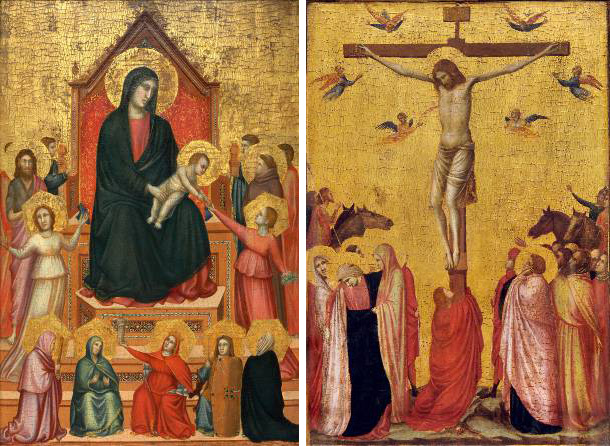
The context here is seven virtues which begs the question as to why two of the 7 standard virtues are supposedly replaced; I’ve already hinted that an exemplar might have replaced the Virtue herself for Temperance so the same may hold true for Faith/Obedience. But first let’s review the unsubstantiated misattribution by the Getty author: Justice, which the Getty author calls “Faith”. I don’t think anyone can dispute that Justice is precisely in the center of the virtues just as she is in the Scrovegni series and has the exact same attributes forgiven/condemned on either side of her and has the same crown. Both I and the Getty call the red figure reaching up to infant Jesus as Charity, and given that Charity’s theological virtue color is red this is fairly clear-cut. But the Getty calls the figure on the far left “Hope” even though she has no attributes other than being clothed in white, the theological color of Faith. Given Charity is appropriately colored one would expect the flanking theological Virtue of Mary/Jesus to also be appropriately colored – and she is. The Getty is simply wrong here about Faith – she is not what I call Justice (even if “divine Justice” of the final Judgement) and is the white robed figure instead. If the three theological virtues then are wearing their traditional colors (such as we find in the contemporary Aquinas fresco) then where is green Hope? If the Virtue was replaced by an exemplar – perhaps the commissioner him/herself – then it would have been inappropriate to have this figure explicitly equated to a heavenly Virtue.Marco wrote:
Please also note that the Assisi fresco includes, next to Humility, Obedience, dressed as a nun in black with a white veil, as I think we see in the Madonna with saints and virtues. So I take the woman dressed as a nun in black and white to represent Obedience. If you can propose Giotto related paintings supporting a different explanation, I will be very interested.

You are undoubtedly correct. Your cognate examples and the detail image, combined with the identification provided by the Getty, are conclusive. Thanks for making it clear.marco wrote:I think what is shown in the devotional piece is a lit candle. As pointed out by Michael, photographs, even the excellent image he has found for us, are "not adequate substitutes for seeing the picture first hand". And the lower part of this small painting (26 centimeters wide) is not in good shape: many of the attributes of the virtues, that were painted as a thin layer of colour, are not as sharp as other details. So, yes, the attribute is harder to read than in the well preserved Assisi fresco and Andrea Pisano's sculpture.
I have posted two images by artists related to Giotto that represent Humility as a woman holding a lit candle. My theory is that the painting we are discussing represents Humility in the same way.
A somewhat later comparable of a nun commissioner in a devotional work featuring Madonna/Child, but placed in the left position of the male donor (not being married, of course, she could assume this position); Venetian c. 1465:I wrote:
What then are the lower left and right persons in my revised theory, after taking in all of the input here? The Temperance exemplar of humility is a neophyte/applicant (a special kind of "pilgrim") to the order, head bowed; the Hope exemplar of Obedience is a full-fledged nun of the Franciscan order, able to look directly at Mary/Jesus. This also explains Faith above the pilgrim-supplicant – Faith’s arms open to receive the woman pledging herself to the Order (John the Baptist above Faith appropriate in baptizing/admitting one into the faith). On the other side the obedient nun/Hope gives her heart to Jesus just as Charity above her (and will of course carry out the Charitable works of the Franciscans). Such a devotional piece would not be out of character for a convent, perhaps in the monastic cell where the sisterhood received new charges.

The Vivarini were a family of Venetian painters whose prolific workshop was rivaled only by the Bellini family. Unlike the numerous large-scale altarpieces for which the Vivarini family were renowned, this small triptych was probably intended for private devotion. The kneeling nun, dressed as a member of the Dominican Order, probably represents a donor. Her diminutive size and the discrepancy in the scale of the figures in the central panel are examples of the archaizing features sometimes found in the work of the Vivarini. Bartolomeo’s debt to Andrea Mantegna is evident in the rendering of the landscape and the figure of the Madonna in the Nativity scene. Although the frame is not original, it conveys the decorative ornamentation typical of the Vivarini workshop.