Banner

Tarot History Forum

Tarot History Forum - 600 years of history in 78 cards

Collection: Artes Liberalis and Virtues

1
It might be of value to have some other combinations of 7 virtues and 7 artes
... perhaps the Bruzio text of c. 1350 is then better understood.
viewtopic.php?f=11&t=862
Panegyric of Bruzio Visconti by Bartolomeo da Bologna

**********************

Image


Image


from ...
http://www.tufts.edu/alumni/magazine/wi ... riage.html
... the page has large pictures

Virtues:
Pesellino shop, Seven Virtues, Birmingham Museum of Art, Birmingham, Alabama. In the depiction of the seven virtues—Prudence, Justice, Faith, Charity, Hope, Fortitude, and Temperance—the female personifications appear in large scale, seated in triumph like secular rulers, with their male exemplars positioned below. Five of the seven male figures hold books, marking them as authors, scholars, or worthies. Only men would have access to formal higher education.
Artes Liberalis:
Pesellino shop, Liberal Arts, Birmingham Museum of Art, Birmingham, Alabama. The seven liberal arts—arithmetic, geometry, music, astronomy, logic, rhetoric, and grammar—made up the Trivium and the Quadrivium of the premodern curriculum.
The page has also Trionfi-pictures. The artist is given as Francesco Pesellino (1422–1457), Florence.

******************

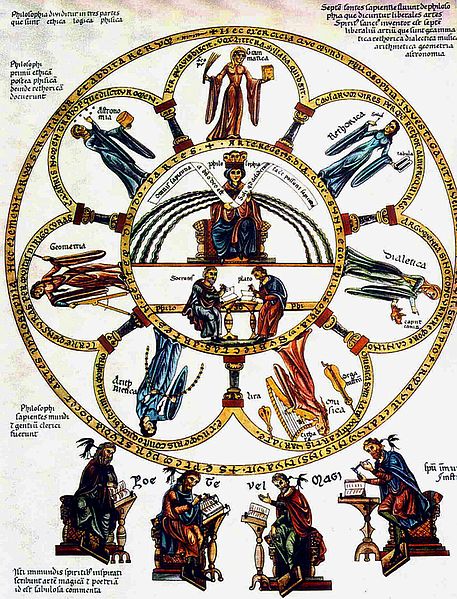
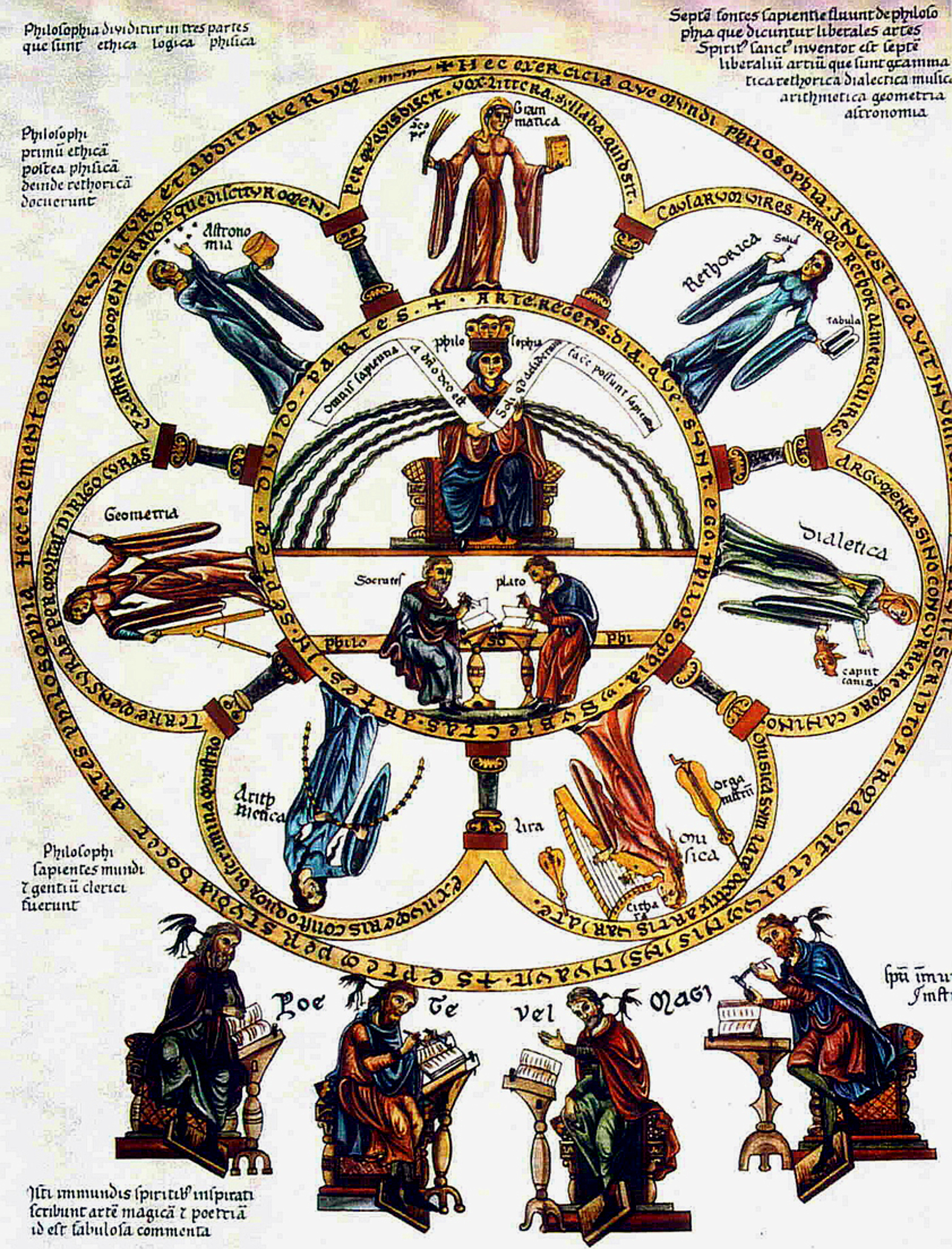
Image


http://en.wikipedia.org/wiki/Hortus_deliciarum
http://en.wikipedia.org/wiki/Herrad_of_Landsberg
Large picture:
http://upload.wikimedia.org/wikipedia/c ... m_1180.jpg

******************

From http://www.nwerle.at/thomasvonaquin.htm

Image

Andrea di Bonaiuto schuf um 1366 in Santa Maria Novella in Florenz diese Darstellung. Thomas wird rechts und links von Tugenden begleitet, vierzehn weiblichen Gestalten, welche die Fächer der Theologie und der freien Künste repräsentieren, zu ihren Füßen jeweils ein Vertreter dieser Kunst, so sitzt Pythagoras zu Füßen der Arithmetik, Euklid vor der Geometrie und Cicero vor der Rhetorik.
Andrea di Bonaiuto (also Andrea da Firenze) c. 1366 in Santa Maria Novella in Florence. The lower 14 figures shall be 7 virtues and 7 artes liberalis. Somebody else assumed, that the seven figures above (with wings) also presented virtues. A third speaks about "14 Sciences" below ... this seems to be correct. The centered figure is Thomas of Aquin.

This page ...
http://www.ulrich-menzel.de/odw/1400.html
... offers ...


Arithmetik - Geometrie - Astronomie - Musik - Dialektik - Rhetorik -Grammatik
Pythagoras - Euklid - Claudius Ptolemäus - Tubal-cain - Aristoteles - Cicero - Priscianus
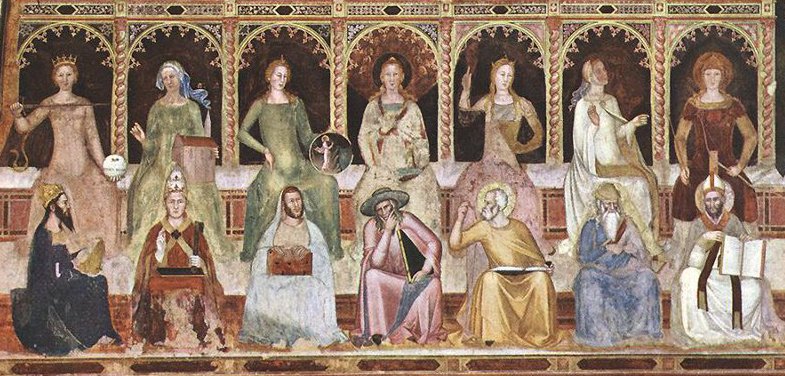

Civil Law - Theological Law - Philosophy - Dogmatik - Scholastik - Mystical Theology - Defending Theology
Justinian - Junozenz IV/ - Pietro Lambardi/Clemens V - Dionysius/Aistoteles - Boethius/Areopagite - John - Augustinus of Damaskus

******************************

Giovanni del Ponte (before 1437) ... seven artes liberales


http://cvc.cervantes.es/img/citas_claro ... v_xv03.jpg

http://www.lessing-photo.com/dispimg.as ... &cr=8&cl=1
Larger picture:
http://www.lessing-photo.com/p3/401401/40140129.jpg

Collection: Artes and Virtues ... Guilds

3
That's not directly Artes and Virtues, but somehow the guilds system in Florence mirrored possibly the Virtues and Artes system.

************************************************************

I stumbled about 21 Guilds in Florence ...

http://en.wikipedia.org/wiki/Guilds_of_Florence

... and it took my attention cause the "21" in it.
The first scheduled list of Florentine guilds encompassing twenty-one guilds, appeared in 1236. The second scheduled list of the twenty-one guilds, differentiating between seven "Greater" Guilds (Arti Maggiori) and fourteen "Lesser" Guilds (Arti Minori), appeared in 1266. That same year the consuls of the seven "Greater" Guilds became the "Supreme Magistrate of the State". In 1280, the first five of the "Lesser Guilds" were designated "Intermediate Guilds" (Arte Mediane) in 1280, when the Signoria first assumed office, and their consults were admitted to the conferences of the consuls of the seven "Greater" Guilds.

In 1282, three "Priors of the Guilds" were elected, with powers only inferior to the Chief-Magistrate of the State.[5] The third scheduled list of guilds, finalizing their order of precedence for over a century appeared in a 1282 document known as the Foro Fiorentino, currently held at British Library. The 1282 document groups the greater and intermediary guilds together, thus creating a new partition of twelve greater guilds and nine minor guilds. The nine lowest guilds were allotted banners and coats-of-arms in 1291.

A General Code, "Il Statuto", for the guilds was promulgated in 1296 with the founding of the Corte della Mercanzia. The Statutes of all the guilds underwent a complete revision between 1301 and 1307, and the "New Code" was first adopted by the Calimala; the statutes were again revised in 1386.

Three new operative guilds were formed in 1378 after the Ciompi revolt. The fourth scheduled list of guilds, appearing in 1415, however, still included only twenty-one guilds, partitioned (as in 1266) between seven greater guilds and fourteen lesser guilds (the intermediary ones having lost their special status).

The Grandi attempted in 1427 to reduce the lesser guilds to only seven. This was defeated. But in 1534, the fourteen lesser guilds were arranged into four Universities, and saw many of their privileges curtailed.
Any ideological reason isn't given. But one might suspect, that the general popularity of 7 virtues and 7 artes etc. had been a role in the ideology. It's interesting, that the recently noted ...

Image


... picture for Thomas of Aquin in 1366 in the church Santa Maria Novella (Florence) uses the same structure "7 above and 14 below", only that the content had been exchanged.

It's interesting, that the year 1427 (so relative short before our observed Trionfi card time) saw a majr conflit, cause one of the political aimed at higher profits by reducing the smaller guilds from 14 to 7. The Medici are said to have taken position for the 7+14 - model and this was part of the conflict 1433/34, who had the issue, that the Medici did win and some of the opponents were banned.

The guild heraldic has no similarity to Trionfi cards (see webpage), the silk dealers, of special interest to us, had a door on their shields. Possibly cause the reason, that the guild also included bronze sculptors and Florence had some famous bronze doors.


*********************

The Cologne system knew not 21, but 22, and they called them "Gaffeln". Each Gaffel could unite some specified "Zünfte".

The system was arranged 1396, following older systems.

The Gaffeln voted 36 members of the city council, in the manner, that ...

1 Gaffel (wool workers) had 4 places in the council ... cause this was the biggest group
11 Gaffeln had each 2 places in the council ... likely an equivalent to Florentine "Grandi"
10 Gaffeln had 1 place in the council ... likely an equivalent to the Florentine "lesser guilds"

... and to these were added 13 further members (called the Gebrecht" chosen on the base of their administrative, technical or political qualities, often from the merchant class, so together there were 49 council members (and it's said, that this number had ideological reasons cause of 7x7 = 49). About ideological reasons for the 22 Gaffeln I found nothing.

If one compares this model to the common German playing card deck (4x12), it's easily perceived, that there are similarities. 36 are the number cards (either 1-9 or 2-10), and 12 are the court cards. The 49th vote (odd number) is naturally needed to have always decisions.

In important decisions like "peace or war" an additional institution was called, to which each Gaffel send 2 additional members (so 2x22 = 44 further votes), in such essential cases the lower class got a higher power and a dominance through the 13 members of the Gebrecht was avoided.

Each citizen MUST have been a member in one of the Gaffeln, and the Gaffeln were responsible for military contributions, they had to organize it, if it was necessary.

http://de.wikipedia.org/wiki/K%C3%B6lner_Rat_bis_1796

A likely modern picture of the Gaffel heraldic I found here:
http://www.flickr.com/photos/11065676@N00/6940596533/

Somehow a Kölsch Proletarian Tarock.

*******************

Whereas for the Florence "21" it could be easily discovered, that the choice seems to be determined ideological, it's difficult to say this from the "22" in Cologne. Well, it might be just a practical number. Or it's just a reference to the Cologne preference for the number 11. Once there were 11.000 virgins ...

Re: Collection: Artes Liberalis and Virtues

5
Some artes liberalis

Image

http://commons.wikimedia.org/wiki/File: ... ales_1.jpg

Image

http://commons.wikimedia.org/wiki/File: ... ales_2.jpg

************

Image

by Marten de Vos, (1532 – 4 December 1603)
http://ru.wikipedia.org/wiki/%D0%A1%D0% ... 1%82%D0%B2

**************

A large collection inclusive Trinci palace and much "later artes" copperplate engravings
http://art-links.livejournal.com/168314 ... ad=8851913#

*************

Church in Freiburg

http://www.scientoskop.ch/projekte/bilder

*************

Reisch 1503, book title
http://www.enzyklopaedie.ch/fronti/tite ... spiz1b.jpg
Der Titel-Holzschnitt 1504 zeigt als zentrale Gestalt eine Personifikation der Philosophie. Die Stickerei auf dem Gewand gemahnt an die Initialvision des Boëthius im Kerker, dem die Philosophie erscheint: an untersten Rand ihres Gewandes ist ein griechisches Pi (für ›Praxis‹) eingewebt, am obersten ein Theta (für ›Theoria‹); dazwischen sind Leitersprossen eingezeichnet, welche die Künste bedeuten, auf denen man emporsteigt. Die Dreigesichtigkeit bezeichnet die drei Hauptdisziplinen, wonach die Philosophie in der Antike üblicherweise eingeteilt wird: Philosophia naturalis (die Natur- oder besser: Sachkunde), rationalis (die Logik), moralis (die Ethik). Beachtenswert ist die Wertschätzung des Buchs im Ensemble der Genius-Flügel sowie von Krone und Szepter. – Sieben Personifikationen der Artes liberales umgeben die Philosophie; sie tragen charakteristische Instrumente in der Hand, zum Beispiel die Arithmetik einen Abakus, die Musik eine Harfe, die Geometrie einen Zirkel. Alle diese Gestalten werden von einem Kreis umfangen. – In den unteren Bildzwickeln repräsentiert Aristoteles die Philosophia naturalis und Seneca die Philosophia naturalis. – Als Pendant zur heidnischen Antike weisen in der oberen Sphäre die vier Kirchenväter Augustinus, Gregor der Große, Hieronymus und Ambrosius auf die Taube des heiligen Geistes hin, in deren Nimbus Philosophia divina steht, ein Kapitel das in der Enzyklopädie indessen fehlt!

Titelbild [pop-up] (Straßburg: Schott 1503; hier in der Variante Straßburg: Grüninger, 1504) — Schemazeichnung [pop up, auf dieser Homepage]

Die Ausgabe 1508 hat ein anderes Titelbild: Die Artes Liberales wachsen an einem Baum, der aus dem Schoße der Philosophie sprießt. Im Hintergrund steht natürlich das genealogische Bild der Wurzel Jesse (Jesaia 11,1–2).

Titelbild [pop-up, auf dieser Homepage] (Straßburg Schott 1508)

• Udo Becker, Die erste Enzyklopaedie aus Freiburg um 1495. Die Bilder der Margarita Philosophica des Gregorius Reisch, Freiburg: Herder 1970.
• Steffen Siegel, Architektur des Wissens. Die figurative Ordnung der artes in Gregor Reischs Margarita Philosophica, in: Frank Büttner, Gabriele Wimböck (Hg.): Das Bild als Autorität. Die normierende Kraft des Bildes, Münster 2004, (Pluralisierung & Autorität 4), S. 343-362.
http://www.enzyklopaedie.ch/fronti/fron ... seite.html

***********

Elsewhere I collected ...
Artes liberalis
in this "Tübinger Hausbuch" (15th century) ...

Image


... it seems, that ...

Sun got Grammatica and gold,
Moon got Rhetorica and silver
Saturn got Geometria
Jupiter got Loica
Mars got Arithmetica
Venus got Musica
Mercury got "fisica" (I assume, that's medicine; medicine was related to astrology/astronomy)

The Tübinger Hausbuch has a lot about astrology.

And many funny pictures.
http://idb.ub.uni-tuebingen.de/diglit/M ... 4505643fe8
**********

A general question about the "artes": The Mantegna Tarocchi had Poetry as an art (picture 27). Old tradition seems to have been, that Poetry had been part of the Trivium, as a a subcategory, not as a major point. Actually I look for another picture of poetry inside the concept of the 7 liberal arts, but for the moment I haven't found one.

Re: Collection: Artes Liberalis and Virtues

6
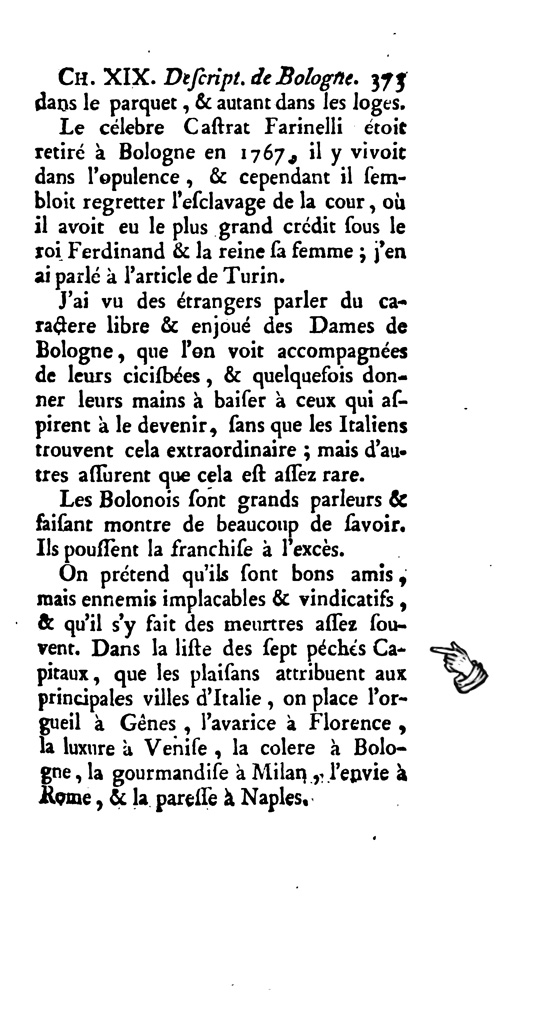
Not about the Virtues, but Jerome Lalande (1732-1804) wrote about the proverbial Seven Deadly Sins that seven cities in Italy exemplified, according to some "jokers" (plaisans) he had heard, in 1786:


Pride - Genoa
Avarice - Florence
Lust - Venice
Anger - Bologna
Gluttony - Milan
Envy - Rome
Sloth - Naples

M. de la Lande, Voyage en Italie (Paris, 1786), p. 373 (the earlier edition, of 1769, does not have this passage).