
A very interesting "tarot" mexica, from c. XVI?
http://www.tulancingo.com.mx/informacio ... zincal.htm
Re: Tarot mexica
2...  ... it seems, they fear for their copyright.
It seems to be 18 cards. How do they come to the opinion, that it is of 16th century?
Here's the same date and the same name mentioned:
http://www.wopc.co.uk/honduras/index.html
Cards from Peru
http://www.wopc.co.uk/peru/rimac/index.html
Another note of the same person
http://books.google.com/books?id=hFUj6_ ... la&f=false
Here are some of the pictures in a better state:
http://www.wopc.co.uk/spain/flores/index.html

It seems to be some different back designs.
************************
***********************************
And here is a report:
HERMES Y MOCTEZUMA, UN TAROT MEXICANO
DEL SIGLO XVI
MA. IsABEL GRAÑÉN PORRÚA
http://royalbunker.com.mx/LaHistoriadel ... Mexico.PDF
It includes all 18 larger pictures
... it seems, they fear for their copyright.It seems to be 18 cards. How do they come to the opinion, that it is of 16th century?
Here's the same date and the same name mentioned:
http://www.wopc.co.uk/honduras/index.html
Cards from Peru
http://www.wopc.co.uk/peru/rimac/index.html
Another note of the same person
http://books.google.com/books?id=hFUj6_ ... la&f=false
Here are some of the pictures in a better state:
http://www.wopc.co.uk/spain/flores/index.html
It seems to be some different back designs.
************************
***********************************
And here is a report:
HERMES Y MOCTEZUMA, UN TAROT MEXICANO
DEL SIGLO XVI
MA. IsABEL GRAÑÉN PORRÚA
http://royalbunker.com.mx/LaHistoriadel ... Mexico.PDF
It includes all 18 larger pictures
Re: Tarot mexica
3a) I am really tired with these "copys" in public domain pictures.
b) I dont understand well. Its not clear. It seem this:
1. In the Archivo General de Indias of Sevilla exist a contract with Alonso Martínez de Orteguilla dated from in 1583. This contract provides Alonso Martínez can produce and sell decks in México. I find this confirmation:
 martinez.gif
Viewed 742 times 34.66 KiB
2. Along with the contract was an uncut sheet.
 Without more evidence, its dangerous to date the cards for 1583 only for this coincidence. In any case...
- The uncut sheet have: 41 cm x 27 cm. Each card 6,8 cm x 9,2 cm.
- Only have 18 cards, and they are in the sheet distributed by pairs.
- The cards presents an obvious Mexican influence. I cant analyze the symbols, they are very small (god save saint Copy), but at least exist two cards similars to standard tarot (the fool and two Emperors; maybe too the Devil).
3. Maybe it's time to review the presence of the tarot in Spain...
I write to Archivo General de Indias. Maybe they can give us more information.
b) I dont understand well. Its not clear. It seem this:
1. In the Archivo General de Indias of Sevilla exist a contract with Alonso Martínez de Orteguilla dated from in 1583. This contract provides Alonso Martínez can produce and sell decks in México. I find this confirmation:
Without more evidence, its dangerous to date the cards for 1583 only for this coincidence. In any case...- The uncut sheet have: 41 cm x 27 cm. Each card 6,8 cm x 9,2 cm.
- Only have 18 cards, and they are in the sheet distributed by pairs.
- The cards presents an obvious Mexican influence. I cant analyze the symbols, they are very small (god save saint Copy), but at least exist two cards similars to standard tarot (the fool and two Emperors; maybe too the Devil).
3. Maybe it's time to review the presence of the tarot in Spain...
I write to Archivo General de Indias. Maybe they can give us more information.
Re: Tarot mexica
51) The first mention are in:
Cristóbal Bermúdez Plata: "Contrato sobre fabricación de naipes en Nueva España", en
Anuario de Estudios Americanos 1945, p. 717-721.
2) The name of original document is:
Sevilla, Archivo General de Indias. Leg. Patronato,183, n. 1, Ramo 6.
3) The cards
(Left - right, left - right)
 mex_1.jpg
Viewed 737 times 144.86 KiB
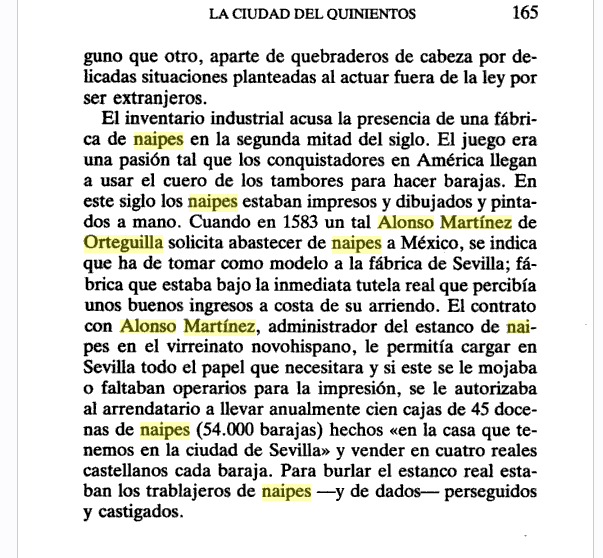
1 - Chimera
2 - Chimera
3 - Monkey
4 - Ibis? (Porrúa said)
 mex_2.jpg
Viewed 737 times 135.95 KiB
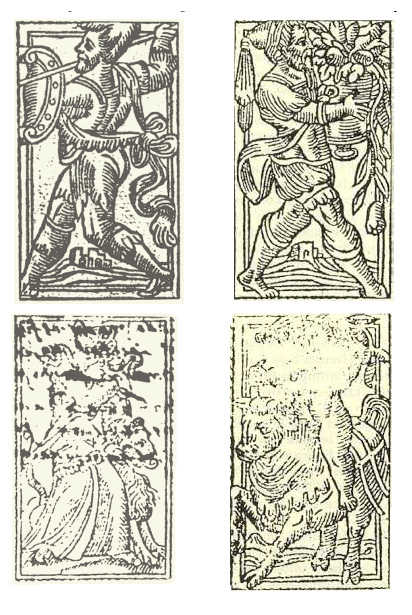
5 - Heracles? (Porrúa said)
6 - Charity?? (Porrúa said)
7 - Fortress <- Fortress
8 - The Rape of Europe
 mex_3.jpg
Viewed 737 times 138.22 KiB
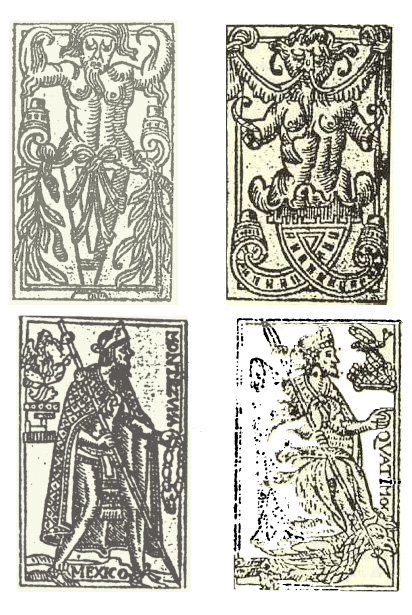
9 - Hermes? (Porrúa said)
10 - Hermes? (Porrúa said)
11 - Moctezuma* <- Emperor / Empress
12 - Cuauhtémoc* <- Emperor / Empress
* The style of these cards is typical of sixteenth-century Mesoamerican codices. If anyone is interested, I can explain this.
 mex_4.jpg
Viewed 737 times 139.27 KiB
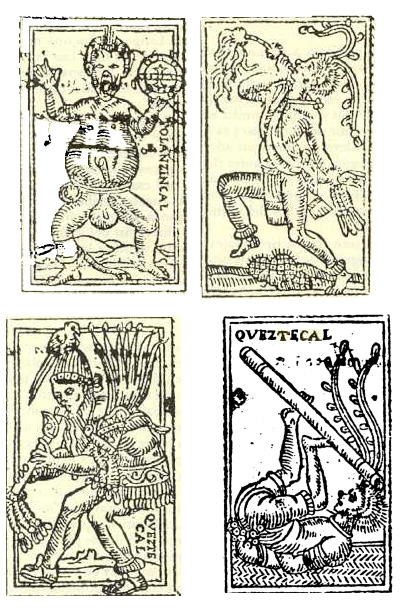
13 - Tolantzincal (a local monster) <- Devil?
14 - Dancing fool (eat drugs) <- Fool
15 - Musician <- Bagato?
16 - Juggler <- Bagato
 mex_5.jpg
Viewed 7029 times 64.29 KiB
17 - "queztecal" <- As Porrúa said, maybe the Chariot / But I think maybe too a teomama <- Pope
18 - Voladores <- Wheel?
Cristóbal Bermúdez Plata: "Contrato sobre fabricación de naipes en Nueva España", en
Anuario de Estudios Americanos 1945, p. 717-721.
2) The name of original document is:
Sevilla, Archivo General de Indias. Leg. Patronato,183, n. 1, Ramo 6.
3) The cards
(Left - right, left - right)
2 - Chimera
3 - Monkey
4 - Ibis? (Porrúa said)
6 - Charity?? (Porrúa said)
7 - Fortress <- Fortress
8 - The Rape of Europe
10 - Hermes? (Porrúa said)
11 - Moctezuma* <- Emperor / Empress
12 - Cuauhtémoc* <- Emperor / Empress
* The style of these cards is typical of sixteenth-century Mesoamerican codices. If anyone is interested, I can explain this.
14 - Dancing fool (eat drugs) <- Fool
15 - Musician <- Bagato?
16 - Juggler <- Bagato
18 - Voladores <- Wheel?
Re: Tarot mexica
6As far I understand Simon Wintle (that's wopc), he thinks, that this are backsides. That's, what I think also. 18 different backsides for 18 different decks.
So it's rather superfluous to search a deck in it. He also made cards with Mexican backside motifs, likely he had customers, which preferred this.
So it's rather superfluous to search a deck in it. He also made cards with Mexican backside motifs, likely he had customers, which preferred this.
Re: Tarot mexica
7Yes. Maybe++
Now I read in the Porrúa's article in the backsides are write:
"Cada una de estas figuras es la espaldilla de cada baraja de naypes, por manera de que cada una destas figuras se pone en la espaldilla de cada baraja de naypes".
+/- = "Each this figure is a deck's backside"
Simon Wintle hypothesis can explain the curious mixture of european and indigenous elements. Each deck will be sold in an area with more or less indigenous presence. It also explains the similar pairs, like the current cards that are "red" and "black".
In any case, are beatifull backsides