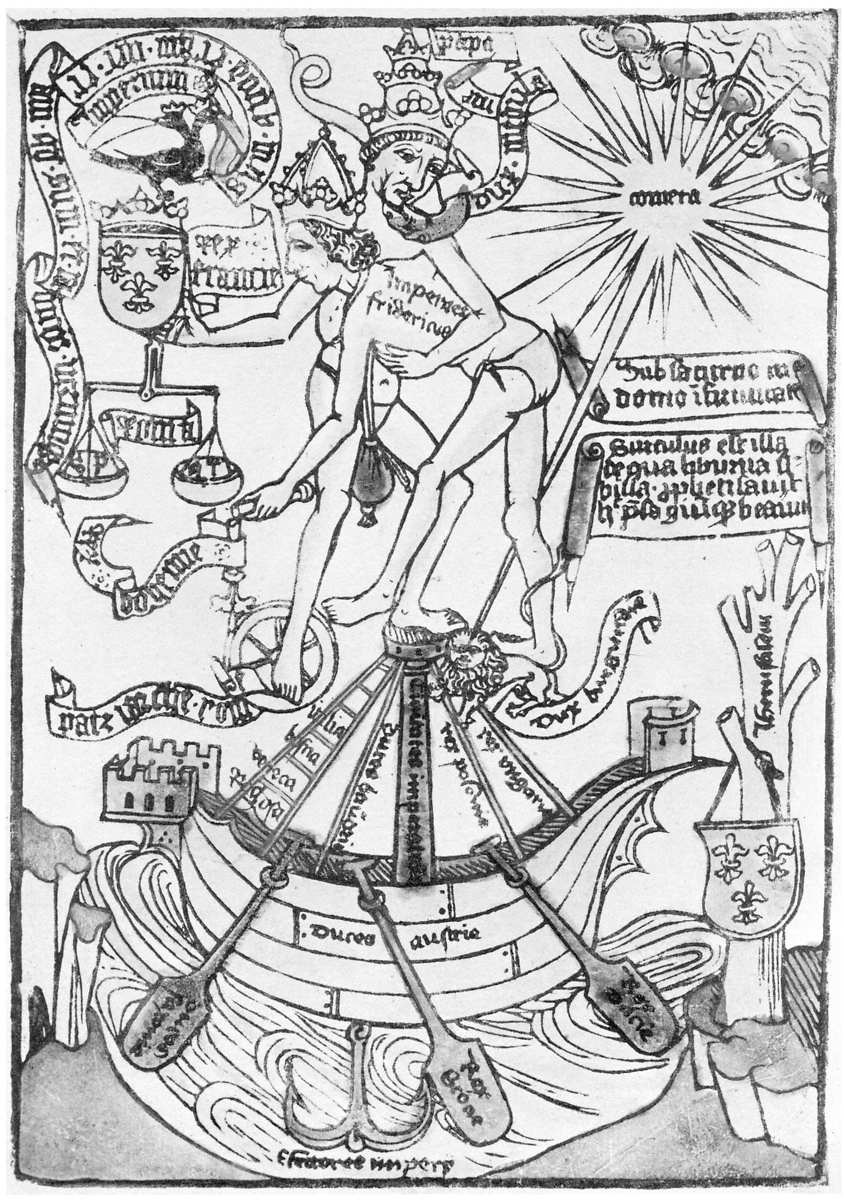
Hi, Marco,
marco wrote:I attach three images that I found in the catalogue of the exhibition “Le muse e il principe” (Ferrara 1991). They are illustrations from a Ferrarese manuscript dating to 1450 ca. The manuscript contains two prophetic texts: “Liber de causis, statu, cognitione ac fine instantis scismatis et tribulationum futurarum” by Telesforo da Cosenza, and the much more famous “Vaticinia Ponificum” by Giocchino da Fiore.
I was attracted by the images that represent the devil being enclosed by an angel (as described in the Book of Revelations). They look similar to early tower cards (e.g. Charles VI). I do not think I have seen images of this kind before, but I guess they should be common in illustrations of the bible.
The typical depiction of the Devil being chained up for the 1,000 years doesn't look like this. Here's an example from Durer:
Here's an example from an earlier Apocalypse -- look in the lower left corner.
marco wrote:Possibly this tower is not to be considered “exactly” as hell. A tower was an obvious place in which to enclose somebody. So this “jail of the devil” is not exactly hell. I don't know

The ultimate source must be from Rev. 20, where he is chained up in "the Abyss", but there are almost certainly some legendary accretions that are also involved.
After the Devil is let out, then he gathers the nations, Gog (the Ultimate Antichirist) and his followers, for the great battle. In my interpretation of the trump cycle, this is precisely the Bible passage being alluded to by the Devil and Lightning cards in Tarot de Marseille, although in a rather different fashion. Moreover, according to the story I've been telling since before The Mendicant's Tale, the reason why the Tarot de Marseille Pope and Devil are so similar in design, and why the Tower is called The House of God, are all part of this same prophetic story. Here is another snippet from that 2000 TarotL post I linked to yesterday:
Michael on TarotL wrote:God Triumphs Over Death and the Devil
The third section is straight from the Bible, and continues to be arranged in a similar triptych pattern. The images are mostly simple allegorical illustrations. But first, another digression. Why does the Devil triumph over the previous XV cards? Over the Pope?! Over all the Virtues?! What's that all about? Isn't that somehow Satanic?
Simply put, he's the ruler of this world, and without God's help, he triumphs over all. That's Christianity, not Satanism. We need Christ to effect salvation. If religious teaching and virtuous living were enough, then the sacrifice on the cross would have been a vanity, a photo op. This is a central message of Christianity, and a dramatic point in the tarot sequence. Why did Christ live and die? "The reason the Son of God appeared was to destroy the devil's work." 1John, 3:8. Without that, we all perish.
So, let's get with the Devil. "When the thousand years are over, Satan will be released from his prison and go out to deceive the nations in the four corners of the earth -- Gog and Magog -- to gather them for battle." Rev. 20:7-8. The Tarot de Marseille card shows the Devil having gathered Gog and Magog for the final battle. Very simple allegorical illustration.
The next verse says, "But fire came down from heaven and destroyed them." Rev. 20:9. And the next card shows fire coming down from heaven, destroying them. Very simple allegorical illustration. (Some of the details, such as blood and giant hailstones are from other passages, and are included for other reasons. Some details, such as the tower itself, suggest another whole level of meaning, as do various symbols throughout the trumps. But again, this post is long enough already.)
marco wrote:A last note is that the illustrations have been attributed to the workshop of Bonifacio Bembo. The author of the article about this manuscript is G. Mariani Canova.
This is really interesting, and suggestive. Thanks very much for finding and posting this stuff. If you find any more information on these prophetic works or sources to pass along, please do so. You've made me want to make another trip to the library.
Best regards,
Michael
P.S. The pictorial apocalyptic traditions of Joachim of Fiore and Telesphorus of Cosenza (
Liber de magnis tribulationibus in proximo futuris), and even the block books and later Reformation images related to the Antichrist, are closer to the Tarot de Marseille images than are those of the more typical medieval Apocalypse. They also emphasize some of the same elements that I have claimed inform the Tarot de Marseille series. For example, consider the Tower card with fire and hail stones and also
wind from the sky. Fire and hail are typical Apocalyptic elements, but the destruction caused by wind (the breath of God) is usually associated with the downfall of the Antichrist. In 2-Thessalonians the Antichrist sets himself up in the House of God (sometimes illustrated as a tower) and is overthrown by the breath of God's mouth. This was depicted in block books, as in the image below. The first scene shows the Antichrist ruling over others, while the second shows him overthrown, with his two followers lamenting outside the tower. We don't have to revise these elements too much to make sense of the Tarot de Marseille
Maison Dieu as the overthrow of the Devil.