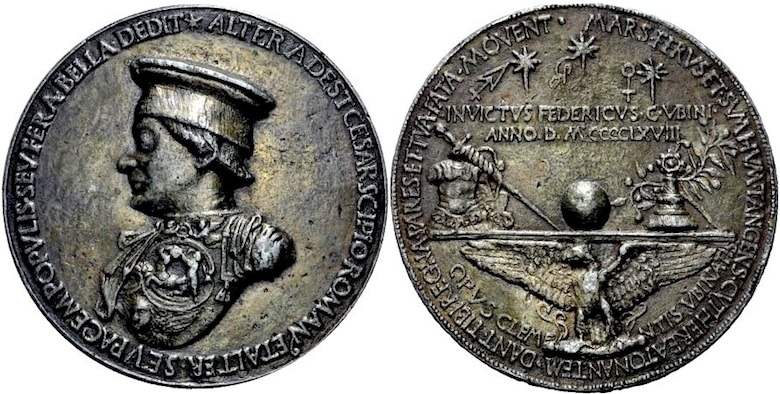
The relevant detail:
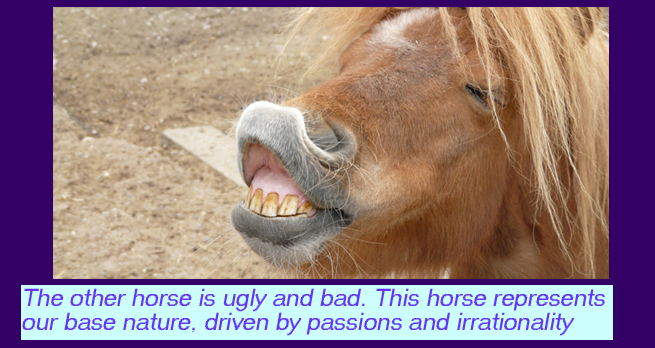
Finally, that teeth could be shown to identify the bad horse is not that unusual, as it occurred to a contemporary of ours trying to explain the Phaedrus:
Thoughts?
Phaeded

Ross Caldwell wrote: 21 Aug 2023, 10:49 I'd interpret those "teeth" as a survival of the gold foil, part of which still outlines the horse's head as well.
The foil just happens to be retained between the horse's neck and between the outer vertical lines in the border decoration, creating the funny illusion of beaver teeth.
As for the Chariot of the Soul interpretation for this card, there is not much that confirms it. The pegasi-horses are not starkly contrasted, as the allegory continually insists on, and the charioteer is not holding any reins at all, let alone struggling to direct the chariot. They are rearing, but it could be thought of as joyful and playful, rather than struggle or fright.
If this is a Chariot of the Soul, then it represents a state of perfect mastery in the charioteer's case, not one where she is in any way struggling to master desire.
I think such an interpretation here is very fanciful, and unlikely.
Fair enough, but the black line forming the outer demarcation of the left "tooth" that is clearly a brush stroke? There is no reason for it to be there and is missing on the other horse:Ross Caldwell wrote: 21 Aug 2023, 16:14 Also on these "teeth", the gold leaf goes into the round punch below. The gold is clearly part of the marginal decoration, not the horse's teeth. In your second picture the lines are even more evidently a continuation of those above and below.
On another subject, you might be more interested to know that I have Marziano and Bruni working together in the same curial office in 1407-1408. Their signatures are side by side in some documents.
Seeing that it is inevitable for virtuous toil to be weakened by fatigue, if the time be excessive, it might be asked whether it would be fitting for a man to find recreation from the weariness of virtue in some kind of game.... Certainly, since the virtue and reason of the honest man would consist in these moral actions, it follows that they are governed by right reason.... And it is even more pleasing where your keen intelligence would notice several most famous Heroes, renowned models of virtue, whose mighty greatness made gods, and ensured their remembrance by posterity. Thus by observation of them, be ready to be roused to virtue. The first order is indeed of virtues; it consists of: Jupiter, Apollo, Mercury and Hercules. The second of riches...the third of virginity or continence: ...The fourth however is of pleasure....
Phaeded wrote: 21 Aug 2023, 17:13 Wow. Would you mind snipping one, if the manuscripts in question are imaged on-line?
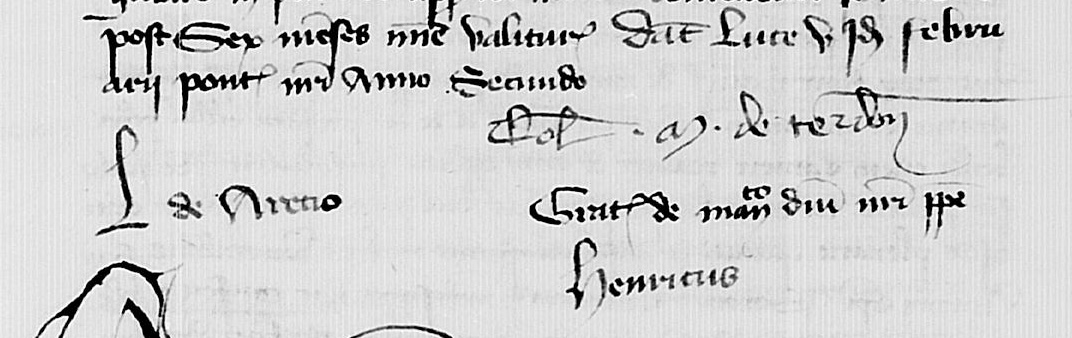
Yes, very much. This is why I began posting here the various "famous men" painted cycles, with their tituli. Marziano surely knew that in Padua, and, who knows what he did before the late 14th century? - maybe he had a trip down to Naples and saw the earliest one, that of King Robert in the Castelnuovo. And those in Florence, in the Sala dei Priori the Palazzo Vecchio. These were explicitly for the kind of moral emulation you and Marziano express. So, my hypothesis is that these kinds of cycles are the general background that inspired Marziano and Filippo Maria.Phaeded wrote: 21 Aug 2023, 17:13
To paraphrase Marziano: one wearies of virtue but the game rouses one to virtuous toil via mytho-historic exempli, not meditation on the virtues themselves.
Thank you, especially for the background of the document! You are undoubtedly right - this just looks like matter of fact notarial business (nothing could be more mundane than a safe conduct). Nonetheless to know Bruni and Marziano belonged not only to the same milieu but actually "crossed quills", as it were, is fascinating and breathes a little more life into the period we're studying.Ross Caldwell wrote: 21 Aug 2023, 17:24 Marziano wasn't long in Gregory XII's service, only from September 1407 to late August, 1408. Given his absence from Bruni's or Poggio's letters, among others, it seems he didn't make much of an impression. Once he got back to Tortona and Pavia, he was caught up in the mess of the duchy there.
Yes it does breathe a little color into things, doesn't it?Phaeded wrote: 21 Aug 2023, 17:41 Thank you, especially for the background of the document! You are undoubtedly right - this just looks like matter of fact notarial business (nothing could be more mundane than a safe conduct). Nonetheless to know Bruni and Marziano belonged not only to the same milieu but actually "crossed quills", as it were, is fascinating and breathes a little more life into the period we're studying.
Yep. The number of lost such cycles must be a staggering number, so even more common than you are indicating. The Este castle in Ferrara is perhaps the most disappointing of all - almost all of the art replaced by a bunch of later Raphael-esque decoration (practically all that is left from the quattrocento are the cartoons for some Arthurian frescoes in one hall).Ross Caldwell wrote: 21 Aug 2023, 17:34Yes, very much. This is why I began posting here the various "famous men" painted cycles, with their tituli. Marziano surely knew that in Padua, and, who knows what he did before the late 14th century? - maybe he had a trip down to Naples and saw the earliest one, that of King Robert in the Castelnuovo. And those in Florence, in the Sala dei Priori the Palazzo Vecchio. These were explicitly for the kind of moral emulation you and Marziano express. So, my hypothesis is that these kinds of cycles are the general background that inspired Marziano and Filippo Maria.Phaeded wrote: 21 Aug 2023, 17:13
To paraphrase Marziano: one wearies of virtue but the game rouses one to virtuous toil via mytho-historic exempli, not meditation on the virtues themselves.
But, instead of fresco cycle of such men, Filippo Maria had a card game, and not of men, but of gods. Or rather, deified men.