I try to go back to the Lorenzo Spirito version of 1482 to check my conclusion about "Taurus-Gemini" relating to the Giovanni-festivity-season in Florence from 1st of May - 24th of June
... however the earlier link to the text of 1482 stopped to operate correctly. So I dropped back to my notes, when I studied this text ... compare
viewtopic.php?f=11&t=442&start=0
The text operated in a 20-20-20-20-scheme, from which the first 20 units were related to kings and the last 20 to prophets. Interesting are the both middle groups, as they show a distant relationship to the Minchiate trumps. The form of Minchiate with 97 cards, when stripped of Fool and court cards, also has a 20-20-20-20 in the form ...
20: 2x10 number-suit-cards, which run from 1-10
20: 2x10 number-suit-cards, which run from 10-1
20: trumps 1-15 plus 3 unnumbered aries
20: trumps 16-35
This are the both middle groups with 20 elements (according to my earlier notes - with private comments)
First group:
Luna - Sole (moon - sun) GREAT PAIR
Scorpione - Stella (scorpio - star) ??? death-star ??? mixed zodiac ???
Alicorno - Diamante (unicorn - diamond ring) WEDDING PAIR
Grifone - Core (grifon - heart shot by Eros) EROTIC ??? I don't understand the Grifon
Pesscie - Buve (fish - bull) ... zodiac ???
Cancer - Serene (cancer - sirene) ... both belong to water, mixed zodiac
Cervio - Dragone (stag - dragon) I don't understand
Lione - Cavallo (lion - horse) I don't understand, mixed zodiac
Cane - Porcho (dog -swine) I don't understand
Gallo - Vergene (cock - virgin with unicorn from the right; virgin looks "ordered")
....
Meanwhile Bernard was so friendly and has found the 1482 edition again ... great, wonderful ..
http://www.ulm.de/sixcms/media.php/29/L ... a_1482.pdf
... and for reasons of safety, I saved a copy this time.
I meanwhile checked a version of 1551 of the Spirito text ...
http://catalogue.ulrls.lon.ac.uk/search ... A&2,2,,1,0
... and I found so many changes to the version of 1482, that I conclude, that only the version of 1482 is of interest
***********
Returning back to the problem, where Taurus and Gemini take an unusual position, it's in the 2nd group, which Spirito called "spheres":
My old notes:
1. Sole - these are planets
2. Saturno - ...
3. Venus - ...
4. Marte - ...
5. Luna - ...
6. Mercurio - ...
....
one expects now Jupiter, but now in pairs follows
7./8.Taurus - Gemini ... that are zodiac signs
9./10. Montone (that's a joke of the author ...looks like Aries, but what is it?) - Sagitario is zodiac sign
11./12. Aquario - Aries (Zodiak)
13./14. Capricorno - Cancer (Zodiak)
15./16. Scorpione - Apollo (on a triumphal chariot) ... well, Scorpio is zodiac, but Apollo is on triumphal march
17./18. Cristallina ???? ... that's the heaven of the stars and then follows Iove (= Jove) (as emperor - or helmed man - with eagle shield)
19./ 20. Virgo (again with unicorn, but now from other side)
Libra
This second group is (mainly) a mix of planets and of zodiac signs: 7 planets + 10 zodiac signs + Montone, Apollo + Cristallina.
From the usual 12 zodiac signs Pisces + Leo are missing, but both appear in the first group. Scorpio appears in both groups.
The pair
Taurus-Gemini appears between planets (6 of 7) and the other zodiac signs .. this might be completely meaningless, but interpreting it with some optimism , it might give them a "door-to-heaven"-function.
Iconographic compositions formed from 7 planet gods and 12 zodiac-signs should have been relatively common, that Spirito went away from the common concept with his "Spheres-model" with ...
1. Apollo ... for poetry ?
2. Cristallina ... for Muses ?
3. Montone, which looks like Aries ... shephards-literature ?
... might have been his personal creative invention, he wished to present a piece of divination-literature for lovers, so Apollo, Muses and shephards stories were preferred topics to him.
To this ...
In this Castor-Pollux discussion I've to go back to the observation, that the Hesiod theogony text mainly spread between 1470-1500 as an added text to Theocritus editions ...
viewtopic.php?f=11&t=661
Milan c. 1480 (Theocritus edition - without theogony)
Milan 1483
Deventer 1492
Paris 1493
Cremona 1495 (Theocritus edition)
Venice 1495/96 (Theocritus edition)
Paris 1497
Deventer 1497
Paris 1498
Paris 1499
Zwolle 1499
Leipzig 1499
Venice 1499 (Theocritus edition)
Venice 1500 (Theocritus edition)
... and Theocritus stood for "shephards literature" and in the Theogony Hesiod himself presents him as a shephard in the Theogony:
(ll. 1-25) From the Heliconian Muses let us begin to sing, who hold the great and holy mount of Helicon, and dance on soft feet about the deep-blue spring and the altar of the almighty son of Cronos, and, when they have washed their tender bodies in Permessus or in the Horse's Spring or Olmeius, make their fair, lovely dances upon highest Helicon and move with vigorous feet. Thence they arise and go abroad by night, veiled in thick mist, and utter their song with lovely voice, praising Zeus the aegis- holder and queenly Hera of Argos who walks on golden sandals and the daughter of Zeus the aegis-holder bright-eyed Athene, and Phoebus Apollo, and Artemis who delights in arrows, and Poseidon the earth-holder who shakes the earth, and reverend Themis and quick-glancing (1) Aphrodite, and Hebe with the crown of gold, and fair Dione, Leto, Iapetus, and Cronos the crafty counsellor, Eos and great Helius and bright Selene, Earth too, and great Oceanus, and dark Night, and the holy race of all the other deathless ones that are for ever. And one day they taught Hesiod glorious song while he was shepherding his lambs under holy Helicon, and this word first the goddesses said to me -- the Muses of Olympus, daughters of Zeus who holds the aegis:
(ll. 26-28) `Shepherds of the wilderness, wretched things of shame, mere bellies, we know how to speak many false things as though they were true; but we know, when we will, to utter true things.'
(ll. 29-35) So said the ready-voiced daughters of great Zeus, and they plucked and gave me a rod, a shoot of sturdy laurel, a marvellous thing, and breathed into me a divine voice to celebrate things that shall be and things there were aforetime; and they bade me sing of the race of the blessed gods that are eternally, but ever to sing of themselves both first and last. But why all this about oak or stone?
So the Theogony - not a very long text - didn't appear without reason as added text in the Theocritus edition. In this context, that shepherds literature became popular in the last 1/3 of 15th century we've to place Spirito's divination text.
So Spirito's arrangement of the spheres has "intended meaning" in the version of 1482 ... but it seems, that later corrupted editions didn't get the context.

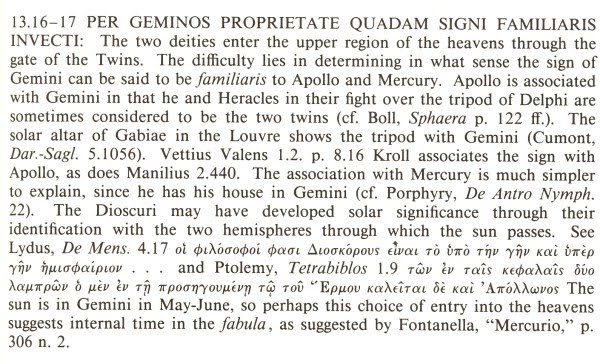

 .... I'm also not so sure, that the Taurus-Gemini connection is really "a sign". But somehow, the Castor-Pollux story seems to be "specific fo Florence" in 16th century and possibly later - as if the Medici had an identification. It just jumped into my eyes.