Banner

Tarot History Forum

Tarot History Forum - 600 years of history in 78 cards

Re: Castor and Pollux / collection to the twins question

21
Reading further in Fulgentius, I spy a difficulty for the idea that Pollus, father of the elements, equals Pollux, of the Twins. Pollux appears in Fulgentius's fable of Leda and the Swan, Mythologies 2.13 (http://www.theoi.com/Text/FulgentiusMyt ... e]Although love of lust is shameful in all men, yet it is never worse than when it is involved with honor. For lust in relation to honor, not knowing what it sets in motion, is always opposed to dignity. He who seeks what he wishes to be something so divine must beware lest it become what it had not been. For Jove disguised as a swan lay with Leda, who laid an egg from which were born the three, Castor, Pollux, and Helen of Troy. This legend carries the flavour of an allegorical interpretation, for Jove is explained as the symbol of power, and Leda is for lide, which in Latin we call either insult or reviling. Thus all power getting involved with insults changes the appearance of its magnanimity. He is said to have changed into a swan because the naturalists, particularly Melistus of Euboea who has expounded the meanings of all the natural scientists, declare that a bird of this species is so filled with reviling that when this bird clamors the rest of the birds nearby become silent. For this reason it is also called an olor, as if derived from oligoria, necessarily involved with insults. But let us see what is produced from this affair, no less than an egg, for, just as in an egg, all the dirt which is to be washed away at birth is retained inside, so too in the work of reviling everything is impurity. But from this egg are born the three, Castor, Pollux, and Helen, nothing less than a seedbed of scandal and strife, as I once wrote: “And the adulteress shatters both worlds with grief.” For they explain Castor and Pollux as symbols of destruction, whence they explain the signs (signa) of the Castors in the sea as creating peril; they say that both of them rise up and fall down alternately, because pride always commands but always falls; whereby in Greek iperefania is the word for pride. Iperefania is strictly the term for appearance above, because, in those two constellations which they call by the name of the brothers, once appears above and the other sinks down, like Lucifer and Antifer; for in Greek Pollux is apo tu apollin, that is, seeking to destroy, and Castor is for cacon steron, that is, final evil.[/quote]
Here Pollux is certainly not the father of Saturn. He is a sun of Jupiter and a "symbol of destruction," whose name he derives from the Greek meaning "seeking to destroy." Allegorically, he and his siblings are the inevitable result when magnanimity descends to insults. Anyone who read this far would not mix up Pollus and Pollux.

This objection is not conclusive, because after all Ridewall did mix them up, explicitly. It is merely a problem. It is possible that someone devised an explanation for how Pollus and Pollux really are identical (e.g. reincarnation, as in the Orphic account of how Phanes and Dionysus are identical); but if so I have not seen it.

Also, there is the difficulty which you recognize, Huck, that the 15th century humanists had many other texts at their disposal, in which the father of Saturn is never either Pollus or Pollux.

Reading Martianus Capella, however, I see another solution to the problem of why the sequence of the signs of the zodiac in Minchiate ends in Gemini. It is two paragraphs further in The Marriage of Philoology and Mercury than the account of the Muses and their assignment to the various levels, from earth (Thalia) to the "outermost sphere" (Urania) (this is at 1.27). Having seen the Muses, Phoebus (Apollo) and the Cyllenian (Mercury), journeying upwards to seek Jove's permission for Mercury to marry Philology, are suddenly transformed into planets, Apollo into "the guise of the sun" and Mercury, too, "into a glimmering planet" (both 1.28). The next paragraph (1.29) then states:
Thus enhanced by this transformation into celestial bodies, they were carried through Gemini, a sign kindred to them, and they shone forth in the majestic sky and soon sought the palace of the Thunderer. (Stahl and Johnson translation, p. 17).

Gemini is kindred to them because the Gemini (Pollux by birth and Castor by either birth or Pollux's sacrifice) have the same father as Apollo and Mercury. But more importantly, it is one of the two signs ruled by Mercury. What is being brought out, I think, is the idea that to enter heaven, the place of Jove, the gate is at Gemini, because Gemini has a special relationship to Mercury. (He could perhaps also have used Virgo.) Mercury is the god who escorts souls to heaven, as we know not only from this book, where he escorts Philology there, but also from Apuleius's "Cupid and Psyche," where Psyche is allegorically the soul. In the Minchiate, the signs of the zodiac occur between the four elements and the unnumbered cards of heaven. They are in the 8th sphere, which separates the cosmos from what is above the cosmos. The Star card, which comes next, is not about a star in the cosmos, but rather Christ as symbolized by a star that transcends the stars and fate (iconographically the Star of Bethlehem on the Minchiate Star card, or the star on the Hope card). To enter the realm of Christ, then--if one follows Capella--one passes last through the gate of Gemini.

I notice that in the Minchiate the signs of the zodiac are all in a very peculiar order, which I do not recognize. So I would feel better about this solution, or any solution, if I knew why in Minchiate that order as a whole was chosen, from Libra to Gemini.

Re: Castor and Pollux / collection to the twins question

22
If, as you state, Fulgentius draws a negative view of Pollux out of its pocket, the whole case "Pollus=Pollux and so reason for the Florentine Minchiate to honor Castor and Pollux", drops in the water.
As I already speculated, a Florentine special favor for Castor and Pollux might have been developed cause of more modern arguments, as for instance the Florentine Giovanni-the-baptist festivities somehow at the "end of Gemini" (which is actually similar to that, what you assume as "Gemini as door to heaven" - cause the sun reaches its highest point at summer-solstice.

Well, this is a pity for the nice Polus-Quaelus-Coeus-Koios topic, I just became used to it.

Re: Castor and Pollux / collection to the twins question

24
mikeh wrote:But I like your tie-in to the Florentine John the Baptist festival. It would be nice to get a fuller description of it, to see what the pagan references were.
We had some exchange at aeclectic, Rosanne and me. Well, it's no SOOO pagan, more religious, though occasionally ... the relationship to Gemini comes from the time of the year, not from the pagan mythology. Florence had an annual series of festivities between 1st of May - 24th of June ...
At this opportunity, I remember, that the Lorenzo Spirito arrangement had somehow a high taurus and a high gemini ... as far the zodiac is concerned and as far remember. This would just be just this time May-June.

For your question to the Minchiate row, we had a sort of system deciphered, perhaps Ross remembers better than me.

Re: Castor and Pollux / collection to the twins question

25
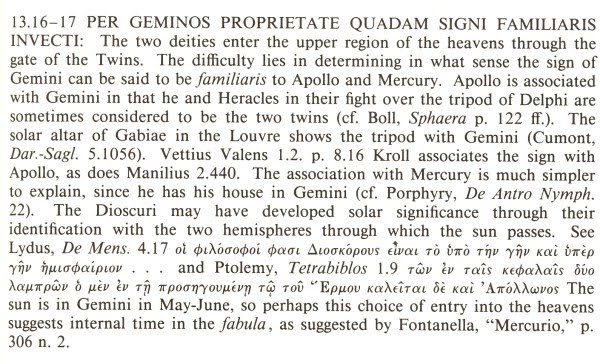
On my quote from Martianus, there is also this, from p. 119 of Danuta Shanzer, A Philosophical and Literary Commentary on Martianus Capella's [De Nuptis Philogiae et Mercurii Book I. At one point in our discussion somewhere, you had a lot to say about Hercules and Apollo as Gemini, in relation to the Renaissance.

Image

Re: Castor and Pollux / collection to the twins question

26
mikeh wrote:On my quote from Martianus, there is also this, from p. 119 of Danuta Shanzer, A Philosophical and Literary Commentary on Martianus Capella's [De Nuptis Philogiae et Mercurii Book I. At one point in our discussion somewhere, you had a lot to say about Hercules and Apollo as Gemini, in relation to the Renaissance.
Me?
Apollo and Artemis (or Diane) are a usual picture for the Gemini. A lot was (historically) made about a contrast between Apollo and Dionysos.

Apollo became a VERY big point in the echecs amoureux, Herakles a VERY big point in the Vatican manuscript (libellus). Do you mean that?

Re: Castor and Pollux / collection to the twins question

27
If you read Heracles' 12 works, you see, that the first 6 happen in Greece and the other 6 outside of Greece. Heracles developed as a literary figure according the growing Greek colonialism ... so later than Apollo, who was "already integrated". So there's Heracles' rebellion against Apollo in the tripod story, according which Heracles has to take the slavery work for Omphale.

Another myth-revolutionary spirit was Dionysos, whose triumphal march from India probably relates to Alexander's successes.

Theseus is another example of myth changing processes. He became "very strong" under Peisistratos. This doesn't say, that Theseus or Heracles didn't exist before, but heroes already created before could collect "further extensions". In Theseus case it seems, that he wasn't originally a son of a king of Athen.

The Argonautes story started in small dimensions as a local cult in the region, where Iason appeared. The big version with heroes from all Greek regions came late.

Somehow Heracles became a "solar" hero, as he got astronomical function and somehow the 13th of the 12 Olympian gods. Also Apollo got solar function, but was part of o the 12 zodiac signs (Gemini in the astrology of Manilius - which likely has a much older base). The version, according which planet-god Mercury reigned Gemini (and Virgo) is younger, I think, about 100 AD (as far I remember).

Re: Castor and Pollux / collection to the twins question

28
I try to go back to the Lorenzo Spirito version of 1482 to check my conclusion about "Taurus-Gemini" relating to the Giovanni-festivity-season in Florence from 1st of May - 24th of June

... however the earlier link to the text of 1482 stopped to operate correctly. So I dropped back to my notes, when I studied this text ... compare
viewtopic.php?f=11&t=442&start=0

The text operated in a 20-20-20-20-scheme, from which the first 20 units were related to kings and the last 20 to prophets. Interesting are the both middle groups, as they show a distant relationship to the Minchiate trumps. The form of Minchiate with 97 cards, when stripped of Fool and court cards, also has a 20-20-20-20 in the form ...

20: 2x10 number-suit-cards, which run from 1-10
20: 2x10 number-suit-cards, which run from 10-1
20: trumps 1-15 plus 3 unnumbered aries
20: trumps 16-35

This are the both middle groups with 20 elements (according to my earlier notes - with private comments)

First group:
Luna - Sole (moon - sun) GREAT PAIR
Scorpione - Stella (scorpio - star) ??? death-star ??? mixed zodiac ???
Alicorno - Diamante (unicorn - diamond ring) WEDDING PAIR
Grifone - Core (grifon - heart shot by Eros) EROTIC ??? I don't understand the Grifon
Pesscie - Buve (fish - bull) ... zodiac ???
Cancer - Serene (cancer - sirene) ... both belong to water, mixed zodiac
Cervio - Dragone (stag - dragon) I don't understand
Lione - Cavallo (lion - horse) I don't understand, mixed zodiac
Cane - Porcho (dog -swine) I don't understand
Gallo - Vergene (cock - virgin with unicorn from the right; virgin looks "ordered")
....
Meanwhile Bernard was so friendly and has found the 1482 edition again ... great, wonderful ..
http://www.ulm.de/sixcms/media.php/29/L ... a_1482.pdf
... and for reasons of safety, I saved a copy this time.

I meanwhile checked a version of 1551 of the Spirito text ...

http://catalogue.ulrls.lon.ac.uk/search ... A&2,2,,1,0

... and I found so many changes to the version of 1482, that I conclude, that only the version of 1482 is of interest

***********

Returning back to the problem, where Taurus and Gemini take an unusual position, it's in the 2nd group, which Spirito called "spheres":

My old notes:
1. Sole - these are planets
2. Saturno - ...
3. Venus - ...
4. Marte - ...
5. Luna - ...
6. Mercurio - ...
....
one expects now Jupiter, but now in pairs follows

7./8.Taurus - Gemini
... that are zodiac signs
9./10. Montone (that's a joke of the author ...looks like Aries, but what is it?) - Sagitario is zodiac sign
11./12. Aquario - Aries (Zodiak)
13./14. Capricorno - Cancer (Zodiak)
15./16. Scorpione - Apollo (on a triumphal chariot) ... well, Scorpio is zodiac, but Apollo is on triumphal march
17./18. Cristallina ???? ... that's the heaven of the stars and then follows Iove (= Jove) (as emperor - or helmed man - with eagle shield)
19./ 20. Virgo (again with unicorn, but now from other side)
Libra
This second group is (mainly) a mix of planets and of zodiac signs: 7 planets + 10 zodiac signs + Montone, Apollo + Cristallina.
From the usual 12 zodiac signs Pisces + Leo are missing, but both appear in the first group. Scorpio appears in both groups.
The pair Taurus-Gemini appears between planets (6 of 7) and the other zodiac signs .. this might be completely meaningless, but interpreting it with some optimism , it might give them a "door-to-heaven"-function.

Iconographic compositions formed from 7 planet gods and 12 zodiac-signs should have been relatively common, that Spirito went away from the common concept with his "Spheres-model" with ...

1. Apollo ... for poetry ?
2. Cristallina ... for Muses ?
3. Montone, which looks like Aries ... shephards-literature ?

... might have been his personal creative invention, he wished to present a piece of divination-literature for lovers, so Apollo, Muses and shephards stories were preferred topics to him.

To this ...

In this Castor-Pollux discussion I've to go back to the observation, that the Hesiod theogony text mainly spread between 1470-1500 as an added text to Theocritus editions ...

viewtopic.php?f=11&t=661
Milan c. 1480 (Theocritus edition - without theogony)
Milan 1483
Deventer 1492
Paris 1493
Cremona 1495 (Theocritus edition)
Venice 1495/96 (Theocritus edition)
Paris 1497
Deventer 1497
Paris 1498
Paris 1499
Zwolle 1499
Leipzig 1499
Venice 1499 (Theocritus edition)
Venice 1500 (Theocritus edition)

... and Theocritus stood for "shephards literature" and in the Theogony Hesiod himself presents him as a shephard in the Theogony:
(ll. 1-25) From the Heliconian Muses let us begin to sing, who hold the great and holy mount of Helicon, and dance on soft feet about the deep-blue spring and the altar of the almighty son of Cronos, and, when they have washed their tender bodies in Permessus or in the Horse's Spring or Olmeius, make their fair, lovely dances upon highest Helicon and move with vigorous feet. Thence they arise and go abroad by night, veiled in thick mist, and utter their song with lovely voice, praising Zeus the aegis- holder and queenly Hera of Argos who walks on golden sandals and the daughter of Zeus the aegis-holder bright-eyed Athene, and Phoebus Apollo, and Artemis who delights in arrows, and Poseidon the earth-holder who shakes the earth, and reverend Themis and quick-glancing (1) Aphrodite, and Hebe with the crown of gold, and fair Dione, Leto, Iapetus, and Cronos the crafty counsellor, Eos and great Helius and bright Selene, Earth too, and great Oceanus, and dark Night, and the holy race of all the other deathless ones that are for ever. And one day they taught Hesiod glorious song while he was shepherding his lambs under holy Helicon, and this word first the goddesses said to me -- the Muses of Olympus, daughters of Zeus who holds the aegis:

(ll. 26-28) `Shepherds of the wilderness, wretched things of shame, mere bellies, we know how to speak many false things as though they were true; but we know, when we will, to utter true things.'

(ll. 29-35) So said the ready-voiced daughters of great Zeus, and they plucked and gave me a rod, a shoot of sturdy laurel, a marvellous thing, and breathed into me a divine voice to celebrate things that shall be and things there were aforetime; and they bade me sing of the race of the blessed gods that are eternally, but ever to sing of themselves both first and last. But why all this about oak or stone?
So the Theogony - not a very long text - didn't appear without reason as added text in the Theocritus edition. In this context, that shepherds literature became popular in the last 1/3 of 15th century we've to place Spirito's divination text.

So Spirito's arrangement of the spheres has "intended meaning" in the version of 1482 ... but it seems, that later corrupted editions didn't get the context.

Re: Castor and Pollux / collection to the twins question

29
Montone. Latin mons = hill or mountain. Since the Spanish is "montagne," perhaps there was a variant similar to "montone."

There is also Braccio da Montone, condittiere who fought for and then against Muzio Attendola Sforza; they both died in a campaign against each other (http://en.wikipedia.org/wiki/Braccio_da_Montone). Montone is the name of the hill town in Umbria (near Perugia) he got from the Pope after his family lost it.

Also, the word "montone" is similar to Old French moton = a ram, from Medieval Latin multo, sheep, probably of Celtic origin; cf. Welsh mollt, Irish molt, according to my dictionary. Hence French mouton, English mutton.

It is hard to say what the significance of "Taurus-Gemini" is in the sequence you mention. as you say, t is here not exactly the gateway to heaven, as a place above the zodiac, but the gateway to the zodiac from the planets. But it at least is a gateway to something.

Crystalline:
The most enduring feature of Anaximenes' cosmos was its conception of the stars being fixed on a crystal sphere as in a rigid frame, which became a fundamental principle of cosmology down to Copernicus and Kepler.
(http://en.wikipedia.org/wiki/Celestial_spheres).
So the crystalline sphere goes with Jupiter as its master, in the ether. Urania usually gets it among the Muses (http://www.flickriver.com/photos/zeevveez/2900531631/). So the crystalline could also go with Apollo, as the master of the Muses. Since it is the vault of heaven, it could also go to Pollus. But I don't see any connection.

Re: Castor and Pollux / collection to the twins question

30
mikeh wrote:Montone. Latin mons = hill or mountain. Since the Spanish is "montagne," perhaps there was a variant similar to "montone."

There is also Braccio da Montone, condittiere who fought for and then against Muzio Attendola Sforza; they both died in a campaign against each other (http://en.wikipedia.org/wiki/Braccio_da_Montone). Montone is the name of the hill town in Umbria (near Perugia) he got from the Pope after his family lost it.

Also, the word "montone" is similar to Old French moton = a ram, from Medieval Latin multo, sheep, probably of Celtic origin; cf. Welsh mollt, Irish molt, according to my dictionary. Hence French mouton, English mutton.

It is hard to say what the significance of "Taurus-Gemini" is in the sequence you mention. as you say, t is here not exactly the gateway to heaven, as a place above the zodiac, but the gateway to the zodiac from the planets. But it at least is a gateway to something.

Crystalline:
The most enduring feature of Anaximenes' cosmos was its conception of the stars being fixed on a crystal sphere as in a rigid frame, which became a fundamental principle of cosmology down to Copernicus and Kepler.
(http://en.wikipedia.org/wiki/Celestial_spheres).
So the crystalline sphere goes with Jupiter as its master, in the ether. Urania usually gets it among the Muses (http://www.flickriver.com/photos/zeevveez/2900531631/). So the crystalline could also go with Apollo, as the master of the Muses. Since it is the vault of heaven, it could also go to Pollus. But I don't see any connection.
Lorenzo Spirito earlier worked as soldier for Piccinino, pupil and follower of Bracchio. Montone is a location near Perugia, where Bracchio and Piccinino had their background. Montone has a ram-similar heraldic element. I wrote about this ...
viewtopic.php?f=11&t=442&start=0
first article near to ..

Image


... :-).... I'm also not so sure, that the Taurus-Gemini connection is really "a sign". But somehow, the Castor-Pollux story seems to be "specific fo Florence" in 16th century and possibly later - as if the Medici had an identification. It just jumped into my eyes.
And Minchiate is from Florence.
But naturally ... Germinella was a Florentine game (14th century). Perhaps it was rather popular - it had to do with two strings and betting. When playing cards developed, they had "twins qualities" - rather normal for playing card decks. This was developed also in the trump series. The enthusiasm about the twin qualities of "their game" caused, that Minchiate got "high gemini" and the name Germini. High Gemini caused some favor for the figures of Castor and Pollux. Some identification for Castor and Pollux developed. That would be a logical way, but Castor and Pollux are then just a result, but no cause.

I've now analyzed this German lot book series, you surely noted this. Gemini has a key role (Adam-Eve, nothing with Castot + Pollux) also in this system. It's a suspicion, that Lorenzo Spirito took his model from this German version and changed it from 22-22-22-22 to a 20-20-20-20-structure.
Sotzmann detected a somewhat obscure connection of Spirito to a text of 1473. Bollstatter now wrote his lot book collection till 1473, then stopped his work (probably moved from his location). It's definite, that Bollstatter "once" in his life made a Jerusalem journey. In 1473 ?
If he went to Jerusalem, he would have crossed Italy.
Bollstatter should have had a very interesting personality, a scholar or researcher type, far more intellectual orientated than other people of his time. He wrote a lot under different names.
He would have visited literary cycles in Italy. A meeting with a German printer in Italy etc. would have been a logical activity. Printing press was in its first developments, and Bollstatter was an author ... so interested.
I wrote about this at the same place ...
viewtopic.php?f=11&t=442&start=0
search "Bollstatter"