Banner

Tarot History Forum

Tarot History Forum - 600 years of history in 78 cards

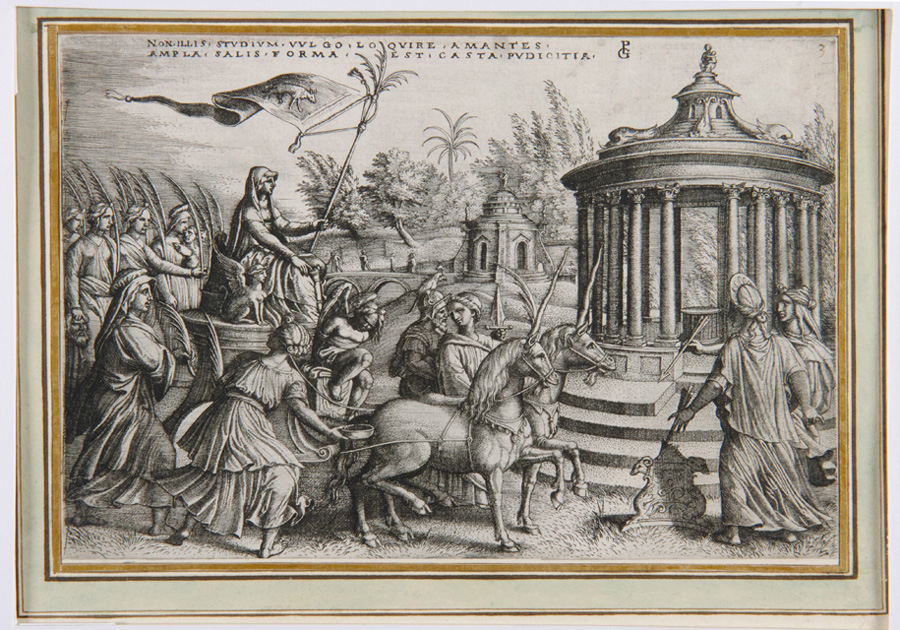
Georg Pencz c1539, Nuremberg

121
https://en.wikipedia.org/wiki/Georg_Pencz
https://de.wikipedia.org/wiki/Georg_Pencz
automatic translation .... https://de-m-wikipedia-org.translate.go ... r_pto=wapp

https://www.meisterdrucke.it/stampe-d-a ... arca..html

https://www.antiquarius.it/it/piccoli-m ... stita.html
... claims to be Il Trionfi della Castita ... but it's clearly Fame with trumpets and elephants

https://patrimonioculturale.regione.fvg ... _id=540909
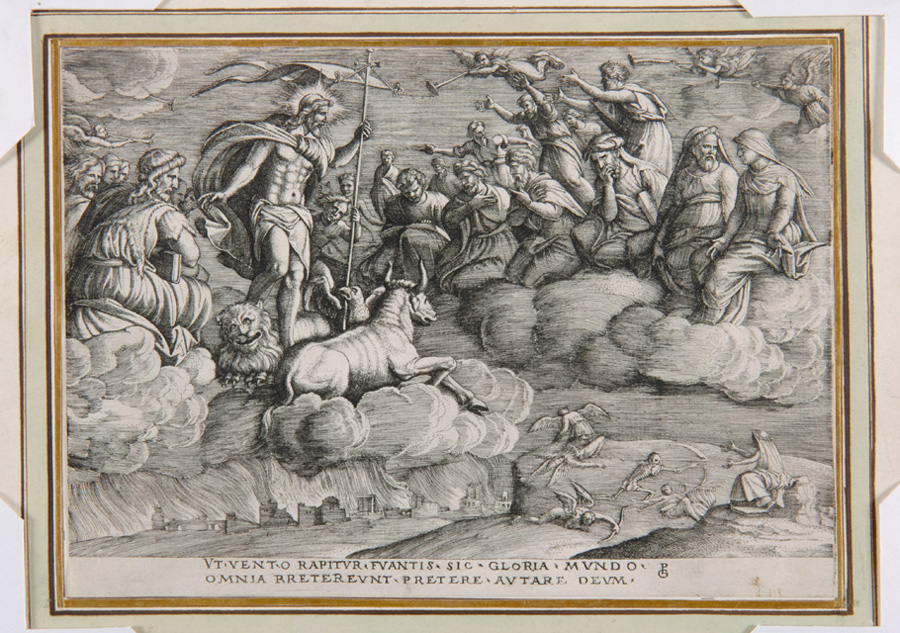
.... has all 6 pictures, thanks. Georg Pencz had a revolutionary biography and his Eternity looks like a very unusual Jupiter ..... thining again about it, there is a cross and it might be a Jesus, which looks a little bit like Jupiter

Image

.... and this is the real Trionfi della Castita with unicorns and a captured Amor.
Image
Last edited by Huck on 19 Aug 2023, 17:00, edited 1 time in total.

Francesco Botticini made also Petrarca Trionfi ??????

122
Image
... compare viewtopic.php?p=11955#p11955

It's clear from that, what we have seen in the recent days, that this picture could run with the name "Eternity", but the official name is "The_Assumption_of_the_Virgin"

I stumbled about a claim from Alamy, that an Amor-Trionfo is regarded as from Francesco Botticino
https://www.alamy.de/stockfoto-der-triu ... 31106.html
"Der Triumph der Liebe, von der die Triumphe von Petrarca, Francesco Botticini, 1480 - 1500
Die Bildunterschriften werden von unseren Anbietern zur Verfügung gestellt."
This looks like a cheat.

This is a nice star pictures heaven, said to be really of Botticini.
Image

Re: Petrarca Trionfi poem motifs in early Trionfi decks

123
mikeh wrote: 08 Aug 2023, 22:56 It seems to me that a second Chariot would be confusing to the players, especially if there was no clear differentiation in gender.
Indeed. They would have been distinguished primarily by the attributes they were holding, attributes that would not have meant much to those who did not have an understanding of Petrarch's Triumphs. This is one reason why I think that players who did not understand the Petrarchan associations eliminated one of them (namely Chastity).

I know I said I was done with this discussion for the moment, and I basically am, but it occurred to me that there is an important point that may not have been mentioned before:

If Petrarch's Trionfi were central to the VdM deck, as they surely must have been, and the deck was designed to glorify Filippo Maria, why would its makers have placed the Visconti insignia so prominently on the World card if, as Mike believes, it represented the Triumph of Fame?

In the Petrarchan schema, Fame is doomed to perish, swept away by Time, forgotten in Eternity. From Decembrio's portrait of him, Filippo Maria was not the kind of pious, humble ruler who would have welcomed a reminder of the fleeting nature of his glory, in a deck of cards presumably intended to enhance that glory.

I had not thought to mention this before, because it has become clear that the VdM World was intended to represent Eternity, due to its links to the Robertet Eternity and the early Florentine Eternity images. The winged trumpet must represent heavenly fame, not worldly fame, so the problem does not arise. But I am nevertheless surprised that it isn't a problem for Mike.

Re: Petrarca Trionfi poem motifs in early Trionfi decks

124
I know this is getting repetitive, but a little won't hurt. I want to state my opinion again, on the points Nathaniel addressed, and then go on, doing something he recommended I do: study the Robertet images one by one
Nathaniel wrote: 09 Aug 2023, 19:08 mikeh wrote: ↑
It seems to me that a second Chariot would be confusing to the players, especially if there was no clear differentiation in gender.

Indeed. They would have been distinguished primarily by the attributes they were holding, attributes that would not have meant much to those who did not have an understanding of Petrarch's Triumphs. This is one reason why I think that players who did not understand the Petrarchan associations eliminated one of them (namely Chastity).

My alternative is that the Issy Chariot is a transformation of the Modrone card (or a predecessor with a similar image), as opposed to an additional card, giving the lady the attributes of worldly fame in Boccaccio. But instead of depicting Plato's two horses as ruly and unruly, they are dark and light, red being particularly appropriate for the unruly one. The transformation is repeated in the Visconti-Sforza, with the variation of making both horses white, which idealizes her in the same way as making her the fifth woman (quintessence) on the chariot of the Issy. The wings on the horses can be interpreted either as those of Fame or those of a goddess's chariot. (While winged horses do appear on one French Triumph of Fame, they appear on Cupid's horses in Sainte-Geneviève ms. 0965). The Minchiate card, which seems to me archaic, is another idealization, nudity being appropriate to a goddess. The switch to a male is a further transformation, approached in a halting fashion in the Alessandro Sforza and then straightforwardly thereafter. So it's a step-by-step transformation. Of course I can't prove that, but it seems plausible enough. Added: And it makes more sense than two similar cards in the same deck. Or the reverse process, the Issy's Fame transformed into Pudicizia by a commissioner who wanted a deck with all the Petrarchans, then adding the World as the replacement card for Fame.

Nathaniel wrote
If Petrarch's Trionfi were central to the VdM deck, as they surely must have been, and the deck was designed to glorify Filippo Maria, why would its makers have placed the Visconti insignia so prominently on the World card if, as Mike believes, it represented the Triumph of Fame?

In the Petrarchan schema, Fame is doomed to perish, swept away by Time, forgotten in Eternity. From Decembrio's portrait of him, Filippo Maria was not the kind of pious, humble ruler who would have welcomed a reminder of the fleeting nature of his glory, in a deck of cards presumably intended to enhance that glory.

I had not thought to mention this before, because it has become clear that the VdM World was intended to represent Eternity, due to its links to the Robertet Eternity and the early Florentine Eternity images. The winged trumpet must represent heavenly fame, not worldly fame, so the problem does not arise. But I am nevertheless surprised that it isn't a problem for Mike.
I do not see any ruling-family devices in any Triumph of Eternity, so I cannot see how such a banner shows anything, other than to identify someone with or wanting Fame.

Yes, Fame is doomed to perish, but in the cosmic scheme of things, in which even Petrarch's fame is doomed to perish. "Eternity" does not mean "forever after", or as long as time lasts. It means being put in God's kingdom, after the Last Judgment.

Winged Trumpets are always associated with temporal fame - including very long periods of time. I do not know any otherwise. Trumpets (without wings) are sometimes associated with Eternity and Eternal Glory, but only in terms of the call to judgment, which will be indicated in the scene below the angels puffing on them.

It is fundamental to Christianity that only God can decide whether someone is worthy of having their sins forgiven and being put in eternal glory - hence the Judgment card, which makes sense as the next. I don't deny that the card-commissioner is putting forth Filippo as such a candidate for Eternity (I don't say one way or the other), but if so it is for his deeds in this world, of which the scene below reminds us. It is not the "New Earth" below, but that of Filippo's this-worldly realm. I am also not convinced that is definitely Filippo holding the flag: his military leaders can do that, too.

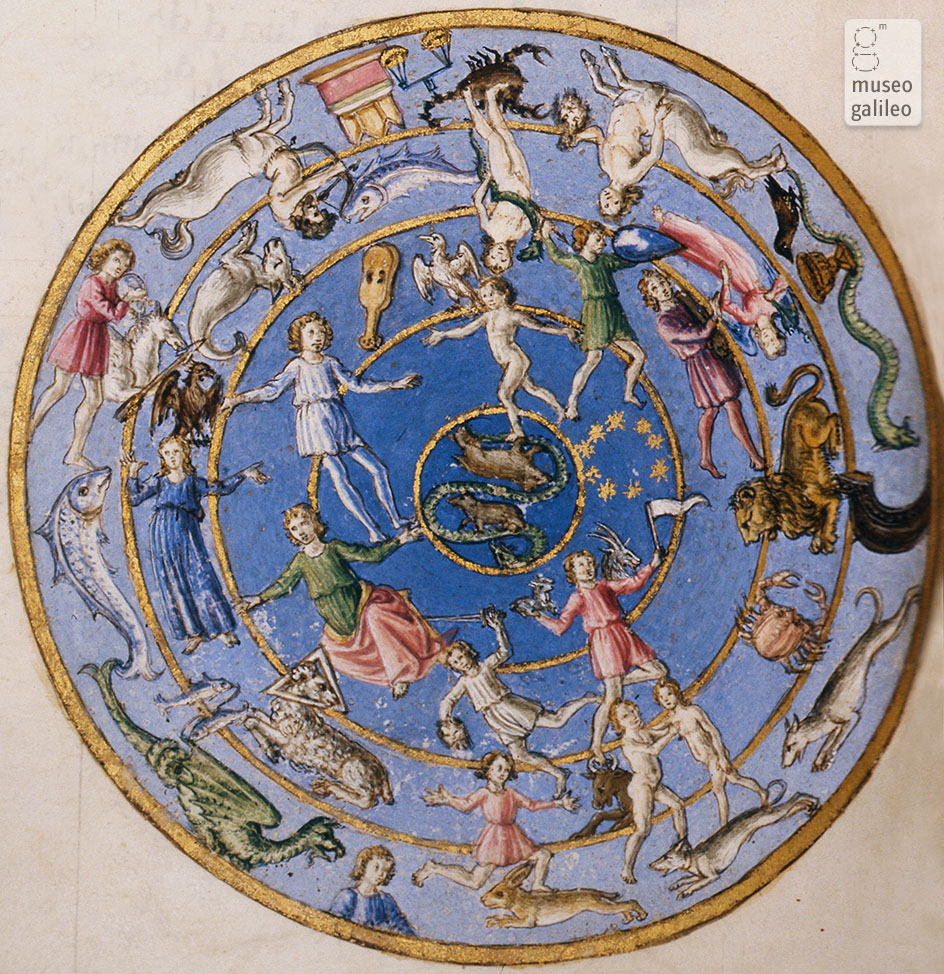
You mention the Florentine Triumphs of Eternity as an influence on Robertet. I assume you mean the multi-leveled arc with the earth below. Robertet does have that arc, if below not a landscape, but just a decapacitated Time and broken symbols of the other four triumphs. The layers are those of the various spheres of the cosmos in which the elements (fire painted red sometimes), planets and stars are situated, all the realms that are in time, ending in the Primum Mobile, First Moved, above which is the Empyrean, outside of Time and apparently without motion (but in which the Trinity and Mary are not statues!), if "Primum Mobile" is taken literally. I am not sure how many layers Robertet's has - 6 to 9, I'd guess, and also that the number was not very important to him.
Image
12148EternityArc.jpg 12148EternityArc.jpg Viewed 165 times 131.13 KiB
If you look at Triumphs other than Eternity in various series of six, they sometimes have the triumphal figure standing on a circle. These circles invariably lack layers: so it is just the earth, conceived as a sphere. See for example, Fame in https://gallica.bnf.fr/ark:/12148/btv1b ... 2/f82.item, compared to Eternity, https://gallica.bnf.fr/ark:/12148/btv1b ... /f106.item. Time also stands on a world, https://gallica.bnf.fr/ark:/12148/btv1b ... 2/f98.item, here assimilated to Cronos devouring his children, in the Chronos/Cronos identification.

If the "12148" is a ms. number, it is one that Cohen doesn't list, at least not with that number 12148. When you click on the word "about" on the left side of the BnF's page, the information that comes up is that of BnF Ital. 548. Moreover, if you then search for 548, what comes up is https://petrarch.mml.ox.ac.uk/item/1208; it describes some triumphs and gives a link, but the link says 12148. That ms. in fact has the number "548" written right on its first inside page, https://gallica.bnf.fr/ark:/12148/btv1b ... 42/f2.item. Moreover, 12148's children-eating Time appears in Cohen's book as that of 548, while its Fame appears in Les Tarots Enlumines, 2022, as from the same ms. So it is a fairly safe assumption that 12148 = 548.

Cohen in her Appendix says that 548 was done by Chierico in 1476, has Lorenzo de' Medici's device of a diamond ring in f. 1, with a man leaning on a laurel tree (it does: https://gallica.bnf.fr/ark:/12148/btv1b ... .item.zoom), and was taken to France by Charles VIII in 1494. (She doesn't cite a source, but one is Pellegrin, whom I quote at length at viewtopic.php?p=16250#p16250). So it may well be that Robertet's arc (below) is taken from that ms.
Image
12148EternityArc.jpg 12148EternityArc.jpg Viewed 165 times 131.13 KiB
I include above the three figures of Faith, Charity, and Hope on 548's chariot. They are represented the same as in the Modrone, but also in Florence (by the Pollaiuolos and others).

I leave this issue with another problem. What do we make of the BnF's descriptions of 548 ( https://petrarch.mml.ox.ac.uk/item/1208), which do not correspond to the illustrations in the link to 12148? It says "Temporis showing the Taurus constellation and the sun (fol. 48r), Eternitatis showing the representation of the earth surrounded by heavens (fol. 52r)." The former corresponds in a very rough way to that in their ms. 594, where some constellation is on the (female) personification's flag. The latter does not. What ms. are they describing?


Now I will try to do what Nathaniel suggested, looking at the Robertet images and identifying features that are shared by the Visconti di Modrone (VdM, Cary-Yale, CY) and Italian images. Since the artist might have been influenced by cards as well as mss., I include them, especially ones that ended up in France. Here are Robertet's triumphs of Chastity and Eternity, next to the VdM card..
Image
RobertetChastityEternityVisWorld2.jpg RobertetChastityEternityVisWorld2.jpg Viewed 165 times 207.38 KiB
I include Chastity for the contrast: hand positions lower, but with the same palm branch. What is similar between Eternity and World are the crown, the hand positions, and the fact that it is a female personification. The arc behind Eternity has some similarity to the arc below the World's personification, but with the difference already discussed.

That leads to the hypothesis that Robertet's Eternity was influenced by something inspired by or inspiring the Modrone World. I do not see how we can say when that something was, whether before or after the VdM World, or even whether it was a card or a Petrarch illustration.

So I looked at images of World and Eternity with similar hand positions, and with somewhat similar objects in both hands. Typically, the ms. miniatures have a bearded figure, sometimes holding one hand up in the sign of blessing and one hand down, holding a book or an orb. Occasionally he has both hands raised, so that his arms are at least horizontal, but he is just displaying his stigmata, perhaps holding a cross in one hand or occasionally even being nailed to a cross. None of these are very similar to Robertet.

However, two equally horizontal hands, displaying two objects, is seen on other triumphs, e.g. Scheggia's birth tray of Fame (sword and little Cupid, https://www.metmuseum.org/art/collection/search/436516), Zanobi's Triumph of Fame (sword and scales, https://commons.wikimedia.org/wiki/Petr ... 1465-2.jpg) and Apollonio's triumph of Pudicizia in Strozzi 174 (book and branch, http://www.bml.firenze.sbn.it/animalifa ... i_174.html).

Also similar are cards. With two objects, the vertical scepter and the more compact orb, similar in symbolism to the crown, I find the Charles VI, which ended up in France. But one of the hand positions is different. (I ignore the octagonal halo for now, which may indicate that it is a personified virtue, or just that it is an allegorical personification.) Looking at hand positions, I find the Bolognese World and Wheel, which also ended up in France. Both hands are of males. In between is the Minchiate World, also male, but with a crown in one hand. Minchiate was popular in Rome, and there were many comings and goings between Rome and France.
Image
WorldChVlMinchBolWorldWheel.jpg WorldChVlMinchBolWorldWheel.jpg Viewed 165 times 234.6 KiB
It seems to me that the hand positions on the cards are related to where the top of the vertical object - branch or scepter - needs to end up. If a long object is desired, the hand is lower. This is a natural compositional principle. No connection to the VdM, however distant, is required, although it remains possible. If there is one, it can be distant as much as immediate.

In all these cases, the card is second to last in the sequence, so not evidence for the VdM card's being last. I am not convinced that any of these examples, except the VdM, illustrates a Petrarchan triumph. The Charles VI personage visually matches that of the guide in Boccaccio's Amorosa Visione precisely. A similar interpretation applies to the Minchiate example. The crown and upward-pointing arrow indicate the state of being victorious over the world and its temptations. That puts one on the path to Eternal Glory. But it is not the victory of Eternity. The Bolognese example is probably similar, but it is hard to say what the figure at the top is supposed to represent. The later colored version of the 17th century version seems to be Mercury, who took Psyche to Olympus, so perhaps having the same function as the Florentine figures.

There are other Robertet images to be taken into consideration: Time, Fame, Love, Wheel, at least. I will get to them. Moreover, everything here is tentative, because of the number of mss., French and Italian, whose images we have not yet seen. (While I am at it, another Florentine ms. taken to France is BnF Ital. 545, at https://gallica.bnf.fr/ark:/12148/btv1b ... 7z/f1.item. Another is BnF Ital. 549, which I have discussed elsewhere in this forum: its only triumph-related image is one of Cupid aiming his arrow at Petrarch.)

Added Nov. 12: According to Franco Simone, 545 belonged to Pope Clement XI (p. 225 of The French Renaissance, 1969). Clement died in 1721. 449 belonged to Cardinal Mazarin (1602-1661 "and so could have entered France at the time of the Italian wars, but there is nothing to prove this with certainty."
Last edited by mikeh on 12 Nov 2023, 10:33, edited 3 times in total.

Re: Petrarca Trionfi poem motifs in early Trionfi decks

125
I have a few more comments about how Petrarch's Eternity relates to the Judgment/Angel card. Natheniel wrote, of which I am commenting on the parts in bold:
Yes, it's true that its Eternity shares a couple of elements with the Visconti-Sforza Judgment/Angel card, but certainly nothing so unusual as to indicate an important link between them. The Time illumination in Barb.lat.3954 is somewhat similar to the Old Man card, and Death has the uncommon bow and arrow of the Visconti-Sforza image, but there is nothing of any real significance beyond that. In this case, just as in the case of Barb.lat.3943, I am essentially in agreement with Ross: these features are not compelling enough to indicate anything more than the fact that the illuminations come from the same place and roughly the same era as the Lombard cards, and consequently sometimes make use of similar iconography for the same or similar subjects. Crucially, they don't mean that the Visconti-Sforza Judgment card was necessarily thought to represent Eternity. I would not rule out that possibility completely, but it seems very unlikely that all six Petrarchan Trionfi were ever present in that deck, as there is no surviving card that plausibly corresponds to Chastity. So even if the cards retained some lingering associations with Petrarch's poem cycle at that stage, it seems unlikely that the poems were still considered important or central to the game by those who designed that particular deck, and their Judgment card may simply have been a depiction of the Last Judgment, with no further meaning intended.
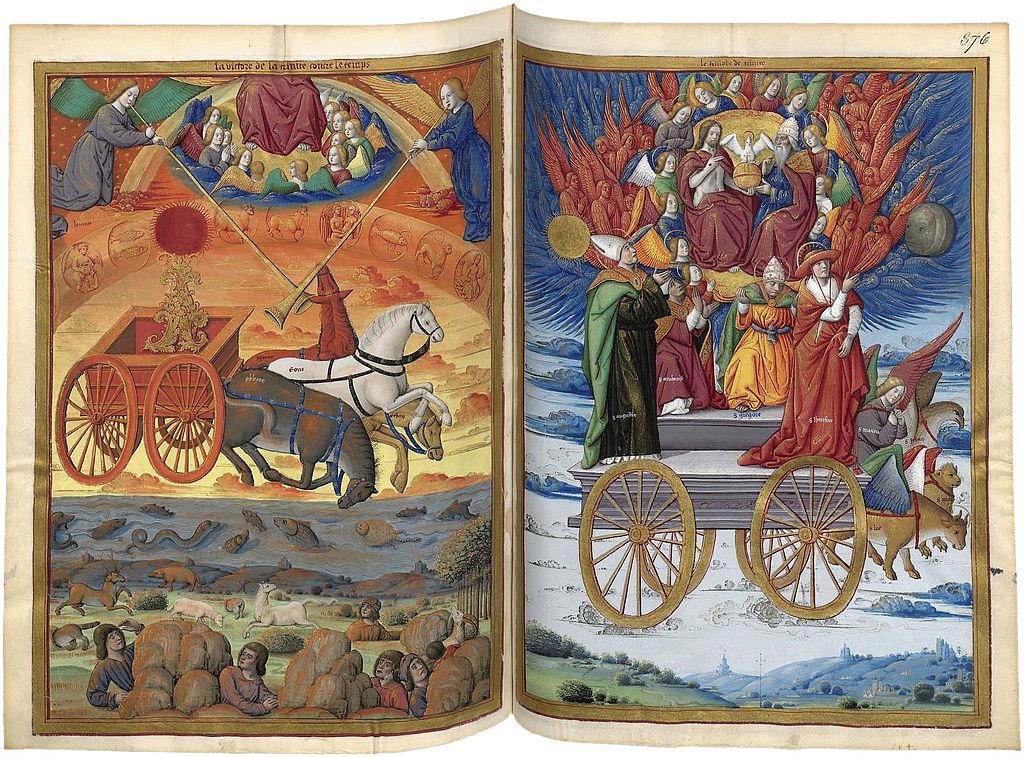
Here I would observe that several other series of Petrarch Triumphs illustrations, besides 3954, convey the sense of the Last Judgment in their Triumph of Eternity. Let me quote from Anna Rita Fantoni in Tarots Enlumines, 2022, p. 108, about a relatively early Triumph of Eternity, attributed to Apollonio di Giovanni in 1442, that of Biblioteca Medicea Lauriziano, Mediceo Palatino 72, https://commons.wikimedia.org/wiki/Cate ... ernity.jpg:
Le triomphe de l'Eternité dépourvu du char mais dérivé du Juugement universal, figure l'univers ptolémaique sur lequel s'appuient Dieu le Pere et les anges: un type de représentation present dans autres manuscrits et également sur certains panneaux de cassoni.

The Triumph of Eternity, devoid of the chariot but derived from the Universal Judgment, depicts the Ptolemaic universe on which God the Father and the angels lean: a type of representation present in other manuscripts and also on certain Cassoni panels.
There are other depictions of the Triumph of Eternity in terms of the Last Judgment: the left-hand side at
https://upload.wikimedia.org/wikipedia/ ... ernity.jpg; https://upload.wikimedia.org/wikipedia/ ... ernity.jpg, https://commons.wikimedia.org/wiki/Cate ... ernity.jpg.

Now I want to look at the Robertet's other images of Petrarch's Triumphs. What I am trying to see is whether they point to a lost ms. of the time of the earliest tarot. Nathaniel says:
Consider also the unusual similarities between the Robertet Love, Time, and Wheel of Fortune images and the early tarot cards of the Milanese tradition. In the case of the Wheel of Fortune, I think these should be obvious. In the case of Love, the most significant feature is that he holds a long arrow like a javelin instead of firing it from his bow. As for Time, he not only holds an hourglass and walking stick (already a highly unusual way of representing Time in this period) but also wears a head covering (something virtually never present in depictions of the Triumph of Time, except those on tarot cards, where it is almost always present) and has a large object hanging from his belt in about the same position as the similarly-sized pouch of the BnF and Bolognese Old Man figures.
There are many Petrarch illustrations that show Cupid holding an arrow instead of having it on a drawn bow. In most, it is not long like a javelin. However, there is the Venetian Banco Raro 103, of which the French woodcut (though with a shorter arrow) is an indication of a copy's arrival in France (download/file.php?id=2788). But Nathaniel may have a point: there might have been an early Petrarch ms. with this feature; alternatively, the Robertets might have seen a copy of BR 103, or of the Milanese card, as several copies seem to have been made.

The same is true of the features of Time: the hourglass, the head covering, the walking stick. I know of only one Triumph of Time with these features, that of Vind. 2649, https://digital.onb.ac.at/rep/osd/?1129156F, said by Cohen to be "North Italian" of 1459. Otherwise, the Robertet image points to a knowledge of some version of the Vecchio card with all these features: so the French card found by Lambert, or the Venice-Ferrara sheet (3rd from left below), both seemingly derived from the Visconti-Sforza (2nd from left). Or a lost manuscript using such images. Here the cards seem to me more likely. Soldiers like to play cards and would be attracted to new decks and games. Many were in northern Italy during the forays of Charles VIII and Louis XII. The "large object hanging from his belt", as Nathaniel points out, is similar to that of the c. 1500 French card found by Giselle Lambert of the BnF and the Bolognese image also in France. But rather than a ms., why not the cards themselves, which appear to be cheap woodcuts?
Image
WheelRobertetSforzaBudaBrandt.jpg WheelRobertetSforzaBudaBrandt.jpg Viewed 165 times 255.33 KiB
For the Wheel of Fortune, I need to quote Nathaniel's earlier post:
The Trionfi illustrations, which are at the very beginning of the Robertet book, are directly followed by a Wheel of Fortune which likewise shares an exceptional number of features with the Wheels in the early tarot decks (although the Robertets have augmented the image by adding other very different features, primarily the figures of Fortune and Reason). I know of no other non-tarot image of the Wheel of Fortune that shares so many features with early tarot cards as this one, despite my best attempts to find one: I have now seen a very great many, but nothing quite like this.
In one way the Ferrara-Venice card (3rd below) is visually more similar to Robertet than the Milanese examples, in having a full animal on top, half-animals on the side, and a full person on the bottom. But the Visconti-Sforza card (2nd) and Brera-Brambilla at least have donkey-ears on two of the figures and the tail on a third, as well as Fortuna herself. Again, it seems reasonable to me that the Robertets could have seen such cards.
Image
The attachment WheelRobertetSforzaBudaBrandt.jpg is no longer available
For non-tarot images, a tradition of four figures on the wheel is already shown by the Carmina Burana ms., with the same banderoles, the person on the bottom perhaps off the Wheel, and again, without banderoles in Christine de Pizan, 1455 (see https://en.wikipedia.org/wiki/Rota_Fortunae). Giving the one going up the head of an ass, the one down the body of an ass, and making the one on top a complete ass, is in the Narrenschiff, 1494 (far right above) with many editions thereafter. In this way it is like the card of Venice and Ferrara. There are similarities and differences to the Robertet in all of these. The Robertet could be a composite. But more likely they saw a copy of the early Milanese card, or else, as Nathaniel says, there was a ms. that used that image, and went from there based on others, because they are the only ones that have all the elements in the Robertet.

Nathaniel goes on:
Does the presence of a very tarot-like Wheel of Fortune next to the Trionfi in the Robertet manuscript mean that the Wheel must also have been present in the original proto-tarot? No, not necessarily. What the Robertet images tell us is that in the place in Italy where those images were first made, Love, Time, Eternity, and the Wheel of Fortune were sometimes depicted in much the same way as images we see on certain tarot cards from that era. The Wheel might have been present in a Petrarchan proto-tarot, but Français 24461 cannot be taken as evidence of that, and I am still very much inclined to doubt it, because the Wheel does not seem like a natural fit for a trump sequence based on Petrarch's Trionfi (unlike the Last Judgment, or the cardinal and theological virtues).
According to Cohen (p. 77, n. 38), three Triumphs of Time have Wheels of Fortune in them: One is a Neapolitan edition of Petrarch from the second half of the 15th century, https://www.researchgate.net/figure/Tri ... _345170277, MS. 78 D 11, fol. 204r, Berlin, Staatliche Museen, Kupferstichkabinett. Notice the animals pulling the chariot: elephants, for the fame of good fortune, and deer for the destructiveness of time. To make sure the image is really a triumph of Time, it would be good to see it in the context of the rest of the ms., but I can't seem to find a reproduction online. Another Triumph of Time where Cohen finds a Wheel of Fortune is Pencz, 1515-1550, https://www.researchgate.net/figure/Geo ... _345170277. All I see is a wheel sticking up from a mill in the background, which is hardly a Wheel of Fortune, but may suggest one. The third is in BR 103, f. 57v. Well, the image that Carandente shows of the Triumph of Time (viewtopic.php?f=11&t=906&p=26086&hilit=103#p26086) does not have one; but perhaps the ms. has more than one illustration of this triumph.

Following Panofsky in Studies in Iconology , Cohen argues for a close connection between Fortune and Time, by way of the ancient concept of Kairos, Occasio in Latin, Opportunity, the right time, the time to be seized to better one's condition. Panofsky and Cohen reproduce a ca. 1400 illustration of "Mere Nature, Temps," https://www.researchgate.net/figure/Mer ... _337561652. She is at the top of a large Wheel of Fortune, at the bottom of which is a "Fortuna Meretrix." Panofsky (p. 79, in archive.org) says that this "Temps" has three heads - i.e. past, present, future - and four wings, for the four seasons. So historically there is a close association between the Wheel and Time. The triumphal nature of Fortune is almost a medieval commonplace. And of course Boccaccio made Fortune one of his triumphs (along with Wisdom, Worldly Fame, Love, Wealth, and Death, the latter a companion of Fortune), in a work closely paralleling Petrarch's, with no Triumph of Time per se.

These are reasons for having a Wheel of Fortune in a book illustrating Petrarch, who has none - and also for supposing the Wheel part of the original Tarot. But such a card is by no means necessary. For 14 total, one or four of the trans-national dignitaries (predecessors "VIII Imperatori" and Karnoffel) suffice, along with four or seven virtues. An example with just one dignitary, the Emperor (as the only trump) is the 1450 Spanish game described by Ross (https://www.academia.edu/6477341/_El_ju ... _card_game). Its author had studied in Florence in the early 1430s.

Finally, I want to say something about the Pudicizia image (Chastity in some manuscripts) in the Modrone, the jousting shield. It has notches in it, one on each side. The French ms. 594's Chastity lady also carries a shield with two notches in it. The detail about the notches, or anything suggesting them, is not in Petrarch. So where did the French ms. get it? I don't think he saw anything like the Modrone image, because the notches are on the same side of the shield, rather than on opposite sides. But he heard about it from someone; the question is, what did that person see, the Modrone card, recognizing it as of Petrarch's Pudicizia, or from a manuscript that used the image? The latter seems more probable, because the shield takes some familiarity with Petrarch to interpret. If so, it is a manuscript so far unknown to us
Image
The attachment WheelRobertetSforzaBudaBrandt.jpg is no longer available
Even if there was a 15th c. Italian manuscript with at least some Modrone-type images, including the Modrone's Charioteer and World-lady, it still does not follow that the World-lady was meant to stand for Eternity in that manuscript. By the time of the manuscript, the World card in Milan, as well as Ferrara, Venice, and France, could have been last in the sequence. So the manuscript might have been adjusted to then-current practice. Either that or the Robertets, assuming that they had Milanese, Ferrarese or French cards at their disposal and knew their order.

Conclusion: The manuscripts that Nathaniel cites, as well as others, do make a good case that at least six of the cards were at least seen by the miniaturists and their patrons in terms of Petrarch, perhaps supplemented by Boccaccio. That is not the same as saying that those six actually did derive from Petrarch's poems. In my view what points to an actual derivation from Petrarch is (1) the name of the game, (2) the coincidence of its documentation with the explosion in Petrarch Trionfi manuscipts, (3) the titles Love and Death, and (4) that four other cards not virtues or dignitaries, three in the Modrone supplemented by one more in the Visconti-Sforza (Time), seem to include details on early cards that correspond, in important ways and in the symbolism of the time, to the themes of Petrarch's poems. Illustrations in the Petrarch manuscripts, and others, are useful for identifying how Petrarch's words, sometimes supplemented by Boccaccio on the same theme, have been translated into visual imagery on the cards. So we have:

Love: Cupid with bow and arrow(s) above pairs of men and women
Pudicizia: Woman with shield.
Death: skeleton with an instrument of death.
Fame: woman with sword and orb, or with one or more trumpet, on a chariot; figure somehow encompassing a circle or semi-circle indicating our world of striving, but just one arc, no additional layers.
Time: old man with a device to help him walk. Possibly the sun or sun-god.
Eternity: trumpeting angels and souls coming from graves. Above, perhaps one or more members of the Christian Trinity.

Since originally posting, I have, a few hours later, added images for Time and Pudicizia, from Robertet and related tarot cards, reworded the conclusion slightly, and added one more paragraph just before it.

Re: Petrarca Trionfi poem motifs in early Trionfi decks

126
Huck wrote, about Vat.Barb. 3954
If I follow this "Barb.lat.3954", I get this page ...
https://petrarch.mml.ox.ac.uk/item/1512
.... titled "Vatican City, Biblioteca Apostolica Vaticana, Barb. Lat. 3954"
The "Notes" text of this webpage contains the following sentence: "information unrelated to Petrarch (e.g., fol. 128r: ‘1447 die 27 ap[r]ilis hora se[con]da noctis aduenie[n]te die uene[r]is 28 obijt d[ominus] aloisius de s[anc]to Seuerino i[n] m[edio]l[an]o du[m] hec sc[ri]berem’).
Probably it means, that something was written at 27th April 1447 by an Aloisius of Sancto Severino or similar. I don't find a note of Robertet.
Image
Somehow added at the sidebar. I don't know, what this means for the dating of the text.

I find this name "Aloisius of Sancto Severino" connected with the date 1471 here ....
Catalogue des Livres Imprimez de la Bibliotheque Du Roy 1739
https://books.google.de/books?id=qQYDto ... no&f=false
Probably a text stolen from Milan by the French king.
And:
Huck wrote: 02 Aug 2023, 12:26 I just added something ... I personally think, that the correct dating is very important. Is 1447 correct?

Added again ...

I found a Luigi Sanseverino and who died indeed in April 1447 ... it was a condottiero.
https://condottieridiventura.it/luigi-da-san-severino/
1447
Gen. Lombardia Assale un piccolo castello al di là dell’Adda. E’ catturato con alcuni cavalli da soldati usciti per una sortita da Cassano d’Adda.
Apr. Lombardia Muore a Milano dopo una lunga malattia causata da una vecchia ferita.
Then we discussed Cohen, who dates 3943 later, mainly in relation to the Lombard ms. with "G Z" at the bottom, dated to 1461. Barb.Lat. 3943 and 3957 are closely related. Some seem to date 3943 by reference to 3954, which would be later (see below). Cohen does not mention 3957.

Then Nathaniel wrote,
Cohen's information in the appendix to Transformations of Time and Temporality is not entirely reliable. I have found several errors in it, which were mostly carried over from earlier sources. Ms. Barb.Lat.3943 was attributed to the Master of the Vitae Imperatorum (or at least his workshop) not only by Samek Ludovici and Trapp, but also by Carandente in I Trionfi nel primo Rinascimento (Turin: ERI, 1963), p. 52.
I would add: and not only them. There is also Stanko Kokola, 2006, at https://books.google.com/books?id=8TkrD ... &q&f=false and the catalog Il Potere, le arti, la guerra (Donati, 2001), which says, on p. 304, c. 1445-1450:
https://books.google.com/books?newbks=1 ... =1445-1450.
Admittedly, this snippet does not say what the work is; for that, here is the rest of the page (I got it from interlibrary loan, but the scan cut off some of the part in the snippet).
Splendor_di_Malatesta_304-5resize.jpg Splendor_di_Malatesta_304-5resize.jpg Viewed 165 times 379.52 KiB
I have a higher resolution version of this scan if anyone is interested: I resized it to fit this forum.

On the other hand, there is Cohen (p. 326):
On fol. 17 a beautiful page shows Laura crowning Petrarch with a coat of arms and the initials GS in the frieze below. the manuscript is exceptional due to its brilliant areas of solid colors with gold highlights and decorative style that identify it as a lombard work. The arms and initials of Giovanni Sforza, lord of Pesaro (1466–1510) must be a later addition to the manuscript. It is likely that the miniatures were executed in the 1460s, at the time Trivulziana cod. 1329 was illuminated for Galeazzo Maria Sforza (1444–76) in the same style (cf. fol. 1 of cod. 1329 in Bologna, 1973, 39). Arms
of the Malatestiani precede the rime of Malatesta de’ Malatesti (243r).
"Bologna" is Giulia Bologna, author of the Trivulziana exhibition catalog. The attribution to the 1460s would seem to be based mainly on the similarity of Barb.3943's picture of Laura crowning Petrarch with the 1461 illustration of the author of the manuscript in question to either Galeazzo Maria Sforza, as suggested by the initials GZ at the bottom, or Francesco Sforza, as suggested by the balding middle-aged appearance.
Triv.1329_Vat.3943resize.jpg Triv.1329_Vat.3943resize.jpg Viewed 165 times 379.85 KiB
Another consideration, dismissed by Cohen, might be the "G...S" in Barb.3943 - Giovanni Sforza. He securely had the ms. in his library, but wasn't even born until 1466. There is also the stemma between the G and the S, pretty securely identified with Sforza. And there is what Huck found about Aliosis in 1471.

The similarity between the two images is striking. But workshops, if they keep the preliminary sketches, can reuse old ideas at a later time. So what are the arguments for the 1440s? And do they take into account the GZ manuscript?

So far I have only been able to examine one Trapp article, the one on Laura - which merely asserts his dating without providing justification - and the Donati 2001 catalog entry. The latter (p. 304) has a lengthy commentary on Barb. 3943 justifying its dating. It explains that beneath the "G S" initials and stemma can be seen an erased by still legible other set of initials - A N - and a different stemma, that which the author identifies as of the Meraviglia family.
Lo stemma sforzesco si sovrappone a uno precedente, scaglionato d’oro e d’azzurro, che credo identificabile con quello della famiglia Meraviglia di Milano, accompagnato dalle iniziali AN. Il medesimo blasone e le stesse iniziali, erase ma ancora leggibili, compaiono nel Ms. 2574 della Biblioteca Universitaria di Bologna, che pure contiene il Canzoniere di Petrarca, le rime di Serdini e di Malatesta de' Malatesti (Trolli 1982), ed e anch’esso miniato da una mano lombarda, con iniziali a girari bianchi su lacunari rossi, verdi, blu e rosa carico, analoghe a quelle che compaiono nel volume vaticano, sia pure di qualita piu modesta.

The Sforza coat of arms overlaps with a previous one, staggered in gold and blue, which I believe is identifiable with that of the Meraviglia family of Milan, accompanied by the initials AN. The same coat of arms and the same initials, erased but still legible, appear in Ms. 2574 of the University Library of Bologna, which also contains Petrarch's Canzoniere, the rhymes of Serdini and Malatesta de' Malatesti (Trolli 1982), and also is illuminated by a Lombard hand, with initials in white scrolls on red, green, blue and deep pink coffers, similar to those that appear in the Vatican volume, albeit of more modest quality.
Here is the detail in question, in Barb.Lat.3943:
Image
Splendor_di_Malatesta_3-pages-8-page-001DET1.jpg Splendor_di_Malatesta_3-pages-8-page-001DET1.jpg Viewed 165 times 72.06 KiB
There does seem to be something behind the Sforza stemma, once I lighten up the image. And red, blue, and green do seem to predominate in the decorations.

You can read about the family at https://www.heraldrysinstitute.com/lang ... it/#scheda. The stemma as they show it is not notable for red and green, except in the feathers, or whatever they are, at the top, which are indeed those three colors..

Wikipedia's article on the Ambrosian Republic lists one member of the family as part of the original governing body of the Republic. They were an old patrician family still very rich in the mid-15th c.

On this line of thinking, the "G.S." and Sforza stemma is a red herring as far as dating the manuscript: they only confirm its later possession by this Pesaro ruling family (from 1447, under Alessandro, but more likely after 1466, when Giovanni was born).

All of the art historians except Cohen tie the dating of Barb.3943 to that of Barb.3954. The contents of the two mss. are virtually the same, and the style suggests the same workshop, but Barb.3954 is on paper rather than vellum, and confines its Trionfi illustrations to the insides of the incipits (initial letters). The defenders of the 1440s mostly cite I codici Petrarcheschi della Biblioteca Vaticana: seguono cinque appendici . . . by Marco Vattasso, 1908. This book is in Google Books and archive.org. In it, on p. 149, we find, as noted by the Donati 2001 catalog entry, about 3954:
Il codice con un sol verso per rigo venne esemplato a Milano verso il 1447; così, infatti, si legge a car. 128 r: 1447 die 27 aprilis, hora secunda noctis, adveniente die veneris 28, obijt d. Aloisius de sancto Severino in Mediolano dum hec scriberem.
This passage is probably the basis for the quote that Huck noted in what I put by him at the start of this post: "1447 die 27 ap[r]ilis hora se[con]da noctis aduenie[n]te die uene[r]is 28 obijt d[ominus] aloisius de s[anc]to Seuerino i[n] m[edio]l[an]o du[m] hec sc[ri]berem."

Looking on the Vatican website, I find it precisely on the page indicated by Vattasso and Huck's source, 128r:
Image
Barb.lat.3954_128r.png Barb.lat.3954_128r.png Viewed 165 times 145.03 KiB
The writing seems fairly contemporary with the text itself. The only issue I see is its odd placement, there as opposed to at the end of the document.

If the book itself was finished in 1447, that is good evidence that at least the unhistoriated (i.e. without the incipits) text was finished by then. If so, the incipits would not be much after, if not even before then (since the incipits stop considerably before the text does).

Another possibility raised by the author of the 2001 catalog is that both mss. were commissioned by the Malatesta family itself, before their ouster in 1443-1447. That would explain why the poems of their ancestor Malatesta de' Malatesti are included along with Petrarch's. That family's stemma is in the ms. too, Here are the two illustrations of him preceding his poems in the two volumes, 3943 on the left.
Image
Vat.Barb.Lat_3943_243r&3954_229rDetails.jpg Vat.Barb.Lat_3943_243r&3954_229rDetails.jpg Viewed 165 times 233.97 KiB
The author of the 2001 catalog, however, favors another explanation:
Mentre la problematica presenza dello stemma malatestiano nei due volumi di medesimo contenuto trova una plausibile giustificazione nella tradizionale iconografia araldica che evidentemente accompagnava i sonetti del signore di Pesaro nell'antigrafo e che tuttavia in ambito sforzesco era accolta e letta come segno della continuita tra il nuovo dominio e quello dell’ antica casata marchigiana (per questi problemi si veda il saggio di F. Lollini in questo volume). [SN]

While the problematic presence of the Malatesta coat of arms in the two volumes of the same content finds a plausible justification in the traditional heraldic iconography which evidently accompanied the sonnets of the lord of Pesaro in the antigraph, which however in the Sforza context was accepted and read as a sign of continuity between the new dominion and that of the ancient Marche family (for these problems see the essay by F. Lollini in this volume). [SN]
I did not think to scan the essay by Lollini. Well, I am re-requesting the book from Interlibrary Loan. SN says nothing about the Trivulziana image, so perhaps he or she wasn't aware of it.

The problem is, if Barb.Lat.3943, if not both, was done for the Meravigli family, how could this motive enter in? It is hard to imagine the Sforza asking the scribe and miniaturist to add the Malatesta poetry to what the Meravigli commissioned, especially in two places, by what appear to be two different artists. Perhaps I am misunderstanding the text.

As usual, I am left with evidence pointing in several directions. Those art historians who draw conclusions seem to ignore one or other part of the evidence: those who advocate a later date, like Cohen, ignore 3954. Those who advocate the earlier seem, at least from what I have read so far, to ignore the Trivulziana ms. Perhaps there is more evidence pointing one way or the other.

There is one other line of thought on these mss. that I don't think has been pursued. Barb.Lat.3943 and 3954 are notable for the different ways they present the Triumphs of Pudicizia and Death. Pudicizia has a shield in Barb.3943, as in the Cary-Yale Chariot card, while that of 3954 does not. Barb.3943's Death likewise is like the Cary-Yale's Death card, in showing high dignitaries being mowed down by Death (in 3943, it is going to happen, unlikely for those at the right, the poor people who look forward to death), while 3954 emphasizes the bowman, which is also the main feature of the PMB (although both mss. have a bowman). One thing I didn't notice is that Barb.3943's Death also has the three fates. So in both regards the Robertet images mirror Barb. 3943 and the CY: the shield and the three fates. Probably this line of thought is part of what Nathaniel had in mind. (For 3943's Death, see the end of my post at viewtopic.php?p=25903#p25903, where I have added it.)

But there is something else. The 1459 Pesaro series now in Vienna adds another parallel. It, like both Barb.Lat. 3943 and 3954, quite unusually, has a bowman for Death. Both the Vienna Pudiciza and Barb.Lat.3954 have a chained Cupid (and no shield) for Pudicizia, as well as her flag. Another parallel between these two (but not 3943, which only has the personification of the sun) is that for Time, both show an old man holding an hourglass with a solar representative in the sky. Moreover, the Pesaro Eternity shows below the main image a figure being lifted up by two winged putti, corresponding to Laura being lifted by two angels in Barb. 3954. Might these fairly unique parallels suggest that 3954 was one of the models for the 1459 Pesaro series? If so, it is earlier than 1460.

For the Barb.Lat.3954 images see my post at viewtopic.php?p=26053#p26053.
The Pesaro series is at https://onb.digital/search/635045. I can't seem to download the images.

Of the 1459 Pesaro series Cohen says that it was probably commissioned by Borso d'Este. That statement strikes me as needing justification: why would Borso go to an artist in Pesaro, when he had plenty at home? If they ended up in Ferrara, that would make sense. But it would be nice to know if that was Cohen's reasoning, or something else.
Last edited by mikeh on 21 Sep 2023, 12:04, edited 1 time in total.

Re: Petrarca Trionfi poem motifs in early Trionfi decks

128
I don't really want to get back into this discussion fully, as I am still nowhere near the point of being able to present my arguments in full detail. But there are a few observations that I can quickly make in reply to Mike's last post here.

The ms made in Pesaro in 1459 is not the one done for Borso d'Este: that is the other, closely related ms from Pesaro, now in Dresden, made in 1460, which has also been discussed in this thread. It was illustrated by the same artist as the ms from 1459, and it has Borso's arms on the first page.

I am glad you have noticed the iconographic similarities between the Lombard mss and the Pesaro mss. I'm of the view that there must have been some substantial influence from Lombard Trionfi illustrations on the Pesaro mss, due to these similarities. Remember when I said that it is highly unusual for Time to be shown with any kind of head covering (as he is shown in the Robertet ms) and you tried to refute this by pointing to the image in the Pesaro ms from 1459? As far as I'm concerned, the two Pesaro Time images are very much the exceptions that prove the rule: you will have a hard time finding any other examples of Time with a head covering in Italian illustrations, and those two Pesaro mss almost certainly have it only because they were influenced by images from Lombardy (or alternatively by images from elsewhere which were themselves, in turn, influenced by a Lombard tradition).

I am puzzled by your remark that "the Pesaro Eternity shows below the main image a figure being lifted up by two winged putti". You must surely be thinking of some other set of illustrations. There is no illustration for "Eternity" in either of the Pesaro manuscripts, nor is there any image that shows a figure being lifted in that way. The lack of an Eternity image in either manuscript is a very interesting feature of them, as I suggested earlier in this thread, because it looks very much as though the image which should be Eternity was revised in both manuscripts into a second Fame, entitled "Triumphus Virtutis". And this Eternity-turned-Fame image looks very much like it was descended from an Eternity image that shared significant features with the Robertet Eternity image. So this would be yet another link between the Robertet images and the Pesaro images, a link that can be most easily explained by both being ultimately derived from some Lombard tradition of Trionfi illustration.

(The Pesaro manuscripts, by the way, do not merely lack an illustration for Eternity, but suppressed Eternity entirely as a separate Triumph. Its verses are still there, but they are presented in both manuscripts simply as the "second chapter of Time" rather than as a Triumph in their own right. But of course both manuscripts still have six Triumphs, each with an illustration, because of the creation of the "Triumphus Virtutis". What I think happened here is that someone at some stage—probably in a manuscript that predates both of these surviving Pesaro creations—decided that the Robertet-style Eternity looked more like Fame than Eternity and restructured the cycle accordingly, creating a second Fame triumph and eliminating Eternity. Petrarch states quite explicitly that there are six Triumphs (in verses 121 and 122 of Eternity) which probably explains why the makers of the mss felt the need to create the new Triumph, rather than just dropping Eternity.
It is likely that there was another prior intermediate stage in which the Eternity image was simply moved to the Fame chapter without actually suppressing Eternity as a triumph or creating a second Fame triumph. So at that stage, Eternity would have still been present but lacking an illustration, while Fame had two; the Pesaro restructuring would then have been an attempt to "improve" that uneven situation. One reason I think this to be likely is because there are other manuscripts that contain the second Eternity-style Fame image, but they also retain Eternity as well; however, those manuscripts also provided Eternity with an illustration to take the place of the one that was (probably) moved.)
Last edited by Nathaniel on 21 Sep 2023, 16:38, edited 1 time in total.

Re: Petrarca Trionfi poem motifs in early Trionfi decks

129
I should perhaps also note—even though I think I have already said this before in this thread—that when I say that someone thought that "the Robertet-style Eternity looked more like Fame than Eternity", I think it is likely that the Eternity image they were looking at did not look exactly like the Robertet one. Rather, I think the female figure must have been holding the winged trumpet of fame in her right hand, as in the VdM version of this image, rather than the palm frond that is there in the Robertet version. This seems the most likely explanation why someone would think that an Eternity illustration should be an illustration of the Triumph of Fame.

The only puzzling thing is that none of the "Eternity-turned-Fame" images in the surviving manuscripts show the female figure holding the winged trumpet, and one or two of them—like the one in the Dresden manuscript—actually show a depiction that looks even more like Eternity than the VdM image, despite being presented as a kind of Fame. So I'm inclined to conclude that someone in the chain of artistic influence that led to the Pesaro mss must have (a) been familiar with manuscripts containing these "Eternity-turned-Fame" images and (b) must have been specifically influenced by a manuscript that had an Eternity illustration of that type, and they simply transposed the image from the Eternity section to the Fame section because it looked so much like those other "Eternity-turned-Fame" images, even though the specific image they were transposing was much better suited to Eternity than to Fame.

It's a complex and admittedly confusing situation, and attempts to reconstruct what happened are not helped by the fact that the majority of the manuscripts produced would have been lost (only about 20% of the illustrated manuscripts created in the 15th century are estimated to survive). But this is the only explanation that seems plausible to me.

Re: Petrarca Trionfi poem motifs in early Trionfi decks

130
Thanks for your reply, Nathaniel. I will try to clarify. You wrote:
The ms made in Pesaro in 1459 is not the one done for Borso d'Este: that is the other, closely related ms from Pesaro, now in Dresden, made in 1460, which has also been discussed in this thread. It was illustrated by the same artist as the ms from 1459, and it has Borso's arms on the first page.
Cohen says that both Pesaro mss. were made for Borso. The one I am referring to is the one now in Vienna. I still do not know why she says that the 1459 was made for Borso.

You go on to say:
I am puzzled by your remark that "the Pesaro Eternity shows below the main image a figure being lifted up by two winged putti". You must surely be thinking of some other set of illustrations. There is no illustration for "Eternity" in either of the Pesaro manuscripts, nor is there any image that shows a figure being lifted in that way.
By "Eternity" I am referring to the illustration at https://onb.digital/result/1129154D. I can download the thumbnail, which is below, along with the corresponding image in Vat.Barb.Lat. 3954 (the putti unfortunately are not very vislble; it is better at the link just given)
Eternity3954plusPesaroVienna1.jpg Eternity3954plusPesaroVienna1.jpg Viewed 6895 times 64.21 KiB
By the figure being lifted up by two winged putti I mean the bearded figure at the bottom:
Vienna1129154D-thumbnailDET.jpg Vienna1129154D-thumbnailDET.jpg Viewed 6901 times 9.25 KiB
It would be worth knowing if he was anyone in particular, for example the commissioner of the ms. He looks the right age to be Alessandro Sforza, and not much like Borso.

That it is Eternity and not Fame is suggested by several factors. First, there is the fact that the figure is being lifted up by winged creatures, just like in Ms. Barb.Lat. 3954. Second, there is the fact that the central person on the ground in the main illustration is pointing upward. Third, there is the flame in the left hand of the figure on top, above the clouds. The flame is an attribute of Charity, as seen in the Cary-Yale card identified with that virtue (in her right hand) and also in the Minchiate Charity card (XVIIII). The allegorical figure has a sword in one hand, for the punishment of hell, and the flame of charity in the other, representing God's charity in granting admission to heaven.

It seems to me that this triumph illustration has been misplaced, probably due to the types of persons standing there, strongmen and scholars, giving rise to the impression that it is about fame, and also because (if I remember correctly) the text contains two sets of verses about fame. Especially, I cannot see how it belongs before the "other" image of Fame, which on the bottom shows the same figure, not going anywhere. Every other indication is that it refers to Eternity. Petrarch has no "triumph of virtue" among his six.

And whatever we call them, I am glad that we agree on the similarity of the images in this Pesaro ms. to the Lombard imagery of mss. 3943 and 3954 and the Lombard cards (which is not to say that there are not other influences on the Pesaro ms.). They suggest, albeit do not prove, that both 3943 and 3954 were in Pesaro then, whenever they got there.

About the 1460 Pesaro triumphs now in Dresden, I have to admit that I cannot find them on the internet. Nor does searching "Dresden" on this forum provide a link. I am not very good at locating contents of libraries other than the BnF, the BM, the British Library, and now the Vatican. Perhaps you have a link.