I have a few more comments about how Petrarch's Eternity relates to the Judgment/Angel card. Natheniel wrote, of which I am commenting on the parts in bold:
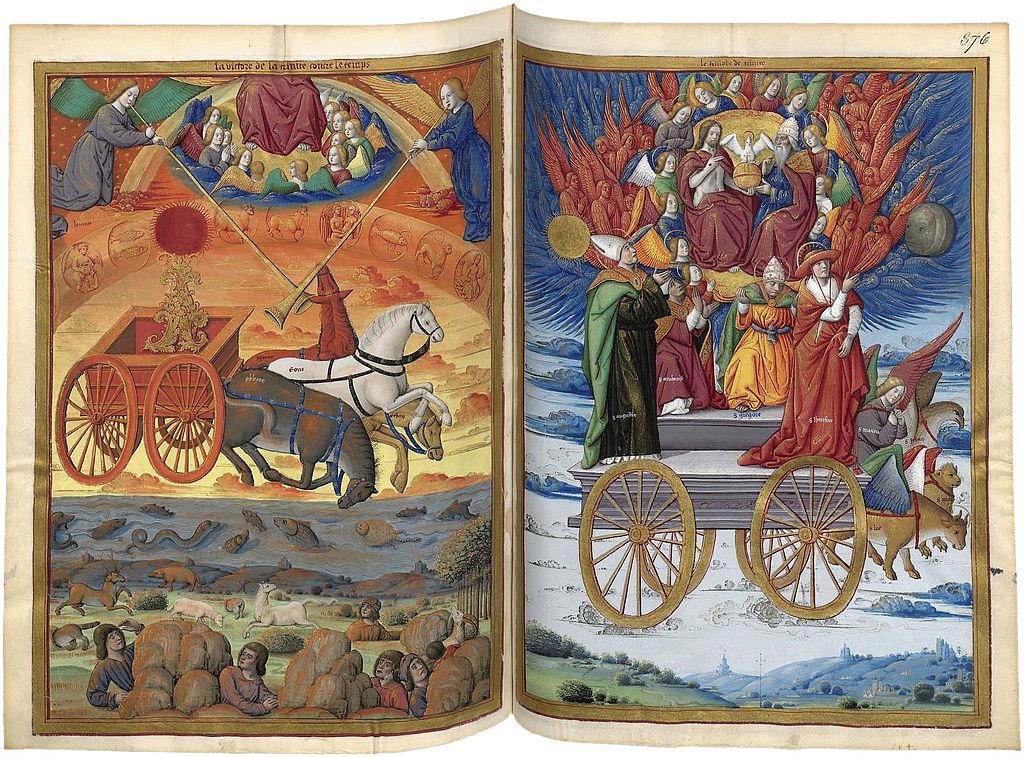
Yes, it's true that its Eternity shares a couple of elements with the Visconti-Sforza Judgment/Angel card, but certainly nothing so unusual as to indicate an important link between them. The Time illumination in Barb.lat.3954 is somewhat similar to the Old Man card, and Death has the uncommon bow and arrow of the Visconti-Sforza image, but there is nothing of any real significance beyond that. In this case, just as in the case of Barb.lat.3943, I am essentially in agreement with Ross: these features are not compelling enough to indicate anything more than the fact that the illuminations come from the same place and roughly the same era as the Lombard cards, and consequently sometimes make use of similar iconography for the same or similar subjects. Crucially, they don't mean that the Visconti-Sforza Judgment card was necessarily thought to represent Eternity. I would not rule out that possibility completely, but it seems very unlikely that all six Petrarchan Trionfi were ever present in that deck, as there is no surviving card that plausibly corresponds to Chastity. So even if the cards retained some lingering associations with Petrarch's poem cycle at that stage, it seems unlikely that the poems were still considered important or central to the game by those who designed that particular deck, and their Judgment card may simply have been a depiction of the Last Judgment, with no further meaning intended.
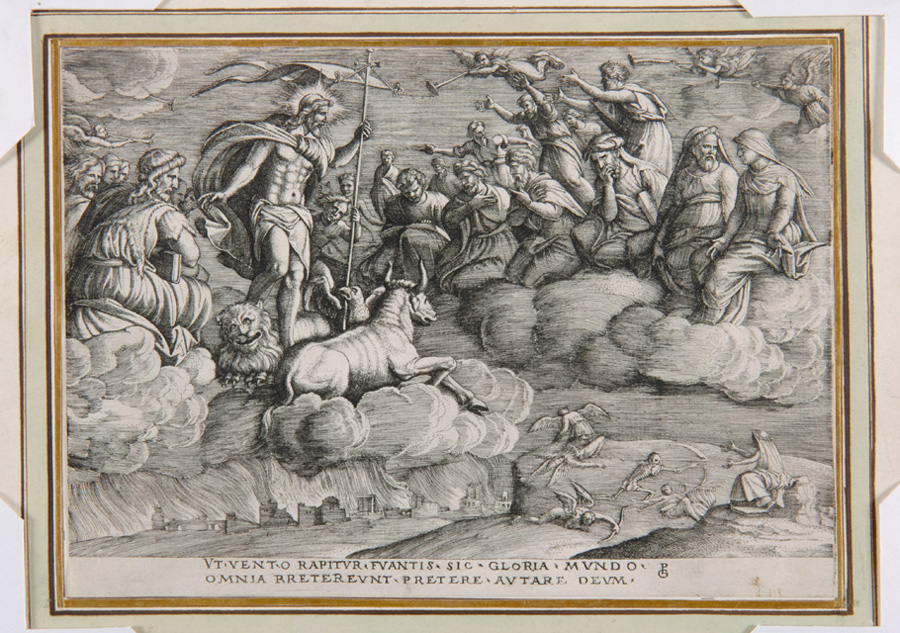
Here I would observe that several other series of Petrarch Triumphs illustrations, besides 3954, convey the sense of the Last Judgment in their Triumph of Eternity. Let me quote from Anna Rita Fantoni in
Tarots Enlumines, 2022, p. 108, about a relatively early Triumph of Eternity, attributed to Apollonio di Giovanni in 1442, that of Biblioteca Medicea Lauriziano, Mediceo Palatino 72,
https://commons.wikimedia.org/wiki/Cate ... ernity.jpg:
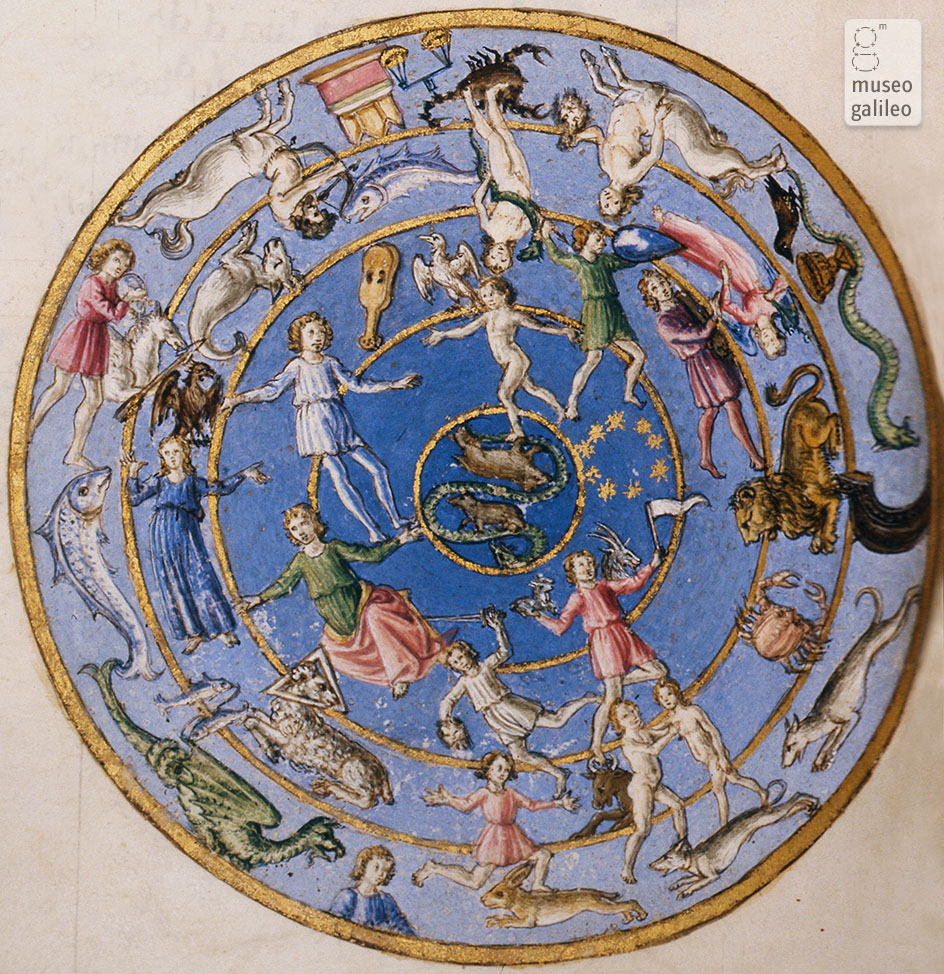
Le triomphe de l'Eternité dépourvu du char mais dérivé du Juugement universal, figure l'univers ptolémaique sur lequel s'appuient Dieu le Pere et les anges: un type de représentation present dans autres manuscrits et également sur certains panneaux de cassoni.
The Triumph of Eternity, devoid of the chariot but derived from the Universal Judgment, depicts the Ptolemaic universe on which God the Father and the angels lean: a type of representation present in other manuscripts and also on certain Cassoni panels.
There are other depictions of the Triumph of Eternity in terms of the Last Judgment: the left-hand side at
https://upload.wikimedia.org/wikipedia/ ... ernity.jpg;
https://upload.wikimedia.org/wikipedia/ ... ernity.jpg,
https://commons.wikimedia.org/wiki/Cate ... ernity.jpg.
Now I want to look at the Robertet's other images of Petrarch's Triumphs. What I am trying to see is whether they point to a lost ms. of the time of the earliest tarot. Nathaniel says:
Consider also the unusual similarities between the Robertet Love, Time, and Wheel of Fortune images and the early tarot cards of the Milanese tradition. In the case of the Wheel of Fortune, I think these should be obvious. In the case of Love, the most significant feature is that he holds a long arrow like a javelin instead of firing it from his bow. As for Time, he not only holds an hourglass and walking stick (already a highly unusual way of representing Time in this period) but also wears a head covering (something virtually never present in depictions of the Triumph of Time, except those on tarot cards, where it is almost always present) and has a large object hanging from his belt in about the same position as the similarly-sized pouch of the BnF and Bolognese Old Man figures.
There are many Petrarch illustrations that show Cupid holding an arrow instead of having it on a drawn bow. In most, it is not long like a javelin. However, there is the Venetian Banco Raro 103, of which the French woodcut (though with a shorter arrow) is an indication of a copy's arrival in France (
download/file.php?id=2788). But Nathaniel may have a point: there might have been an early Petrarch ms. with this feature; alternatively, the Robertets might have seen a copy of BR 103, or of the Milanese card, as several copies seem to have been made.
The same is true of the features of Time: the hourglass, the head covering, the walking stick. I know of only one Triumph of Time with these features, that of Vind. 2649,
https://digital.onb.ac.at/rep/osd/?1129156F, said by Cohen to be "North Italian" of 1459. Otherwise, the Robertet image points to a knowledge of some version of the Vecchio card with all these features: so the French card found by Lambert, or the Venice-Ferrara sheet (3rd from left below), both seemingly derived from the Visconti-Sforza (2nd from left). Or a lost manuscript using such images. Here the cards seem to me more likely. Soldiers like to play cards and would be attracted to new decks and games. Many were in northern Italy during the forays of Charles VIII and Louis XII. The "large object hanging from his belt", as Nathaniel points out, is similar to that of the c. 1500 French card found by Giselle Lambert of the BnF and the Bolognese image also in France. But rather than a ms., why not the cards themselves, which appear to be cheap woodcuts?
 WheelRobertetSforzaBudaBrandt.jpg
Viewed 165 times 255.33 KiB
For the Wheel of Fortune, I need to quote Nathaniel's earlier post:
The Trionfi illustrations, which are at the very beginning of the Robertet book, are directly followed by a Wheel of Fortune which likewise shares an exceptional number of features with the Wheels in the early tarot decks (although the Robertets have augmented the image by adding other very different features, primarily the figures of Fortune and Reason). I know of no other non-tarot image of the Wheel of Fortune that shares so many features with early tarot cards as this one, despite my best attempts to find one: I have now seen a very great many, but nothing quite like this.
In one way the Ferrara-Venice card (3rd below) is visually more similar to Robertet than the Milanese examples, in having a full animal on top, half-animals on the side, and a full person on the bottom. But the Visconti-Sforza card (2nd) and Brera-Brambilla at least have donkey-ears on two of the figures and the tail on a third, as well as Fortuna herself. Again, it seems reasonable to me that the Robertets could have seen such cards.
The attachment WheelRobertetSforzaBudaBrandt.jpg is no longer available
For non-tarot images, a tradition of four figures on the wheel is already shown by the Carmina Burana ms., with the same banderoles, the person on the bottom perhaps off the Wheel, and again, without banderoles in Christine de Pizan, 1455 (see
https://en.wikipedia.org/wiki/Rota_Fortunae). Giving the one going up the head of an ass, the one down the body of an ass, and making the one on top a complete ass, is in the
Narrenschiff, 1494 (far right above) with many editions thereafter. In this way it is like the card of Venice and Ferrara. There are similarities and differences to the Robertet in all of these. The Robertet could be a composite. But more likely they saw a copy of the early Milanese card, or else, as Nathaniel says, there was a ms. that used that image, and went from there based on others, because they are the only ones that have all the elements in the Robertet.
Nathaniel goes on:
Does the presence of a very tarot-like Wheel of Fortune next to the Trionfi in the Robertet manuscript mean that the Wheel must also have been present in the original proto-tarot? No, not necessarily. What the Robertet images tell us is that in the place in Italy where those images were first made, Love, Time, Eternity, and the Wheel of Fortune were sometimes depicted in much the same way as images we see on certain tarot cards from that era. The Wheel might have been present in a Petrarchan proto-tarot, but Français 24461 cannot be taken as evidence of that, and I am still very much inclined to doubt it, because the Wheel does not seem like a natural fit for a trump sequence based on Petrarch's Trionfi (unlike the Last Judgment, or the cardinal and theological virtues).
According to Cohen (p. 77, n. 38), three Triumphs of Time have Wheels of Fortune in them: One is a Neapolitan edition of Petrarch from the second half of the 15th century,
https://www.researchgate.net/figure/Tri ... _345170277, MS. 78 D 11, fol. 204r, Berlin, Staatliche Museen, Kupferstichkabinett. Notice the animals pulling the chariot: elephants, for the fame of good fortune, and deer for the destructiveness of time. To make sure the image is really a triumph of Time, it would be good to see it in the context of the rest of the ms., but I can't seem to find a reproduction online. Another Triumph of Time where Cohen finds a Wheel of Fortune is Pencz, 1515-1550,
https://www.researchgate.net/figure/Geo ... _345170277. All I see is a wheel sticking up from a mill in the background, which is hardly a Wheel of Fortune, but may suggest one. The third is in BR 103, f. 57v. Well, the image that Carandente shows of the Triumph of Time (
viewtopic.php?f=11&t=906&p=26086&hilit=103#p26086) does not have one; but perhaps the ms. has more than one illustration of this triumph.
Following Panofsky in
Studies in Iconology , Cohen argues for a close connection between Fortune and Time, by way of the ancient concept of Kairos, Occasio in Latin, Opportunity, the right time, the time to be seized to better one's condition. Panofsky and Cohen reproduce a ca. 1400 illustration of "Mere Nature, Temps,"
https://www.researchgate.net/figure/Mer ... _337561652. She is at the top of a large Wheel of Fortune, at the bottom of which is a "Fortuna Meretrix." Panofsky (p. 79, in archive.org) says that this "Temps" has three heads - i.e. past, present, future - and four wings, for the four seasons. So historically there is a close association between the Wheel and Time. The triumphal nature of Fortune is almost a medieval commonplace. And of course Boccaccio made Fortune one of his triumphs (along with Wisdom, Worldly Fame, Love, Wealth, and Death, the latter a companion of Fortune), in a work closely paralleling Petrarch's, with no Triumph of Time per se.
These are reasons for having a Wheel of Fortune in a book illustrating Petrarch, who has none - and also for supposing the Wheel part of the original Tarot. But such a card is by no means necessary. For 14 total, one or four of the trans-national dignitaries (predecessors "VIII Imperatori" and Karnoffel) suffice, along with four or seven virtues. An example with just one dignitary, the Emperor (as the only trump) is the 1450 Spanish game described by Ross (
https://www.academia.edu/6477341/_El_ju ... _card_game). Its author had studied in Florence in the early 1430s.
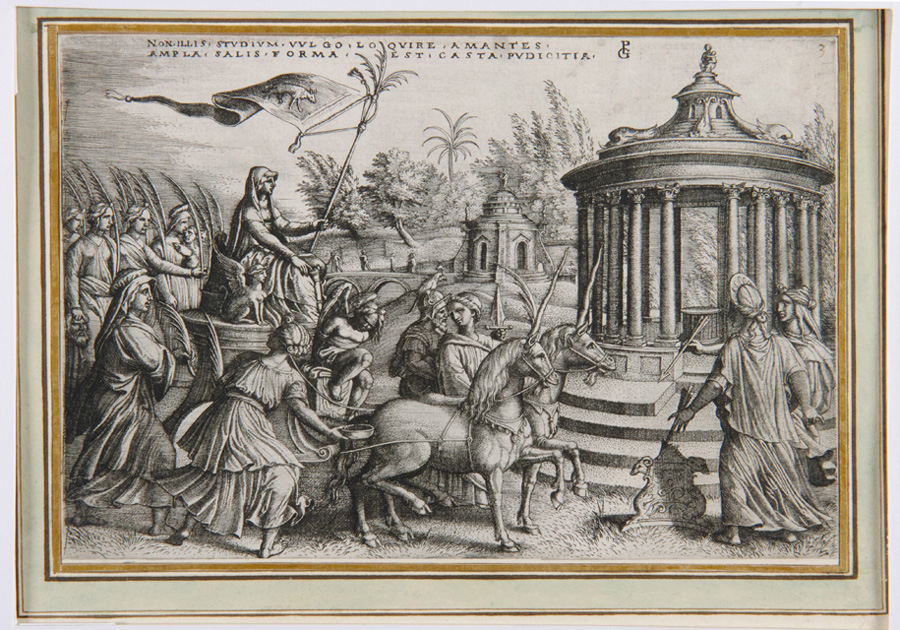
Finally, I want to say something about the Pudicizia image (Chastity in some manuscripts) in the Modrone, the jousting shield. It has notches in it, one on each side. The French ms. 594's Chastity lady also carries a shield with two notches in it. The detail about the notches, or anything suggesting them, is not in Petrarch. So where did the French ms. get it? I don't think he saw anything like the Modrone image, because the notches are on the same side of the shield, rather than on opposite sides. But he heard about it from someone; the question is, what did that person see, the Modrone card, recognizing it as of Petrarch's Pudicizia, or from a manuscript that used the image? The latter seems more probable, because the shield takes some familiarity with Petrarch to interpret. If so, it is a manuscript so far unknown to us
The attachment WheelRobertetSforzaBudaBrandt.jpg is no longer available
Even if there was a 15th c. Italian manuscript with at least some Modrone-type images, including the Modrone's Charioteer and World-lady, it still does not follow that the World-lady was meant to stand for Eternity in that manuscript. By the time of the manuscript, the World card in Milan, as well as Ferrara, Venice, and France, could have been last in the sequence. So the manuscript might have been adjusted to then-current practice. Either that or the Robertets, assuming that they had Milanese, Ferrarese or French cards at their disposal and knew their order.
Conclusion: The manuscripts that Nathaniel cites, as well as others, do make a good case that at least six of the cards were at least seen by the miniaturists and their patrons in terms of Petrarch, perhaps supplemented by Boccaccio. That is not the same as saying that those six actually did derive from Petrarch's poems. In my view what points to an actual derivation from Petrarch is (1) the name of the game, (2) the coincidence of its documentation with the explosion in Petrarch Trionfi manuscipts, (3) the titles Love and Death, and (4) that four other cards not virtues or dignitaries, three in the Modrone supplemented by one more in the Visconti-Sforza (Time), seem to include details on early cards that correspond, in important ways and in the symbolism of the time, to the themes of Petrarch's poems. Illustrations in the Petrarch manuscripts, and others, are useful for identifying how Petrarch's words, sometimes supplemented by Boccaccio on the same theme, have been translated into visual imagery on the cards. So we have:
Love: Cupid with bow and arrow(s) above pairs of men and women
Pudicizia: Woman with shield.
Death: skeleton with an instrument of death.
Fame: woman with sword and orb, or with one or more trumpet, on a chariot; figure somehow encompassing a circle or semi-circle indicating our world of striving, but just one arc, no additional layers.
Time: old man with a device to help him walk. Possibly the sun or sun-god.
Eternity: trumpeting angels and souls coming from graves. Above, perhaps one or more members of the Christian Trinity.
Since originally posting, I have, a few hours later, added images for Time and Pudicizia, from Robertet and related tarot cards, reworded the conclusion slightly, and added one more paragraph just before it.