Banner

Tarot History Forum

Tarot History Forum - 600 years of history in 78 cards

Re: Cary Sheet again

51
Ross G. R. Caldwell wrote:
On the other hand, in the Duchy of Burgundy they seem to have been very much in fashion through Philippe le Bon's time (1419-1467).
...

I'm trying to see if they carried on under his successor, Charles the Bold (1467-1477).

I would assume that anywhere poulaines were the fashion, they would also have pattens to match when circumstances demanded wearing them.
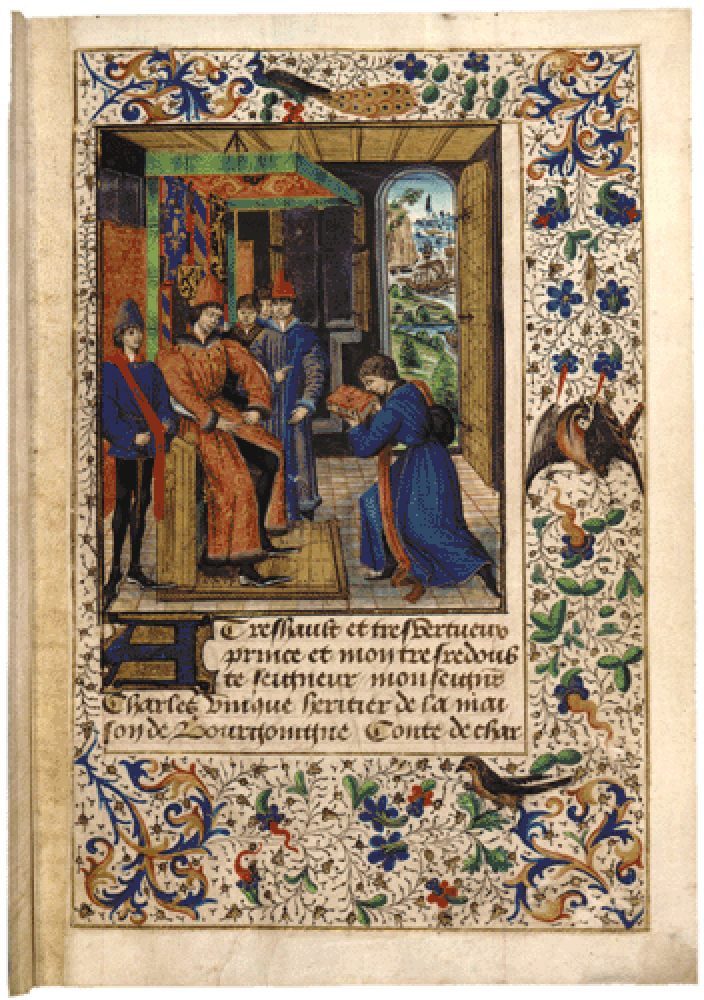
Charles the Bold surprising David Aubert. (Before 1472)

http://en.wikipedia.org/wiki/File:Auber ... Martel.jpg

OT: an additional use for the magician's table :)
http://en.wikipedia.org/wiki/File:Medie ... sician.jpg

Re: Cary Sheet again

53
SteveM wrote: OT: an additional use for the magician's table :)
http://en.wikipedia.org/wiki/File:Medie ... sician.jpg
Ah, this is what the Lovers are up to! The stool is identical and the gown a close match (but in the card the man has not undressed yet).

PS: what about the hairstyle of the Empress and Temperance? Are they wearing some kind of bonnet? Have you find any (possibly crowned) woman with an attire like that? I think the way in which the bonnet (or hair) covers the forehead is rather peculiar for the XV Century.

Re: Cary Sheet again

54
SteveM wrote: The workshop of Rogier van der Weyden we have already met:
http://commons.wikimedia.org/wiki/File: ... iature.jpg
...
Weyden himself and his workshop as well as providing a training ground for Italian artists such as Bugatto were directly commissioned by Italian patrons, for example by Alessandro Sforza (1409-1479) for the Sforza tryptich:

http://www.wga.hu/frames-e.html?/html/w ... orza1.html

(click on the image and then the degree of magnification)

St. Bova on the left, with Falcon, is wearing poulaines.
Lorredan wrote:Here is a Painting- that is called one of the 'irrational' of International Gothic because his poulaine is unstuffed and weeping? Painted in 1450 by Giambono and is in Venice.
http://www.lib-art.com/artgallery/28003 ... chele.html
SteveM wrote:St. Georges droops too here, but not quite to the same extent:

http://upload.wikimedia.org/wikipedia/c ... orgio4.JPG

and again:

http://commons.wikimedia.org/wiki/File:San_Giorgio.jpg
The droopy poulaine of riders can also be seen on St. George on the exterior of the Sforza Triptych:

http://www.lib-art.com/artgallery/18696 ... eyden.html
(click to see full size).

Re: Cary Sheet again

55
SteveM wrote:
SteveM wrote: The workshop of Rogier van der Weyden we have already met:
http://commons.wikimedia.org/wiki/File: ... iature.jpg

"Zanetto Bugatto (Milan, documented from 1458 - 1476) was a painter Italian.

"Official portraitist at the court of Galeazzo Maria Sforza, the fifth Duke of Milan, where he arrived in 1458 and where he painted (in 1460) a portrait of Ippolita Sforza, daughter of the Duke, and probably that of the Duke himself, exhibited in the Pinacoteca del Castello Sforzesco ( dated between 1474 and 1476).
Weyden himself and his workshop as well as providing a training ground for Italian artists such as Bugatto were directly commissioned by Italian patrons, for example by Alessandro Sforza (1409-1479) for the Sforza tryptich:

http://www.wga.hu/frames-e.html?/html/w ... orza1.html

(click on the image and then the degree of magnification)

St. Bova on the left, with Falcon, is wearing poulaines.
So is it Italian or Flemish? Is the deciding factor here the Milanese patron or the known Flemish (but in general frequently anonymous) craftsman employed?

There is the anonymous 'Master of Milan' Adoration of the Magi c.1515, the triptych is currently in the Pinacoteca di Brera, Milan: the center piece shows one of the Magi with poulaine, the right hand panel has a wooden patten. The identity of the anonymous 'Master of Milan Adoration', in the style of Antwerp mannerism, was attributed to the Flemish painter Jan de Beer early last century.

See Triptych c.1515, second picture down.
http://www.wga.hu/frames-e.html?/html/c ... index.html

Perhaps the deciding factor is neither patron or craftsmen but 'style'? The Milanese style is described as International Gothic with North European influence (which seems to me to fit the CY sheet pretty well too), in particular Flemish (with either Italian artists having undertaken training in Northern Europe or Italian patrons directly employing the services of North European artists/workshops); this seems to me to somewhat complicate the notion of being able to ascribe to a region or nation as such by consideration of disparate elements of what belongs and what doesn't, if not downright dichotomous - (being complicated by imposition of modern notions of nationality, regional boundaries, the relationship between patron and artist/craftsman and of ownership and identity; by the fact that Flemish and North European art was as much if not more influential on Milanese style than the art of its Italian City state neighbours).

Ross G. R. Caldwell wrote:
SteveM wrote:
From 1525 we have this landscape with magicians, I can’t get the detail but it looks like one of the figures is wearing long foot wear with wooden base:
http://upload.wikimedia.org/wikipedia/c ... ._1525.jpg

You can magnify it up to 200% here:

http://www.wga.hu/frames-e.html?/html/c ... index.html
Thanks Steve. That's a very interesting fantasy painting, that reminds me of Breughels and Bosch. I can't see what he's wearing on his feet though - I wouldn't want to claim it as proof of anything.
Yes it does look like a Breughel or Bosch - and even if it turns out that the magician (in Carpi's landscape) is not wearing poulaines with patten, would we not still think, if it was anonymous and we did not know otherwise, that it was Flemish or Dutch? If the magician is wearing poulaines and patten then applying current criteria would we not be declaring confidently that it cannot possibly be Italian?
Last edited by SteveM on 01 Aug 2010, 08:07, edited 2 times in total.

Re: Cary Sheet again

56
I guess it is known that Zanetto Bugatti Bianca's court painter was sent to the studio of Rogier van der Weyden to learn the style of the famous painter.
The Duchess of Milan, Bianca Maria Visconti, sent her court painter Zanetto Bugatto to Brussels to become an apprentice in Rogier's workshop.
Wikipedia

In one of Rogier van der Weydon's paintings there is a crosier like on the Cary Yale sheet. I have been trying for ages to find a crosier in Italian paintings like this one. I have until now seen only the ball shape on the staff.
http://www.artsconnected.org/resource/3 ... -s-crozier
The style is called Gothic international.

Now the artist of the crozier was Martin Schongauer, who was a follower of the style of van der Weydon.
So it would seem by association SteveM is right- the Style of the Cary Yale Sheet may well be Flemish, but designed in Italy. If this is right it would put the Cary Yale sheet circa 1470, or at least earlier than 1500.
Hehe who said the Devil is in the detail?

~Lorredan

Re: Cary Sheet again

57
Lorredan wrote:
Hehe, who said the Devil is in the detail?

~Lorredan
I believe it actually was the Devil himself who said that! And he ought to know! :ymdevil:

Re: Cary Sheet again

58
Lorredan wrote: So it would seem by association SteveM is right- the Style of the Cary Yale Sheet may well be Flemish, but designed in Italy.
The typical 'Milanese Style' combined a strong International Gothic base (which developed in the 14th and early 15th centuries from a system of court patronage among royal families strongly connected by marriage ties, in particular the courts of the Holy Roman Emperors, the Visconti, the Valois and the Plantagenet) with Flemish influences in the latter half of the 15th century such as that of the workshop of Rogier van der Weyden.
SteveM wrote: " Art Milan was therefore a mixture of different styles: a strong and always appreciated based International Gothic (especially on the brothers Zavattari), are joined with certain peculiarities Flemish (in portraits, especially, and the pictorial details of a typical certain style Lombard), there were more modern influences such as those of Brescia Vincenzo Foppa, those Ferrara, those Mantegna. In the late 70's came to town Bramante, who with his majesty made a definitive change in the course of art in Milan. It is in this environment that the style of the new generation of Lombard artists have grown up, in portraits of Ambrose, set the Flemish Gothic there is some kind of balance, clear vision of the Nordic and the nucleus of a potential hint of modernity. All together, these features form the typical Milanese painter."

http://it.wikipedia.org/wiki/Giovanni_A ... _de_Predis
trans. google.
I do think the CY fits generally into the Milanese style, and the odd North European details such as the Germanic devil, French/Flemish/German poulaines with pattens, French straw hats and Flemish croziers could all well fit into the 'potage' of that internationally influenced style somehow. Details may be drawn for example from model books the artist may have made/obtained while studying in North European workshops, or simply as conventions made familiar through perfection of one's training in North European workshops.

Re: Cary Sheet again

60
SteveM wrote: Yes it does look like a Breughel or Bosch - and even if it turns out that the magician (in Carpi's landscape) is not wearing poulaines with patten, would we not still think, if it was anonymous and we did not know otherwise, that it was Flemish or Dutch? If the magician is wearing poulaines and patten then applying current criteria would we not be declaring confidently that it cannot possibly be Italian?
I'm not declaring confidently that it cannot possibly be Italian - I just see no reason to think that it is to begin with.

I think all the little details add up to "not Italian", but "cannot possibly be" is pretty strong. I don't know that Carpi's magician's footwear, in a fantasy painting of 1525, can prove anything about an engraving that Dummett assigned to Milan in 1500.

It is true that my initial impression of the Carpi was Flemish, but I would have quickly changed that in view of the architecture - which is southern French and Provençal or northern Italian - and the coastline. It is also clearly a fantasy painting, not an actual landscape - it is certainly nothing that really exists in or around Ferrara, Bologna or Rome.

If we want to keep it in Milan, we have to find a likely engraver, not a painter (sure it can be both, but then we have to find one who was both, like Mantegna was). Given all the inconguities with Italian style, it seems to me that fighting for Italian provenance is grasping at straws.

To me, the real excitement is the growing certainty that it is much earlier than 1500.