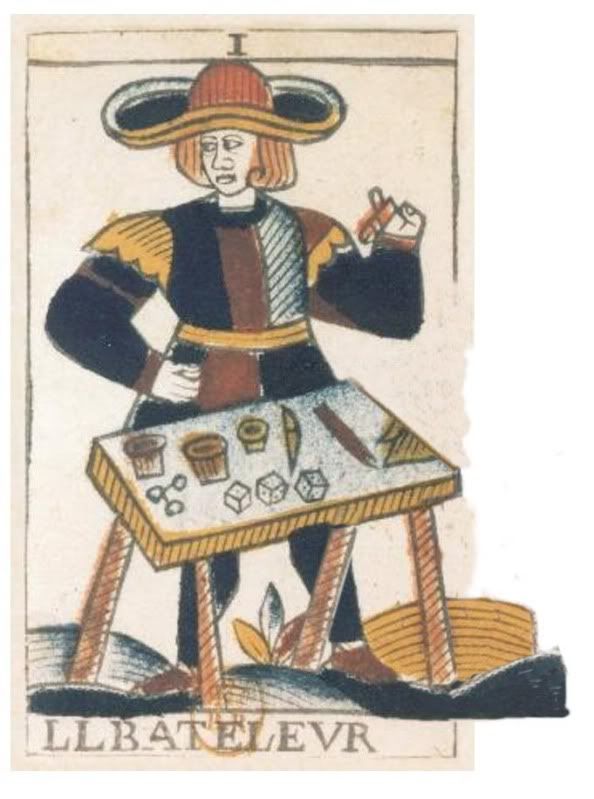
I had another thought about the Bateleur's knife, a 15th century chain of associations. The card is often linked iconographically to the "Artisan" card in the so-called "tarocchi of Mantegna." They're both about guys at a table with knives and other tools. That the association was made even back then is suggested by the Schoen Horoscope of 1515 and other contemporary images. Robert O'Neill discusses them at
http://www.tarot.com/about-tarot/librar ... ll/bagatto. First he shows a collage of different historical tarotBagattos/Bateleurs/Magicians, his Fig. 1. Then:
Because of the table and the variety of objects, the figures in Fig. 1 resemble images of the artisan or alchemist, such as that found in the 'tarocchi of Mantegna' (2).
Similar images of the artisan also appear in woodblock images of the planets and their children under Mercury (e.g., Hind 1935, Fig 105 ~1470). One such image (3). shows a goldsmith, a doctor performing a dissection and a couple at table with carafe, plates, glasses, balls. An image of the artisan as goldsmith (alchemist?) also appears in stained glass in the Milan Cathedral (Fig. 2, ~1480) where the objects on the table include bowls, tools, and a ring. Contemporary images of the artisan (4) , (5), often bear a distinct resemblance to the early Bagatto card.
Yet another image of the artisan appears in an astrological woodcut of 1515 (Fig. 3). Figure 3 is primarily of interest because the artist, Erhard Schoen, is known to have produced woodcuts for German playing cards. Therefore, it is probably not surprising to find that entire woodcut appears to contain several images that resemble early Tarot images. As a result, we will return to this same woodcut a number of times in future chapters as images that may be related to the emperor, pope, lovers, wheel, hangedman and death all appear in this single nativity calendar. The implied association of the Tarot image with divination may seem tenuous, yet other images of the magician/astrologer/diviner (6) do bear some resemblance to the early Tarot image.
...
These images of the artisan, suggesting associations with alchemy and astrology, show sufficient resemblance to the early Tarot cards that one can argue to an intended association. The status of the artisan as a distinct "estate of man" also seems to fit the other estates represented in later cards. However, it is difficult to argue that the images in Fig. 1 represent an artisan in his workshop, rather than a street entertainer.
I am not reproducing all O'Neill's images, as denoted by the numbers in parentheses without "Fig." next to them; go to the website for them. Fig. 1, as I said, is a composite of various historical tarot-Magician images. His Figure 3 is the artisan image from the Schoen Horoscope: below I reproduce it in the context of the one before it in the Horoscope, a scene of birthing, representing the First House. Schoen's artisan is in the Second House. The right-hand image below is the "Mantegna" artisan.
Here is his Figure 2, the image in stained glass from 1480. I will get to the image from Hind (usually dated 1938) later.
To focus on just the "Mantegna" image: what is this Artisan making? He looks more like a cook than an alchemist or a goldsmith, but never mind. Perhaps Schoen was playing it safe. Comparing it to other images of the time, a goldsmith is certainly suggested. In addition to the stained glass, here is a "Children of Mercury." It is not the woodcut referred to by O'Neill (
Introduction to a History of Woodcut, fig. 105, dated by Hind at 1470); that one looks German, and I'm more familiar with Italy. This image is an engraving attributed to the Florentine engraver Baldini or his workshop, c. 1460-1464.
As in the woodcut O'Neill describes, there is a table with a couple eating--although it is two men, and one appears to have a contract. The table is similar to the Bateleur's. For the present I direct you to the lower left-hand corner. That scene clearly has a goldsmith at work. Someone is even examining a pitcher with designs cut in it by a goldsmith.
To be sure, gold connotes alchemy; there is even a female-looking assistant, like the alchemist's soror. But let's look further.
Further down the table, there is a guy either cutting into a flat plate, used for making engravings, or making a drawing for such a plate, a female nude. Next to him in the picture, but outside, a sculptor is making the form of a clothed woman. His sculpting instrument is not well drawn. Here is another version, done slightly later (but before 1465), a reversed near-copy, but with changes here and there (I showed the two versions of the man on the top floor in an earlier post; I get this one from Hind,
Early Italian Engravings]/i] 1938; the other, with more gray, is from Lambert, Les Premieres Graveurs Italiannes1998)
I include more details because they are interesting: one of the men at the food-table is standing up, like the Bateleur. And then there are the two astronomers, looking very much like the "Charles VI" Stargazers.
Now comes my addition to O'Neill, another interpretation, focusing on the knife. In those days, and for centuries, playing cards were made by chiseling designs into blocks of wood. In the context of the tarot as a series of steps leading to salvation. these images lead me to think of the tarot-cutter as one involved in the making of the spiritual body that lasts after the death of the physical body, soul-making, in other words. That suggests the function of the tarot, and the tarot-maker (or demiurgos, to use the Greek word for "artisan"): to engrave in the mind the steps toward salvation.
In English, the word for someone who carves out of wood, besides "carver," is "chiseler." That word has an interesting double meaning: it also means a cheat, a swindler. Probably it was someone who was thought to remove by slight of hand a few items out of a bag of goods, e.g. potatoes, after it had been weighed and purchased, or who shaved off some of a precious metal after it had been weighed and a price agreed upon. So it has the same double meaning as "magician" and other names for this card. I would really like to know whether there is an equivalent double-meaning in other languages, such as French, German, or Italian.