
Hi, Julian,
this word is an abbreviation, indicated by the dash over the /o/. The scribe uses the same abbreviation for "pontifex", in the phrase "O pōtifex cur & c.", for "O pontifex cur etc." (O Pontifex (Papa, Pope), why?"), in the second line of the Papessa entry, Other examples in the names of the Triumphs are the /p/ dashed in the descender in "Impator" (Imperator), and "Impatrix" (Imperatrix).
A dash over a vowel is the most common way to abbreviate an /n/ or /m/.
Above the list, you can see from Kaplan's photograph that the whole text is highly abbreviated. For instance the last sentence before the list is "Sunt enim 21 triumphi qui 21 gradus alterius scale in profundum inferi mittentis."(Truly they are 21 triumphs which are 21 steps of another ladder cast into the deepest hell (the "another" is the game of cards mentioned before Triumphs)).
You can't see the whole sentence in the picture, but the part you can see, without the diacriticals (various lines and squiggles), which I am unable to reproduce, iis written: "triumphj qi 21 gdus alti scale i pfudu infer mittetis".
So the /i/-dash is "in", the /p/'s descender indicates it is "pro" (not "per", which is just a line), and the two /u/'s have a line over them indicating an abbreviated /n/ and /m/ respectively, and finally the dash over the /e/ in "mittetis" becomes "mittentis".
Abbreviated Latin is the norm, even in printed texts, up to the 18th century. See the Wikipedia article "Scribal Abbreviations" for more information -
https://en.wikipedia.org/wiki/Scribal_abbreviation
The standard resource for tackling Latin paleography, with its abbreviations, is Adriano Cappelli's "Dizionario di abbreviature", which is in a lot of places on the web, for instances here:
http://www.hist.msu.ru/Departments/Medieval/Cappelli/
Re: The World
182Thanks for the links Ross - I was looking for sources to show it was an abbreviation but couldn't find one, thank you -Ross G. R. Caldwell wrote: 18 May 2018, 17:11
The standard resource for tackling Latin paleography, with its abbreviations, is Adriano Cappelli's "Dizionario di abbreviature", which is in a lot of places on the web, for instances here:
http://www.hist.msu.ru/Departments/Medieval/Cappelli/
Re: The World
183Hello, I am currently doing undergraduate research on The World Card and how its iconography changed over time. I have put together a list of notable decks that include The World card but I would love some input on any decks that I might be missing or any other leads that might point me in a new direction.
This is my list:
- Visconti Sforza Bergamo: c. 1451
- Visconti Sforza Cary-Yale: c. 1466
- Sforza Castle (Single Card): ?
- Jean Noblet Marseilles: c. 1650
- Jacques Vieville: c. 1650
- De Poilly Minichiate: c. 1650
- Jean Dodal Marseilles: 1701 - 1715
- Belgian Deck: 17th - 18th Centuries
- Grimaud Deck: 1748
- Le Monde Primitif Engravings: 1787
- Lucca Minchiate: ?
- Bolonese Tarrocchi: ?
- Swiss 1JJ: 1831 - 1838
- Liquart - Paris: c. 1890
- Rider-Waite: 1909
- Book of Thoth: 1944
Thank You!
Re: The World
184Welcome to the forum Grayqg.
The early part of your list is missing some, and needs to be rearranged.
Cary-Yale is better known in scholarship as Visconti di Modrone, the name of the family that owned it until the 1940s. It dates to 1441-1442.
Alessandro Sforza, around 1450.
Visconti-Sforza, known in scholarly literature as the Colleone deck. 1456-1458.
Charles VI, around 1460. Still called "Charles VI" although it had nothing to do with that French king. I give the date 1460 on the authority of art historian Emilia Maggio, although I disagree with it. I believe that the Alessandro Sforza and Charles VI decks must have been made around the same time, possibly even earlier than 1450.
"El mondo (cioe Dio Padre)" (The World (that is, God the Father). This is from the list of trumps in the "Steele Sermon," dated by Nathaniel Shockley to the early 1460s. Not a physical card, but it does contain an interpretation of what the World represents, in the opinion of the author.
Ercole d'Este, 1473.
Rosenwald Sheet, around 1500.
Budapest Sheets, circa 1538.
Francesco Piscina "Discorso", description with interpretation in an essay published in 1565: "... it is necessary to act well in order to gain the glory of Paradise, as taught by these four Evangelists, intended and signified by the four symbols, Angel, Ox, Eagle, and Lion, who represent those four most famous and holy pillars of the sweet and infallible faith in Jesus Christ."
Anonymous "Discorso" author around 1565: "The last figure is the World, which he created from nothing; since it includes everything, it also includes this game, which is a true image and portrait of the nature of all this is contained in man, who is a little world."
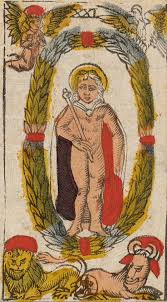
Sforza Castle World, around 1600.
Philippe Vachier, Tarot de Marseille, 1639.
Tarocchi Bolognese Dalla Torre, circa 1650.
Giuseppe Mitelli, Bologna, circa 1660.
Good luck with your research!
Re: The World
185Thank you so much! I am now wondering how Piscina (1565) references the tetramorph in the World Card when the first World Card we know of with the tetramorph is from at least half a century later.Ross Caldwell wrote: 27 Jan 2026, 18:18
Francesco Piscina "Discorso", description with interpretation in an essay published in 1565: "... it is necessary to act well in order to gain the glory of Paradise, as taught by these four Evangelists, intended and signified by the four symbols, Angel, Ox, Eagle, and Lion, who represent those four most famous and holy pillars of the sweet and infallible faith in Jesus Christ."
Re: The World
186Robert's favourite answer would be that cards like the Sforza Castle World, whose pattern is clearly Tarot de Marseille, must have existed during the 1500s. I personally think the Castle cards are earlier than others on the forum, but base that only on the iconography of the card missing the titles, whilst others disagree.
Re: The World
187My view is that some World cards showed the four evangelical creatures at least as early as the 1460s, and quite possibly even earlier. This is based on:Grayqg03 wrote: 27 Feb 2026, 18:31Thank you so much! I am now wondering how Piscina (1565) references the tetramorph in the World Card when the first World Card we know of with the tetramorph is from at least half a century later.Ross Caldwell wrote: 27 Jan 2026, 18:18
Francesco Piscina "Discorso", description with interpretation in an essay published in 1565: "... it is necessary to act well in order to gain the glory of Paradise, as taught by these four Evangelists, intended and signified by the four symbols, Angel, Ox, Eagle, and Lion, who represent those four most famous and holy pillars of the sweet and infallible faith in Jesus Christ."
- The presence of the four creatures on the highest "Prima Causa" card in the later S-series Mantegna Tarocchi, variously dated to the first half of the 1470s or the mid 1480s. There is also a related image in the manuscript Urb. Lat. 717, dated to 1471, which shows the four creatures on this "Prima Causa" image. The Mantegna Tarocchi have many details in common with tarot cards from northeastern Italy, and the highest tarot trump in that region was the World.
- Many of the earliest depictions of Petrarch's Triumph of Eternity – from the mid 15th century – show the four evangelical creatures positioned at the "four corners" of the world (which was the eternal "New World" described by Petrarch in his poem). These depictions also show God the Father or Jesus seated in majesty above that world image.
- The earliest known list of tarot trump names, in the Steele Sermon - again from northeastern Italy - gives "God the Father" (Dio Padre) as an alternative name for the World card.
- There is strong evidence (which I have presented elsewhere on this forum) that the World card was, in the earliest proto-tarot decks, an allegorical representation of Petrarch's Triumph of Eternity.
Therefore, it would not be surprising if some of the early World cards displayed an image with similarities to other depictions of that Triumph at that time, at least with the four evangelical creatures around the corners of the World, and in at least a few cases, also with God the Father seated above it.
- The tarot design pattern represented by the Adam C. De Hautot deck (Rouen, ca. 1723-1748) and the "Belgian" tarot show a World card with the silhouettes of two long-tailed quadripedal animals on either side of the number at the top, and two heads in clouds in the two lower corners, presumably two anthropomorphic "wind" figures. The World of the anonymous Tarot de Paris (17th century) has a very similar design, but there the two winds are joined by two others above them, making the usual number of four. The anonymous Tarot de Paris also shows the two animal silhouettes at the top of every trump card, not just the World. The Tarot de Paris treatment of these details is very likely to be a stylistic alteration of the version seen in the Hautot/Belgian design: this is partly because the Tarot de Paris was, in general, evidently a non-standard amalgam of design features from various sources, whereas the Hautot/Belgian decks clearly exemplify a standard pattern that was manufactured and used for play over a long period of time.
The Hautot/Belgian tarot card designs have much in common with the 17th century Vievil deck, and both they and the Vievil share many features with the Bolognese tarot pattern. Given the apparent relationship between the rules of the Bolognese tarot game and the Piedmontese tarot game, one can conjecture that the Vievil and Hautot/Belgian designs are in large part the descendants of some early Piedmontese tarot card designs, which themselves were descended from early Bolognese designs. Consequently, this World design with the two animals at the top and the two "winds" at the bottom is likely to have forebears going back all the way to 15th century Bologna, which is the most likely time for the Piedmontese to have adopted the Bolognese game (i.e., before tarot could reach Piedmont from Milan).
It seems to me more than likely that these two animal silhouettes and two "winds" were derived from an earlier design in which they were the four evangelical creatures: the lion and the ox above, and the man/angel and the eagle below. This is the inverse of their positions in the Castello Sforzesco/Tarot de Marseille designs – there the man and eagle are above and the lion and ox are below – but in both cases the four were at the four courners of the card.
So, we have evidence of a World card in the mid 15th century in northeastern Italy that showed the four evangelical creatures positioned at the four "corners" of the world-sphere, and we have good reason to believe that something similar was depicted on cards in Piedmont (northwestern Italy) around the same time. The presence of the four creatures at the corners of the Castello Sforzesco/Tarot de Marseille World suggests that there were World cards in Lombardy that also had this feature at a fairly early stage, by the mid 16th century at the latest.
In other words, it was probably a fairly widespread feature of World designs across northern Italy in the second half of the 15th century and the first half of the 16th, deriving from the very early (and seemingly quite brief) period when the World card was still regarded as a depiction of Petrarch's Eternity.
Further, based on the above reasoning, I believe it very likely that the "four winds" shown positioned around the world-sphere on the Minchiate World card were probably derived from an earlier design showing the four evangelical creatures in those positions. In this sense, the Minchiate World can be taken as additional evidence to support the above reconstruction. The eagle shown at the base of the world-sphere on the World of the Este deck is also consistent with that reconstructed design evolution.
Re: The World
188I also think it is likely Petrarch's Eternity quite early and I think the Vieville shows this bridging to what you describe.
Re: The World
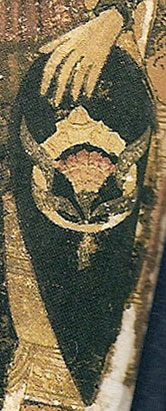
189Examples of two quite different Ferrarese coins which include the ring motif of interest to us.Ross G. R. Caldwell wrote: 25 Jul 2012, 13:20 the Catania deck is more commonly known as the "Alessandro Sforza" tarot, because his heraldic emblem is on the shield of the King of Swords -
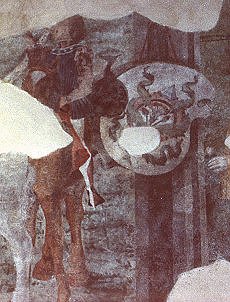
(compare to another instance of the same device -
in Carpi)
What is coincidental is that Alessandro Sforza was Lord of Pesaro from 1445-1473, containing the time-frame for the composition of this tarot deck.
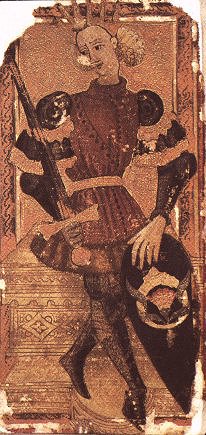
𝐓𝐨𝐩 𝐂𝐨𝐢𝐧
𝘖𝘣𝘷𝘦𝘳𝘴𝘦: Saint Maurelius, Ferrara’s secondary patron saint, anchoring civic and spiritual identity.
𝘙𝘦𝘷𝘦𝘳𝘴𝘦: Este ring device with a flower, paired with Psalm 117:16 (𝘋𝘦𝘹𝘵𝘦𝘳𝘢 𝘋𝘰𝘮𝘪𝘯𝘪 𝘦𝘹𝘢𝘭𝘵𝘢𝘷𝘪𝘵 𝘮𝘦).
𝐌𝐞𝐬𝐬𝐚𝐠𝐞: This coin emphasizes religious legitimacy and civic devotion. The Psalm ties Este rule to divine exaltation, the Pope's "divine investiture" (as the verse of the psalm reflects) and link with the Papal states.
𝐁𝐨𝐭𝐭𝐨𝐦 𝐂𝐨𝐢𝐧
𝘖𝘣𝘷𝘦𝘳𝘴𝘦: Double‑headed eagle, symbol of imperial authority and Este’s Imperial alignment.
𝘙𝘦𝘷𝘦𝘳𝘴𝘦: Este ring device with a different flower (likely carnation/garofano, Ercole’s personal badge).
𝘓𝘦𝘨𝘦𝘯𝘥: 𝐇𝐄𝐑𝐂𝐔𝐋𝐄𝐒 𝐃𝐔𝐗 𝐅𝐄𝐑𝐑𝐀𝐑𝐈𝐀𝐄, explicitly naming Ercole I d’Este.
𝐌𝐞𝐬𝐬𝐚𝐠𝐞: This coin asserts dynastic sovereignty and political power. The eagle situates Ferrara within the imperial framework, while the flower personalizes Ercole’s impresa.
𝐓𝐡𝐞 𝐞𝐦𝐛𝐥𝐞𝐦 𝐨𝐧 𝐭𝐡𝐞 𝐬𝐡𝐢𝐞𝐥𝐝 is more akin to me to that of the top coin, than Ercole's more personalized one as on the bottom coin:
Attachments
Re: The World
190Yes it's an Este symbol that they granted to Alessandro Sforza to use. It's hard to judge only on that basis who the cards were made for.
If we go with Ercole d'Este, who became lord of Ferrara in 1471, that seems pretty late to have been getting Tarot cards made in Florence. Borso also had his own local production by then. Did Leonello use the device? If he did, we might have a deck made for Leonello. But he had in-house production as well.
I'm still partial to Alessandro Sforza on the basis that the cards were made in Florence.