
Here is the story of Jupiter and the Origin of Cards, according to the poem by Bartolomeo Fonzio which he dedicated to Ercole d'Este, Duke of Ferrara:
Jupiter was the originator of the ancient game of cards. The poem begins with a great dispute among the gods: which power rules the world, strength or wealth. Mercury and Bacchus stand for riches and pleasure, while Hercules and Mars stand for force and war. Each side gathers followers, and their disagreement grows into open conflict, as ambition and pride inflame both gods and men.
The forces of strength are led by Mars, armed with his sword and followed by heroes and conquerors, while Hercules advances at the head, fierce and unconquered, bearing his club and weapons as signs of power. Opposing them are Mercury and Bacchus, leading a company adorned with gold, silver, and luxury. Mercury carries his winged staff, bringing rest and ease, while Bacchus rides among abundance and pleasure. Around them are examples of rulers and empires whose stories reveal the instability of power and the dangers of ambition. As the conflict grows, it threatens to surpass even the greatest wars of the past.
Seeing this, Jupiter intervenes. With thunder and lightning he scatters the armies and calls all to account. Seated among the assembled gods, he rebukes them for their pride and for disturbing heaven and earth. He questions why they seek dominion through strength or wealth, when both are uncertain and fleeting. The gods stand in fear, and at last Mercury speaks on their behalf. He admits their error, but argues that it came not from malice, but from the natural desire to excel. Each, he says, was only defending what properly belongs to him: strength for Hercules and Mars, wealth for Mercury and Bacchus. He asks Jupiter for mercy, arguing that forgiveness brings greater honor than punishment.
Jupiter, moved by these words but still mindful of justice, resolves the dispute in an unexpected way. Since neither strength nor wealth can be judged superior in human affairs, he creates a painted game. He assigns each power its place within it: Hercules to batons, Mars to swords, Bacchus to cups, and Mercury to coins. In this way, the conflict is transformed into play.
The poet declines to describe the rules of the game, saying they are already known. Instead, he concludes with its meaning: victory does not belong to strength or to wealth, but to fortune and chance. The game of cards thus becomes a reflection of the world itself, where human ambition is subject to forces beyond control.
Re: Casa del Petrarca
102Thanks for drawing our attention to the Fonzio poem, Steve. For me, this is yet another item demonstrating the value placed on play and leisure by the illustrious Este court in Ferrara.
I don't think it's a coincidence that all the images of card playing that I can recall from Italy prior to the mid 16th century either come from Lombardy during or shortly after the time of Filippo Maria Visconti, or from Ferrara. It seems that there weren't many people in the Italian elite who were prepared to dignify card playing as a worthy pursuit, but Filippo Maria and the Este were the notable exceptions to the rule. This poem is another marvellous demonstration of that.
I don't think it's a coincidence that all the images of card playing that I can recall from Italy prior to the mid 16th century either come from Lombardy during or shortly after the time of Filippo Maria Visconti, or from Ferrara. It seems that there weren't many people in the Italian elite who were prepared to dignify card playing as a worthy pursuit, but Filippo Maria and the Este were the notable exceptions to the rule. This poem is another marvellous demonstration of that.
Re: Casa del Petrarca
103I cannot help but notice the resemblance to Marziano's four orders of gods, each linked to a suit. It is not four gods per suit, Mercury is moved to riches, Mars to strength, and there is nothing for virginities. But otherwise similar, possibly derivative from Marziano's treatise. And each god is placed "within" a suit. Interesting.
I would compare these lines to what is in the scans of Campori 187, but I can't find the poem. The scans look like they are just of letters.
"di Maia" is a reference to Mercury, son of Maia. I also like it that the word "seme" is used, where Marziano would have had two orders, one of gods and one of birds and their kings.Ne' bastoni Hercol, Marte in spade messe
Bacho in coppe, in danar di Maia il seme,...
I would compare these lines to what is in the scans of Campori 187, but I can't find the poem. The scans look like they are just of letters.
Re: Casa del Petrarca
104One not need be Florentine to be all too familiar with Alberti, but that poem from Bartolomeo Fonzio (who was Florentine) reads like an order-over-chaos rebuttal to Alberti's Momus, which famously savages a pope-as-Jupiter. And that would suit Ercole d'Este all too well:
And Momus was enduring enough to show up in a deck of 17th century playing cards: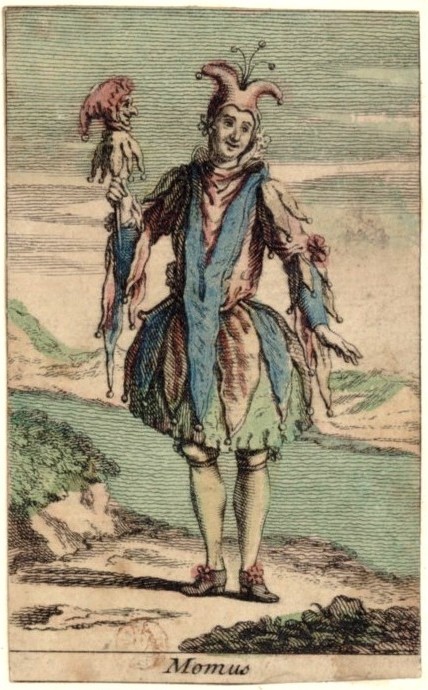
In 1482–1484 he fought the War of Ferrara with the Republic of Venice, which was allied with Ercole's nemesis, the Della Rovere Pope Sixtus IV, occasioned by disputes over control of the salt monopoly. Ercole was able to end the war by ceding the Polesine at the Peace of Bagnolo, and Ferrara escaped the fate of destruction or absorption into the papal dominions, but the war was a humiliation for Ercole, who lay sick and immobilized while the besieging army destroyed Este properties in the surrounding neighbourhoods. After this, he remained neutral in the Italian War of 1494–1495, and tried for the rest of his rule to improve relations with the Papal states.
And Momus was enduring enough to show up in a deck of 17th century playing cards:
Re: Casa del Petrarca
105Yes I looked through the online digital Campari 187 too, which are mostly as you say, letters - it seems to be a different ms. to what Leonardi refers to? I can find none of the poems or poets Leonardi reports on.mikeh wrote: 10 Apr 2026, 23:11 I would compare these lines to what is in the scans of Campori 187, but I can't find the poem. The scans look like they are just of letters.
Re: Casa del Petrarca
106"di Maia il seme" here just means "the offspring of Maia", i.e. Mercury. It has nothing to do with seme in the sense of a suit in a deck of cards. The word might not yet have been used in that sense at that time. In his letter describing Boiardo's trionfi game, probably written in the 1480s, Pier Antonio Viti uses the term giochi to refer to the four suits. Battaglia's earliest citation for seme in that sense is from 1619. It's not in either edition of Florio.mikeh wrote: 10 Apr 2026, 23:11"di Maia" is a reference to Mercury, son of Maia. I also like it that the word "seme" is used, where Marziano would have had two orders, one of gods and one of birds and their kings.Ne' bastoni Hercol, Marte in spade messe
Bacho in coppe, in danar di Maia il seme,...
Indeed, those images are not from the Campari 187 manuscript. They appear in the search for "Campari 187" simply because they are from the library's collection of Campari documents and their metadata includes the number 187. The actual manuscript is not online, as far as I can tell.SteveM wrote: 11 Apr 2026, 04:26 Yes I looked through the online digital Campari 187 too, which are mostly as you say, letters - it seems to be a different ms. to what Leonardi refers to? I can find none of the poems or poets Leonardi reports on.
Re: Casa del Petrarca
107Some further thoughts on the origin of this sense of "seme": semantically the word seems akin to English "pip", which likewise originally meant "seed" before the word was applied to the suit symbols of a deck of cards. It seems strange to use a term meaning seed to refer to the suit symbols of the Italian-suited decks, which are depicted on the cards as things that look nothing like seeds ‒ but it would make a lot more sense if the deck in question had French suit signs. The suit symbols of French-suited decks appear as small dots, about the same size as large seeds, spread out across the surface of the numeral cards. The similarity of their appearance to seeds was even greater in the first centuries, when the symbols were just roughly stenciled spots of color, their contours not so sharply defined as they are on modern cards.Nathaniel wrote: 13 Apr 2026, 09:05 The word might not yet have been used in that sense at that time. In his letter describing Boiardo's trionfi game, probably written in the 1480s, Pier Antonio Viti uses the term giochi to refer to the four suits. Battaglia's earliest citation for seme in that sense is from 1619. It's not in either edition of Florio.
So it is highly probable that the term "seme", like English pip, was first used by players to describe the suit symbols of French-suited decks, before being transferred at some later stage to all other types of playing-cards as well. The French suit symbols probably weren't invented before about 1480, and certainly could not have reached Italy by that time. So we can be pretty confident that "seme" was not being used in that sense when Fonzio wrote his poem.