In the discussion of the Rosenwald deck which started with the article ...
http://trionfi.com/rosenwald-tarocchi-sheet .... November 2011, the 3rd article of Pratesi at trionfi.com
... the idea appeared, that once there was a deck type with 96 cards as an early form of Minchiate.
The argumentation was based on the observation, that 4x24 is ideal for a cheap deck without complications and the observation, that "1 Bagatello" on the Rosenwald sheet No. 1 (lower trumps) looked like a Fool.
The original has no colors.
In the same discussion appeared also the idea, that there should have been once a card deck type with 2x24 and a card deck type with 3x24, both based on the extant Rosenwald sheets.
Later a card deck was found (called the Assissi deck), which fulfilled the expectation of the 2x24-deck (no 10s, no Queens).
Re: Bolognese sequence
472Magic Moon wrote,
Pratesi (in some article) suggested that the difference between Germini and Minchiate might lie in a card or in the Fool's card. I don't remember exactly what Pratesi said, but it was something like that. I don't think he gave any details. He simply gave this diffuse idea. Perhaps some of you know what Pratesi was referring to, it is, what the small difference between Germini and Minchiate could be. Perhaps he meant that Minchiate-I didn't have a Fool and Germini did have a Fool. However, perhaps Germini didn't have a Fool either. That is, perhaps Minchiate-I and Germini lacked a Fool. However, we know that Minchiate-II has a Fool and a Magician. It seems possible to me that Germini had a fool without a table (Fool) and didn't have a Magus.
Pratesi wrote about 96 cards at http://trionfi.com/naibi-on-sale, which I learned from one of your posts. He notices entries for "doubled" packs, and wonders if that could be 2x48=96. He observes:
As a speculation about "Germini", it doesn't amount to much. A couple of years later, he tried to trace the origin of "Germini" and found no reason for supposing a derivation from "Gemini" at all (see https://www.naibi.net/A/332-GERMINI-Z.pdf). Instead, he advocated that "Germini" came from a word for sprouts, that is to say, the next stage of a plant after seeds. It is similar to how the word for "suit" in Italian is the same as the word for "seed," seme.
I myself have no idea. Andrea Vitali in another essay no longer on the web cites a play in which one character talks to another about "doing the Germini," meaning sexual intercourse. That is a kind of doubling, i.e. twinning, Gemini, as in Adam and Eve. Gemini is of course the highest sign of the zodiac in the game. Some people historically seemed to have made a connection between Germini and Gemini.
It seems almost obvious that "minchiate" was associated with foolishness "minchioneria", and fools, "minchione". We already have Berni, who spoke of "any Sminchiate whatever" in relation to foolishness, minchioneria.
Another name for the game was Ganellini, Liguria, or Gallerini, Sicily. According to Andrea Vitali in an essay no longer on the web (and very briefly in Bologna and the Tarot, p. 53, these are names they also gave for the Bagatto. So take your pick.
In the Bolognese tarocchino, both the Fool and the Bagatto had the same role in scoring sequences: either could substitute for a missing card. But of course when it came to trick-taking, the Bagatto, as usual, was the lowest trump and the Fool unable to beat any card at all.
Pratesi (in some article) suggested that the difference between Germini and Minchiate might lie in a card or in the Fool's card. I don't remember exactly what Pratesi said, but it was something like that. I don't think he gave any details. He simply gave this diffuse idea. Perhaps some of you know what Pratesi was referring to, it is, what the small difference between Germini and Minchiate could be. Perhaps he meant that Minchiate-I didn't have a Fool and Germini did have a Fool. However, perhaps Germini didn't have a Fool either. That is, perhaps Minchiate-I and Germini lacked a Fool. However, we know that Minchiate-II has a Fool and a Magician. It seems possible to me that Germini had a fool without a table (Fool) and didn't have a Magus.
Pratesi wrote about 96 cards at http://trionfi.com/naibi-on-sale, which I learned from one of your posts. He notices entries for "doubled" packs, and wonders if that could be 2x48=96. He observes:
. He seems to be wondering whether "Germini" as a corruption of "Gemini" might be two packs of 48 cards, each of the same 4 suits, presumably with the same backs, used together in a game of that sort.Whether these 96 cards could be an early version of "our" 97-card pack, independent of the existence and use of the name with which it became known a few years later, is a decision so hard to reach that I must leave it open to the profound reflection of the various experts. By the way, however, it is known that one possible explanation of the word "germini" itself has been recurrently traced back to Gemini, or Gemelli, that is twins; now, the distance from a double pack to a twin pack is rather short
As a speculation about "Germini", it doesn't amount to much. A couple of years later, he tried to trace the origin of "Germini" and found no reason for supposing a derivation from "Gemini" at all (see https://www.naibi.net/A/332-GERMINI-Z.pdf). Instead, he advocated that "Germini" came from a word for sprouts, that is to say, the next stage of a plant after seeds. It is similar to how the word for "suit" in Italian is the same as the word for "seed," seme.
I myself have no idea. Andrea Vitali in another essay no longer on the web cites a play in which one character talks to another about "doing the Germini," meaning sexual intercourse. That is a kind of doubling, i.e. twinning, Gemini, as in Adam and Eve. Gemini is of course the highest sign of the zodiac in the game. Some people historically seemed to have made a connection between Germini and Gemini.
It seems almost obvious that "minchiate" was associated with foolishness "minchioneria", and fools, "minchione". We already have Berni, who spoke of "any Sminchiate whatever" in relation to foolishness, minchioneria.
Another name for the game was Ganellini, Liguria, or Gallerini, Sicily. According to Andrea Vitali in an essay no longer on the web (and very briefly in Bologna and the Tarot, p. 53, these are names they also gave for the Bagatto. So take your pick.
In the Bolognese tarocchino, both the Fool and the Bagatto had the same role in scoring sequences: either could substitute for a missing card. But of course when it came to trick-taking, the Bagatto, as usual, was the lowest trump and the Fool unable to beat any card at all.
Re: Bolognese sequence
473Huck, do you know the exact expression used in the ledgers that kept double decks? pari naibi doppi? Were they double decks or double cards? I'm referring to the ones Pratesi found in the Puri trade between 1447 and 1449. This would help study this mysterious matter of double cards or double decks (doppi). We don't know if they were two decks or one deck made with cardboard twice as thick.
Another hypothesis was that doppi or pari was a normal deck, while the single deck (scempi) would have only two suits. In that case, what were the two suits missing from the single deck? I seem to recall Teikemeier raising this hypothesis in relation to the game Cucú. I believe the earliest evidence of the Cucú game refers to a game played with a conventional four-suited deck. The special Cucú cards are later.
The hypothesis of the "doppo" deck interpreted as an early Germini is generally rejected, as you've said.
******
Huck and Mikeh, you've explained some important details, but I'd like to clarify some details that seem mysterious or dubious. I will explain the doubts that I see in mystery. I think that it is interesting.
The issue of the Fool in the poem "Germini" has me a little confused. I once thought there wasn't a Magician in that deck, but rather a Fool, due to what I've explained: the poem's introduction says the Fool is included in the 40 trumps, and trump One also mentions a hungry dog. I think there's a dog later in the Magician of the Paris Tarot, but generally the Fool seems hungrier to me than the Magician.
Huck reminds us that Rosenwald has been interpreted as reflecting the existence of a 96-card Minchiate deck that didn't feature a conventional Fool but rather a Magician in Fool or Jester's clothing. It's difficult but necessary to specify the dates. I understand that Minchiate I (from 1466) had no more than 22 allegorical cards. Therefore, the supposed 96-card Minchiate would really be the so-called Germini (from 1506). During the first half of the 16th century, Minchiate or Sminchiate were sometimes mentioned, and it's possible that this refers to Germini, whose protagonist, the Magician, would be the same as in Minchiate I (1466). This isn't what I thought until a few days ago, but I'm trying to adopt a conception that's consistent with all the details. Possibly, your conception is similar to what I just suggested in this paragraph.
The author of the poem "Germini" says that someone asked him for a Germini deck, so the poet told him to go and ask a deck maker, such as Padovano, for that deck. He's not referring to the place Padoua (that's what Amparo Aguirre translates), but rather to the manufacturer named Padovano, who surely also made the Germini deck. The poet then says that the person laughed and repeated in detail what he wanted. I suppose he was asking for a poem instead of a deck. The request was to make 40 trumps with the Fool among them. I thought this meant the Fool was in the 96-card Germini deck. I thought there was a Walking Fool instead of a Magician with a Table. You're suggesting that the Fool (Pazzo) was the Magician, since that card merges both characters in Rosenwald. That's one possibility. There are possibly other interpretations. If the Germini deck had a Magician-Fool card like in Rosenwald, then why did they ask the poet to write verses with the Fool included? Danilo Romei suggests that the Fool was outside the sequence of 40 trumps. That's not what the poem says, but perhaps the Germini deck had 40 trumps plus the Fool (40+1), and they asked the poet to include the Fool in the 40 cards. We have trouble knowing where the Fool is in the poem, and we also have the difficulty of guessing if the Germini deck was as the poem reflects or perhaps the poet made an exception for the Fool, obeying what was asked of him. We don't know if the Germini deck had 96 cards or 97 cards (96+Fool). We assume that the deck had 96 cards with the Magician in trump One. Besides, was there a Fool out of the sequence or was the Fool only in the Tarot?
I believe I have located the solution to the Fool's (Pazzo) problem in the poem Germini. According to the poet, the Fool is one of the two twins in the Gemini card, as indicated in that stanza (XXXV) and in another trump (V). In this way, the poet managed to include the Fool (Pazzo) among the 40 cards. We may assume that this was related to the name of the deck Germini, which has occasionally been considered a reference to the Gemini card, a corruption of the name Gemini for the zodiac sign. However, we are not aware that the Gemini card was ever considered the Fool. Therefore, I believe this solution was an invention of the poet to please whoever asked him to include the Fool among the 40 trumps. It seems likely that there was no Fool in the Germini deck. Therefore, he was asked to include it. If the deck had 97 cards (96 + Fool), then it would not seem necessary to include the Fool among the trumps. In that case, it would have been logical for the poet to write a poem with the structure of the deck (97). If they asked him to include the Fool, perhaps it was because the Germini deck didn't have a Fool. Or do you think the Fool was out of the sequence? I have doubts. Perhaps the Fool wasn't in the Germini sequence and was added later. I consider the word Germini related to the concept of germination. Pratesi say that and I know his point of view. But I think that probably germination is conected with Fool card. For example, the Fool in the Tarocchi Met (Budapest Tarot) has a branch with leaves (sprouted). I think that the Fool (Matto) is not the protagonist of Minchiate. I think that the word Minchiate is related to the stupid or clownish Magician, that we see in Rosenwald (son of the Moon by Baldini). I think that in the Minchiate logic, the magician is the one who does stupid things. Mikeh say something similar. I think that the word Germini is related to the Fool, who has a club. Do we agree on something? Was there a Fool in Germini besides the Magician-Jester?
If the Germini deck was born in 1506 with a Magician-Jester but without a Fool, then my association of the Fool with the name Germini is wrong. However, I think there was possibly some small difference (like that one) between Germini and Minchiate-II: perhaps Germini (like Minchiate-I) did not have Fool. On the other hand, if Germini had Fool and Wizard (as it persisted later in Minchiate-II) then there is no difference between the two, but perhaps I can think that Germini owes its name to the Fool, which was added when the Germini deck was born, since possibly before there was no Fool (in Minchiate-I).
Re: Bolognese sequence
474Magic Moon wrote
The mention of a dog in the poem - "I cringe like a dog" - is rather peripheral and at most is like the hat: it is something that can be associated with the Fool, but also is not out of place with the Bagatto. Hiereonymus Bosch's painting called "The Conjurer" (https://en.wikipedia.org/wiki/The_Conjurer_(painting)) is an example. Dogs can do tricks and help to distract the audience from what the Conjurer is doing.
The leaves on the "Budapest" Fool's clubs are not germine: they do not come from seeds. They are simply branches and leaves. Also, they come from a very different set of images than those seen in minchiate later, Ferrara-based rather than either Bologna or Florence. The minchiate Fool is believably a development out of something like the Charles VI Fool, with children around. There are no children on the "Budapest". The "40 Prostitutes" germini poem at least has children, so not of the "Budapest" type. All the evidence suggests that the Budapest is irrelevant to either germini or minchiate.
Your discovery of the Fool (as "pazzo") in the verses for V and XXXV is certainly of interest. That may well be how the author intended the Fool to be part of the 40 when he says " "I say that I would like you to do the Germini in the way [mo' = modo per Romei in his notes] that we will tell you: forty triumphs and with the Pazzo in them": that is, inserted in one or two of the stanzas. That "pazzo" is inserted into the verses for Gemini is some support for a link between the two names of the game, Minchiate and Germini, since Minchaie = Fool and "pazzo" is in Gemini, not normally associated with the idea of "twins". That "pazzo" also appears in V seems to me not to count against that idea, as Love and Fools were conventionally associated anyway.
I do not think that in either minchiate or the Rosenwald sheet, the Magician is someone who does stupid things. The Rosenwald Magician/Bagatto merely wears the hat associated with court jesters, i.e. people who entertained by means of their wit, which might be thought foolish by some and wise by others, or foolish on the surface but wise if their words are taken in a different way. Shakespeare's Fools are examples of what I mean. This is not to suggest that the Rosenwald figure at a table is an example of that kind, just that he wears that hat.I think that in the Minchiate logic, the magician is the one who does stupid things. Mikeh say something similar. I think that the word Germini is related to the Fool, who has a club.
The mention of a dog in the poem - "I cringe like a dog" - is rather peripheral and at most is like the hat: it is something that can be associated with the Fool, but also is not out of place with the Bagatto. Hiereonymus Bosch's painting called "The Conjurer" (https://en.wikipedia.org/wiki/The_Conjurer_(painting)) is an example. Dogs can do tricks and help to distract the audience from what the Conjurer is doing.
The leaves on the "Budapest" Fool's clubs are not germine: they do not come from seeds. They are simply branches and leaves. Also, they come from a very different set of images than those seen in minchiate later, Ferrara-based rather than either Bologna or Florence. The minchiate Fool is believably a development out of something like the Charles VI Fool, with children around. There are no children on the "Budapest". The "40 Prostitutes" germini poem at least has children, so not of the "Budapest" type. All the evidence suggests that the Budapest is irrelevant to either germini or minchiate.
Your discovery of the Fool (as "pazzo") in the verses for V and XXXV is certainly of interest. That may well be how the author intended the Fool to be part of the 40 when he says " "I say that I would like you to do the Germini in the way [mo' = modo per Romei in his notes] that we will tell you: forty triumphs and with the Pazzo in them": that is, inserted in one or two of the stanzas. That "pazzo" is inserted into the verses for Gemini is some support for a link between the two names of the game, Minchiate and Germini, since Minchaie = Fool and "pazzo" is in Gemini, not normally associated with the idea of "twins". That "pazzo" also appears in V seems to me not to count against that idea, as Love and Fools were conventionally associated anyway.
Re: Bolognese sequence
475Hi Mike.
The Gemini poem mentions children in Trump One, but Roseneald's Fool Magician doesn't have children. Then, we see children in Minchite II (17th century), but the hat isn't a jester's hat. We don't know exactly what the artwork was like in the Germini deck (16th century). We tend to think of Rosenwald as reflecting early Minchiate, but there's no Fool (Matto) in Rosenwald. So I thought Mikeh was associating Rosenwald's Fool Magician with the name of the game Minchiate, which is later called Gallerino or Ganellino, just like the Magician card, as you say. If Minchiate I didn't have a Fool (Matto), and you say the Magician didn't consider himself a fool, then why was the game called Minchiate? Do you prefer the theory that the players were fools, or what's your explanation for the name of the game Minchiate? Do you know that Minchiate is associated with someone who is foolish? You don't admit that illusion games and clown shows were considered nonsense by those who chose the name for the game. But the clown's hat was used to illustrate foolish or silly characters. So I don't exactly see your point. The question is whether Rosenwald's clown magician was the protagonist of the game, called Minchio (fool) early on, which would derive from the name of the game. If you don't agree with this, what was your usual proposal on the matter? You say that Minchiate and Germini seem to connect when we look at the Pazzo in the Gemini zodiac sign card. But what did you think was the connection between the deck and the name Minchiate?
******
I'm glad you find my observation about the Fool (Pazzo) in the Gemini card interesting. Your observation about Love being associated with Folly, which must be overcome through the virtues in higher steps of the sequence, is interesting. The Pazzo is mentioned in trump V (Love), but it's located in Gemini because that's what the text says: "ho nel cervello un certo mie Cechino con ch’io volevo il pazzo mescolato". The translation: "I carried with me a certain Fool with whom I carried the mixed Pazzo". This phrase speaks of mixing the Fool (pazzo) with Cechino, which is the name of the Gemini triumph in the poem.
*******
I suppose you generally thought that Germini and Minchiate-II had a Magician and a Fool, that is, the same deck (97 cards) had two names. Nowadays, after the study we are doing: do you still think that or perhaps Germini lacked a Fool card and only had a buffoonish Magician (like in Rosenwald or Minchiate-I) or a Magician with children (like in Minchiate-II)? I have doubts and would like to know your opinion. Did the Germini deck (16th century) have 96 cards or 97 cards? The poem was written to reflect 96 cards, but the Fool was conceived by the poet in the Gemini card. Does that mean the Germini deck had 96 cards? Or can we assume that the Fool existed in the Germini deck as an external card to the sequence of numbered trumps?
Re: Bolognese sequence
476See http://trionfi.com/naibi-doppi-scempiMagic Moon wrote: 10 Jul 2025, 00:15 Huck, do you know the exact expression used in the ledgers that kept double decks? pari naibi doppi? Were they double decks or double cards? .... etc.
Franco Pratesi visted original business texts from persons, which traded with cards. Occasionally there are expressions, which are not explained by the authors of the text. In these cases one can build theories, how these expressions should be interpreted ... but these are only theories.
In Germany is a game with the name Doppelkopf. It is played with two identical set of cards 2x20 cards or 2x24 cards. 4 Queens, 4 Fante, 4 Kings, 4 Aces, 4 Tens for 2x20 decks and additionally 4 Nines for the 2x24s. The game is very complicated and very interesting. I would need a longer text to explain the many rules to you. That's this Doppelkopf. In texts of 19th century I met another Doppelkopf expression and this meant a well known quality of playing cards with 2 heads ....
Re: Bolognese sequence
477Huck.
That German deck with 20/24 cards seems interesting. This half deck had only hi cards from 4 suits. Interesting! This is similar to Skat, Trappola and Piquet but smaller.
The link you posted takes us to an article by Pratesi, and in the right-hand column is Teikemeier's explanation of Cuckoo, which I mentioned in a recent post. Nice.
Pratesi speaks interchangeably of "naibo doppi" or "doppi deck," but the two expressions are different. Pratesi doesn't say the exact expression in the ancient documents he consulted in Florence with that information. Tommaso Puri doesn't explain what double decks or double playing cards were like, but he wrote it in a precise way that Pratesi doesn't quote. I've searched Pratesi's articles on the subject, but I don't see him using quotation marks, nor do I see a photograph of any page written by Tommaso Puri where "scempi" or "doppi" are mentioned. Pratesi knows how that was written in the documents, but we know the exact expression?
?- "pari doppi"
?- "naibi doppi"
?- "pari naibi doppi"
?- only "doppi"
?- what was the expression wrote by Tommaso Puri?
I've explained my question now because I'm not sure I explained myself well before. I ask about how Puri wrote this dates that Pratesi published. Pratesi only say "doppi" in the table. The old text say doppi deck or doppi cards? Both expressions are different.
Re: Bolognese sequence
478Huck.
That German deck with 20/24 cards seems interesting. This half deck had only hi cards from 4 suits. Interesting! This is similar to Skat, Trappola and Piquet but smaller.
The link you posted takes us to an article by Pratesi, and in the right-hand column is Teikemeier's explanation of Cuckoo, which I mentioned in a recent post. Nice.
Pratesi speaks interchangeably of "naibo doppi" or "doppi deck," but the two expressions are different. Pratesi doesn't say what was the exact expression in the ancient documents (by Puri) that he consulted in Florence with that information. Tommaso Puri doesn't explain what double decks or double playing cards were like, but he wrote it in a precise way that Pratesi doesn't quote. Right? I've searched Pratesi's articles on the subject, but I don't see him using quotation marks, nor do I see a photograph of any page written by Tommaso Puri where "scempi" or "doppi" are mentioned. Pratesi knows how that was written in the documents. But do we know the exact expression? Perhaps you or somebody know the exact expression by Tommaso Puri about doppi. Here I propose some posibilities:
?- "pari doppi"
?- "naibi doppi"
?- "pari naibi doppi"
?- only "doppi"
?- what was the expression wrote by Tommaso Puri?
I've explained my question now because I'm not sure I explained myself well before. I ask about how Puri wrote this information that Pratesi published as a comment. Pratesi only say "doppi" in the table. The old text say doppi deck or doppi cards? Both expressions are different.
Re: Bolognese sequence
479Magic Moon wrote,
Added July 11: Labriola, in Tarots illumines, p. 115, speaking of Lo Scheggia:
I want to answer Magic Moon about the Rosenwald. I did not say that the Rosenwald sheet with trumps was a minchiate or germini. I very much doubt that it was. I think it has the trumps of a 78 card trionfi, because the cards shown are consistent with tarocchi as we know it and not minchiate: none of the additional cards of minchiate are present, and there is a popess, which minchiate as we know it does not have. Whether this deck, of which we see 24 cards on the sheet, had a Fool card I cannot say, because obviously there would have been other sheets. Whether the two sheets with suit cards that were found with the triumphs plus queens sheet go with that sheet is another matter, as well as whether they are for a minchiate/germini.
At least one of those sheets found with the triumph and queens sheet, that with the monster-knights, is a centimeter higher and half a centimeter wider than the other two (30 × 44.1 cm. for https://www.nga.gov/artworks/41320-playing-cards, vs. 29.1 × 43.5 cm for https://www.nga.gov/artworks/41321-playing-cards; the remaining one is at https://www.nga.gov/artworks/41319-playing-cards, of 29.1 x 43.6 cm). Even if this difference can be accounted for, the suit cards, including the monsters, are similar to the Assisi deck of 48 cards, which is not a minchiate/germini. Assisi is not far from Perugia.
I only gave the Rosenwald Trump One as an example of a Bagatto in a Florentine-style deck which had the Fool attribute of a fool's cap, so that it is possible that there was no Fool in that game.
Also, I see no reason to conclude that the germini deck of the prostitutes-poem did not have 40 trumps plus the Fool. What the author says is that he has included the Fool among the forty triumphs. The Fool is not a triumph. As you noted, a "pazzo" is mentioned in the verses for trumps V and XXXV. That is probably all he means. In the stanza about Trump One, a word for "fool" does not occur; it is therefore most likely about the bagatto only, and the children referred to are those of the minchiate Uno card only and not the Fool.
Added a few minutes later: To make a tarocchi deck out of three sheets like the three Rosenwalds, four tens and a queen are needed, at least. With a Fool, that would be six cards repeated four times. Without a Fool, there would be four blank spaces. Alternatively, there could have been three other sheets, each with 18 cards, for a total of 78 cards. (Without a Fool, there would be one blank space.) We know from some inventories (e.g. Pratesi's most recent article, in The Playing-Card about a year ago) that blocks were of various sizes. Different-sized blocks are also needed for the backs, which are larger cards, because their edges fold over to the front.

Unfortunately, Pratesi's essay on Puri is written in English only, so it is hard to know. But occasionally Pratesi slips into Italian: for example, commenting on Puri's inventory (http://trionfi.com/naibi-on-sale):Pratesi knows how that was written in the documents, but we know the exact expression?
?- "pari doppi"
?- "naibi doppi"
?- "pari naibi doppi"
?- only "doppi"
?- what was the expression wrote by Tommaso Puri?
Here we find "naibi 'doppi'", suggesting "naibi doppi" as the original. It is also possible that Puri did not use any expression for "cards", but only used the adjectives. But since Pratesi does use "naibi," and moreover, Depaulis specifically of "naibi doppi" with what is presumably the same reference (cited by Pratesi in the essay Huck links to), probably that is the expression Puri used. There is no reason to suppose that the word "pari" was used: Pratesi always, in my experience, cites that word if it was used. In any case, I cannot see why it makes any difference.It is easy to verify that more packs of naibi "doppi" are sold than "scempi": 42 dozens with respect to 30.
Added July 11: Labriola, in Tarots illumines, p. 115, speaking of Lo Scheggia:
Also, p. 118: "Rappelons qu'en 1447-1448 Lo Scheggio fournissait en naibi le marchand Tomasso Puri." Whether Pratesi in fact used the word "naibi" in this place I do not know. But that is how Labriola and the editors of the 2022 catalog understood him.En 1447-1448, il fournit vingt-huit jeux de naibi a Tommaso di Piero Puri, marchand mercier et proprietaire d l'une des numbreuses boutiques que proposaient des ustensiles et autres objets d'usage courant. (16)
__________
16. Pratesi 2012, p. 34-35, 36-37. (Playing-card trade in 15th-century Florence, North Walsham, Norfolk, 2012 (IPCS papers, 7).]
I want to answer Magic Moon about the Rosenwald. I did not say that the Rosenwald sheet with trumps was a minchiate or germini. I very much doubt that it was. I think it has the trumps of a 78 card trionfi, because the cards shown are consistent with tarocchi as we know it and not minchiate: none of the additional cards of minchiate are present, and there is a popess, which minchiate as we know it does not have. Whether this deck, of which we see 24 cards on the sheet, had a Fool card I cannot say, because obviously there would have been other sheets. Whether the two sheets with suit cards that were found with the triumphs plus queens sheet go with that sheet is another matter, as well as whether they are for a minchiate/germini.
At least one of those sheets found with the triumph and queens sheet, that with the monster-knights, is a centimeter higher and half a centimeter wider than the other two (30 × 44.1 cm. for https://www.nga.gov/artworks/41320-playing-cards, vs. 29.1 × 43.5 cm for https://www.nga.gov/artworks/41321-playing-cards; the remaining one is at https://www.nga.gov/artworks/41319-playing-cards, of 29.1 x 43.6 cm). Even if this difference can be accounted for, the suit cards, including the monsters, are similar to the Assisi deck of 48 cards, which is not a minchiate/germini. Assisi is not far from Perugia.
I only gave the Rosenwald Trump One as an example of a Bagatto in a Florentine-style deck which had the Fool attribute of a fool's cap, so that it is possible that there was no Fool in that game.
Also, I see no reason to conclude that the germini deck of the prostitutes-poem did not have 40 trumps plus the Fool. What the author says is that he has included the Fool among the forty triumphs. The Fool is not a triumph. As you noted, a "pazzo" is mentioned in the verses for trumps V and XXXV. That is probably all he means. In the stanza about Trump One, a word for "fool" does not occur; it is therefore most likely about the bagatto only, and the children referred to are those of the minchiate Uno card only and not the Fool.
Added a few minutes later: To make a tarocchi deck out of three sheets like the three Rosenwalds, four tens and a queen are needed, at least. With a Fool, that would be six cards repeated four times. Without a Fool, there would be four blank spaces. Alternatively, there could have been three other sheets, each with 18 cards, for a total of 78 cards. (Without a Fool, there would be one blank space.) We know from some inventories (e.g. Pratesi's most recent article, in The Playing-Card about a year ago) that blocks were of various sizes. Different-sized blocks are also needed for the backs, which are larger cards, because their edges fold over to the front.
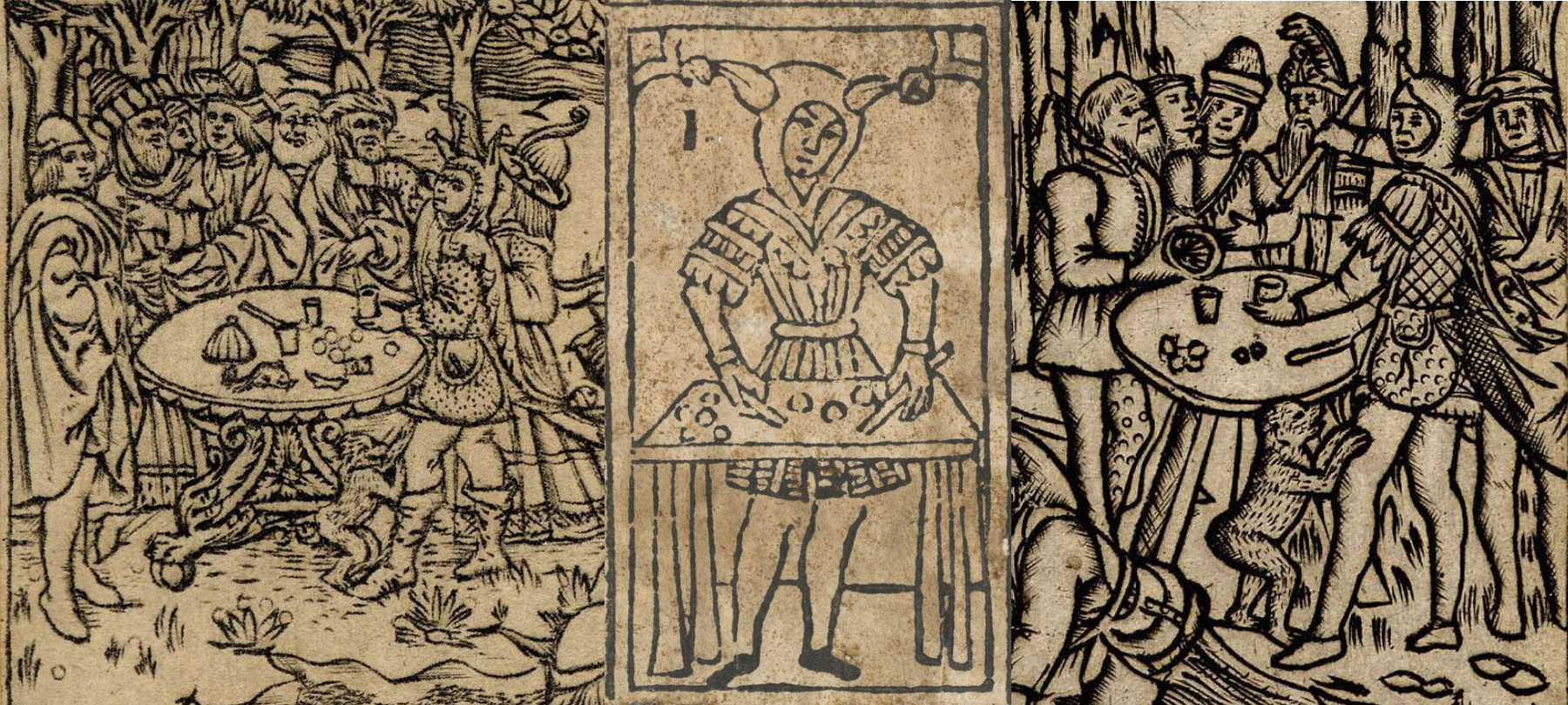
Last edited by mikeh on 12 Jul 2025, 03:32, edited 3 times in total.
Re: Bolognese sequence
480The only place outside of Tarot in the 15th century that I have found imagery of the Bagatto is in Children of the Planets, specifically Children of the Moon, in both Italy and Germany.
Florentine Baccio Baldini's two versions, both dated to the 1460s, show the Bagatto with a fool's cap. Their similarity to the Rosenwald card is quite remarkable, especially that on the right, below. Whether this allows us to tentatively date the Rosenwald sheet to the 1460s, I don't know.

Florentine Baccio Baldini's two versions, both dated to the 1460s, show the Bagatto with a fool's cap. Their similarity to the Rosenwald card is quite remarkable, especially that on the right, below. Whether this allows us to tentatively date the Rosenwald sheet to the 1460s, I don't know.
