I think the spelling of vulgus as volgus is a rare variant, occasionally found in medieval manuscripts that I think would have been archaic even in the late 15th century, I wonder if it is purposely intended to make the card look older?Magic Moon wrote: 20 May 2025, 21:45
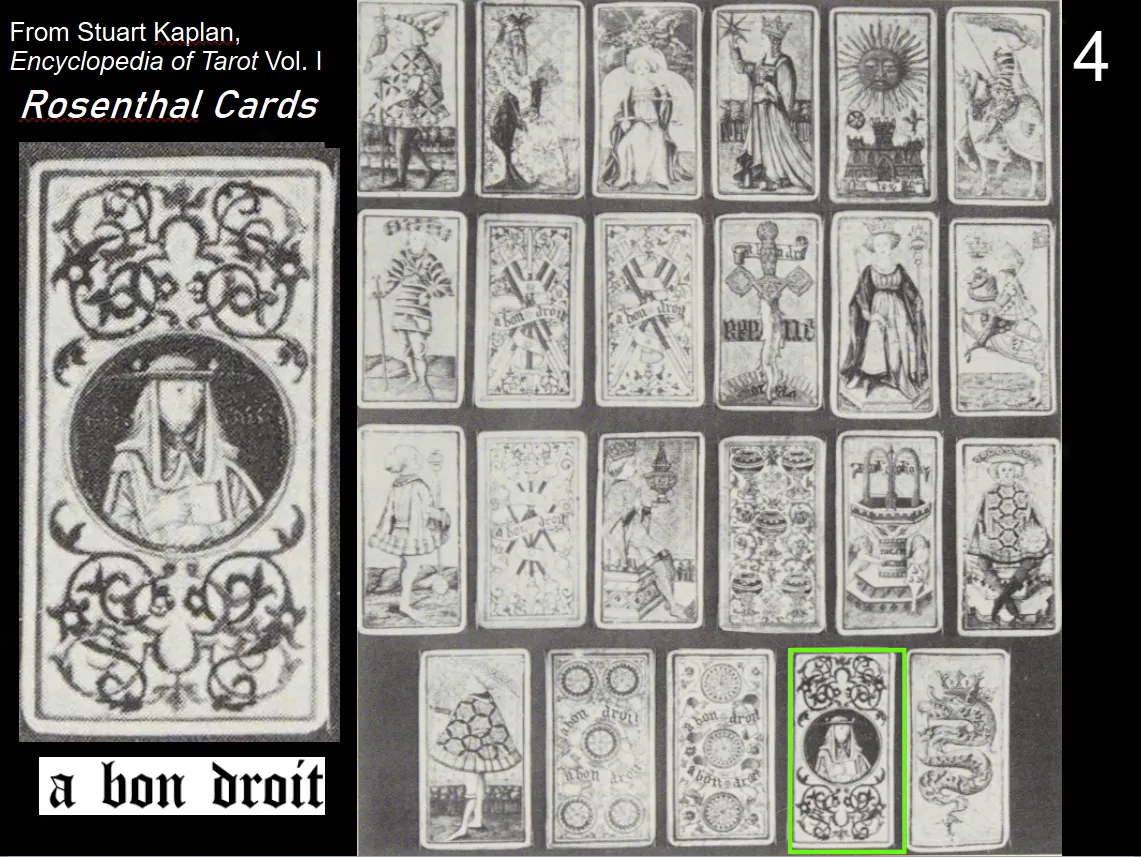
This ship card could be the only indication that the Minchiate had 40 triumphs in the 15th century. It's a very slight clue. I don't think that this ship card belonged to a Minchiate. The design resembles certain cards from the Visconti Sforza group. I don't think that this card is from the late 15th century but from the early 16th century.
The line:
"Odi profanum vulgus et arceo"
“I hate the common crowd and keep them at bay.”
Horace, Odes 3.1.1
beneath the image of the ship anchors the card within a humanist, emblematic, or moralizing tradition—likely placing it after the late 15th century. It functions like a motto which, on a card paired with an image, matches the conventions of Renaissance emblems or allegorical educational decks.
The text elevates the image into moral or philosophical territory, encouraging us to read the ship as a symbol of the initiated, of stoic detachment, or of the chosen soul sailing away from the vulgar masses.
At least, that is, if we take the one line on its own: However, if we take it as the first line from which we should recall the Ode as a whole, as a stoic eulogy for the simple life v. the heavy load of power & riches, then the symbolism of the ship & of the sea takes on a much darker, and contrary aspect.
In particular the verses:
Desiderantem quod satis est neque
tumultuosum sollicitat mare
nec saevus Arcturi cadentis
impetus aut orientis Haedi,
The man content with what is enough
is not troubled by stormy seas
nor the wild gales
of sinking Arcturus or rising Haedi.
Arcturus and Haedi: stars associated with violent storms.
Quod satis est = the Stoic golden rule—sufficiency, not excess.
Contracta pisces aequora sentiunt
iactis in altum molibus: huc frequens
caementa demittit redemptor
cum famulis dominusque terrae
The fish feel the seas shrink
under mounds of stone cast into the deep:
The builder drops concrete blocks
for the landowner and his crew.
Refers to Romans reclaiming sea for villas
caementa: raw stone—symbols of luxury expansion.
An allegory [or exemplar] of the hubris in reshaping nature.
https://hakaimagazine.com/features/how- ... ked-beach/
Fastidiosus: sed Timor et Minae
scandunt eodem quo dominus, neque
decedit aerata triremi et
post equitem sedet atra Cura.
But still, Fear and Menace
climb aboard with their owner.
They don’t leave his bronze-trimmed ship;
Angst, black-robed, rides right behind him.
aerata triremi = elite ships—luxury travel.
atra Cura: "black Care" = anxiety, guilt, worry, dread.
An allegory for the Stoic maxim - Wherever you go, you bring yourself.
In the context of hubris, guilt, existential angst, fears & menaces, we may perhaps see a justification for the substitution of the Devil by the Ship as in the Sicilian Tarot: the which however, is far to late for our card if the dating is anywhere near correct. I note, for completeness, the coincidence of a Sicilian reference in the Ode, however tangential, in which those under the sword of Damacles (a Sicilian) cannot in their existential angst enjoy the taste of a Sicilian feast, nor drowse sweetly to the sounds of the lyre or bird-song:
Destrictus ensis cui super inpia
cervice pendet, non Siculae dapes
dulcem elaborabunt saporem,
non avium citharaeque cantus
somnum reducent,...
The drawn sword hanging over a godless head
spoils the taste of Sicilian feasts;
neither birdsong nor harp music
will bring back sweet sleep.
Sword of Damocles—an image of peril hanging over power.
Siculae dapes: Sicily was famed for luxurious foods, and was a classical Epithet for the pleasure seeking in general.
Sleep eludes the guilty—a Stoic insight: peace lies in virtue, not luxury.