From “Dante gli uomini illustri e il bene comune,” 15 ottobre 2021-16 gennaio 2022, Sala dei Gigli, Museo di Palazzo Vecchio
Dante Alighieri, Illustrious Men and the Common Good
Sala dei Gigli, Palazzo Vecchio Museum
“The dignity and greatness of the fathers also ennobles the sons, but only if they also distinguish themselves by their own virtue.”
Leonardo Bruni, Laudatio Florentinae Urbis, 1404
On the occasion of the seven hundredth anniversary of the death of Dante Alighieri (1321-2021), this project highlights the figure of the sublime poet in relation to the history of the City Hall. In the 1380s, Dante, by then reinstated in Florence and already widely celebrated for his work, was selected as one of the examples of virtue to be depicted in a painted cycle: twenty-two illustrious men from history, emblems of high ethical and political values, who could inspire the city’s rulers.
The Florentine series – devised by Coluccio Salutati, notary, intellectual and Chancellor of the Florentine Republic, and now lost – followed the trend of the civic and political painting developed in the 14th century among Italian municipalities, which aimed to convey their political message directly and effectively: one only has to think of the Allegorie e agli effetti del Buon governo e del Cattivo governo [Allegories and Effects of Good and Bad Government], painted by Ambrogio Lorenzetti, in the Palazzo Pubblico of Siena. The idea of the Common Good, understood as the good of a community, to be defended against personal and factional interests, is to be seen in this context. In Florence, the Dominican friar Remigio de’ Girolami had dedicated a treatise to the Common Good in 1304, placing it at the centre of the relationship between individuals and the community, and an allegory of it had been painted by Giotto, according to Giorgio Vasari, in the Palazzo del Podestà, flanked by the cardinal virtues of Fortitude, Prudence, Justice and Temperance. In line with this superior political and ethical concept, its virtues and fundamental principles, but also exemplary figures from history who so well embodied them, occupied a prominent place.
In particular, the cycle painted in the Aula Minor in Florence – which most probably corresponds to this room – was associated with what had been created a few years previously in Padua in the Palazzo of Francesco Da Carrara with the Sala Virorum Illustrium, modelled on the work of Francesco Petrarch: in fact, the characters drew their inspiration from Petrarch’s De Viris Illustribus, but also from the famosi cives, the famous citizens celebrated by Filippo Villani in the same years, thus interweaving ancient history and Florentine glory.
The Florentine series brought together nine heroes of the Roman Republic, two condottieri, six great monarchs and five Tuscan poets, in the following order: Brutus, Furius Camillus, Scipio Africanus, Curius Dentatus, Dante Alighieri, Pyrrhus, Hannibal, Francesco Petrarch, Fabius Maximus, Marcus Marcellus, Ninus, Alexander the Great, Claudian, Zanobi da Strada, Giovanni Boccaccio, Julius Caesar, Octavian Augustus, Constantine, Charlemagne, Cicero, Fabricius Luscinus and Cato of Utica.
The Roman heroes, first and foremost Brutus, the ultimate defender of liberty and Salutati’s favourite example of virtue, embodied the great civic virtues of Magnanimity, Justice and Prudence, in contrast to Pyrrhus and Hannibal, who were destined to succumb to mighty Rome. The six monarchs, from the Assyrian Ninus to Charlemagne, symbolised the idea of universal government as an antithesis to tyranny; while the five Tuscan literati, peculiar only to this cycle, showed how Florence was a worthy successor to Rome on account of the extremely high value of its poetry. Here, alongside the arms and the toga once defined by Cicero, in Salutati’s programme literature became a distinctive expression and extraordinary excellence of Florentine history: poetry represented the city’s intrinsic virtue and placed it in direct continuity with Rome’s golden past. In this respect, Claudian’s presence in the cycle was emblematic, as he was the last great Latin poet, at the time reputed to be of Florentine origin, a symbolic link between the ancient age and Florentine rebirth.
The civic, ethical and political message was made even more explicit by the inscriptions attached to the effigies, in a perfect interplay of poetry and painting: indeed, each character was accompanied by a titulus, which described the distinctive characteristics for which the individual figure had been chosen to feature in the cycle. “The pictorial cycles of Famous Men do not conceal their message […] amid the tortuosity of erudite allusion or allegory: they embody it, transparently, in galleries of well-known figures, which in any case are identified, almost invariably, by means of tituli, verbally expressing the sense of the figurative homage.” (Maria Monica Donato)
In addition, the inscriptions – in Latin – were written in the first, second or third person, thereby constituting an ideal gathering of people, a perfect assembly of great men of action and intellect: “those who could look at the personages and read their epigrams on the wall could have the impression of a varied and unpredictable intertwining and alternating of words spoken and heard”. (Giuliano Tanturli)
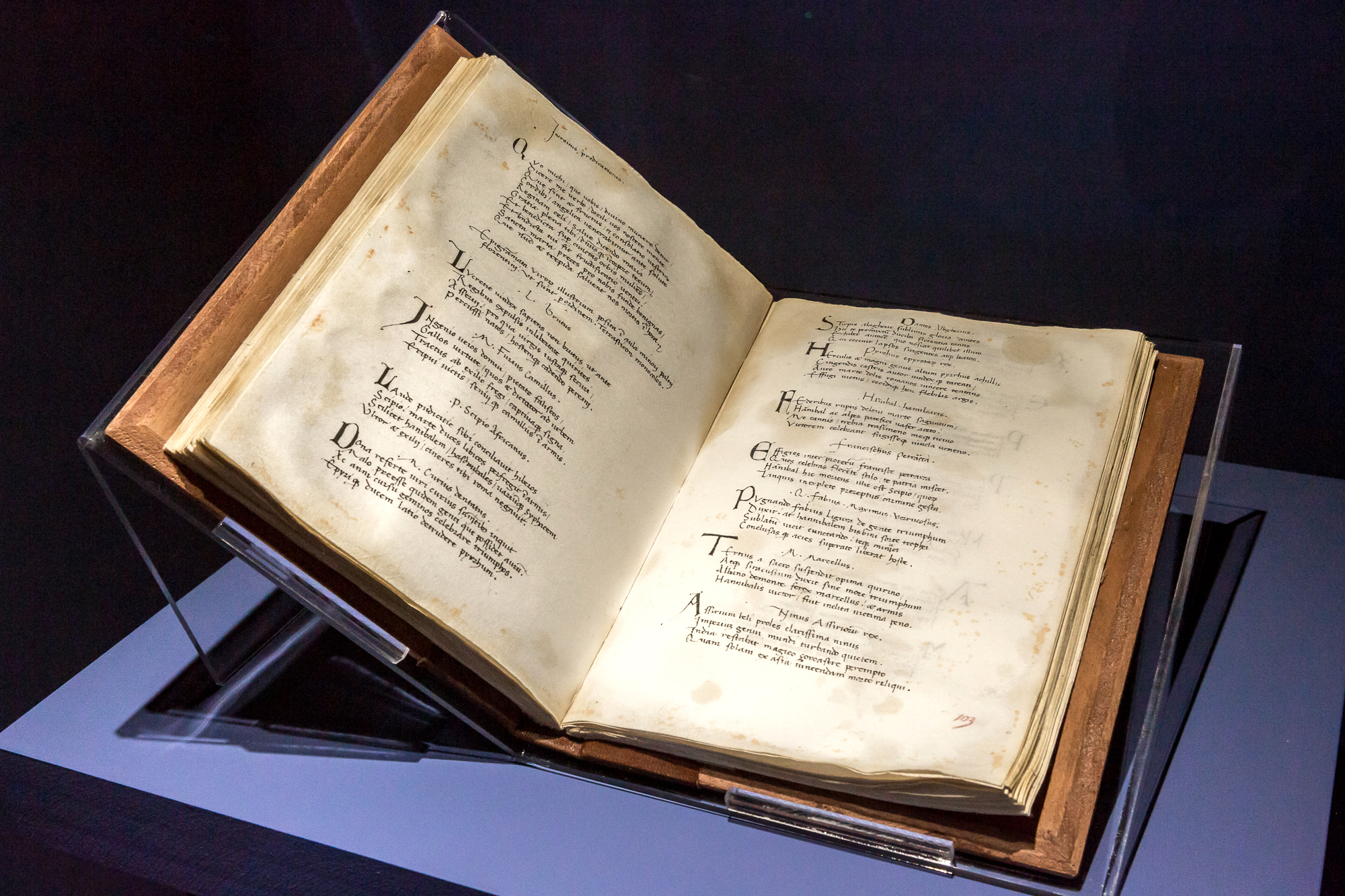
We have direct evidence of the inscriptions present thanks to the Laurentian manuscript Conv. Sopp. 79, displayed here and opened specifically on the pages dedicated to the Illustrious Men. We can in fact read the Epigrammata virorum illustrium posita in Aula Minori Palatii fiorentini, ut sunt per ordinem.
In particular, Dante Alighieri is remembered thus: “Dantes Alligherius. Stirpis alagherie sublimi gloria dantes / Hic te permixtum ducibus florentia tantis / Exhibet, autorem, quo noscat quilibet illum /Qui cecinit lapsos, surgentes atque beatos”, that is, “Dante Alighieri. Dante, sublime glory of the Alighieri family, Florence depicts you here, together with such great warriors, so that all may know the author who sang of fallen souls [for eternity], of those destined to ascend [to heaven] and of those blessed”.
We know that, as the culminating element of the cycle, in 1416, no less than Donatello’s marble David was transferred to the room, accompanied by an inscription of a strongly civic and inspirational nature: “Pro patria fortiter dimicantibus etiam ad versus terribilissimos hostes Dii praestant auxilium”.
In the mid-fifteenth century, the Illustrious Men continued to inspire the Florentine Seigneury, to the extent that in 1451 Filippo Lippi – one of the most outstanding artists of the time – was asked to restore and repaint some figures, among which Dante Alighieri was expressly mentioned: “Dante Aringhierum et alios famosos viros in Salecta Palatii Dominorum”. Ten years later, in 1461, the portrait of the deceased Chancellor Poggio Bracciolini was added to the series, as had presumably already been the case with Coluccio Salutati.
From 1469, it was decided to carry out major work on the room and the adjacent one, followed three years later by the resolution to renovate the whole interior with a new decorative programme.
The structural work was completed in the summer of 1475, and in the following year Benedetto and Giuliano da Maiano, together with Francesco di Giovanni (known as il Francione), began work on the connecting door between the two rooms (now the Sala delle Udienze and the Sala dei Gigli). The marble-relief decoration features a striking interplay of religious and secular, classical and Florentine references, while the wooden door shutters have inlays of two of the Illustrious Men from the previous cycle: Dante and Petrarch.
In the spring of 1476, the Seigneury purchased from Lorenzo and Giuliano de’ Medici another sculpture of David – this time in bronze – by Verrocchio, which was positioned at the top of the stairs, at the entrance to the room.
In October 1482, the Works Council commissioned Domenico Ghirlandaio, Sandro Botticelli, Perugino, Bigio Tucci and Piero Pollaiolo to paint the walls of the room. Only the wall assigned to Ghirlandaio was completed: in the centre stands St. Zanobi, flanked by the coats of arms of Florence, the cross and the red lily, emblems of the People and the Municipality of Florence. On the sides, in an illusionistic setting that recalls a triumphal arch, there appear six Roman heroes, updated echoes of ancient examples of virtue: the triad on the left presents Brutus, Mucius Scaevola and Furius Camillus; on the right Decius Mus, Scipio Africanus and Cicero.
The Illustrious Men gathered here at the end of the fourteenth century have taken on an updated form and a new arrangement and can still be seen today as visual memories of an ideal past, but also, and above all, as inspirational aspects, constantly reinterpreted, of our individual and common actions.
Epigrammata Virorum illustrium posita in aula minori pal[a]tii florentini. Ut sunt per ordinem. Tetrasticon monocolos.
L. BRUTUS
Lucretie vindex sapiens non brutus ut ante
Regibus expulsis in libertate quirites
Asserui. pro qua virgis iustaque securi
Percussi natos, hostemque cadendo peremi.
M. FURIUS CAMILLUS
Ingenio veios domui, pietate faliscos,
Gallos virtute, quos et dictator ad urbem
Tractus ab exilio fregi, captivaque signa
Eripui victis, senuique camillus in armis.
P. SCIPIO AFRICANUS
Laude pudicitie sibi conciliavit hiberos
Scipio. marte duces libicos perfregit in armis,
Scilicet hanibalem, hasdrubales, variumque Syphacem
Ultor et exilii, cineres tibi roma negavit.
M. CURIUS DENTATUS
Dona referte viri curius samnitibus inquit
Malo preesse quidem genti que possidet aurum.
Ac anni cursu geminos celebrare triumphos.
Epyrique ducem latio detrudere pyrrhum.
DANTES ALLIGHERIUS
Stirpis alagherie sublimis gloria dantes
Hic te permixtum ducibus florentia tantis
Exhibet, autorem, quo noscat quilibet illum
Qui cecinit lapsos, surgentes atque beatos.
PYRRHUS EPYROTARUM REX
Herculis et magni genus altum pyrrhus achillis
Cingendis castris autor vindexque tarenti,
Auro marte dolis romanos vincere tentans,
Effugi victus, cecidique heu flebilis argis.
HANNIBAL HAMILCARIS
Federibus ruptis delevi marte saguntum,
Hannibal ac alpes patefeci vafer aceto.
Me cannis, trebia, trasimeno meque ticino
Victorem celebrant, fugisseque vincla veneno.
FRANCISCUS PETRARCA
Effigies inter procerum Francisce petrarca
Quos celebras florente stilo, te patria miscet.
Hannibal hic moriens, illic est Scipio, quorum
Linquis inexpleto prereptus carmine gesta.
Q. FABIUS MAXIMUS VERRUCOSUS
Pugnando Fabius Ligura de gente triumphum
Duxit. at hannibalem bis bini sorte trophei
Sublatum vicit cunctando. teque minuci
Conclusasque acies superato liberat hoste.
M. MARCELLUS
Tertius a sacro suspendit opima quirino
Atque siracusium duxit sine more triumphum
Albano de monte ferox marcellus. et armis
Hannibalis victor, fuit inclita victima peno.
NINUS ASSIRIORUM REX
Assirium beli proles clarissima ninus
Imperium genui, mundi turbando quietem.
India restabat magico çoroastre perempto
Quam solam ex asia vincendam morte reliqui.
MAGNUS ALEXANDER REX MACEDONUM
Clarus Alexander patris ultus fata, rebelles
Evertit thebas, doctisque pepercit athenis.
Persas, et scithios, bactrasque subegit, et indos,
Qui sacra deposcens periit babilone veneno.
CLAUDIANUS POETA FLORENTIUS
Egipto genitum nova me florentia civem
Legibus agnovit, magnis iam digna poetis.
Infernos raptus cecini pugnasque deorum,
Cesareas laudes, necnon stiliconis honores.
D. ÇENOBIUS DE STRATA
Pyeridum studiis, meruit çenobius altis
Vatibus ascriptus circundare tempora lauro.
Ingenium, cuius doceant cum plurima, frugem
Heu dolor eripuit properate iniuria mortis.
DOMINUS IOHANNES BOCCACCIUS
Progenies celebris boccaccia clare Iohannes
Qui genus omne deum, qui pascua, quique virorum
Illustres casus celebrans, mulieribus omne
Das decus, ex meritis, hic te Florentia pinxit.
G. IULIUS CESAR
Marte ferox Cesar, positis placidissimus armis,
Quinque micat victor sumptis ex hoste triumphis.
Gallica bella, phari, ponti, libies, et hyberi,
Gloria victoris. morienti curia testis.
OCTAVIANUS AUGUSTUS
Accia me genuit. Cesar dictator adoptat.
Inferias patri, Brutos, sociosque peremi.
Terque triumphavi, Ianique sacraria clausi,
Imperii sceptrum, ac orbis moderamina sumpsi.
COSTANTINUS IMPERATOR
Me constantinum mergens celestibus undis
Claviger ethereus lepra simul atque reatu,
Liberat, inde sacre merui crucis esse repertor.
Imperiique throno statui decorare biçantum.
KAROLUS MAGNUS
Rex ego gallorum karolus cognomine magnus
Perdomui gentes longobardosque tirannos
Nactus et imperium mea te Florentia muris
Fortibus armavi romanis civibus auctam.
M. TULLIUS CICERO
Inclitus eloquii latialis Tullius autor.
Ingenium cuius habuit per roma triumphis
Imperioque suo, Catilinam fregit. at ipsum
Antonii gladius, libertatemque peremit.
G. FABRITIUS LUCINIUS
In partem regni pyrrho donante vocatus
Pauper Fabricius, contempsit munera regis
Donaque samnitum, quo dictus cultor honesti
Firmior esse, suum quam sol intendere cursum.
M. PORTIUS CATO UTICENSIS
Gloria virtutum gremio conceptus honesti
Sum cato qui semper vitiis acerrimus hostis
In coniuratos statui cum sanguine penas
Eiciensque animam, mea liber ad astra redivi.
Museum translation:
Epigrammi degli Uomini illustri, posti nell’aula minore di Palazzo Vecchio a Firenze. Qui riportati secondo il loro ordine di apparizione. Quartine di esametri
BRUTO
Io, vendicatore di Lucrezia, “Il saggio” e non più “Lo sciocco” come prima, dopo aver espulso i re da Roma, ho donato ai Quiriti la libertà, per la quale ho abbattuto i figli [del re] a suon di bastonate e con la scure infallibile, e morendo ho ucciso il mio nemico.
FURIO CAMILLO
Io, Camillo, con la mia destrezza piegai Veio, con il mio rigore morale i Falischi, con il mio coraggio i Galli. Li annientai, e tornai a Roma da dittatore. Sottrassi ai vinti le insegne militari che avevano conquistato, e invecchiai tra le armi.
SCIPIONE L’AFRICANO
Con i meriti dovuti alla sua clemenza Scipione si conquistò il favore degli abitanti dell’Iberia, annientò in guerra i comandanti libici, Annibale, i due Asdrubale e lo sleale Siface, e, vendicandosi dell’esilio [a cui si era ritirato], a te, Roma, negò [la sepoltura] del suo corpo.
CURIO DENTATO
“O ambasciatori, riportate indietro i vostri doni!”– disse Curio ai Sanniti – “Preferisco dominare su un popolo che possiede dell’oro [piuttosto che avere dell’oro io stesso], celebrare un doppio trionfo nel corso di un anno e allontanare dal Lazio [la minaccia di] Pirro, re dell’Epiro”.
DANTE ALIGHIERI
Dante, gloria eccelsa della famiglia Alighieri, Firenze ti rappresenta qui, insieme a così grandi condottieri, affinché tutti conoscano l’autore che cantò delle anime cadute [per sempre], di quelle destinate a salire [in cielo] e di quelle beate.
PIRRO, RE DELL’EPIRO
Io, Pirro, della stirpe antica di Ercole e del grande Achille, campione nel cingere in assedio gli accampamenti [nemici] e vendicatore di Taranto, dopo aver tentato di vincere i Romani con l’oro, con la guerra e con l’inganno, sconfitto fuggii, e caddi – oh, disgraziato me! – ad Argo.
ANNIBALE, FIGLIO DI AMILCARE
Io, Annibale, dopo aver rotto l’alleanza [con i Romani], distrussi in guerra Sagunto e, astutamente, mi aprii una strada nelle Alpi [frantumando] con l’aceto (i massi che ostacolavano il cammino). Mi celebrano come vincitore a Canne, sulla Trebbia, al Trasimeno e al Ticino, e per aver fuggito le catene [della schiavitù] con il veleno.
FRANCESCO PETRARCA
Francesco Petrarca, la patria pone [anche] te tra le immagini dei grandi, che tu celebri con il tuo stile ornato. Qui c’è Annibale morente, lì Scipione, dei quali tu, rapito [dalla morte prima del tempo], abbandoni le gesta lasciando il tuo canto incompiuto.
QUINTO FABIO MASSIMO, “IL VERRUCOSO”
Combattendo Fabio riportò il trionfo sul popolo ligure. Ma temporeggiando vinse due volte Annibale, imbaldanzito dalla fortuna di una doppia vittoria, e, sconfitto il nemico, libera te, o Minucio, e le schiere ormai accerchiate.
MARCELLO
Il feroce Marcello consacrò per terzo al sacro Quirino le spoglie opime [del nemico sconfitto] e celebrò il trionfo su Siracusa, contro l’uso, sul Monte Albano. Vincitore di Annibale in guerra, fu vittima illustre del Cartaginese.
NINO, RE DEGLI ASSIRI
Io, Nino, figlio illustrissimo del re Belo, diedi vita all’impero assiro, turbando la quiete del mondo. Dopo aver ucciso il mago Zoroastro, rimaneva [ancora] l’India, che sola di tutta l’Asia con la mia morte lasciai da conquistare.
ALESSANDRO MAGNO, RE DEI MACEDONI
L’insigne Alessandro, dopo aver vendicato la morte del padre, distrusse la ribelle Tebe e risparmiò la dotta Atene. Sottomise i Persiani, gli Sciti, gli abitanti della Battriana e dell’India, lui che, richiesti con insistenza onori divini, morì di febbre a Babilonia.
CLAUDIANO, POETA FIORENTINO
Nato in Egitto, mi riconobbe come suo cittadino Firenze, inesperta nelle leggi, ma già degna di grandi poeti. Cantai il ratto [di Proserpina] nell’Ade e le battaglie degli dei [nella Gigantomachia], lodi in onore dell’imperatore e omaggi a Stilicone.
ZANOBI DA STRADA
A causa della dedizione alle Muse, Zanobi meritò di essere ascritto tra i grandi poeti e di avere le tempie cinte della corona di alloro. E mentre moltissime opere ne mostrano l’ingegno, l’offesa di una morte prematura – ahimè, [che] dolore! – se ne portò via il frutto.
GIOVANNI BOCCACCIO
O illustre Giovanni, famosa progenie della famiglia Boccaccio, tu che celebri tutta la discendenza degli dèi, la vita agreste e le vicende illustri degli uomini, e dai ogni onore alle donne, Firenze ti ha ritratto qui per i tuoi meriti.
GIULIO CESARE
Cesare, feroce in guerra, mitissimo dopo aver deposto le armi, rifulge vittorioso dopo aver celebrato sul nemico cinque trionfi. Le guerre galliche, quelle presso Faro [in Egitto], sul Mar Nero, in Libia e presso il fiume Ebro sono gloria per il vincitore. La Curia [di Roma] è testimone della sua morte.
OTTAVIANO AUGUSTO
Azia mi generò. Il dittatore Cesare mi adottò. Annientai Bruto con gli altri cesaricidi e i loro alleati, sacrifici in onore di mio padre. Celebrai il trionfo per tre volte, chiusi le porte del tempio di Giano, assunsi lo scettro dell’impero e il timone del mondo.
COSTANTINO IMPERATORE
[San Pietro], portatore delle chiavi del cielo, facendomi immergere nell’acqua sacra [del Battesimo], libera me, Costantino, dalla lebbra e insieme dal peccato, motivo per cui ho meritato di essere lo scopritore [dei frammenti] della sacra croce. E decisi di onorare Bisanzio del trono imperiale.
CARLO MAGNO
Io, Carlo, soprannominato Magno, re dei Galli, domai il popolo e i re dei Longobardi e, conquistatomi l’impero, ti fornii di forti mura, Firenze mia, accresciuta [com’eri] di [nuovi] cittadini romani.
MARCO TULLIO CICERONE
Tullio [Cicerone] fu insigne autore dell’eloquenza in lingua latina. Roma stimò il suo ingegno pari ai propri trionfi e alla propria potenza. Represse [la congiura di] Catilina, ma la spada di Antonio uccise lui e la libertà.
FABRIZIO
Chiamato da Pirro, che gli voleva donare la quarta parte del suo regno perché povero, Fabrizio disprezzò le offerte del re e i doni dei Sanniti, e per questo si disse che quel campione di onestà era più irremovibile di quanto lo fosse il sole nel percorrere il proprio corso [nel cielo].
CATONE L’UTICENSE
Onore delle virtù, concepito nel grembo dell’onestà, io sono quel Catone che, sempre acerrimo nemico dei vizi, si pronunciò per la pena di morte dei congiurati. Esalando l’ultimo respiro, tornai libero alle mie stelle.
ChatGPT translation 24/06/2023 (I'm working through revisions)
Epigrams of Illustrious Men, placed in the smaller hall of Palazzo Vecchio in Florence. Presented here in the order of their appearance. Quatrains in hexameters.
BRUTUS
I, avenger of Lucretia, now “the wise” no longer “the stupid”, after expelling the kings from Rome, bestowed upon the Roman citizens their freedom, for which I struck down the king's sons with blows of a staff and the unfailing axe, and in death, I killed my enemy.
FURIUS CAMILLUS
I, Camillus, conquered Veii with my skill, the Falisci with my moral rigor, the Gauls with my courage. I annihilated them and returned to Rome as a dictator. I took away from the defeated their military insignia that they had conquered and aged among the arms.
SCIPIO AFRICANUS
Through the merits of his clemency, Scipio won the favor of the inhabitants of Iberia, defeated the Libyan commanders in war, Hannibal, the two Hasdrubals, and the treacherous Syphax. And in avenging his exile, he denied you, Rome, the burial of his body.
CURIO DENTATUS
"O ambassadors, take back your gifts!" - Curio said to the Samnites - "I prefer to rule over a people who possess gold rather than to possess gold myself, to celebrate a double triumph in the course of a year and to drive away Pirro, the king of Epirus, from Lazio."
DANTE ALIGHIERI
Dante, glorious pride of the Alighieri family, Florence portrays you here, alongside such great leaders, so that all may know the author who sang of fallen souls, of those destined to ascend and of the blessed ones.
PYRRHUS, KING OF EPIRUS
I, Pyrrhus, of the ancient lineage of Hercules and the great Achilles, skilled in besieging enemy camps and avenger of Taranto, after attempting to conquer the Romans with gold, war, and deceit, I fled defeated, and alas, wretched me, I fell in Argos.
HANNIBAL, SON OF HAMILCAR
I, Hannibal, after breaking the alliance with the Romans, warred against Saguntum and cunningly opened a path through the Alps, crushing the rocks that obstructed the way with vinegar. I am celebrated as the victor at Cannae, on the Trebia, at Trasimeno, and at Ticinus, and for escaping the chains of slavery with poison.
FRANCESCO PETRARCA
Francesco Petrarch, the homeland includes you among the images of the great, as you celebrate them with your adorned style. Here lies the dying Hannibal, there Scipio, of whom you, taken by death prematurely, abandon the deeds, leaving your song incomplete.
QUINTUS FABIUS MAXIMUS, "THE VERRUCOSUS"
In combat, Fabius triumphed over the Ligurian people. By delaying tactics, he twice defeated Hannibal, emboldened by the fortune of a double victory, and having defeated the enemy, he liberated you, Minucius, and the now besieged troops.
MARCELLUS
The fierce Marcellus consecrated the spoils of the enemy as a third offering to sacred Quirinus and celebrated the triumph over Syracuse, against custom, on Mount Alburnus. As the victor over Hannibal in war, he became an illustrious victim of the Carthaginian.
NINUS, KING OF ASSYRIA
I, Ninus, most illustrious son of King Belus, founded the Assyrian empire, disturbing the world's tranquility. After killing the sorcerer Zoroaster, only India remained unconquered throughout Asia, which I left to be conquered by my death alone.
ALEXANDER THE GREAT, KING OF MACEDON
The renowned Alexander, after avenging his father's death, destroyed rebellious Thebes and spared learned Athens. He subjugated the Persians, the Scythians, the inhabitants of Bactria, and India. He, who, when demanded with insistence to accept divine honors, died of fever in Babylon.
CLAUDIAN, FLORENTINE POET
Born in Egypt, Florence acknowledged me as its citizen, inexperienced in laws but already worthy of great poets. I sang of the abduction in Hades and the battles of the gods in the Gigantomachy, praises in honor of the emperor, and homage to Stilicho.
ZANOBI DA STRADA
Due to his dedication to the Muses, Zanobi deserved to be counted among the great poets and to have his temples adorned with the laurel crown. While numerous works display his genius, the misfortune of premature death - alas, what sorrow! - took away their fruit.
GIOVANNI BOCCACCIO
O illustrious Giovanni, famous scion of the Boccaccio family, who celebrates the entire lineage of the gods, rustic life, and the illustrious deeds of men, and bestows honor upon women, Florence has depicted you here for your merits.
JULIUS CAESAR
Caesar, fierce in war, most gentle after laying down his arms, shines victoriously after celebrating five triumphs over the enemy. The Gallic Wars, those near Pharos [in Egypt], the Black Sea, Libya, and the Ebro River are glory for the conqueror. The Curia [of Rome] testifies to his death.
OCTAVIAN AUGUSTUS
Asia bore me. Dictator Caesar adopted me. I annihilated Brutus along with other assassins and their allies, offering sacrifices in honor of my father. I celebrated triumph three times, closed the gates of Janus' temple, assumed the scepter of the empire and the helm of the world.
CONSTANTINE THE EMPEROR
[Saint Peter], bearer of the keys to heaven, by immersing me in the sacred water [of Baptism], liberated me, Constantine, from leprosy and from sin, for which I deserved to discover the fragments of the Holy Cross. And I decided to honor Byzantium with the imperial throne.
CHARLEMAGNE
I, Charles, called the Great, king of the Franks, subdued the people and the kings of the Lombards and, having acquired the empire, provided you, my Florence, with strong walls, enriched with new Roman citizens.
MARCUS TULLIUS CICERO
Tullius [Cicero] was a distinguished author of eloquence in the Latin language. Rome esteemed his genius equal to its own triumphs and power. He suppressed [the conspiracy of] Catiline, but the sword of Antony killed him and liberty.
FABRIZIO
Summoned by Pyrrhus, who wanted to bestow upon him a quarter of his kingdom because of his poverty, Fabrizio rejected the king's offers and the gifts of the Samnites. For this reason, it was said that this champion of honesty was more steadfast than the sun in its course through the sky.
CATO THE YOUNGER
Honored for his virtues, conceived in the womb of honesty, I am that Cato who, always the bitter enemy of vices, pronounced in favor of the death penalty for the conspirators. As I breathed my last breath, I returned free to my stars.