Huck wrote: 27 Mar 2022, 06:47
Actually there are 5 versions from much later time and the Trionfi note for instance is only in one of them.
I guess, that Malatesta wasn't in Florence. The political change from Piccinino back to the Florentine side should have been arranged by diplomats.
Possibly Guisto was one of the active diplomats in this matter.
Bingo. And who was he being diplomatic for?
The only business that Giusti had in Florence at this time, besides provisioning troops, is dealing with the
Dieci for
condotti. From that body's perspective Giusti was a natural go between with Malatesta to cement getting him back in the fold (the Dieici could have given him a fattened contract in that regard to defer the cost of purchasing the luxury deck, which he duly notes he purchased in Florence). Remember that Trevisan and Papal troops were also sent to Malatesta at the time he received his deck of the ur-tarot. Malatesta was both a papal and Florentine ally, forced away by Piccinino.
And who was on that Medici-dominated
Dieci that had cultural/art production connections? Leonardo Bruni, who had previously laid out a program for the 'gate's of Paradise' for the Baptistery's doors. I still say Bruni is a natural candidate as the inventor of
trionfi, his own guild hall featuring the virtues on its ceiling, and his writings focusing on the virtues, and he had the management of domestic and foreign affairs as his concern as chancellor. The virtues were mixed with exemplary themes from Dante, on his mind from his popular
vita of Dante from just four years before Anghiari.
Back to Giusti: Nowhere else in the journal does he evince an interest in any kind of art production. For him to buy art on any occasion is out of character. He notes spoils of war to which he and his clients are entitled and civic celebrations - especially
palio winners - as he had what we might call in America 'blue collar' tastes. Giusti was a practical man, turning a buck (er, Florin), for whom the world of art is someone else's business. To think the gift of
trionfi was his idea - and not the
Dieci's with whom he is dealing before setting off to Malatesta - seems preposterous. Later in the journal we find Giusti as a specific go-between for Cosimo and Malatesta. Malatesta formerly owning the city that was won after Anghiari, San Sepolcro, and it slipping away from him as Florence bought it from the pope, was yet another reason for diplomatic gifts.
What of the
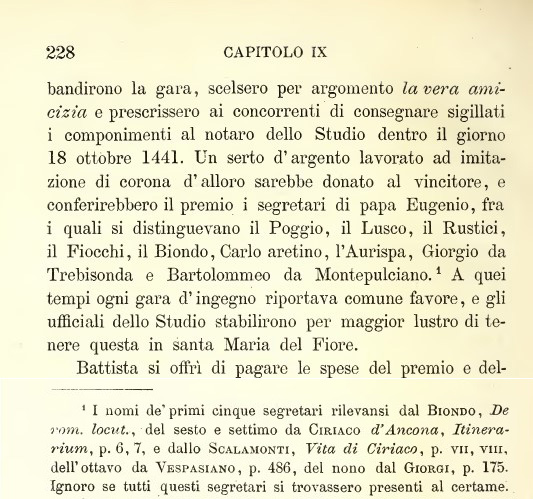
Certame coronario of a year later in October 1441? Brian Maxson's paper is the most illuminating in my opinion: "The Certame coronario as Performative Ritual" in Rituals of Politics and Culture in Early Modern Europe: Essays in Honour of Edward Muir. Essays and Studies, 39. Toronto: Centre for Reformation and Renaissance Studies, 2016: 137-63. On-line here:
https://www.academia.edu/26020071/The_C ... ive_Ritual
While whom the judges were is of some interest, they didn't even pick a winner. Who set up the competition is more noteworthy:
The planning for the Certame coronario began in the dramatic diplomatic environment of September or early October 1441.3
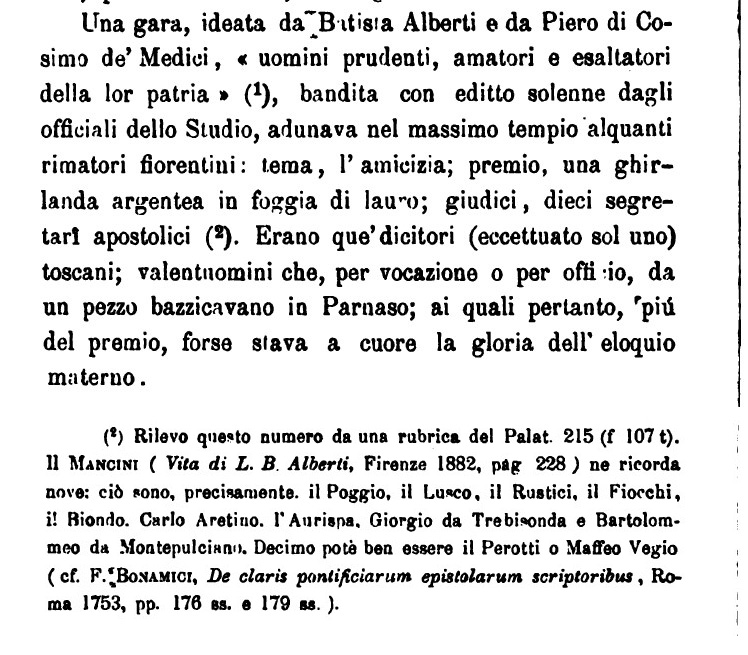
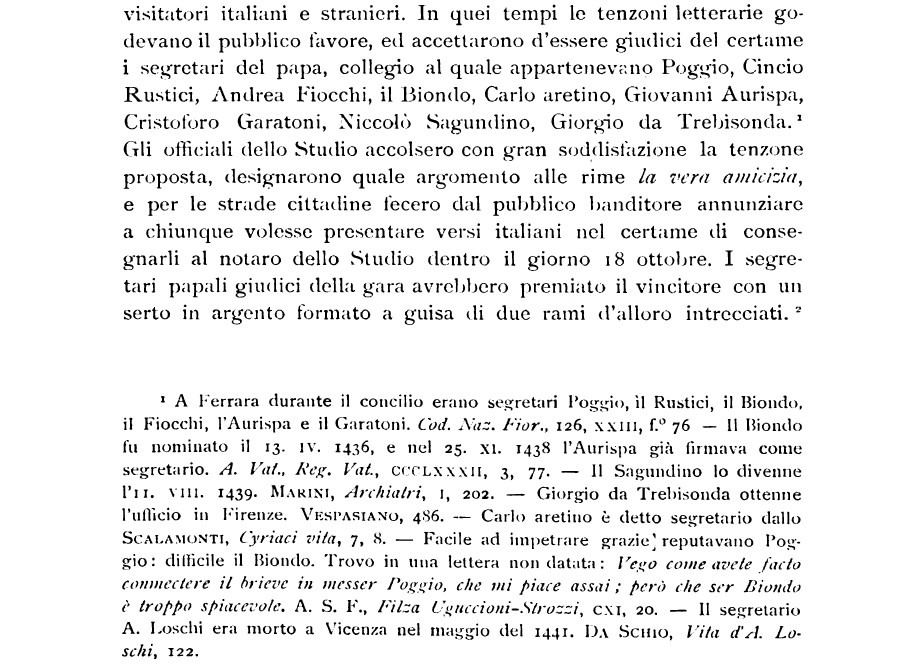
“The city of Florence,” began one principal manuscript witness, “continuously had endured extreme suffering and attacks because of the continuous wars waged against Filippo Maria, duke of Milan. hose wars were still not entirely at an end when, for the consolation of their afflicted souls, messer Batista degli Alberti and Piero di Cosimo de’ Medici,” approached the Florentine Studio with an idea.4 [= Bertolini, De vera amicitia, 519]. From 1439 the condottiere Francesco Sforza — employed by Florence, Venice, and Pope Eugenius IV — had fought against Milan’s condottiere Niccolò Piccinino, with the figures alternately seizing and liberating lands in Lombardy, Tuscany, and the Romagna. Drawn out of Tuscany by Sforza’s encroachment towards Milan, Piccinino and various Florentine exiles were defeated at the battle of Anghiari in the summer of 1440. The victory turned the tide of the war decisively in favor of the Florentines, Venetians, and the pope, and set in motion events that led to the Peace of Cavriana, a treaty based upon the marriage between the Milanese Bianca Visconti and Florentine/Venetian and papal condottiere Francesco Sforza. Informed contemporary viewers of the political proceedings seem to have thought that the peace could reach a long-lasting solution to the Lombard conlicts.5 For example, Biondo Flavio chose the Peace of Cavriana as the event with which to close his massive Decades. 6 Leonardo Bruni similarly chose the events later Anghiari to end his Commentaries.7 Both men, thus, symbolically suggested their views on the significance of the Sforza/Visconti marriage and the peace it fostered. Just two days before this heralded marriage, the Florentines hosted the Certame coronario, a poetry competition on the nature of true friendship. he event, as argued below, was a performative ritual that looked to solidify the connection between Sforza and Visconti.
To summarize: The Anghiari and related campaigns all were swept up into Sforza's brokered Peace of Cavriana and related marriage to Bianca, which the Medici viewed as an era-defining moment (per Flavio and Bruni's works, among others). The victory cementing their own power in Tuscany and permanently keeping Milan at bay (so they hoped); just as much as Filippo thought having Sforza in his camp would somehow turn the future tide to his favor (sorely mistaken), Medici viewed Sforza, indebted to them, as a means of avoiding future conflicts. The Certame's olive leaf theme of "friendship" even included an implicit nod from Alberti to his old friend and current mouthpiece of the Albizzi/Filippo alliance, Filelfo:
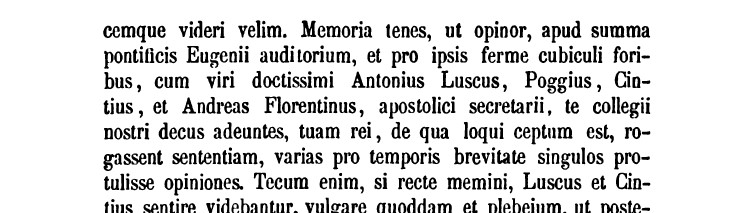
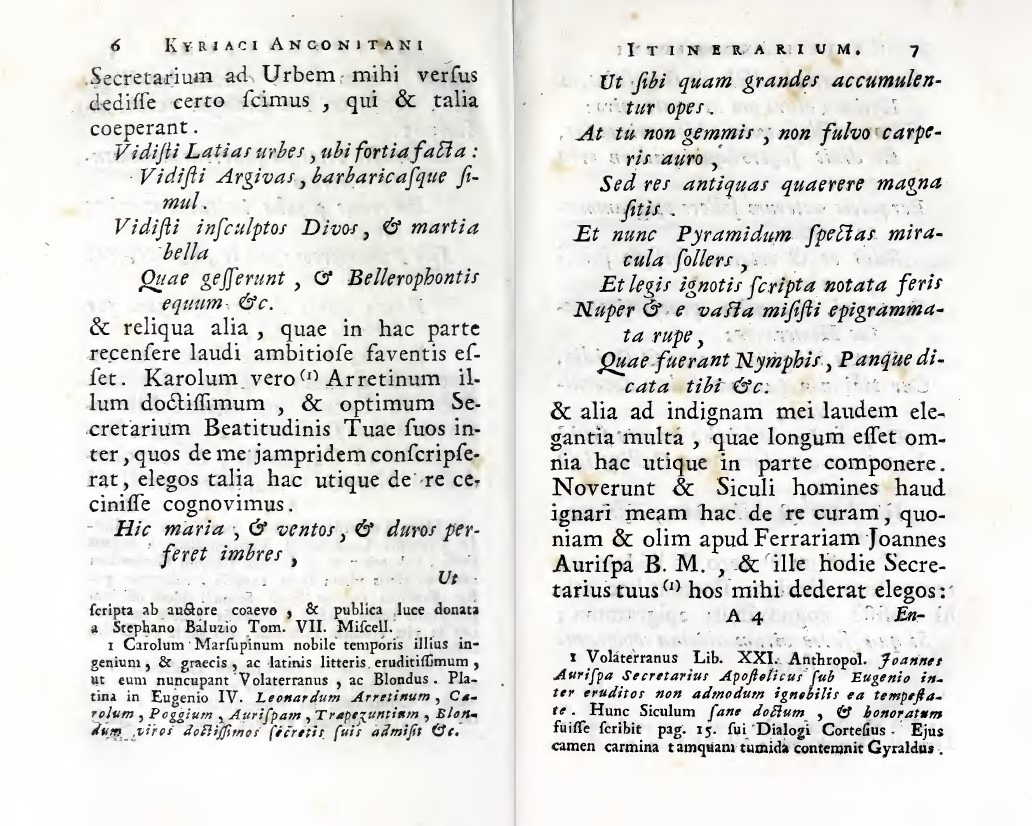
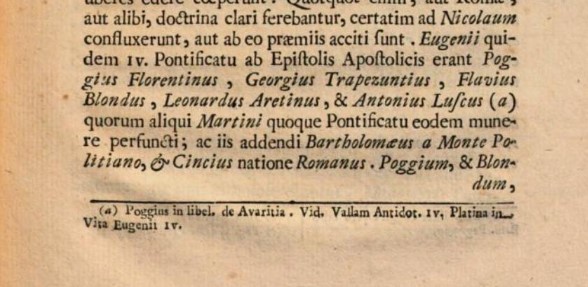
The speakers were Francesco Alberti, Antonio Agli, Mariotto Davanzati, Anselmo Calderoni [town herald who had already written a piece praising the 'men of Sforza' after Anghiari], Benedetto Accolti, Cyriac of Ancona, Leonardo Dati, and Leon Battista Alberti, although Antonio di Meglio and his son Gregorio recited the poems by Agli and Davanzati for them.93 The words by Alberti were recited either by Antonio or Gregorio di Meglio, or even possibly by a young Cristoforo Landino.94 A speech by Niccolò della Luna seems to have inaugurated the event.95 These men all came from various political factions in Florence. Francesco Alberti was a member of anti-Medici groups in Florence.96 The Davanzati family, by contrast, was made up of Medici partisans.97 Benedetto Accolti also was a friend of the Medici.98 Niccolò della Luna, by contrast, was a friend of Francesco Filelfo and the son of a man who would be exiled from Florence in 1444.99 The individuals in the Certame coronario varied in their domestic politics, but they almost all shared very close connections to Pope Eugenius IV (154-55).
Pope Eugene was a problem since yet another condottiero friendly to him, Baldaccio (also from Anghiari and married into the Malatesta family), had been thrown out of the town hall window to his death at this time. So the point of this "friendship" poetry competition was to ameliorate the pope and show him that although victorious the Medici were making nice with Milan and even dissident voices in Florence, with whom the pope was friendly. But equally straining was the Medici and pope's relationship to Sforza - the former placed him at the center of their own security and the latter loathed him as one making in-roads to Papal fiefs (namely Ancona). All of this then, the Certame, was a smokescreen to place the Medici-Sforza alliance in a peaceful light in regard to Milan and the pope's own precarious position in regard to the Church's holdings and his need to return to Rome. That this failed and that the pope left Florence in a huff does not change the intent of this competition.
Now for what amounts to a smoking gun, in my opinion, of the Certame in the context of the production of
trionfi - the CY:
At one level, the Certame, as a ritual, sought to ensure the success of the marriage — occurring almost on the exact same day — in the north between Francesco Sforza and Bianca Maria Visconti, daughter of Sforza’s long-time rival Filippo Maria Visconti, as well as the related peace negotiations to end the wars in Lombardy. Additionally, the Certame had another context closer to home, where it served to attempt to quell tensions rising over the death of the condottiere Baldaccio d’Anghiari.(137)
The production of the ur-trionfi at the time of Anghiari, arguably immediately after the battle, from which Giusti ordered the personalized deck for Malatesta, can be framed as a predecessor production of the Certame, as part of the Medici's on-going public relations, the latter personally pushed for by Piero.
The biggest question is who commissioned and created the CY, which has all the hallmarks of having been created for the Sforza-Bianca wedding, simultaneously celebrated at the time of the Certame. Given the presence of one groomed by Filelfo in the Certame competition, as a means of underscoring the non-partisan "friendship" promoted by the Medici (again Piero was equally a sponsor as Alberti), might suggest the Medici commissioned the deck for the wedding, since it was part and parcel of the peace they desperately coveted (skyrocketing
castato taxes for war since the 1420s were untenable going forward). Filelfo's poetic invectives against the Medici reached a peak right up to the batlle of Anghiari, and so any peace offering in that direction (through the symbol of the Filelfo-allied family of the della Luna) would have been notable. But the intended audience was the Pope still resident in Florence - who was not at that Sforza-Bianca wedding in Cremona - and so anything beyond the Certame gesture was pointless.
The CY deck itself militates against the idea of Florentine production, even if the Florentine ur-tarot was the immediate model. For instance, there are no signs of 16 card Florentine suits. More importantly, it has now been shown that the impresa - what was especially done for the Malatesta deck (
belli) - were not Sforzas', but rather Visconti house symbols loaned to Sforza, as indeed was the Visconti name itself on his medal at this time:
VICECOMES. The Medici would never have done that. What was once popularly thought of as the quince symbolizing the Sforza ancestral fief of Cotignola on the CY Sword court cards has now been shown to be the Visconti medlar. However, that suit and along with the suit of cups/fountain was meant to be associated with Sforza is still borne out by the king of Swords - the king looking away from the helmeted page surely points to Sforza's father, Muzio (he drowned trying to save a page; there has been no other explanation offered that I am aware of). Even after taking Milan as his duchy, Muzio was highlighted in all laudatory works for Sforza; at this earlier period, Muzio would have been even more important to Francesco's standing.
Filelfo, on intimate terms with both Alberti and Bruni, would have known exactly what they were up to on behalf of the Medici (and he was present in Florence until 1435 and in Milan sometime in 1439). An ur-tarot deck must have found its way to Milan. I still believe he modified the ur-tarot for Filippo in the form of the CY archetype (subsequent variants such as the Brambilla exist of course) as a gift for Bianca at her wedding, with the goal of emphasizing that Sforza was being made
Vicecomes and out of the orbit of Medici Florence. It was a counter gesture to what he surely thought as a bullshit token of "friendship" occurring via the Certame in Florence on or near the same day as the wedding. Florence and Milan's versions of the ur-tarot were at odds in terms of intended audience and allegiance and have to be fundamentally viewed that way in my opinion.
Phaeded