Sortes' 16 kings in Wien, Österreichische Nationalbibliothek (ÖNB), Cod. 2352 and Marziano's 16 Deorum
This is highly speculative but thought I'd repost this here from the 'affirmative action' thread.
What is somewhat limiting in the consideration of Marziano - especially if Ross's early date of 1412 is used (just 10 years after Giangaleazzo's death) - is focusing on Decembrio's late comments about Filippo Visconti and not on what his father was already into in Pavia. Marziano would have been more closer to the father's culture than the son's at that point, the father likely influenced by relations with King Wencelaus from whom he purchased the duchy's imperial title.
So here is the background on sortes and the specific MS associated with Wencelaus:
The Latin term sortes is used in modern academia to refer to a textual genre which the Western European vernacular languages call “lot book” (German: “Losbuch”; Dutch: “lot boek”) or “book of sorts” (French: “livre de sorts”; Spanish: “libro de (las) suertes”; Italian: “libro delle sorti”); in English, this type of texts is also called “a book of fate” or “a book of fortune”. In medieval times, the terms sortes and sortilegium could be used in this narrow sense, but were also used to refer to all kinds of sortition and cleromancy. In fact, sortes texts are, in their general structure, comparable to other texts on sortileges, like Mantic Alphabets and geomantic tables but, although they share common features, the sortes form a separate genre and belong to a different tradition (Heiles 2018, 89–126; Lemaitre-Provost 2010, 49–56).There are two types of sortes texts: sortes without questions or “colecciones libres”, as Montero Cartelle (Montero Cartelle and Alsonso Guardo 2004, 20–31) calls them, and sortes with questions or “collectiones dirigidas” (Heiles 2018, 39–68; Luijendijk and Klingshirn 2019, 27). Both types provide a number of independent sayings and possess a special layout structure that makes it possible to read only one of these sayings selected through a random process. In its simplest form, a sortes without questions text is divided into 56 paragraphs and the reader is guided by a dice roll. The reader of the Sortes Sanctorum, a Latin sortes text written in late-antique Gaul and transmitted until the fifteenth century, for example, requires the reader to roll three dice and sort them by number. He then needs to look for a paragraph marked with his combination, e. g. 6–6–4. In this lucky case, he would be informed: “C.C.IIII. Deus te adiuvabit de quo cupis. Deum roga, cito perveniens ad quod desid-eras” (Sortes Sanctorum, eds. Montero Cartelle and Alsonso Guardo, 70) / 6–6–4 “God will help you regarding what you desire. Ask God, soon you will achieve what you wish.” While these texts make only unspecific declarations, the sortes with questions provide detailed answers to a given set of questions. The Prenostica Socratis Basilei, a twelfth-century Latin translation of Arabic sortes, for example, give a list of 16 questions. These sortes can tell the reader, inter alia, if it is a good idea to take a wife or not, if a captive will escape, if a pregnant woman will give birth to a boy or a girl, or if lost property will be recovered. Here, the reader must randomly select a number between two and ten (or between one and nine in older versions of the text), by creating a line of points without counting them, by turning a wheel, which will point to a number, or by throwing two dice (if the figure obtained exceeds number nine, this amount is subtracted). The result determines the answer. A table and set of diagrams lead the reader to his answer spoken by one of twelve kings. If the reader wishes to know, whether he should marry, and if his number is 10, the king of the Tatars would give him a clear answer: Caveas tibi ab uxore (Prenostica Socratis Basilei, eds. Montero Car-telle and Alonso Guardo, 234) – “Beware of the wife.” (Heiles, Marco. "Sortes". Prognostication in the Medieval World: A Handbook, edited by Matthias Heiduk, Klaus Herbers and Hans-Christian Lehner, Berlin, Boston: De Gruyter, 2020: 978-983, 978).
What is intriguing are the numbers noted above - 56 questions could be related to a 56 card deck. More intriguing, is the 16 questions answered by 16 kings (not the 12 kings noted above, unless 4 of the kings are depicted twice to answer two questions each) in the
Prenostica Socratis Basilei, in Wencelaus's MS 2352 noted in more detail below, and its potential relationship of that to Marziano's work.
What has not been adequately explored, certainly not by M. Azzolini whose work focuses on the Sforza (mainly the latter ones in her
The Duke and the Stars, 2013), is the cultural borrowing, especially astrological and related "sciences", between the Visconti and German royal houses. Bernabo Visconti's children intermarriage with Germans is somewhat staggering:
Taddea Visconti (1351 – 28 September 1381), married on 13 October 1364
Stephen III, Duke of Bavaria, by whom she had three children including Isabeau of Bavaria, Queen consort of King Charles VI of France
Verde Visconti (1352 – bef. 11 March 1414), married on 23 February 1365
Leopold III, Duke of Inner Austria, by whom she had six children.
Marco Visconti (November 1353 – 3 January 1382), Lord of Parma in 1364; married in 1367
Elisabeth of Bavaria, by whom he had one daughter.
Antonia Visconti (ca. 1354 – 26 March 1405), engaged in 1366 to King Frederick III of Sicily, but he died before the wedding took place; married 27 October 1380
Eberhard III, Count of Württemberg, by whom she had three sons.
Maddalena Visconti (ca. 1366 – 17 July 1404), married 9 April 1382
Frederick, Duke of Bavaria, by whom she had five children including Henry XVI of Bavaria.
Elisabetta Visconti (1374 – 2 February 1432), married on 26 January 1395
Ernest, Duke of Bavaria, by whom she had five children including Albert III, Duke of Bavaria.
Lucia Visconti (ca. 1380 – 14 April 1424), married firstly on 28 June 1399
Frederick of Thuringia (future Elector of Saxony) but the union was dissolved on grounds of non-consummation shortly after; married secondly on 24 January 1407 Edmund Holland, 4th Earl of Kent. No issue.
That's 7 marriages to German princes/princesses, not to mention their ensuing children who had Visconti blood and ongoing relations.
Duke Giangaleazzo Visconti (1351 - 1402) was himself married to one of these siblings/offspring of Bernabo, Caterina. What is intriguing about him is his alliance with Wenceslaus (1361 –1419), King of the Romans, Germany and of Bohemia (deposed 1400) and as king assumed the government of the Holy Roman Empire, but never crowned as such, from whom Visconti received the title of Duke of Milan from in 1395 for 100,000 florins. They attempted to help each other with their respective goals of King of Lombardy (Italy even?) and Holy Roman Emperor.
An intriguing illuminated book made in Prague for Wencelaus is Vienna, Österreichische Nationalbibliothek Cod. 2352, dated to 1392 (just 3 years before the Duchy of Milan is granted to Visconti), which features the Sortes version
Prenostica Socratric Baslilei and also features a symbolic Rota Fortuna (with the “regno” terms found in tarot) and the additional astrological material of Michael Scot's
Liber introductorius, shifting the focus on fate to things astrological. The
Prenostica Socratis Basilei,to reiterate,, is the Latin translation of Arabic sortes, with the list of
16 questions, which begs the question as to whether Giangaleazzo had a version of this in his Pavia library via his ally...and again, did this influence Marziano in any way with his 16
heroum?
Just as the practice of divination by sortes was seemingly contextualized by astrology in the dedication MS for King Wencelaus IV. (both the Michael Scot section and the sortes sectione both feature an astronomer in their respective title pages), so did Giangaleazzo's own practices via eclipse tables.The imperial duchy title must have involved additional gift-giving from both sides, and indeed an imperial legate, Benesio Cumsinich, was in Milan with a 200,000 florin crown for the ceremony. Perhaps astrological practices were shared as well, deemed so essential to ruling as it was. Giangaleazzo was himself into a certain form of 'sortes' tables for predicting the future himself - the Easter computational tables of Lat. 757 features solar and lunar conjunctions and oppositions beginning in 1395, the year of his coronation; to which Kirsch adds: "Contemporary accounts document Giangaleazzo's dread of solar eclipses (especially understandable in view of the sun's role as one of his principal emblems), and he very probably would have regarded tables indicating the possibility of such events as aids in promoting an auspicious ducal reign" (Edith Kirsch, Five Illuminated Manuscripts of Giangaleazzo Visconti, 1991: 28).
Wencelaus's MS 2352 can be viewed on-line here:
https://digital.onb.ac.at/RepViewer/vie ... iew=SINGLE
A few images from it:
The title page for the opening Michael Scots section features an astronomer, but this leaf, featuring the motto of Wencelaus and impresa (Visconti also used the knot), precedes the sortes section as a second title page within the codex:
The attachment Wien, Österreichische Nationalbibliothek (ÖNB), Cod. 2352.jpg is no longer available
Sol and Luna remain little changed from the earlier use in the Visconti castle frescoes at Angera, right, and this MS - Michael Scot's
Liber provided a fairly stable copybook of astrological images:
Above, Wien, Österreichische Nationalbibliothek (ÖNB), Cod. 2352 f. 175 Rota Fortuna; below, the badly damaged Visconti Angera wheel of fortune
The 16th king, followed by the alphabet wheel with lot numbers cast (the preceding folios feature 3 kings per sheet):
All 16 kings:
Wien, Österreichische Nationalbibliothek (ÖNB), Cod. 2352 - 16 Kings
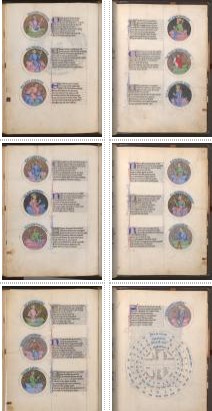 Wien, Österreichische Nationalbibliothek (ÖNB), Cod. 2352 - 16 Kings.jpg
Viewed 12782 times 27.87 KiB
While Marziano does not seem to engage in any kind of divination and is simply a game, the circular nature of the sortes would remind one of the
Etruscan 16 divisions of the sky for divination - and from both Marziano might have borrowed in inventing his game.
Phaeded