Banner

Tarot History Forum

Tarot History Forum - 600 years of history in 78 cards

Re: Le Tarot arithmologique - la séquence 1+4+7+10 = 22

321
Mayas had 10 fingers and 10 toes and found the 20 an interesting number. Even if they had the 0, they had no opportunity to tell it to the West or to the East of the World. The "0" got its value by positional notation or place-value notation ... see https://en.wikipedia.org/wiki/Positional_notation

The Boiardo poem (1487) uses 10 pairs 1-2, 3-4, 5-6, 7-10, 9-10, 11-12, 13-14, 15-16, 17-18, 19-20, and the whole embedded between an 11th pair 0-21. Odd numbers were presented by men figures and their false behavior (beside 21) and even numbers were presented by women figures and their good behavior (beside 0, if one considers 0 as even number). The latter with an exception for the poem 6 ... no real single female figure, possibly 6 was associated to love.

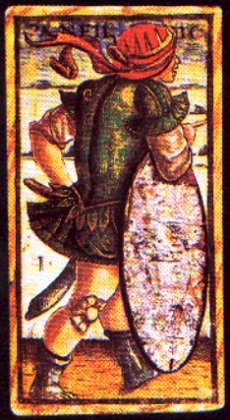
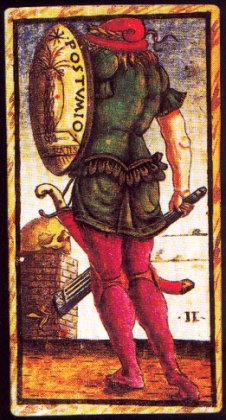
The Sola Busca (1491) also used a pairing principle ...

Odd numbers look to the right ..

Image


Even numbers to the left ... with exception of the card 6, possibly 6 was associated to love.

Image


Image


So again 1-2, 3-4, etc.

The Lorenzo Spirito lot oracle book also used a pairing principle (1482) ... I discussed this once. Possibly also the Minchiate, which can be parted in 1-15 + "5 not numbered" (20 cards) and 16-35 (20 cards).
Also there were pairs in biographical representations ... see https://en.wikipedia.org/wiki/Parallel_Lives
Also there pairs with the 9 worthies, which got 9 female figures later and occasionally a 10th pair.

The oldest "0" we find on the Sola Busca Fool (Matto). I think, that the earliest known 5x14-version (PMB without 6 added cards, possibly 1452) counted originally 1-14 with Fool at the 11th place. John of Rheinfelden in his 60 cards deck (1377) counted 1-10 for the numbers and 11-15 for the courts. The Hofämterspiel (1455) had the Fools as number 1. The Rosenwald (possibly c. 1465), which possibly was a Minchiate with only 96 cards, had a Magician/Fool as 1. The Mantegna (possibly 1474) had the beggar as I.

So there was a fashion with this pairing principle, which in the period 1482-1487-1491 might have been a new stylish element, which was accompanied by the idea 0 = Fool and the invention of the number 22 for the trumps row.
The "0" was already used by merchants a longer time before in their business books, but it was seldom used for other reasons till the late 15th century. Likely the victory of "0" was accompanied by book printing technology, which had a practical advantage from Arabic numbers against long Roman numerals, especially for page or folio numbers (2 printing signs against 8 for number 88 = LIIIVIII).

Re: Le Tarot arithmologique - narrowing datations

322
BOUGEAREL Alain wrote:Sermones de Ludo cum allis should be relative late. See: http://trionfi.com/0/p/17/
"The manuscript pages have many different watermarks. All of them date from around 1500 and come from places near Ferrara. The order of the Tarot trumps, as given in the manuscript, is the Ferrarese order. The author was definitely a monk. One of the sermons is about the stigmata of St. Francis, so I think it likely that the monk was a Franciscan. I do not know on what basis others have declared the author to have been a Dominican." (Ronald Decker)

A part of the text with playing cards, which didn't include the Trionfi list, was earlier (around 1470). Ross explained this once.

Have we more informations about this?
####
This person was mentioned in the context, as far I remember.
https://en.wikipedia.org/wiki/James_of_the_Marches
###

The Boiardo deck (assumed in January 1487) might have been the first with the game structure 4x14+22. so just one month before the wedding of Lucrezia d'Este (who likely got this poem ... according my assumption).
Pico made once a Trionfi card poem, Ross detected it. I think from 1481, but I don't find the discussion.
Have we more information abou this?
###
... I remember a boring poem, nothing special. As I said, I didn't find it. As I said repeatedly, we need more structure to find such things.
###


Huck
What have we about this Lady PIA so influent in the Court of Urbino games?
Viti is said to be influent there ...[/quote]

###
search.php?keywords=emilia+pia&terms=al ... mit=Search
###

Re: Le Tarot arithmologique - la séquence 1+4+7+10 = 22

323
[quote="Huck"]Mayas had 10 fingers and 10 toes and found the 20 an interesting number. Even if they had the 0, they had no opportunity to tell it to the West or to the East of the World. The "0" got its value by positional notation or place-value notation ... see https://en.wikipedia.org/wiki/Positional_notation

Huck

You're "fooling" me (smile);
I never said the Mayan influenced West ou Estern World!
I gave it as an example of the use of Zero by those ho invented the concepT of the Zero.
What was important in my post was :

22=0 :
one can count
- from 1 to 22nd : the Bagat is First and the Math is 22nd after the 21th, the World
or
- from 0 to 21th : the Math is Zero, the Bagat is First and the World is 21th

Image
Last edited by BOUGEAREL Alain on 02 Oct 2016, 22:21, edited 2 times in total.

Re: Le Tarot arithmologique - la séquence 1+4+7+10 = 22

324
An interesting link
Franchinus Gaffurius / Johannes Martini and Isabelle d'Este

Le cas d’ Isabelle d’Este témoigne de la co-existence en une personne et d’une formation musicale pythagoricienne et d’un goût prononcé pour les cartes (scartino) - ce qui ne signifie pas qu'elle ait associé l'un à l'autre.

Isabelle d’ Este, épouse du duc de Mantoue Francesco GONZAGUE est reconnue historiquement comme une grande protectrice des arts et de musique.
Elle a un penchant certain pour les cartes (scartino) : search.php?st=0&sk=t&sd=d&sr=posts&keyw ... d%5B%5D=11

Or, son goût musical aurait précisément été façonné par son éducation à la cour de son père, le duc Hercule d'Este de Ferrare, sous l'autorité du compositeur [Johannes Martini], ami de Franchini Gaffurio à Milan.
En 1491 et 1492, Johannes Martini entretenait une correspondence avec la fille d’ Hercule d’ Este de Ferrare. Selon certaines sources, il aurait été son professeur de musique avant qu’elle ne devienne l’épouse de François II GONZAGUE le 11 - 15 février 1490 à Mantoue. L' union des familles d'Este et de Gonzague furent 'occasion de fastueuses festivités
(Isabelle d' Este , marquise de Mantoue : http://docnum.univ-lorraine.fr/pulsar/R ... _41675.pdf p.35)

[Johannes ] Martini prend aussi une place prépondérante dans une importante collection de chansons, portant les armes des deux familles Este et Gonzague et rassemblée à l’occasion et en l'honneur du mariage (I-Rc 2856)
https://fr.wikipedia.org/wiki/Franchini_Gaffurio
https://fr.wikipedia.org/wiki/Johannes_Martini
https://en.wikipedia.org/wiki/Franchinus_Gaffurius


Image

Franchini GAFFURIO dans Clarissimi ac prestantissimi musici Franchini Gafori laudensis theoricum opus musice discipline publié circa 1490 montrant entre autres choses les intervalles harmoniques du monocorde.
(Cf :GAFFURIO Francini, Theoricale musicale, Milan, 1492 : commentaire sur https://books.google.fr/books?id=NwocAg ... =html_text)
Last edited by BOUGEAREL Alain on 02 Oct 2016, 16:13, edited 8 times in total.

Re: Gosselin 1582

325
BOUGEAREL Alain wrote:
The reviews about Gosselin are now about to be finished.

Michael's review in English is already published.
http://letarot.it/page.aspx?id=608
I've translated in French and in extenso his analysis specific of Gosselin in my own article : it is the first part.

I'm closing now this topic with the final version of my lecture of Gosselin.

You can read it on : viewtopic.php?f=11&t=1102&p=17459#p17459

Nevertheless,before publication, I'm open to any comments or rectifications...
for sure,in the future, if new data is offered, the topic shall be re-opened...
To resume the different lectures of Gosselin :
Pratesi : a non historical analysis of ordinary cards with a superficial touch of pythagoreanism
Howard : a Pythagorean framework
Bougearel : a Pythagorean lecture with a correspondence Elements / Enseignes in conformity with Plato's Timeus

Thanks for sharing your appreciations

Mikeh? Steve? Huck?
Links :

On THF : viewtopic.php?f=11&t=1102&p=17459#p17459
Last edited by BOUGEAREL Alain on 01 Oct 2016, 14:49, edited 2 times in total.

Re: Le Tarot arithmologique - la séquence 1+4+7+10 = 22

326
Nota bene

Michael has not yet reviewed the translation I offer of his Gosselin.
Steve has not yet reviewed the presentation I give of his contributions.
Huck has not yet reviewed the link to Pratesi I gave.

Definitive editing after these 3 approvals or necessary rectifications or additifs ...


Thanks
Last edited by BOUGEAREL Alain on 01 Oct 2016, 21:01, edited 1 time in total.

Re: Le Tarot arithmologique - la séquence 1+4+7+10 = 22

327
BOUGEAREL Alain wrote:Nota bene

Michael has not yet reviewed the translation I offer of his Gosselin.
Steve has not yet reviewed the presentation I give of his contributions.
Huck has not yet reviewed the link to Pratesi I gave.

Definitive editing after these 3 approvals or necessary rectifications or additifs ...

Link : https://drive.google.com/file/d/0B5Hg6j ... sp=sharing


Thanks
... :-) ... what do you want me to do?
Cette opinion fait quelque part écho à à celle exprimée il y a 25 ans par Franco PRATESI :

http://www.naibi.net/A/44-PHYTHAG-Z.pdf

(Merci à Huck MEYER pour cette information :

viewtopic.php?f=11&t=1102&start=260#p17498 )
You better leave me aside, I just told you a link. Franco wrote a two pages article, it's relative common to mention earlier writers on the same topic.
For a web article you have to many and too long links, you disturb the reader, I would say. You can put the links in footnotes.

Re: Le Tarot arithmologique - la séquence 1+4+7+10 = 22

328
Thanks Huck

Updated for your link : viewtopic.php?f=11&t=1102&p=17459#p17459

PS
A priori, this article / essay (midway) is written in French by a French writer for a francophone public.
Why? Because, although it might interest some foreign searchers such as Mikeh or Steve for example, , it is about the most ancient French litterary reference of a Pythagorean lecture of the Game of Trente et ung.
I don't think that there will be an English translation - maybe at best some kind of resume.

Same thing with other articles in the past (now out of date) for example :
Le Tarot dit de Charles VI : Bologne?
http://bougearel.blog.lemonde.fr/2006/0 ... ot_dit_de/
L’épineux problème de la datation du Tarot de Marseille de François Chosson
http://bougearel.blog.lemonde.fr/2006/0 ... x_problme/

In France, researchers are alone. But they are read ...

The main authority is Thierry DEPAULIS.
In the tradition of cardsmakers, we had FLORNOY; but he went away.

One "typical French" Tarot Forum : http://www.traditiontarot.com/

Created by Laurent EDOUARD (Translator in French of the TarotL History Fact sheet circa 2006), it is dedicated to the memory of Jean Claude FLORNOY.

The most recent thread :
Le tarot arithmologique : http://www.traditiontarot.com/viewtopic.php?id=862

Old threads :
Le Tarot : un jeu éthique? http://www.traditiontarot.com/viewtopic.php?id=44
L'épineux problème de la datation du Tarot de Marseille de François Chosson : http://www.traditiontarot.com/viewtopic.php?id=16

Re: Le Tarot arithmologique - la séquence 1+4+7+10 = 22

329
Discussion in French about the Arithmological Tarot on :
http://www.traditiontarot.com/viewtopic ... 619#p12619

The Forum was created by Laurent EDOUARD (Translator in French of the TarotL History Fact sheet circa 2006), it is dedicated to the memory of Jean Claude FLORNOY.

Of interest for those who understand French ...

Recreative Aparte : From dices to Tarot
I expose my speculative take about Moakley's remark that cards replaced dices.

"Why are there fifty-six suit cards, and why are there twenty-one trumps? The answer is found when we remember that cards, as a game of chance, replaced dice almost completely. In the dice games which use three dice, there are fifty-six possible throws, and with two dice twenty-one.”

I. The 21 throws of 2 dices (with 6 faces 1,2,3,4,5,6) and the 21 Triomphes + 1 as Nulla = 22

I suggest that the 22nd is an invalid throw or Nulla [0].
I present the 21+1 invalid throw [0]) throws in the generation of the pentagonal Number 22 as 22 Triomphes :
22 = 1+4+7+10


Resume of my proposal applied to Order C as example but it is correct also for whatever list has 21 or 22...

Moakley 's proposition within the Pentagonal Number 22 applied to 22 Triomphes :
(to understand : remember each throw with 2 dices each with 6 faces from 1 to 6 - so one face among 6 on each dice at each time)

First enclosure :
1+1 Bateleur

Second enclosure :
1+2 Impératrice
1+3 Empereur
1+4 Papesse
1+5 Pape

Third enclosure :
1+6 Amoureux
2+2 Tempérance
2+3 Chariot
2+4 Force
2+5 Roue
2+6 Ermite
3+3 Pendu

Fourth enclosure :
3+4 Mort
3+5 Diable
3+6 Tour
4+4 Etoiles
4+5 Lune
4+6 Soleil
5+5 Jugement
5+6 Justice
6+6 Monde
0+0 Math

Remark : Independently of the arithmological sequence in 1+4+7+10 , the pure succession of the 22 combinaisons is not impossible to remember for a normal person and unically memorizing the order of the Triomphes, the signification is immediatey given. No? Finally knowing the Bagat as first as 1+1 and the World as 6+6 and the Math as NULLA, therz are only four Triomphes to remember :
Temperance who initiates the Twos
The hanged Man who initiates the Threes
The Star who initiate the Fours
The Judment who initiates the Fives

Well at least, now you can use 3 dices if you haven't yur deck at hand!
Changes if your deck belongs to Order A or B ...
Could be useful in case of urgency :D


1+1 Bateleur
1+2 Impératrice
1+3 Empereur
1+4 Papesse
1+5 Pape
1+6 Amoureux
2+2 Tempérance
2+3 Chariot
2+4 Force
2+5 Roue
2+6 Ermite
3+3 Pendu
3+4 Mort
3+5 Diable
3+6 Tour
4+4 Etoiles
4+5 Lune
4+6 Soleil
5+5 Jugement
5+6 Justice
6+6 Monde

0+0 Math


II. The 56 throws with 3 dices and the 56 suit cards (correct in English?)

The correspondences are at work because they still need to be grounded, from an arithmological point of view, on a clear relation of Enseignes (cards) : emblems (tarots) with the 4 Elements in the following order : Earth / Water / Air / Fire ...

So, as it is in my mind...
Yet, if the 22 combinations with two dices are easily memorized, it seems quite complicate to memorize the 56 combinations of 3 dices ; Wibold's lists or Ovid's grouping in singles, pairs and threes? See final Note ...

The 56 throws of 3 dices (6 faces each) corresponding to the 56 suit cards
(remember 4 Tetractys of 4 Elements = 40 Numerals + 4 Squares of 4 Elements = 16 honours)

So :
-vertical column 14 = 10 numerals + 4 honours
-horizontal column : 4 elements

(remember each throw has 3 dices with one number from 1 to 6 : see Final Note
[easier seems to me pseudo Ovid' grouping in singles, pairs and threes ]

Example : the As of "Earth" should be [1+1+1] while the King of "Fire" as {6+6+6]

-- Earth / Water / Air / Fire
1 1+1+1 / ... / ... / .... /

2
3

4
5
6

7
8
9
10

J
C
Q
K ... / ... / ... / 6+6+6

Note about the 56 throws of 3 dices with 6 faces :
The 56 distinguishable occurences were associated with practise of Virtues for monacal reasons by Wibold of Cambrai circa 1000 AD.
He enumerated 56 virtues - one corresponding to each of the ways 3 dices could be thrown irrespective of order
The use of dices for the purpose of choosing among a number of possibilities is much older than Wibold.

The earliest approch to the counting of the numebrs of ways in which 3 dices can fall appears to occur in a latin poem "De vetula"; this remarquable work was regarded as Ovide's for some time, and is included in some of the medieval editions of his poems. It is however suppositious and several candadates have been proposed for authorship. The relevant passage may be briefly and freely construed as follows :
If all three numbers are alike, there are 6 possibilities.
if two are alike and the other different, there are 30 cases because the pair can be choosen in 6 ways
and if all three are different, there are 20 ways because 30 x 4 = 120, but each possibilities arises in 6 ways [120 : 6 = 20]


Cf : https://books.google.fr/books?id=LLEZQC ... es&f=false

Nota bene
The number 56 in classical antiquity realated to "divination" :
Two kinds of dice were used in classical antiquity: dice proper (kuboi, tessarae), which are virtually identical to six-sided modern dice, and knucklebones (astragali, tali), which have four sides (Halliday 205-15, esp. 213-15; David 1-7; Ore 193). For divination, five astragali were rolled, and the resulting combination was looked up on a four-sided pillar, many examples of which survive in more or less fragmentary form (e.g., Sterrett "Epig.", "Wolfe"; Kaibel). It so happens that the number of possible five-astragali throws is 56, exactly the number of Minor Arcana, and that the throws were listed on the tablets in four "suits" (two of 15 throws, two of 13; see Halliday 213n3).
(http://wisdomofhypatia.com/OM/BA/PT/Mintro.html)

END of the Aparte upon Dices and Tarot

Last edited by BOUGEAREL Alain on 03 Oct 2016, 23:36, edited 34 times in total.