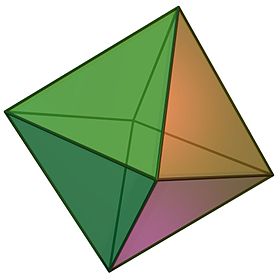
... now the North-South line isn't identical to Steven's version.

Yes my version describes an octohedron, but it would work on the globe model with three lines too.Huck wrote:
The described object might be a cube or an octahedron ....
http://en.wikipedia.org/wiki/Octahedron
... one of the platonic bodies, or it might be also 3 lines on a globe, which make the globe look like a round christmas parcel. Like this ...
http://www.polaris.iastate.edu/NorthSta ... ivity1.htm
... made by 3 circle lines, one forming an aequator, the other both connecting North and South and everywhere we've nearly 90 degree at the cutting points. The 6 cutting points (in six directions, seen from the center) cause, that there are 12 direct connection lines. These might be that, what we're talking about.
Indeed, it likely doesn't seem to make a different pattern, if octahedron or if globe. Could it be, that the cube logic also doesn't make a difference?SteveM wrote: Yes my version describes an octohedron, but it would work on the globe model with three lines too.
SteveM wrote:Of the cube model the Long version is I think the most elegant and the zodiacal sequence quite clear:
Actually not that much difference. Mine vary from the Long where the Long always starts at the top -- in order to trace a continuous I have to go top to bottom then bottom to top. However, the result is similar, in that as the Long divides into Cardinal top, Fixed middle & Mutable bottom - so the octohedron also divides in cardinal, fixed and mutable planes. It also gives one a different method to derive tree models based on polygons other than cubes.Huck wrote:Indeed, it likely doesn't seem to make a different pattern, if octahedron or if globe. Could it be, that the cube logic also doesn't make a difference?SteveM wrote: Yes my version describes an octohedron, but it would work on the globe model with three lines too.
A cube has 6 sides, 8 corner and 12 outside lines.
An octahedron has 8 sides, 6 corners and 12 outside lines.