Banner

Tarot History Forum

Tarot History Forum - 600 years of history in 78 cards

Re: Jewish-Christian interactions in Italy before 1500

71
Thanks for laying out the relevant page of the Long Version, Huck. Actually, I do have that part of Kaplan's book; I made a copy the last time I had it checked out. What I need is p. 91 and whatever else he says about the "migration" os sefira 2. Hopefully it will be returned to the library soon.

Re: Jewish-Christian interactions in Italy before 1500

72
I finally gave up and bought a used copy of Kaplan's book. Now, what were we talking about? Oh, yes...

Huck wrote, quoting me:
Huck wrote,
Aryeh Kaplan in his interpretations interestingly comes to the idea (page 71), that it is not Sephira 1, which transmutes to Sephira 10 Malkuth, but Sephira 2.
Well, that's what I think, in the most logical reading of what "2" is (i.e. most consistent with how the procession goes otherwise, i.e. from north not to east or west but south), namely, the sefira opposite 1 on the diamond. But I don't know if he means what I mean. I hope I get to see the library's copy of Kaplan's SY soon.
Considering the math of I-Ching as the true background, I would think, that this is nonsense, considering the SY "5 pairs" model "first-last, good-bad, north-south, west-east, top-bottom" it makes sense.

Malkuth is the last (in later kabbala), but the second in the row of the 5 pairs.
Well, now I have read what Kaplan says, I think. I can't find him talking about the migration of Malkhut. That's a belief we have to infer from his words. He does think that Malkhut is sefira 2, i.e. "breath of breath", in Chapter One of the SY, long version sections 10-14 (short version sections 9-14) where he has the sequence (my words in brackets):

sefira 1 = breath of [from] Living God
Sefira 2 = breath of [from] breath
sefira 3 = water from [of] breath
sefira 4 = fire from [of] breath.
sefira 5 = upward
... [etc. through downward, east, and west]
sefira 9 = south [but north is second to last in long version sections 10 and 11, numbers not assigned]
sefira 10 = north [but south is last in long version sections 10-11, numbers not assigned]

If by "Malkhut" is meant "the sefira that used to be sefira 2 in the SY" then I agree. And for Kaplan to say this, he must think it migrated to position 10 later. But he nowhere says this or explains what the "tree" looked like with Malkut in position 2.

I myself wouldn't say that in the SY that sefira is Malkhut. The SY doesn't mention any sefira called Malkhut. However I would say that the sefira that was in position 2 in one way of seeing the sefira (not the way of Chapter One, but the way of chapters 3-4-5, which, however, does not mention sefirot at all, but which must somehow be present) did move to position 10 and was called "Malkhut".

Then there is the sequence of five pairs, Chapter 1, section 5 (section 6 in short version):
[1] depth of beginning
[2] depth of end
[3] depth of good
[4] depth of evil
[5] depth of above
....[etc. through below, east, west, and north]
[10] depth of south

Either of these sequences is capable of being represented in precisely the same way. Kaplan on p. 10 says that "the Ten Sefirot define a five dimensional space. The 32 paths correspond to the number of apexes on a five dimensional hyptercube". He does not say which of these apexes are sefirot.

I hope he does not think he is being historical. There is no inkling of non-Euclidean geometry in ancient or medieval times that I know of.

On p. 44 he has a different way of describing the situation, more historically accurate. There is a space continuum of three dimensions, a time continuum, and a "moral spiritual" dimension. He also says these make up one five dimensional continuum. But at least they are not five spatial dimensions! How they form one continuum is not explained. Presumably it is by means of a graph in five dimensional space, which of course he does not provide. Again, this last part is nonsense in the context of ancient and medieval times.

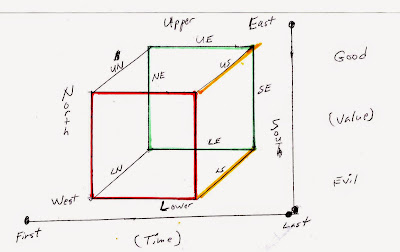
My own proposal for a picture of this "continuum" is a drawing I presented earlier:
Image

There are as many of these pictures as you like, "without limit", as the SY would say, for any point in time and any sized cube. The faces of the cube, and all the space before and after other such faces, are what correspond in the text to "facing north" etc. going as far out as you want to specify. The boundaries are those imaginary lines that demarcate "up" from "forward", "north" from "east", etc., dividing a sphere of any radius into sixths. It is a matter of circling the cube (as opposed to squaring the circle). But there is no curved space or other such non-Euclidean ideas.

The sefirot are then the faces of the cube plus the two end points of the quite discontnuous lines of time and value.It is not a five dimensional continuum. It is a three-dimensional continuum with indicators of time and value.

Then there is the question of how to assign numbers to the sefirot so defined. The two lists are very close to being parallel in the parts that are the same, i.e. the directions. The only exception is that in a couple of places north and south are interchanged. However the pairs themselves go in the same order. Other things being equal, I think we would assume that the first four of each list are also identical. In other words

sefira 1 = breath from living God = depth of beginning
sefira 2 = breath from breath = depth of end
sefira 3 = water from breath = depth of good
sefira 4 = fire from water = depth of evil

Kaplan, however, does not agree. He says that sefira 1 is depth of good and sefira 2 is depth of evil, sefira 3 depth of beginning, and sefira 4 is depth of end. I myself said that, although Huck disagreed. My feeling was that since sefira 2 later moved to the 10th spot, it must have been because although created "good" it had become "bad", i.e. a "bad girl", like Eve or the shulamite of the Song of Songs in parts of that poem (assuming, reasonably, that people thought it was one poem). But now I see that such a solution does not answer the question in the context of the SY, because we are talking about the situation at creation, not later. So what arguments does Kaplan give?

Kaplan cites Proverbs 4:7: "The beginning is wisdom." When I look online at that verse (King James as opposed to Douay-Rheims), it seems to say something else: "Wisdom is the principal thing". That is different. It means principal in relation to the other thing, understanding or good judgment. I don't know how Jews understood that verse in ancient times.

Another argument is that Keter is "good" because it is "closest to God". Malkhut is the sefira furthest from God, hence evil--although not "actually evil, since all the sefirot are completely and absolutely good. But since Malkhut points in the direction away from God, it is said to denote the direction of evil." Here one problem is that there is no Malkhut per se in the SY. In any case, being one of the top 4 is not being "furthest from God". It is definitely not number 10. And what does the idea of a sefira "furthest from God" even mean in the context of the SY? However they relate to the lines that are the letters that create the "lower worlds", they are all on an equal level as far as the SY is concerned. Kaplan singles out Wisdom for depth, and depth with the earth (p. 48); but all the sefirot are called "depths".

Another one of Kaplan's arguments is that male activity comes before female receptivity and hence "beginning" and "end" are more appropriate to masculine Hokmah and feminine Binah, assuming that in the SY they correspond to the second and third sefirot. That is a good assumption, but no help unless you know that Keter isn't male and Malkhut isn't female. Malkhut in fact usually was imagined as female. And in Wisdom 4, Wisdom is personified as famale, not male. But there is nothing about male and female sefirot in the SY.

Kaplan also wants to appeal to "tradition", but doesn't cite sources before the 16th century. Well, Alemanno in around 1490 says that God is the unity of good and evil. The split doesn't happen until after the 1st sefira. It makes sense that the sefira on the right side of the diagram, whatever it is called and numbered, be "good" because that's where love, positive commandments, and intuitive understanding are, as opposed to severity and negative commandments. This is all in later Kaballah, of course. But the SY in fact speaks in Chapter 3 section 1 of the foundation for the Mother letters as "the pan of liability, the pan of merit, and the tongue of decree deciding between them." The Mothers are horizontal lines. The foundation of a horizontal line is its endpoints, with a midpoint between them. This suggests a side of good and a side of bad.

So I am inclined to agree with Huck's interpretation of the SY's sefirot. But if he still holds that the sefirot that became Malkhut wandered from position 1 to position 10, I disagree. "End" in the SY doesn't mean the bottom of a tree with all the sefirot on it. It just means "end" as in a line with "beginning" at the other end, as in my diagram. It is most naturally opposite "beginning", wherever "beginning" is. It is most naturally the only sefira left, the one that became Keter, sefira 1 in the SY.

It still may be that sefira 2 got demoted for being "bad". But if so, it could be due to the influence of sefira 4, right next to it, the one that later became Binah. This is in the diagram I presented earlier as that of the sefirot with the lines added, modifying chapter 1's picture in the light of chapters 3-5. Sefira 1 = B; sefira 2 = J; sefira 3 = C; sefira 4 = A. Then after the SY and its moment of creation, sefira 2 went to the bottom, as I described.
Image

Kaplan says that Binah was called the source of free will, and so the source of evil. Without free will, no evil. If so, it would be natural to identify "evil" with sefira 4 rather than 2. But there is nothing about free will in the SY.

It also may be--and more likely, I think--that sefira 2 wanted to be at the bottom, so as to be closer to the lower beings of creation, especially humanity, as God's presence in the world, the Shekinah.

Re: Jewish-Christian interactions in Italy before 1500

73
mikeh wrote: So I am inclined to agree with Huck's interpretation of the SY's sefirot. But if he still holds that the sefirot that became Malkhut wandered from position 1 to position 10, I disagree. "End" in the SY doesn't mean the bottom of a tree with all the sefirot on it. It just means "end" as in a line with "beginning" at the other end, as in my diagram. It is most naturally opposite "beginning", wherever "beginning" is. It is most naturally the only sefira left, the one that became Keter, sefira 1 in the SY.
... :-) ...
I try to explain my position again. Simple:
The SY ideas developed from the same mathematical object, which was also used by the Chinese in the I-Ching. Following just this mathematical object, one gets, that there are 64 hexagrams and 32 hexagram pairs (called 32 ways of wisdom in SY). If one analyses this mathematical system, one gets, that the 64 hexagrams and the 32 ways are not all equal in "importance". One hexagram pair in the group of the 22 elements is in the category "very important" (111111 and 000000, hex. 1 and 2), and in the group of 10 also one hexagram pair (101010 and 010101).
In the interpretation of SY Sephira 1 is singled out and the most important. So likely the author gave the value "101010 and 010101 /hex 63 and 64)" to Sephira 1.

In the later Provence/Spain Kabbala the graphical experiments gave the Sephira 10 (then called Malkuth) a "lonesome position", and prefered to group the first 3 Sephiroth (1-3) and the next 6 (4-9) together. Following this idea, then this 10 and this Malkuth would have been the selected very important hexagram pair in the 10-ways group.

But: As the related later kabbalists likely had forgotten about the 64 hexagrams and the true background of the SY author, this wasn't for them a problem.

Of course Malkuth couldn't wander. Malkuth didn't exist for the SY author, at least one has to assume, that he didn't know this expression.

Actually we cannot trust, that the author of SY himself knew about the background of he 32 ways. Possibly he followed just older traditions and mixed some curious older ideas together in a potpourri of different mathematical imaginations.

The Bahir speaks at one place in context of the 32 ways of a "64" which he then adds to an "8" (8 trigrams perhaps) to get a "72". The Bahir is a very confused book, likely also "a lot of potpourri". Scholem is very critical about it.
95. The Blessed Holy One has a single Tree, and it has twelve diagonal boundaries: The northeast boundary, the southeast boundary; The upper east boundary, the lower east boundary; The southwest boundary, the northwest boundary; The upper west boundary, the lower west boundary; The upper south boundary, the lower south boundary; The upper north boundary, the lower north boundary; They continually spread forever and ever; They are the arms of the world. On the inside of them is the Tree. Paralleling these diagonals there are twelve Functionaries. Inside the Sphere there are also twelve Functionaries. Including the diagonals themselves, this makes a total of 36 Functionaries. Each of these has another. It is thus written (Ecclesiastes 5:7), "For one above another watches." [This makes a total of 72.] It therefore comes out that the east has nine, the west has nine, the north has nine, and the south has nine. These are twelve, twelve, twelve, and they are the Functionaries in the Axis, the Sphere, and the Heart. Their total is 36. The power of each of these 36 is in every other one. Even though there are twelve in each of the three, they are all attached to each other. Therefore, all 36 Powers are in the first one, which is the Axis. And if you seek them in the Sphere, you will find the very same ones. And if you seek them in the Heart, you will again find the very same ones. Each one therefore has 36. All of them do not have more than 36 forms. All of them complete the Heart [which has a numerical value of 32]. Four are then left over. Add 32 to 32 and the sum is 64[/b]. These are the 64 Forms. How do we know that [b]32 must be added to 32[/b]? Because it is written (Ecclesiastes 5:7) , "For one above another watches, [and there are higher ones above them]." ]We thus have 64, eight less than the 72 names of the Blessed Holy One. These are alluded to in the verse, "there are higher ones above them," and they are the seven days of the week. But one is still missing. This is referred to in the next verse (Ecclesiastes 5:8), "The advantage of the land in everything is the King." What is this "advantage"? This is the place from which the earth was graven. It is an advantage over what existed previously. And what is this advantage? Everything in the world that people see is taken from its radiance. Then it is an advantage.
http://www.servantsofthelight.org/QBL/B ... hir_1.html

Re: Jewish-Christian interactions in Italy before 1500

74
That's a rather nice passage, and it definitely shows the 64 in the 32. But when you say
In the interpretation of SY Sephira 1 is singled out and the most important. So likely the author gave the value "101010 and 010101 /hex 63 and 64)" to Sephira 1.

In the later Provence/Spain Kabbala the graphical experiments gave the Sephira 10 (then called Malkuth) a "lonesome position", and prefered to group the first 3 Sephiroth (1-3) and the next 6 (4-9) together. Following this idea, then this 10 and this Malkuth would have been the selected very important hexagram pair in the 10-ways group.
I don't see why the "first sefira" in the SY has to be the sefira later called "Malkhut" (if that's what you mean to say; maybe it isn't). It could just as well be the sefira later called "Keter". In the SY, there are two groups, one of 4 and one of 6. Later we have 3 + 6 + 1. One of the 4 moved to be the 10 later. If the 1 earlier was the most important, if it went down down it might jeopardize the whole structure. The 2 has more freedom of movement. It can go down and be 10, so as to give the lower worlds special attention, attention that the 6 directions aren't equipped to do.

There's another thing I find interesting in Bahir 95: the beginning part. It shows how the diagram was constructed from the cube. It also shows an intermediate step in the process of redaction, I think. The Bahir says:
The northeast boundary, the southeast boundary; The upper east boundary, the lower east boundary; The southwest boundary, the northwest boundary; The upper west boundary, the lower west boundary; The upper south boundary, the lower south boundary; The upper north boundary, the lower north boundary; They continually spread forever and ever; They are the arms of the world. On the inside of them is the Tree.
This list should be considered in the light of the short version and the long version. The short version has:
Their measure is the twelve diagonal boundaries: the north-east boundary, the south-east boundary, the upper-east boundary, the lower-east boundary, the upper-north boundary, the lower-north boundary, the south-west boundary, the north-west boundary, the upper-west boundary, the lower-west boundary, the upper-south boundary, the lower-south boundary. They continually spread for ever and ever. They are the Arms of the Universe.
And the long version:
The twelve diagonal boundaries peel off as six orders divided between each direction: the eastern upper boundary, the eastern northern boundary, the eastern lower boundary; the southern upper boundary, the southern eastern boundary, the southern lower boundary; the western upper boundary, the western southern boundary, the western lower boundary; the northern upper boundary, the northern western boundary, the northern lower boundary. They continually spread until eternity of eternities, and it is they that are the Heights of the Universe.
I find the differences between these three versions of great interest. The long version is the most symmetrical. There are four groups of three, each described in a similar way: an upper boundary, a boundary with another compass direction, and a lower boundary. Very elegant, except when you imagine actually going from one boundary to another according to these instructions on a cube. Here it is, for reference:
Image

If you go from line to line, it proceeds very oddly. There are three adjacent lines, but then instead of going to another adjacent line, it jumps to a non-adjacent one. Then there are three adjacent lines, and another jump. And so on. At the end, if you wanted to get back to the beginning, you'd make another such jump. It is a rather odd jump: to get to the next line in the sequence, you have to make two ninety degree turns, in three dimensions--very awkward.

Also, you have to keep in mind that these lines are also zodiacal constellations (the word "constellations" is used). The zodiacal constellations should go in order visually, not jump to the other side of the sky every three constellations.

In the Bahir, there are still four groups of three, but they are not symmetrical. It is in 6 groups of 2, each consisting of an upper and a lower. That part is symmetrical. But the 6 are grouped as 4 east, 4 west, 2 north, and 2 south. It seems to me that the redactor of the long version didn't like even that asymmetry. His version is an improvement, verbally. But pictorially, the Bahir version makes more sense. You describe the four edges of one face, going from opposite edge to opposite edge and then adjacently; then you do the four edges of the opposite face, doing the same thing. Then you do the ones left over, the four that connect the two opposite faces. That is much more what a person would do, enumerating the lines on a cube.

However visually the sequence still doesn't fit the order of constellations in the sky. It has four, then jumps to the other side for the next four, then jumps all around for the final four.

The short version is the most awkward verbally but makes the most sense visually. You describe one set of four, then go then from the two ends of the last line, you connect to the next set of four. Then, to get back to the first four, you stick out two bridges to get to the other side again. It is the sequence of the year, up in the sky, in two main seasons and two bridge seasons, which are some of one and some of the other. They are easily divided into four groups of three, all in the shape of a U, and all lines adjacent to each other.

It seems to me that this nation of sheperds and farmers had a big interest in describing the sky and the seasons. The mother letters do the same, in a different way. So I say that the Short Version is the most primitive, being closest to people's experience of time and the universe. The Bahir's is next, and the Long Version a later effort by someone who thought verbally and was relatively disconnected from the land and the sky. He also had a vision of "worlds" among the heavens, with the sefirot higher than the rest. The SY in general is not so complex. There is heaven (fire) and earth (water), and the connections between them (air); that is wonderful enough.

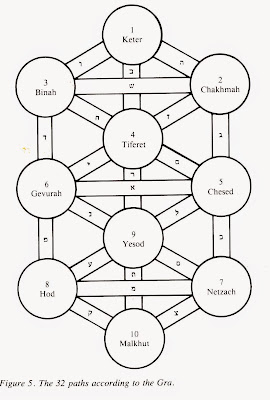
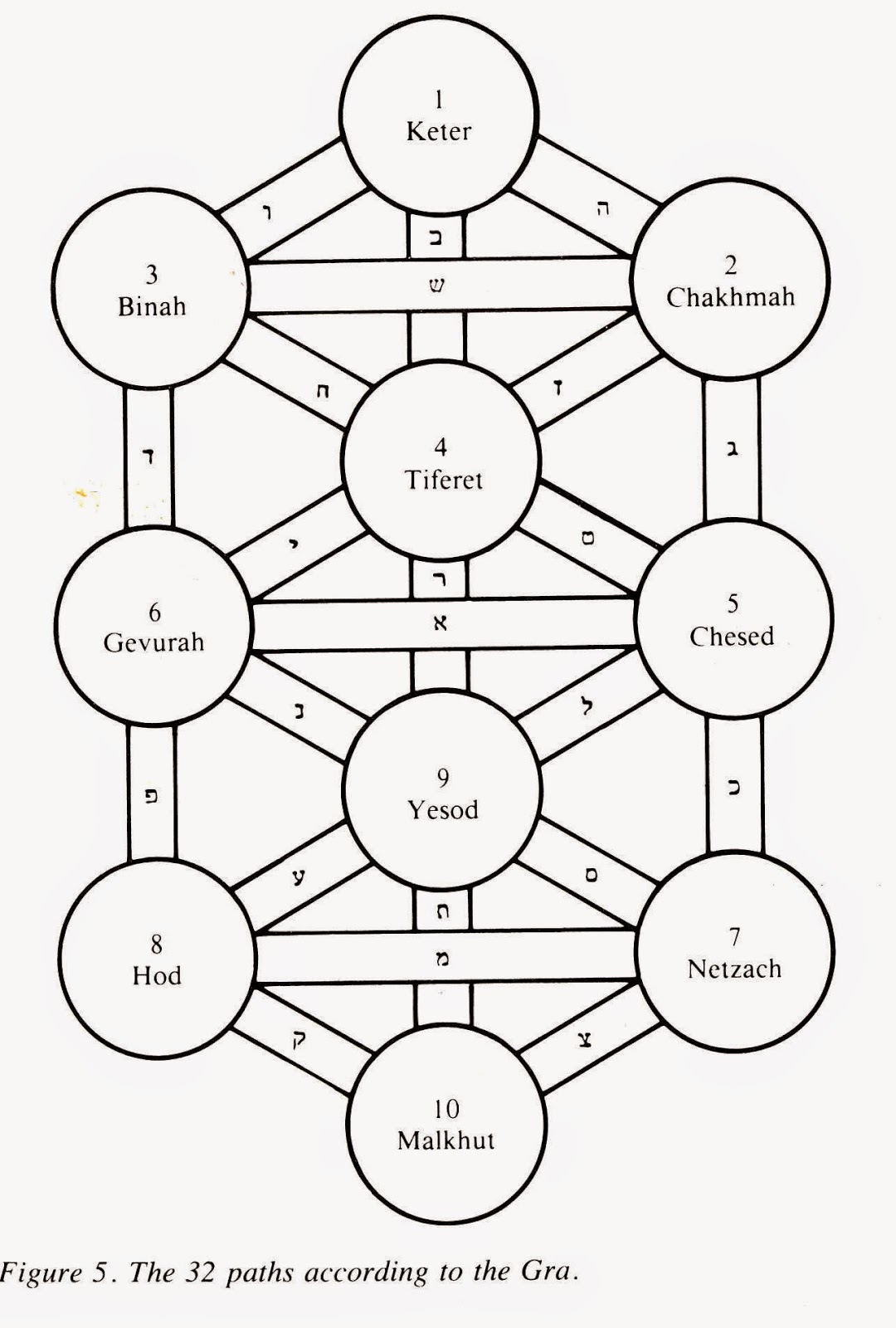
Reading Kaplan, I noticed that besides this important difference between the long and short versions, with the Bahir now in the middle, there was also another major diagram of the "tree"--the most un-tree like of the bunch-- the "Gra" version:
Image


This is the one most like what I envision as the SY form: the difference, of course, is that the sefirot wouldn't have had the names there, but rather the names in the SY, and in a different order: that is, what is 4 there would be 2 in the SY, what is 2 would be 3, and what is 3 would be 4. And there would also be another difference, latent in the SY and manifested later, in that the sefira later called Malkhut would have been sefira 2 in that diagram. By the time that sefira moved to the 10th position, moreover, the diagram wouldn't have been the "Gra" diagram any longer: there would have been a "tail" at the bottom.

But the "Gra" letter assignments (see the larger view at http://3.bp.blogspot.com/-rv8bExRR1rc/V ... g)--unlike those of the "Ari" one (i.e. Luria), which I still make no sense of--are quite sensible. The constellations, corresponding to the letters as they descend in the "tree", enter the upper sky in perfect order as the months go by. This would seem to be a late assignment of letters, however, because there is no correlation between letter assignments and directions that I can see (nor has Kaplan given any). Below are all the assignment, and at the end the directions, first in the long version, then the Bahir, then the short (they correspond to a table in Kaplan, p. 204, plus Huck's quote, up to down and left to right). This way the three patterns are all together: the Long goes east 3, south 3, west 3, and north 3. The Bahir goes east 4, west 4, south 2, north 2; the Short goes east 4, north 2, west 4, south 2. The letters apply to all of them, including the Gra.

Left_____________________________Right
Vav = Taurus = EU/ES/ES.________Heh = Aries = EU/EN/EN
Chet= Cancer = SU/EL/EL________Zayin = Gemini = EL/EU/EU
Yod = Virgo = SL/NW/NL _________Tet = Leo = SE/SW/NU
Nun = Scorpio = WS/WL/WN______Lamed = Libra = WU/WU/WS
Ayin = Capricorn = NU/SL/WL ____Samekh = Sagittarius = WL/SU/WU
Kuf = Pisces = NL/NL/SL_________Tzadik = Aquarius = NW/NU/SU

I have gone through and added a couple of additions to a couple of previous posts in this thread to reflect these points; the main one is at viewtopic.php?f=11&t=1049&p=15960#p15960.

Re: Jewish-Christian interactions in Italy before 1500

75
mikeh wrote: There's another thing I find interesting in Bahir 95: the beginning part. It shows how the diagram was constructed from the cube. It also shows an intermediate step in the process of redaction, I think. The Bahir says:
The northeast boundary, the southeast boundary; The upper east boundary, the lower east boundary; The southwest boundary, the northwest boundary; The upper west boundary, the lower west boundary; The upper south boundary, the lower south boundary; The upper north boundary, the lower north boundary; They continually spread forever and ever; They are the arms of the world. On the inside of them is the Tree.
This list should be considered in the light of the short version and the long version. The short version has:
Their measure is the twelve diagonal boundaries: the north-east boundary, the south-east boundary, the upper-east boundary, the lower-east boundary, the upper-north boundary, the lower-north boundary, the south-west boundary, the north-west boundary, the upper-west boundary, the lower-west boundary, the upper-south boundary, the lower-south boundary. They continually spread for ever and ever. They are the Arms of the Universe.
And the long version:
The twelve diagonal boundaries peel off as six orders divided between each direction: the eastern upper boundary, the eastern northern boundary, the eastern lower boundary; the southern upper boundary, the southern eastern boundary, the southern lower boundary; the western upper boundary, the western southern boundary, the western lower boundary; the northern upper boundary, the northern western boundary, the northern lower boundary. They continually spread until eternity of eternities, and it is they that are the Heights of the Universe.
Also, you have to keep in mind that these lines are also zodiacal constellations (the word "constellations" is used). The zodiacal constellations should go in order visually, not jump to the other side of the sky every three constellations.
Do these necessarily describe a cube? When is the earliest mention of a 'cube of space'? (I think it may be fairly modern, but not sure.) Couldn't it as easily describe more of a diamond shape. i.e.,

you have an axis above and below, to the front and behind, to the left and the right. You then have for example a diagonal line from a point/seal above you to a point in front; a diagonal line from a point in front of you to a point to the left of you; a diagonal line from a point left of you to a point below you; etc, etc, (this zigzag or 'lightning' pattern of diagonal lines connected the points above/below' front/back. left/right can be completed unicursally so that you end up in a diamond shape). Placing the zodiac signs to these lines, then the diamond shape can be split via three planes of cardinal, fixed and mutable signs.
mikeh wrote: This is the one most like what I envision as the SY form...
I don't think there is an SY form of the tree, the two models there are three dimensional, one of concentric spheres (or in 2d form of concentric circles I guess), and one of a 'cube' or 'diamond' shape space.
Last edited by SteveM on 14 Feb 2015, 14:25, edited 2 times in total.

Re: Jewish-Christian interactions in Italy before 1500

77
Re: the order of the signs above, they are all 150 degrees apart in the zodiac, it is the only aspect that allows a unicursal star connecting all the signs.

Yod He = Virgo Aries, two signs in quincunx aspect. If you draw aspect lines of 150 degrees between the signs, you get a dodekagram within the wheel of the zodiac.

He Vau = Aries Taurus, two signs next to each other, semi-sextile aspect (30 degrees) draw aspect lines of 30 degrees between the signs you get a dodecagram.

YH = dodekagram
HV (or VH - taurus aries) = dodekagon

YH VH = dodekagram inside a dodekagon

As the numbers of the divine names are circular number, so the semi-sextile and quincunx are circular aspects, that may be continued to result in a 'return to the beginning' while having passed through each and all of the signs.

Qabalistically the Yod is said to represent the active principle, the first He the passive
principle and Vau the median, balancing the active and the passive. These three express
the Trinitarian law. The second He represents the transition from one level of existence to
another, a germinal Yod of a second trinity on another level of existence. Thus
qabalistically the sacred name can be written with the second He beneath the Yod to
express this idea thus:

YHV
H

If we extend this permutation, we get four levels before the pattern repeats itself:
YHV
HYH
VHY
HVH

If we say each of the letters of the sacred name correspond to an element, for example Yod to Fire, the first He
to Water, the Vau to Air and the second and final He to Earth. The above table of letters can be expressed as a table of elements:

YHV = fire | water | air
HYH = earth | fire | water
VHY = air | earth | Fire
HVH = water | air | earth

Notice that the first element of each level follows the order of elements in the zodiac. If to the top of each column we attach the three qualities Cardinal, Fixed and Mutable in their natural order then we get:

Aries | Scorpio | Gemini
Capricorn | Leo | Pisces
Libra | Taurus | Sagittarius
Cancer | Aquarius | Virgo

The resulting order of signs, Aries, Scorpio, Gemini, Capricorn, etc, are all 150 degrees apart. If on a blank wheel of the zodiac you trace an aspect line between these signs, you get a series of quincunx aspects that form between them a unicursal dodekagram: "His word in them is running and returning."

To draw a dodecagram inside a circle you do the following:
Make a point on the circumference of the circle - make a second point 150 degrees from the first point and draw a line between the two points. Measure another 150 degrees from the last point and draw another line. Repeat the process until you arrive back at the first point. A dodecagram is a 12-pointed star with point angles of 30 degrees.

Image
Last edited by SteveM on 14 Feb 2015, 16:15, edited 9 times in total.
Attachments
YodAspectWheel.jpg YodAspectWheel.jpg Viewed 112 times 166.74 KiB

Re: Jewish-Christian interactions in Italy before 1500

79
Fourth pentacle of Mercury from the ‘Key of Soloman’ with dodecagram :

This is further proper to acquire the understanding and Knowledge of all things created, and to seek out and penetrate into hidden things; and to command those Spirits which are called Allatori to perform embassies. They obey very readily.

In the centre is the Name of God, El. The Hebrew letters inscribed about the dodecagram make the sentence, 'IHVH, fix Thou the Volatile, and let there be unto the void restriction.' The versicle is:--'Wisdom and virtue are in his house, and the Knowledge of all things remaineth with him for ever.'

Could ‘sealing’ space be similar to ‘restriction of the void’?
Five: With three of the simple letters seal "above". Choose three and place them in His great Name: YHV. With them seal the six extremities. Face upward and seal it with YHV.
Six: Seal "below". Face downward and seal it with YVH.
Seven: Seal "east". Face straight ahead and seal it with HYV.
Eight: Seal "west". Face backward and seal it with HVY
Nine: Seal "south". Face to the right and seal it withn VYH.
Ten: Seal "north". Face to the left and seal it with VHY.

This seal is invoked through the power of psalm 119 (the acrostic psalm), and it is said the invocation of this seal invokes the angels of the holy letters. It is also called the seal of mazel tov, good luck, destiny, fortune, but mazel also means constellation, zodiac, good fortune or 'drippings' from the stars.
Attachments
PentacleMercury.jpg PentacleMercury.jpg Viewed 7732 times 42.42 KiB

Re: Jewish-Christian interactions in Italy before 1500

80
Thanks for giving us your presentation of the "diamond", Steve. I will be studying it. For now I have a few comments, mainly about the first two posts. SteveM wrote:
Do these necessarily describe a cube? When is the earliest mention of a 'cube of space'? (I think it may be fairly modern, but not sure.) Couldn't it as easily describe more of a diamond shape. i.e.,...
"Cube" is my abbreviation for something I described in more detail elsewhere in the post (or sometimes a previous post, as it is a rather long description). The SY just says, "Face east" etc., for the six directions. What is "east"? I will repeat my description as clearly as I can.

I think we have to assume that space (Euclidean space, although "Euclidean" is of course a modern term, too) is an expanding sphere in every direction. Since there are six directions, you divide the sphere into sixths. I don't know if there is a word for that. "Quadrant" is the word for a circle divided in fourths; maybe it also applies to spheres. And may maybe "sextant", which Webster's says means "sixth part of a circle" in New Latin. (So people used to think in these terms, even if we moderns don't.) Today in English that word means something else, so I won't use it. When I divide an orange into four parts, I say "quarters". But the directions don't divide a sphere in the way I divide an orange, so I don't know what to say, except "sixths". Also,since it is a sphere that is being divided, the surface of these spaces is really curved (but not like a cone). In solid geometry, there must be a term, but I never took solid geometry. From Hellenistic times to the 19th century, they did. All I know is straight lines and cubes. Between "east" and "north" there is a dividing line separating the two "sixths", 45 degrees north of due east. That dividing line marks off one side of an ever-expanding cube. There is another one separating "east" from "south". There is another one separating "east" from "above", 45 degrees between the surface of the earth and straight up. And likewise separating "east from "below". "East" is all the space between those lines, an ever-expanding square whose vertices are on those four lines at 45 degrees from north, south, up and down. Six of those squares make up the six directions. That's the geometrical equivalent of those directions. It is not the 6 lines in the middle of these squares, as some might say. That is what "due east" etc. is. not "east", etc. So six of the sefirot are the six sixths of an ever-expanding sphere, marked off by 6 lines from the center. The sefirot are also not those lines. Those are the dividing lines. The SY is speaking of 12 diagonal lines marking off the 12 zodiacal constellations. These diagonal lines are most naturally construed as the 12 ever-expanding (without limit) lines that make up the faces of an ever-expanding cube. The terms "upper north" "northeast" etc. most naturally fit those precise lines, too. The lines are precisely what the SY says they are: "boundaries" marking off sections of space. They are not diagonal, however, until they are projected onto two dimensions, as people did know how to do, in the same uncomplicated way we do, i.e.:
Image

but imagined as ever-expanding.

SteveM wrote,
you have an axis above and below, to the front and behind, to the left and the right. You then have for example a diagonal line from a point/seal above you to a point in front; a diagonal line from a point in front of you to a point to the left of you; a diagonal line from a point left of you to a point below you; etc, etc, (this zigzag or 'lightning' pattern of diagonal lines connected the points above/below' front/back. left/right can be completed unicursally so that you end up in a diamond shape). Placing the zodiac signs to these lines, then the diamond shape can be split via three planes of cardinal, fixed and mutable signs.
In this interpretation, the sefirot, on this view are the points due east, etc. Two problems: they are not "northeast" etc.; they are "north to east" etc. It only works if you assume that the Hebrew doesn't have explicit prepositions such as "to", but uses some other way of denoting that relationship. I don't know Hebrew, but somehow I doubt that that is true, because if it were there would have been a footnote explaining what was going on. Second problem: where are the 7 planets and 3 elements here, the verticals and horizontals? You talk about 4 elements. That's not what the SY says: "earth" is subsumed under "water" (see short version 3.3, at . You get 4 elements by making them stand for the letters of YHVH. That's not consistent with the SY. First, the elements are explicitly Alpha, Mem, and Shin. Second, the elements are horizontal lines. You have used diagonals. And third, there's a lot of strange stuff in the explanation of the "four elements". for example:
Qabalistically the Yod is said to represent the active principle, the first He the passive
principle and Vau the median, balancing the active and the passive. These three express
the Trinitarian law. The second He represents the transition from one level of existence to
another, a germinal Yod of a second trinity on another level of existence. Thus
qabalistically the sacred name can be written with the second He beneath the Yod to
express this idea thus:

YHV
H
I suppose one can read "trinitarian law" as a fancy (and Christian) way of saying there are two pans witha rod, or "tongue" in the middle indicating whether they are in balance. But how do you get the rest out of the SY? I'm not saying it can't be done. But if so, I don't understand it.