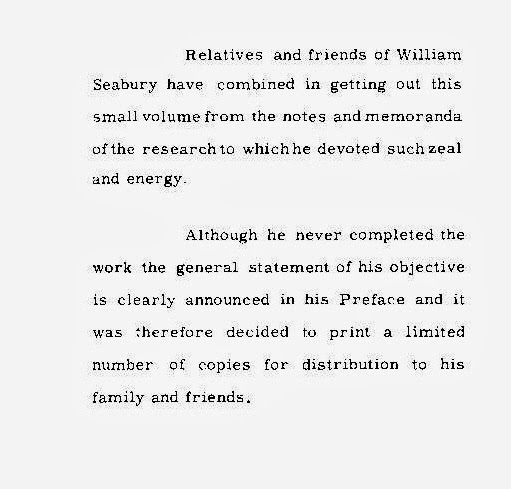
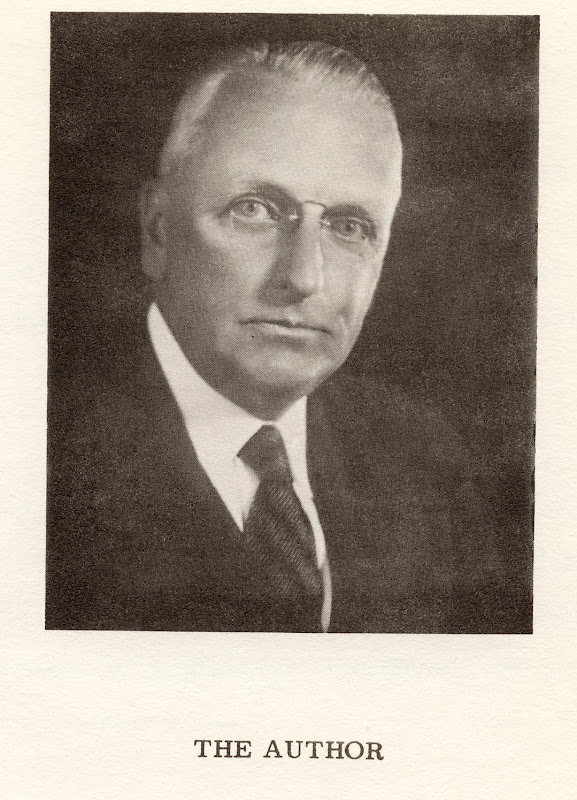
Seabury died before finishing the book. The copyright, by his wife, is 1951 (http://4.bp.blogspot.com/-MNzI91uSFLc/U ... B.JPG).The dedication says that except for the preface it was assembled from his notes (http://3.bp.blogspot.com/-Al9XJN9EgzA/U ... eaburD.JPG). He did not know the game of tarot but was an avid bridge player; his bridge partner wrote a short preface about his method of bidding, adding at the end that he died at the bridge table. Otherwise he was a lawyer and expert on international economics. On the Web (http://www.findagrave.com/cgi-bin/fg.cg ... id=7489535, I learn additionally that he wrote two other books, both on the motion picture industry, and that his grave marker says that he was born March 18, 1878, and died November 8, 1949. http://2.bp.blogspot.com/-OjkgQ1JOVmY/U ... Cphoto.JPG
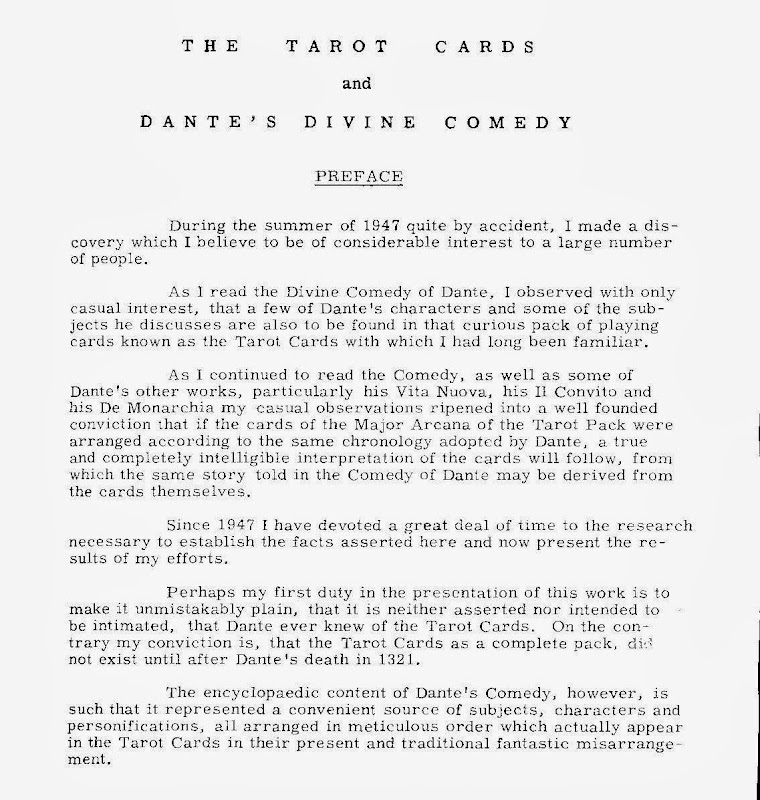
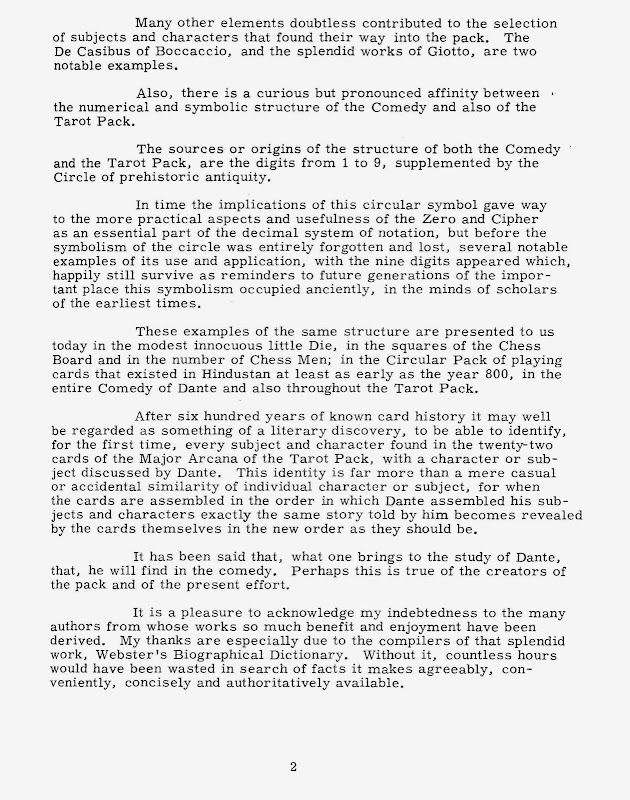
The author's preface, dated August 11, 1949, explains his excitement upon reading the Divine Comedy and seeing the tarot figures there, although in a different order than we are familiar with. He notes a similarity with the works of Giotto as well, although we get no elaboration. Surely he means the famous "vitues and vices" series in Padua. He mentions dice, chess, and the symbolism of the digits 1 through 9, again without elaboration, and a mention of the circle as an important symbol Some of the oldest playing cards, he says, are circular, from Hindustan of around 800 a.d. http://3.bp.blogspot.com/-lKdfrXUbyx0/U ... bury01.JPG, http://4.bp.blogspot.com/-7E0LPyVT2M0/U ... bury02.JPG
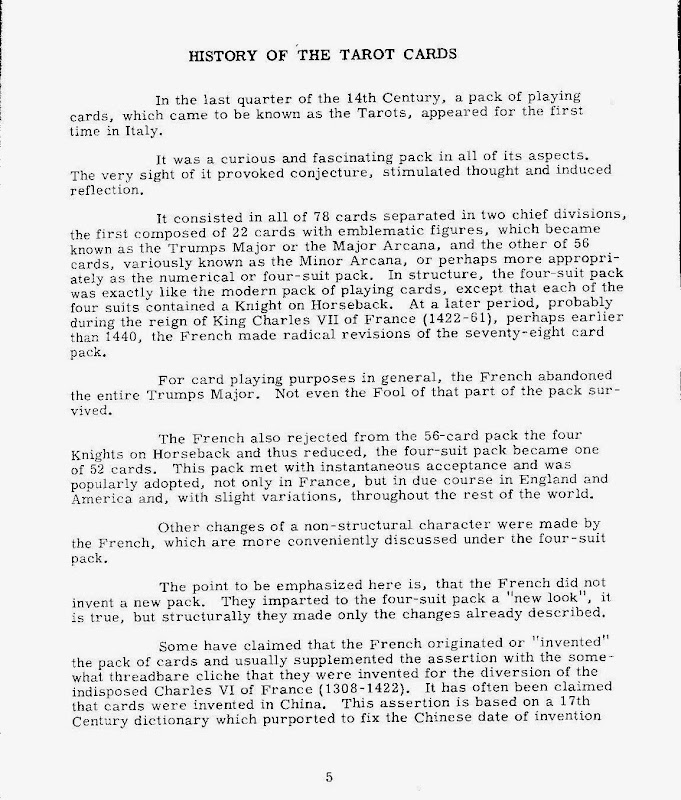
On page 5 Seabury says that the tarot arose in the late 14th century in Italy; I expect that this dating is that given then of the Charles VI deck. He recognizes that French-style decks are later than Italian and have removed the Knights and changed the imagery. http://1.bp.blogspot.com/-7j5QFDiBScg/U ... bury05.JPG
The only early deck he seems to have perused is the PMB, or at least the "PM" part of it, at the Pierpont-Morgan Library in New York, of which he reproduces the Hanged Man and the 10 of Swords. He also reproduces card 49 of the "Tarot of Mantegna" in the Metropolitan Museum's collection (p. 4) but does not say much about it. I did not scan these reproductions.
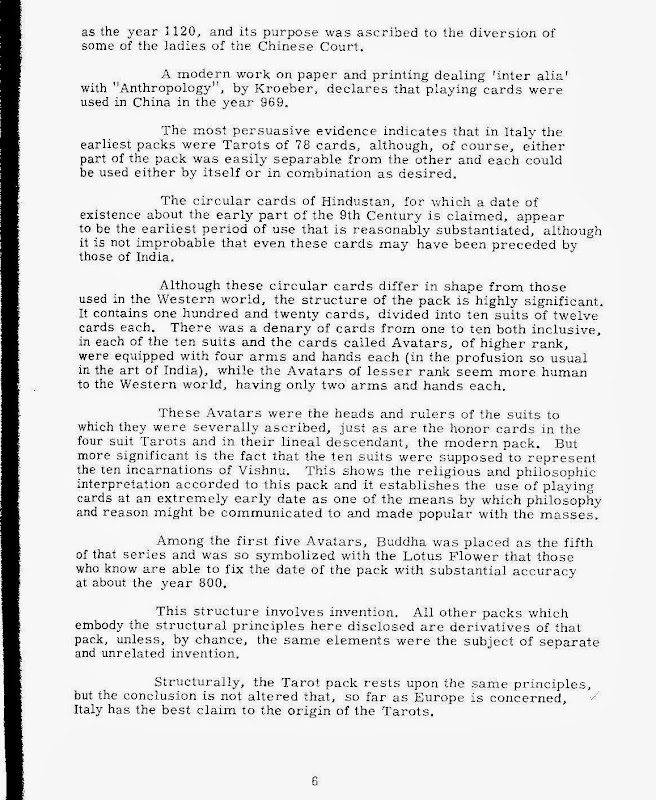
His survey of sources puts playing cards in China in the 10th century (p. 5), but Hindustan in the 9th, with its circular cards (p. 6). He observes that there are 10 suits of 12 cards each, 10 number cards and 2 Avatars, one of higher rank with four arms and one of 2 arms and lower rank. He says that the 10 suits are the 10 incarnations of Vishnu. Buddha is the Avatar of the 5th suit. So the pack is filled with religious symbolism, and
Structurally the tarot rests upon the same principles, he says (all p. 6, http://3.bp.blogspot.com/-Rnkrqvt2rPs/U ... bury06.JPG)it establishes the use of playing cards at an extremely early date as one of the means by which philosophy and reason might be communicated to and made popular with the masses.
Dante's Divine Comedy gives him clue as to the tarot's symbolic nature. He quotes E. K. Chesterton, "This story begins in hell and ends in heaven." (p. 7, http://1.bp.blogspot.com/-9WR5yUD5SHc/U ... bury07.JPG). He again emphasizes the 14th century origin of the tarot, citing A.E. Waite.

So we come to "The Roots of the Tarots".
"When arranged in suitable order, he tarot cards reveal in mute pictorial form the destiny of man". It draws on the creation story in the Bible and Christian art and literature up to the 14th century (p. 7-8).
For support of what he recognizes might be thought a strange idea, he talks about the symbolism in dice. On dice the dots on opposite sides of the die form three sets each of which adds up to 7. This is similar to a 3x7 structure for the tarot sequence. http://2.bp.blogspot.com/-04wliSuBFlU/U ... bury08.JPGFrom the earliest times the story of the Creation and its manifold implications were expressed not only in the art, drama, and literature of the early centuries, but were symbolized in allegories, sometimes with stories of mythology.
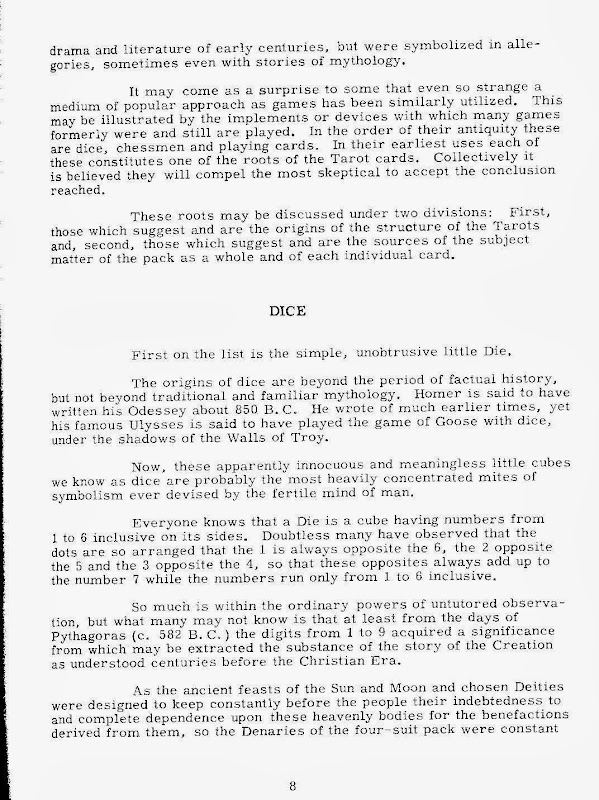
In ordinary cards, he says, each of the numbers from 1 to 10 were considered symbols, a tradition dating from Pythagoras. They were also a reminder of the heavenly bodies. (I assume he means the 10 spheres of the Ptolemaic cosmos.) But of course all this symbolism was lost on the masses. Another game he mentions is goose, which he says was played by Ulysses under the gates of Troy, according to Homer in the Odyssey. I have found no such mention, but over 10 Etruscan funeral urns show Ajax and Achilles playing a boardgame, on what is probably an 8x8 board (http://en.wikipedia.org/wiki/Ajax_%28mythology%29). There is considerable debate on what game it is.
The next section is on chess:
However he says no more, merely referring us about chess to the Encyclopedia Britannica. There is nothing in either the 11th or the current edition of the Britannica about tarot. http://1.bp.blogspot.com/-gersCI66BSI/U ... bury09.JPGAfter dice the next oldest game which contained a similar symbolism of structure and subject matter is chess.
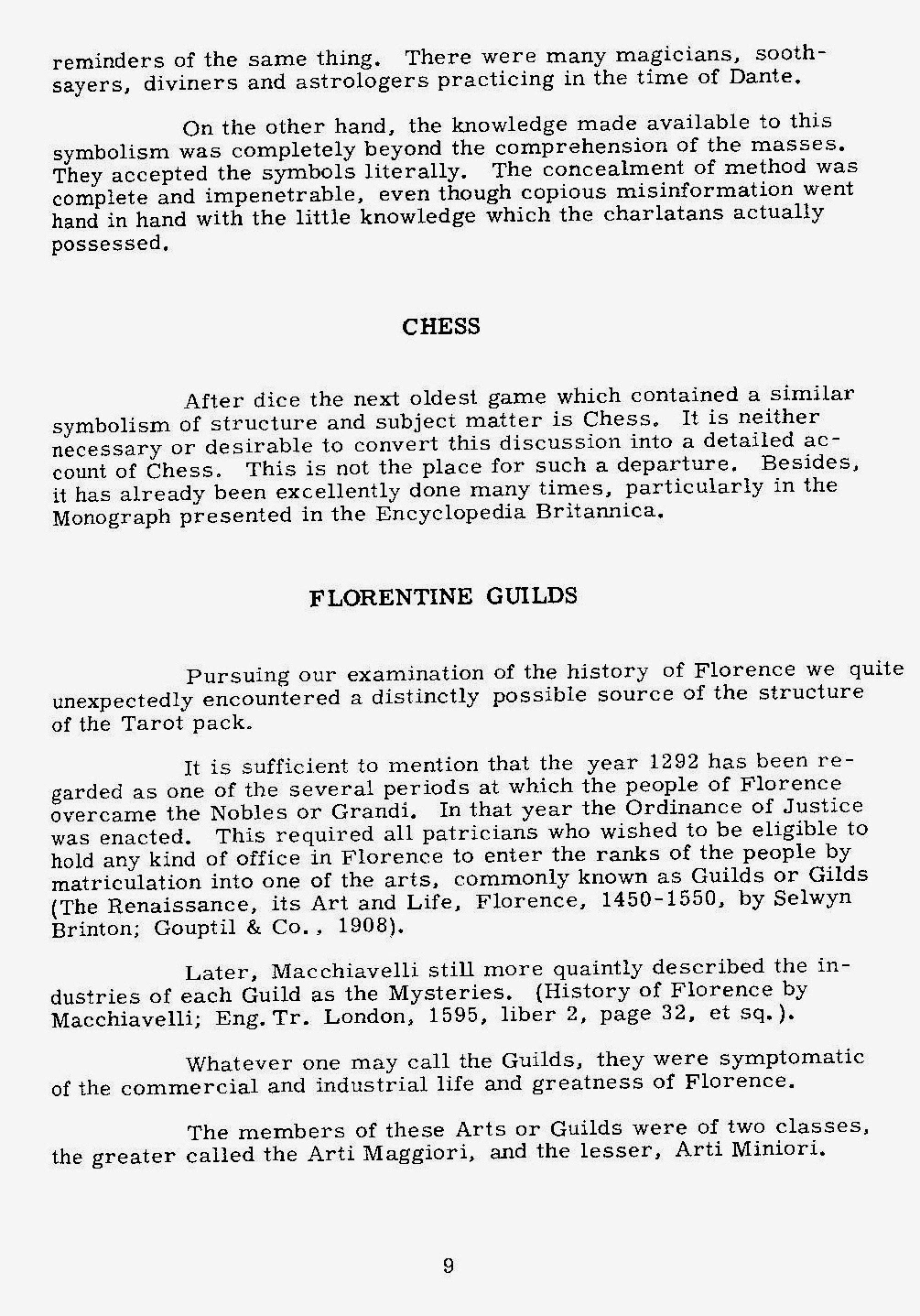
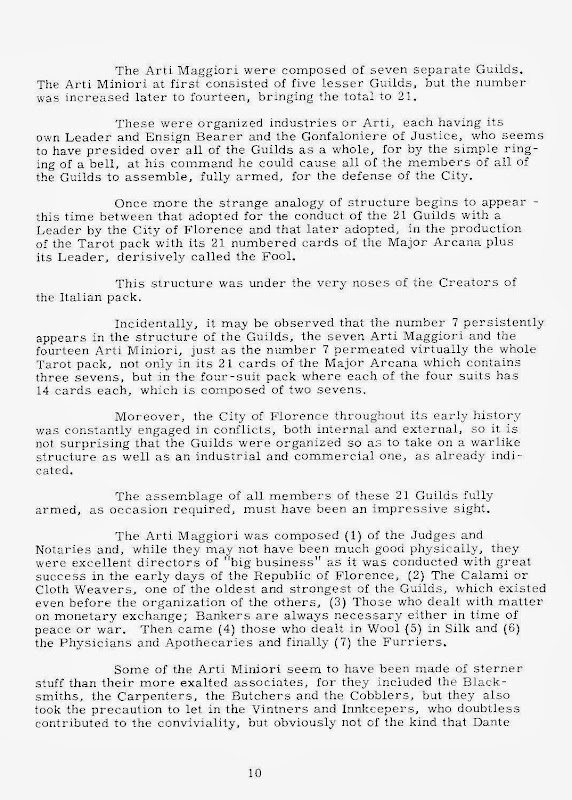
Next he takes up Machiavelli's account of the Florentine guilds (p. 9-11), There were 21 guilds in Florence, 7 major and 14 minor. This gives him support for a structure based on the number 7. There are 7x3 trumps and 7x2 suit cards. He goes into detail on what the guilds were. Besides p. 9 above, see also http://3.bp.blogspot.com/-tue3De-yYKE/U ... bury10.JPG; http://3.bp.blogspot.com/-H02SijLSmmU/U ... bury11.JPG
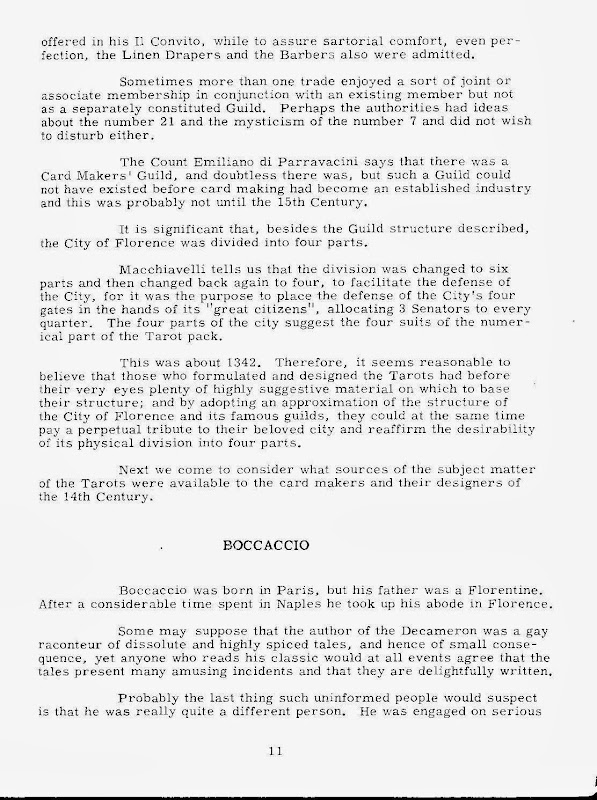
Then, still on p. 11, he turns to Boccaccio, and in particular to De Casibus in the translation/paraphrase by John Lydgate, done 1430-1438. He finds similarities in three ways. First, of course, is Fortune and her Wheel. He has an intelligent discussion of how the classical idea of Fortune as chance was superseded by Boethius's notion that what appears to be Fortune is really the working of God (bottom p. 12- top of 13). http://4.bp.blogspot.com/-w0-frozqjZw/U ... bury12.JPG, http://3.bp.blogspot.com/-twV4BQbrIDg/U ... bury13.JPG

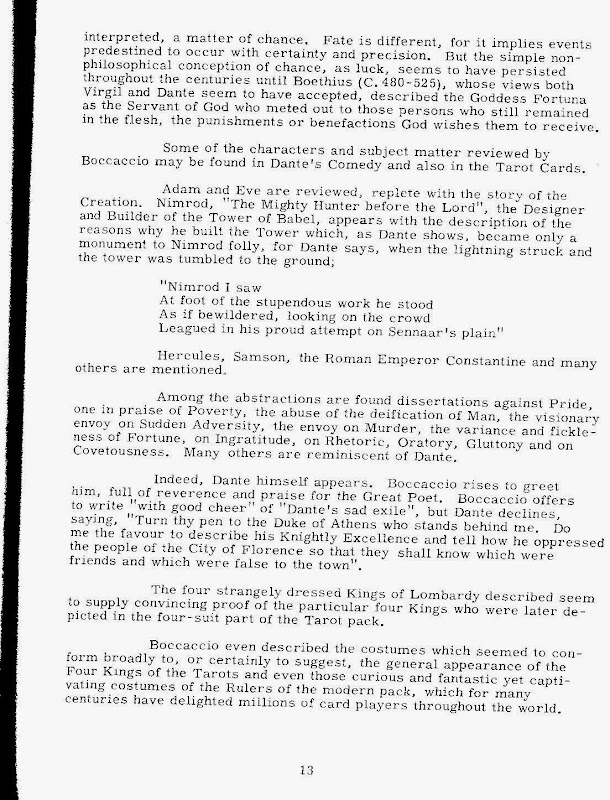
Still on Boccaccio and p. 13, he finds one parallel in his Creation story, the Tower of Babel and Nimrod, where he quotes Dante. He also notes Hercules, Samson, and the Roman Emperor Constantine are mentioned, among others, as well as "Sudden Adversity", murder, and various vices. I presume he sees the people mentioned as parallel to the Force and Emperor cards.
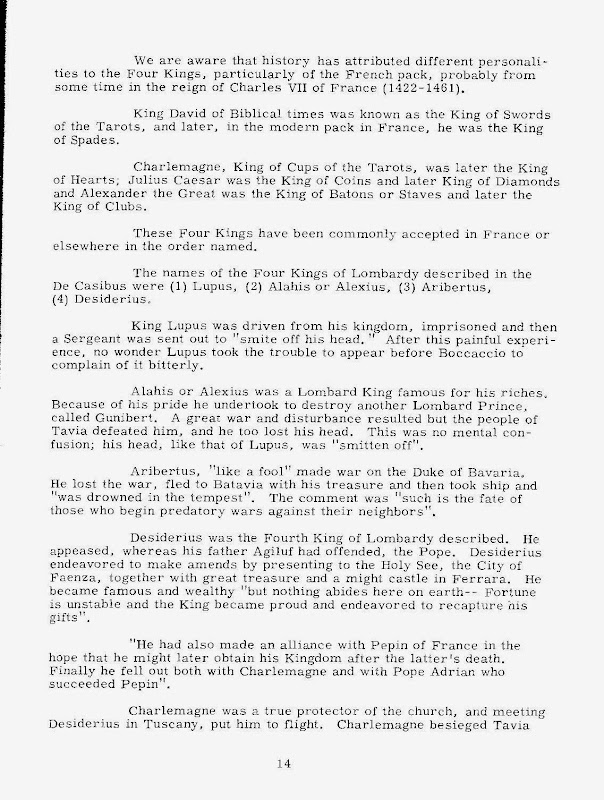
Then he says that while in France the four kings were identified with David, Charlemagne, Caesar, and Alexander, in De Casibus there are the four kings of Lombardy, each of whom deservedly comes to a bad end. http://1.bp.blogspot.com/-Nmx3z7tdGg0/U ... bury14.JPG
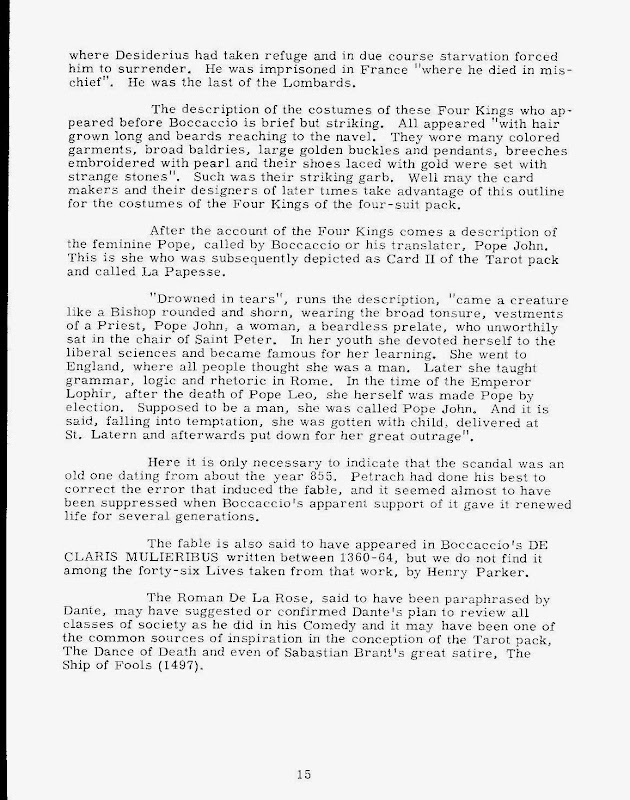
On p. 15 he compares the description of the kings' attire to that of the kings in the early tarot. He does not specify which kings he has in mind. It is not the details, perhaps, but the general sumptuousness that he finds comparable. http://3.bp.blogspot.com/-9u4DuLTC2yY/U ... bury15.JPG
The final comparison with De Casibus, middle of p. 15, is to me the most interesting, a figure he relates to the Popess card, namely, the "Pope John" who was actually a woman. Seabury paraphrases the passage in Lydgate's Fall of Princes in modern English I found the Middle English original, which is similar; see http://4.bp.blogspot.com/-PLuhtgtRcCk/U ... 46Joan.JPG
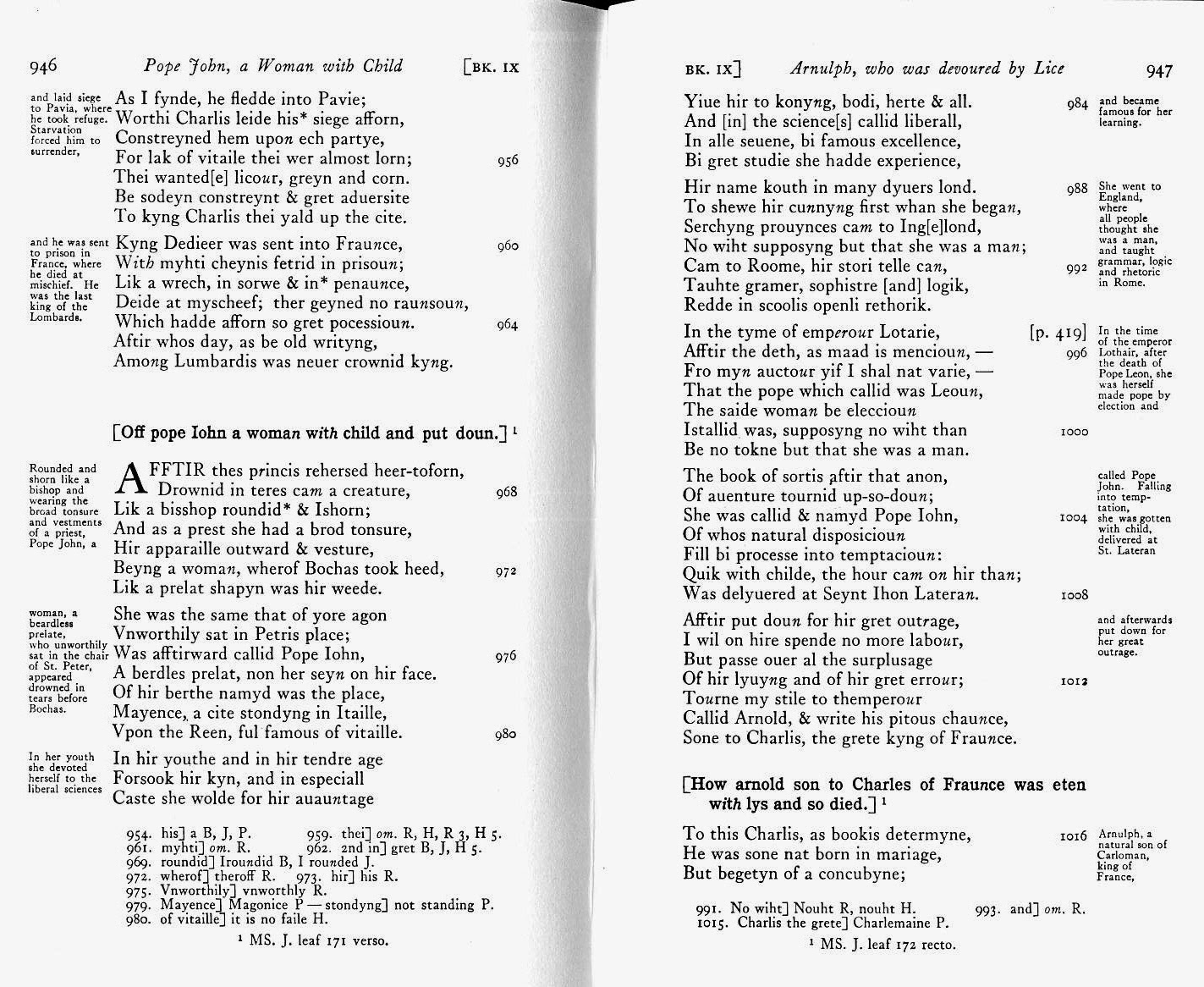
Seabury assumes that this account in Lydgate, which he says comes right after that of the four kings, was in Boccaccio's original of De Casibus. This particular incident is actually not there. It was incorporated into the work by French translators using the section on Pope Joan in Boccaccio's "On Famous Women" (see note 26 on p. 163 of The afterlife of Pope Joan in Early Modern England, http://books.google.com/books?id=ZuuJCO ... an&f=false). Seabury could not find the relevant episode in the edition of that book available to him.
I could not resist looking on the Web for illustrations of this Popess. I found one right away, a 1467 illumination by the "master of Berry" (http://www.luminarium.org/medlit/lydgatefalls2.htm). Lydgate himself, as the title of his work says, was a "monke of Berry".

Seabury ends this section with a brief note that another possible source, for its portrayal of the various classes of society, is the Roman de la Rose, In the next section (p. 16) he says that batons are the peasants, cups the clergy, swords the military, and the coins the merchants (bottom of p. 17, http://4.bp.blogspot.com/-AxsvDHquG40/U ... bury16.JPG
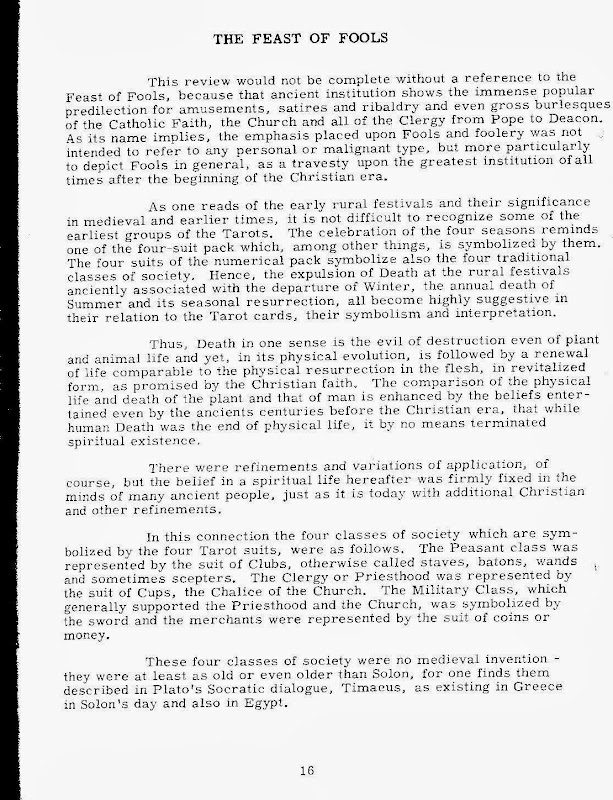
Next he relates the medieval "Feast of Fools" to the Fool card (pp. 16-18). He says it derived from pagan festivals such as the Saturnalia, around Christmas and New Years. With the change of the seasons it celebrated, we see the Death card, with its rural reaping tool, as the end of the old and the beginning of the new (p. 16). The Star, Moon, and Sun cards are what remain of the celebrations of the planetary deities.
It was sometimes called the Feast of Asses, the Feste Asinorum.
http://4.bp.blogspot.com/-AxsvDHquG40/U ... bury16.JPG

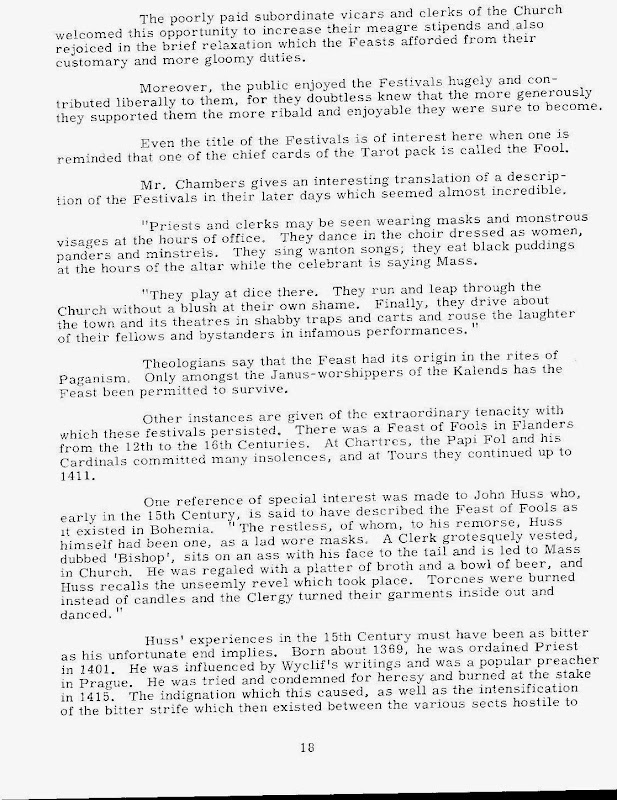
It "depicted Fools in general, as a travesty upon the greatest institution of all time after the beginning of the Christian era" (p. 16). Although the church authorities tried many times to stamp it out. starting in the 12th-13th centuries, they were not successful in France until about 1721. To the minor clergy, very underpaid, this was an important source of income (top of p. 18). The people loved it and gave generously. (http://2.bp.blogspot.com/-kCSBZsbJMxs/U ... bury17.JPG
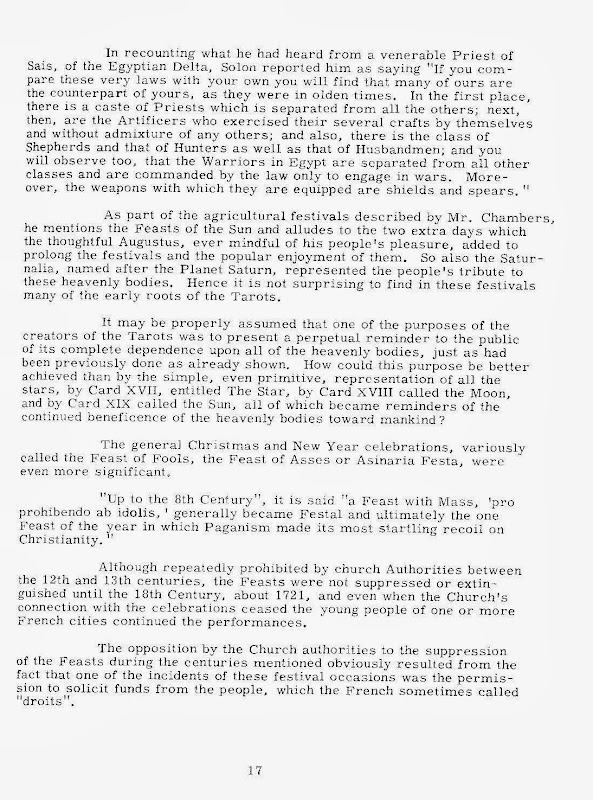
It was a time in which the clergy were the opposite of serious (p. 18). They dressed as women and danced in the choir. They wore masks and ate "black pudding" at the altar. I assume he means blood pudding, a take on Christ's blood. They were also given "a platter of broth and a bowl of beer".
http://4.bp.blogspot.com/-LuvwiFgGnls/U ... bury18.JPG
I suspect that an image that Jung shows in Symbols of transformation, Plate XLIII, may be related to this "Feste Asinorum", a graffito in Rome
http://1.bp.blogspot.com/-1Tuq2bxBI3Q/U ... gXLIII.JPG

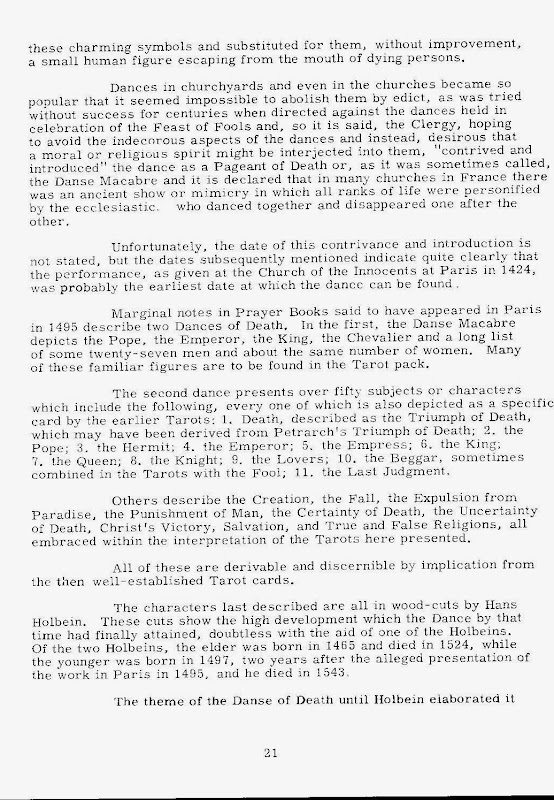
Seabury moves on to the "Dance of Death" (p. 19 and 21), which he says was danced by the clergy and introduced to counteract the dances of the Feast of Fools (p. 21).
http://2.bp.blogspot.com/-y9LdmM5KXBo/U ... bury19.JPG
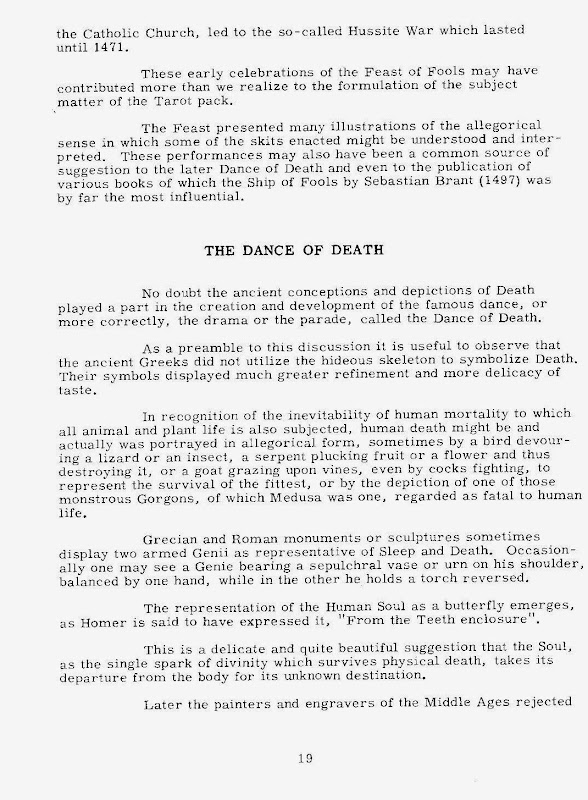
He is concerned to date when these performances occurred. He sees the closest correspondence to Holbein's 16th century depiction in an account found in the margins of prayer books, describing a version in 1495 Paris, which he enumerates. Before that, the earliest he finds is 1425, also in Paris.
He relates its personnages to numerous cards, some explicitly and others implicitly, of all stations in life, including those of Pope, Emperor, Empress, the Hermit, Lovers, the , Beggars,and the court cards (omitting for some reason the Page), ending with the Last Judgment I wish he had said more about the implicit ones. "True and False Religion" might correspond to the Pope and the Popess, but he doesn't say so.
http://1.bp.blogspot.com/-M-yoSSjlneg/U ... bury21.JPG
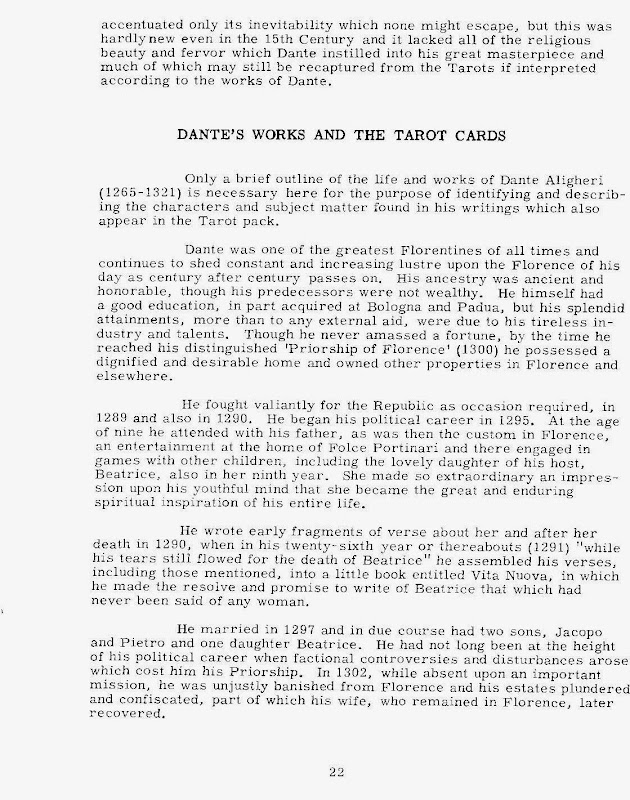
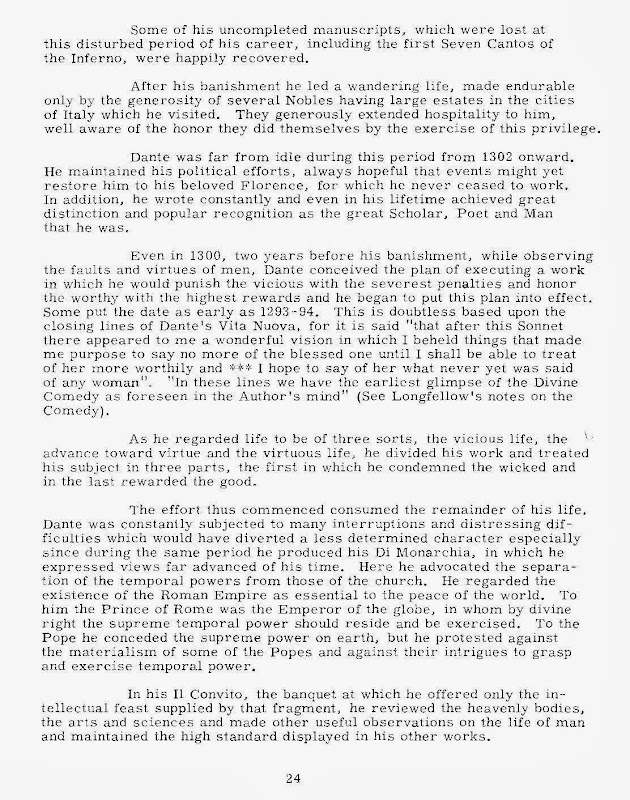
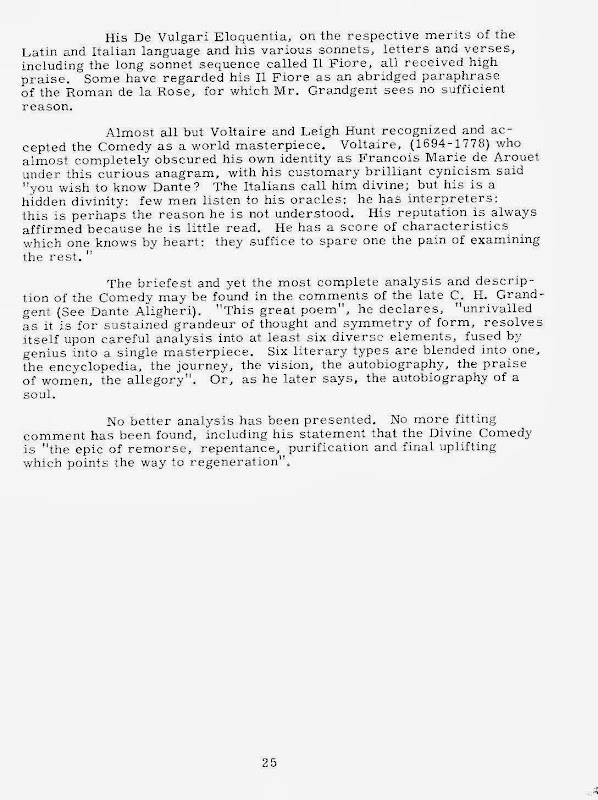
Finally, there is the Divine Comedy. He has three pages on Dante's life and works, but nothing directly related to the tarot except perhaps the quote at the end, where he ends with a quote from C. H. Grandgent,t hat it is "the epic of remorse, repentance, purifiction, and final uplifting which points the way to regeneration". Here are these pages:
http://2.bp.blogspot.com/-t8LLSSc8TIg/U ... bury22.JPG
http://2.bp.blogspot.com/-ASYdmrg3X1U/U ... bury24.JPG
http://1.bp.blogspot.com/-9d39FtIahME/U ... bury25.JPG
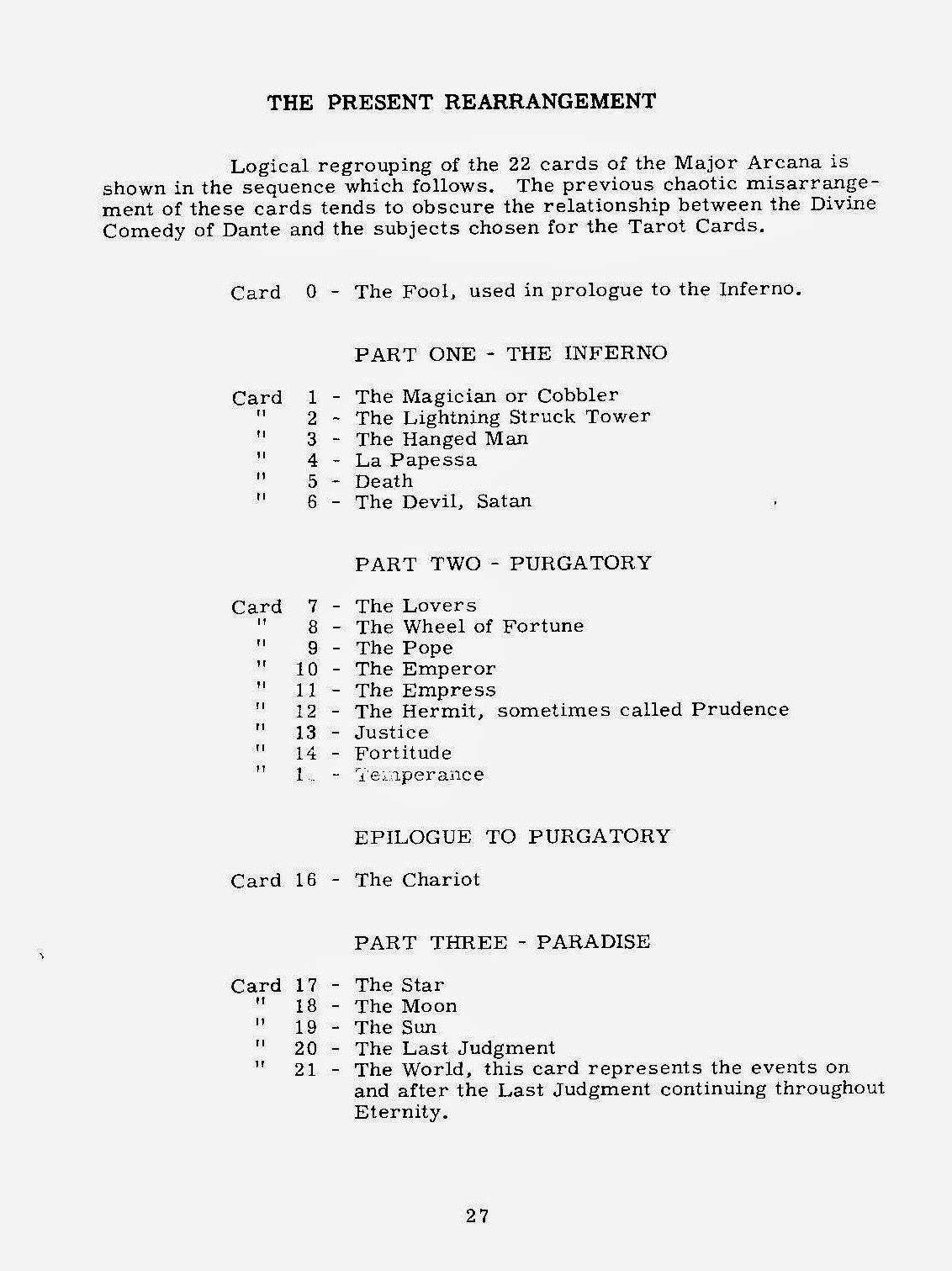
Then comes the list of cards in what he thinks the proper order, correlating each with one part of The Divine Comedy. He says that since all the figures on the cards are there, but presented in a different order, he assumes that the original order of the tarot is that he finds in Dante. For us, this seems dubious, because all the early orders reported from various places consistently follow a different pattern of groups, as Dummett showed. But the list is still interesting for the parallels he draws. Some, like the Chariot, are hard to fit into the actual orders that have survived. http://1.bp.blogspot.com/-U9YSaF1dJlA/U ... bury27.JPG
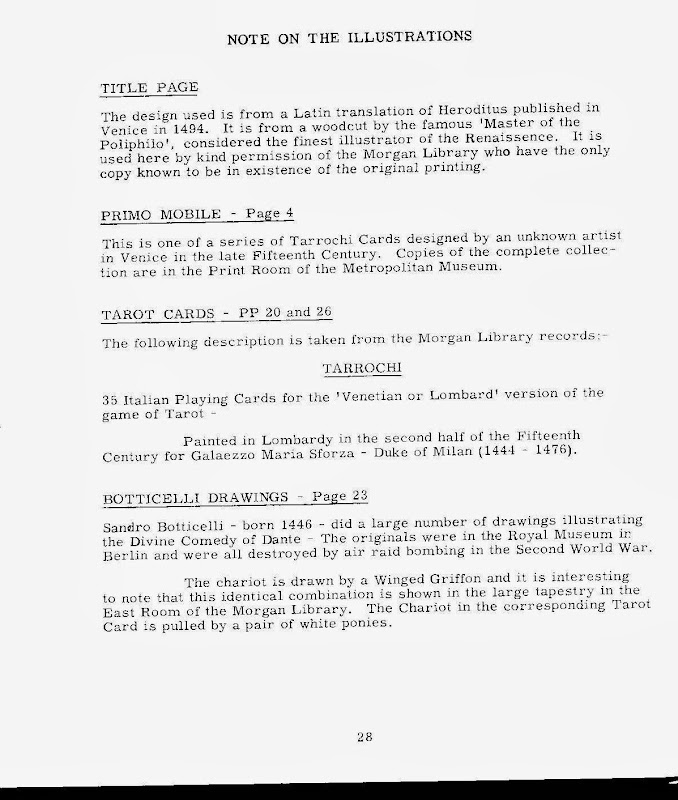
He also reproduces (p. 26) two of Botticcli's illustrations to the Divine Comedy, from reproductions in the Morgan Library; he finds similarities to a few cards . The bottom one was reproduced by Ross at viewtopic.php?f=12&t=464&start=10#p5947. He finds the Lightning-Struck tower, which Ross says illustrates Purgatory XII (although Seabury has it in the Inferno). I would note in addition the upside down devil and Pope-looking God in the lower right. The top illustration, he sys, shows the Chariot, from the end of the Purgatorio. See http://commons.wikimedia.org/wiki/File: ... roject.jpg.

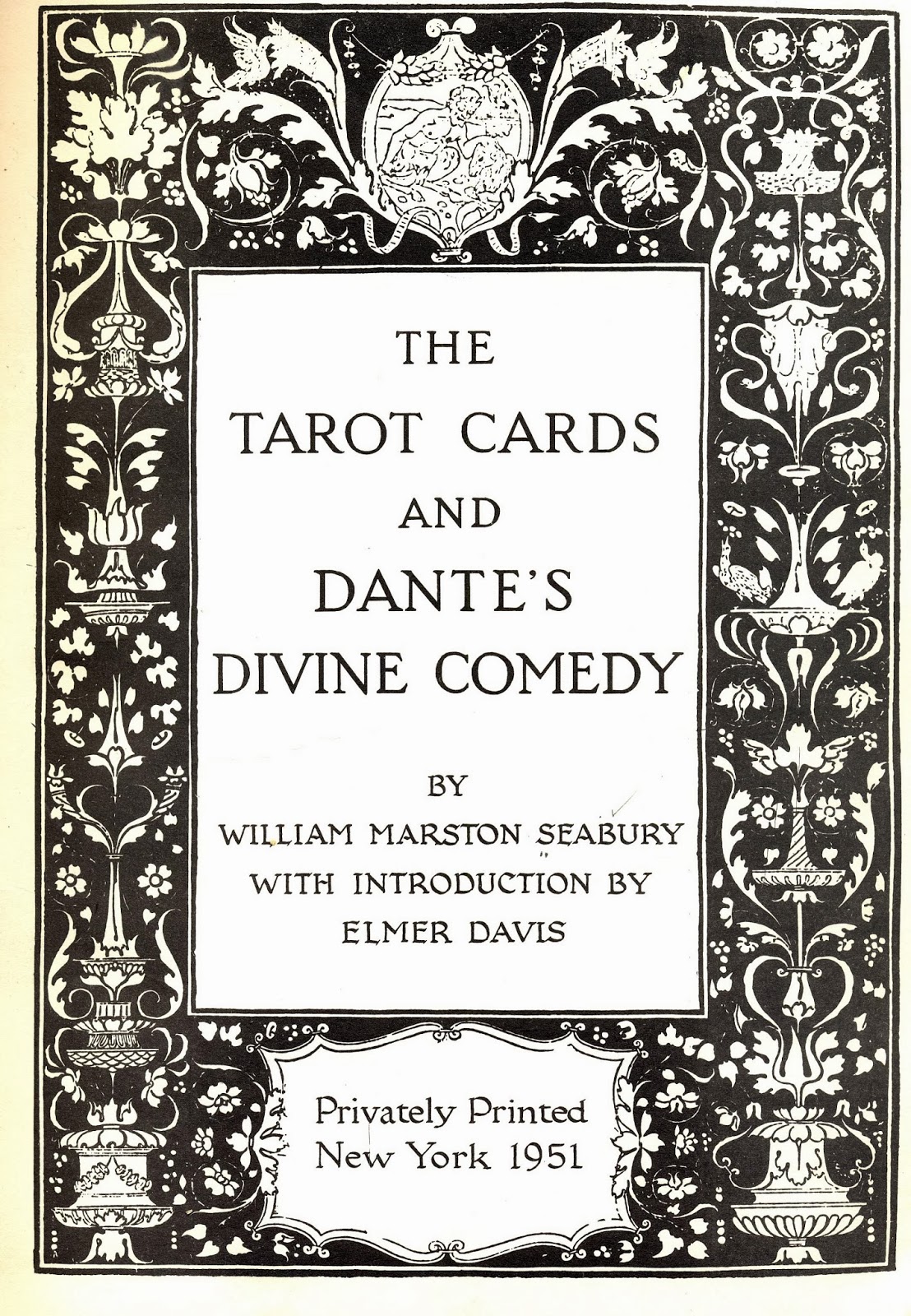
All in all, as I say, it seems quite a pioneering book for its time. His friends did right by him. At the end he discusses his illustrations. I end with that plus the title page.
http://3.bp.blogspot.com/-oBAmNvy6-qc/U ... bury28.JPG
http://4.bp.blogspot.com/-RGfMkKAiSc0/U ... ATitle.JPG