hm ...
maybe it's not clear, but I was focused on the development of the Trionfi poem. Later developments are surely also of interest, but not for the early development.
The Christie's information of 1373 and Pandolfo Malatesta seem to relate to the Canzonieri.
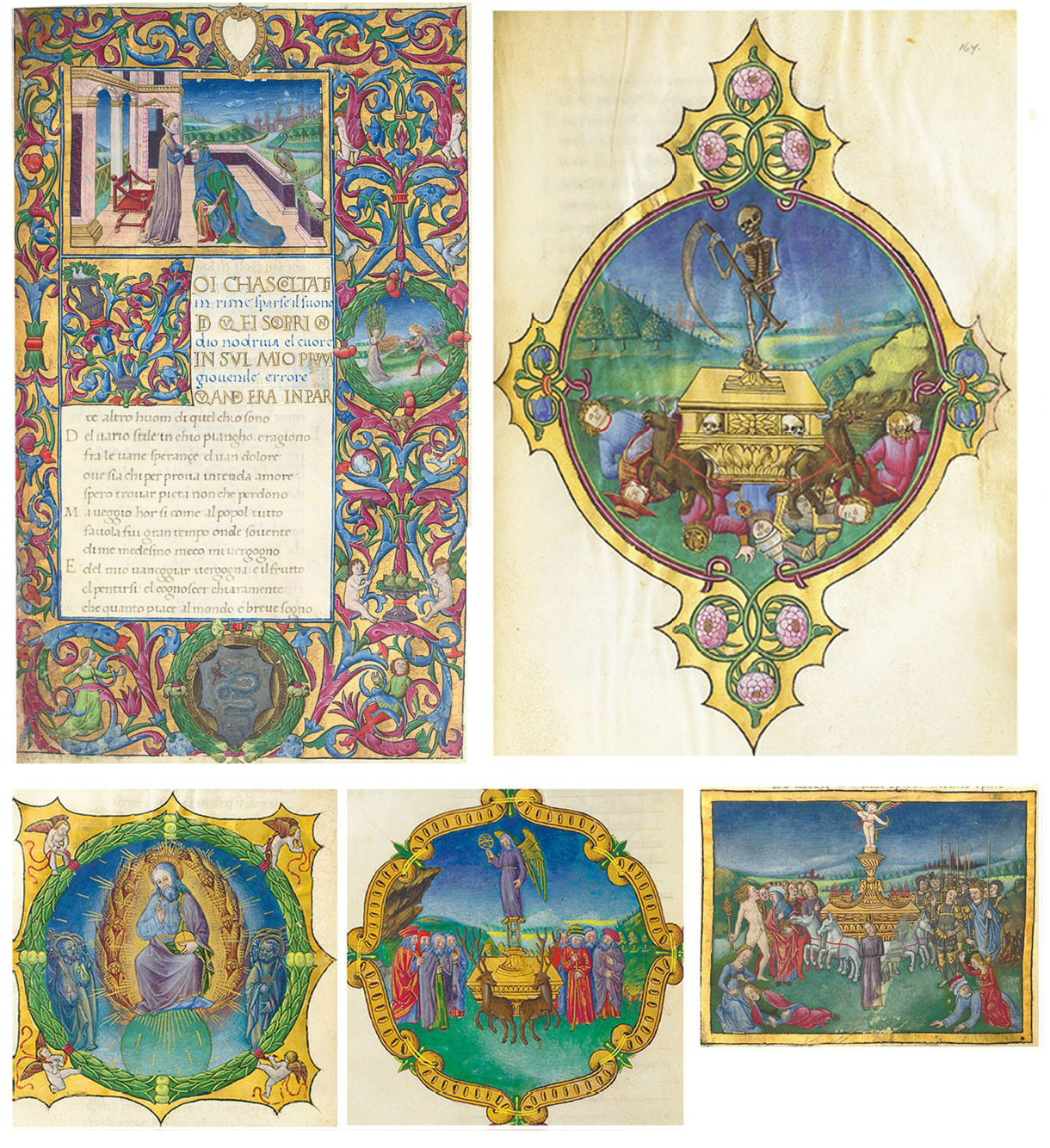
In later arrangements of the collection, including the final version known from the partly autograph manuscript that Petrarch was modifying until the year of his death (Vatican City, BAV, Vat.Lat.3195), the verses were divided into two parts, those written during Laura's lifetime, 'in vita', and those after her death, 'in morte', the second part beginning with verse 264. This is the arrangement followed in the present manuscript, although the large illuminated initial allowed for on f.108v and intended to mark the opening of the second section was never supplied. The arrangement of the 'in vita' poems conforms to the ordering known as the 'forma malatesta' from the manuscript sent by Petrarch to Pandolfo Malatesta in 1373 (E.H. Wilkins, The Making of the Canzoniere and other Petrarchan Studies, 1951).
The categories "in vita" and "in morte" belong to the Canzonieri and NOT to the Trionfi, as far I understood it. I became later custom, that the Canzonieri and Trionfi were combined in one book. "In vita" likely belongs to poems "before April 1348" and "in morte" to poems "after April 1348" and in April 1348 happened the likely artificial death of Laura.
The letter of Matteo de Pasti (24th of January 1441) is assumed to be the first known indication of an illustrated Trionfi poem edition, commissioned by Piero de Medici. The interesting phenomenon is, that we've in September 1440 the (momentary) first note about Trionfi cards, and the close-in-time . appearance of both art productions let me assume a causal connection between both (both triggered by the popularity of the Trionfi poem, not the Canzonieri). Naturally the general popularity of Petrarca triggered the popularity of the Trionfi poem, but the question is "when".
The fame of the "Trionfi poem" likely didn't start, when the poet hadn't finished it. And it wasn't finished at his death time. So it was between Petrarca's many papers. Other writings of Petrarca were already famous and with some probability they found earlier some attention.
Bruni wrote a Petrarca biography in 1436, Giannozzo Manetti in c. 1441. Both are from Florence and from Florence we've now the earliest Trionfi card production date.
Other biographies of Petrarca are known from an earlier time than this, some are related to Florence. Padova (Carrara) is another place of Petrarca interests. Here worked Pier Paolo Vergerio the Elder ...
http://en.wikipedia.org/wiki/Pier_Paolo ... _the_Elder
... , who published Africa and his biography is praised between the others. He had access to the Carrara material till 1405, but he later went to Hungary. Sicco Polentone wrote 1433, but has kept details very short and is called of minor relevance.
All early biographies are called "not very intensive". Petrarca's fame as a scholar is (for the early biographies)' called greater than his fame as poet.
From this it's imaginable, that the Trionfi poem text appeared in the 1430s out of the nothing, known only by few.
Well, we research Trionfi cards, and the reasons for them to appear. We cannot overlook Manetti's Petrarca biography (c. 1440), Manetti's close relation to Bruni (Petrarca biography 1436), the Trionfi note of September 1440 and Matteo de Pasti's letter January 1441. Everything is close in time.
Naturally the generally book fair fever already in Ferrara 1438 and the book fair fever in Florence 1439 are of interest and it plays its role with all the import of Greek books from Constantinople. Bruni and also Manetti get their name as likely the most important translators from Greece to Latin in this early time. The library project in Florence already started 1437 after Niccolo de' Niccoli's death, that's true.
But for the Trionfi cards we likely have to look at the festivities in Florence 1439. Here was welcomed Pope Eugen at January 27th "in triumph", and Patriarch Joseph at February 11th (but he complained, that his welcome was less prestigious than that of the pope) and the welcome of the Greek Emperor at February 15th, again "in triumph". The praising oratio then was given by Leonardo Bruni, no wonder, he could speak the best Greek.
700 Greek guests in Florence with a lot of communication problems ... we should assume, that persons like Bruni and Manetti got a lot of importance by their translation abilities.
For the casa del Petrarca and its close distance to the castle in Monselice its of interest, if Marcello already had the castle and possibly was involved in the Petrarca fever.