Women with a book and a cross
Posted: 02 Sep 2013, 21:03
The main attributes of the Visconti-Sforza Popess are a triple-crown tiara, a book and cross. While the tiara has been widely discussed and is an obvious symbol of papacy and the Catholic church, the couple book-and-cross has been less explored.
I want to collect here a few examples, in order to understand what were the most common subjects featuring these two attributes.
Giotto's Allegory of Faith in the Scrovegni Chapel [1300 ca]
This fresco has been widely discussed. Andrea Vitali provides some information I was not aware of: in her right hand, she grasps a rod with a cross, in her left hand a cartouche where the first affirmations of the Nicene and Constantinople Creed can be read. So the scroll reads something like: “I beleeve in one God the Father Almighty, Maker of heaven and earth” (“Credo in unum Deum, Patrem omnipotentem, Factorem cæli et terræ”). Vitali also presents and translates the latin inscription below Giotto's fresco: “Figurata et ierata / presentatur homini, indiscussa manet fides… cuius autem valet tactus / aprobando loyter. Congregavit subiugavit / ydola viriliter, coronatur et fundatur / supra petra firmiter, angelorum et virorum / confortatur numine, mire recta et perfecta…” (Figured - i.e. represented with her canonical symbols - and hieratic, she appears to man, faith stays beyond discussion… and her value lies in the influence coming from evidence provided by logic. She gathered and subdued the idols with much force, is crowned and firmly based on stone, is comforted by the consensus of angels and men, wonderfully just and perfect).
God's Wisdom – Sapientia Domini [12th century]
On the same page, Andrea Vitali mentions another ancient image: The iconographic predecessors of this card [the Popess] are to be found among the personifications of the highest moral and religious virtues, as we can see in the 12th century illuminated initial known as “Sapientia Domini” (Biblia Sacra, Florence, Laurenziana Library, Ms. Mugell, 2 f, 58) which shows the same attributes. The relevance of this image has been first pointed out by Daniela Pagliai. Ross Caldwell and Michael Hurst discuss this important and early image in the postscript and comments to this pre-gebelin post.
Truth – Lyon 1641
 s_thomas2.jpg
Viewed 16644 times 241.77 KiB
I found this allegory in a frontispiece published by the Victoria University Library, British Columbia, Canada. The description says that the allegory on the right (the one with the globe) represents Erudition and the one on the left (with the book and the cross) represents Truth. It is interesting that the book has something written on it: “Nisi Jesum Chritum et hunc crucifixum”. A quote from 1 Corinthians 2,2 : “For I determined not to know any thing among you, save Jesus Christ, and him crucified." The frontispiece belongs to a commentary to the works of Saint Thomas.
Theological Virtues, Tuscany XVI Century
 fiorentino_XVI.jpg
Viewed 16645 times 49.36 KiB
I find this anonymous painting interesting mainly because the virtues present the polygonal halo that we see on ancient Florentine decks (e.g. Charles VI and the Rosenwald sheet). The one on the left with the book and the cross is Faith.
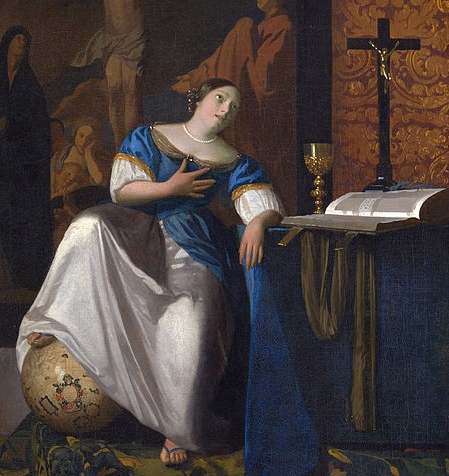
Vermeer - Faith [1670 ca]
 vermeer_faith.jpg
Viewed 16645 times 125.01 KiB
A painting by Vermeer which shows how the same attributes could still be used in a composition much more modern in style. The whole painting is here.
I want to collect here a few examples, in order to understand what were the most common subjects featuring these two attributes.
Giotto's Allegory of Faith in the Scrovegni Chapel [1300 ca]
This fresco has been widely discussed. Andrea Vitali provides some information I was not aware of: in her right hand, she grasps a rod with a cross, in her left hand a cartouche where the first affirmations of the Nicene and Constantinople Creed can be read. So the scroll reads something like: “I beleeve in one God the Father Almighty, Maker of heaven and earth” (“Credo in unum Deum, Patrem omnipotentem, Factorem cæli et terræ”). Vitali also presents and translates the latin inscription below Giotto's fresco: “Figurata et ierata / presentatur homini, indiscussa manet fides… cuius autem valet tactus / aprobando loyter. Congregavit subiugavit / ydola viriliter, coronatur et fundatur / supra petra firmiter, angelorum et virorum / confortatur numine, mire recta et perfecta…” (Figured - i.e. represented with her canonical symbols - and hieratic, she appears to man, faith stays beyond discussion… and her value lies in the influence coming from evidence provided by logic. She gathered and subdued the idols with much force, is crowned and firmly based on stone, is comforted by the consensus of angels and men, wonderfully just and perfect).
God's Wisdom – Sapientia Domini [12th century]
On the same page, Andrea Vitali mentions another ancient image: The iconographic predecessors of this card [the Popess] are to be found among the personifications of the highest moral and religious virtues, as we can see in the 12th century illuminated initial known as “Sapientia Domini” (Biblia Sacra, Florence, Laurenziana Library, Ms. Mugell, 2 f, 58) which shows the same attributes. The relevance of this image has been first pointed out by Daniela Pagliai. Ross Caldwell and Michael Hurst discuss this important and early image in the postscript and comments to this pre-gebelin post.
Truth – Lyon 1641
Theological Virtues, Tuscany XVI Century
Vermeer - Faith [1670 ca]


