Page 1 of 1

Oracle of Seni, astrologer of Wallenstein

Posted: 21 Apr 2014, 09:03
by Huck
Giovanni Battista Seni ( 1602 (?) Padova - 1650 Genova) ...

Image

http://de.wikipedia.org/wiki/Datei:Karl ... ty_001.jpg

... has some fame in Germany as the astrologer of Wallenstein, and maybe some special attention by the fact, that Friedrich Schiller gave him a great role in his theater play trilogy about Wallenstein, especially in "Wallenstein's Death" (actually he has not much text, but it seems, that he was impressive, somehow a German Merlin). I learned about him in early school, maybe he could be called the most famous astrologer in Germany for some time ... (well, we have Albertus Magnus, Cusanus, Regiomontanus, Faust, Kopernicus, Agrippa of Nettesheim, Kepler and others, but the impressive German astrologer archetypus seems to be Seni, an Italian).
It seems, that English wikipedia even doesn't know him. World is curious.

I took some energy to get data about this Seni oracle, that I bought in the 1970s.

The book tells, that a Reserveoffizier (no name) had been lodged in an old French chateau, and was expecting a big battle nearby ... in the French/German war 1870/71. He was astonished by the calm of an old lady, owner of the chateaux. She told him, that the battle wouldn't take place at this location and she knew it from an old book and a card game, which once was left at the chateau by the astrologer Seni and had passed through the centuries in the family, always telling the truth. She was interested in the young man, and she told him (with the help of the cards) also about his future. He was soon to get deeply wounded in the war and would leave the battlefield. She declared him to be the heir of these cards and book, cause she would soon die, in short time, and had no relatives, whom she could give the cards.
According the book it happened, as she (and the book) had told, he was crippled and got the book. But with the old French he couldn't deal, and so the game stayed a curiosity inside his family.

*************

The publication was distributed by the publisher Bärmeier&Nikel, any other publisher or a date is not mentioned. Bärmeier&Nikel is known to have engaged in satiric productions ... :-) ...
http://de.wikipedia.org/wiki/Hans_A._Nikel
... they made the satiric newspaper "pardon", leading in this genre in the 1970s on the German market.

The book is titled: "Corona Horoscope" mit 36 Karten, and "Ein Blick in die Karten" and "Sterndeutung für jedermann". It's estimated to have been produced c. 1975. Printed in old German fracture. One picture gives Sol on a triumphal chariot in a 15th century style. It claims to be reprinted similar to the original (which would say, that the original was printed).

************

I detected the following: an article ...
http://www.spiegel.de/spiegel/print/d-41561080.html
... of the newspaper "Spiegel" (leading political magazine in Germany) of the year 1975 (same year as the probable publication year according my researches; 3 February), which is about a "Paul Devrient (bürgerlich: Paul Stieber-Walter)", an opera singer, who once worked as a secret home teacher of Adolf Hitler (teaching voice and rhetorical gestures for appearances on a stage). He had died 2 years before (1973), and his son desired to publish his memories on the work with Hitler (which happened in the year 1932).

It's confirmed by German wikipedia
http://de.wikipedia.org/wiki/Paul_Devrient

The book was announced, but got another title. The work was edited by Werner Maser ...
http://de.wikipedia.org/wiki/Werner_Maser
Werner Maser (Hrsg.): Mein Schüler Hitler. Das Tagebuch seines Lehrers Paul Devrient, bearbeitet und herausgegeben von Werner Maser. Ilmgau Verlag, Paffenhofen 1975
Werner Maser (Hrsg.): Paul Devrient. Mein Schüler Adolf Hitler. Universitas Verlag, Tübingen 2003
Werner Maser is given as a Hitler specialist of some fame. Maser seems to have been strong in biographical details, far less accepted he was in his political interpretations.

I don't know the book, but I found, that the 1st edition had 50.000 books, which is a huge number. The publication expected a high interest.

*************

The book description (Spiegel article) contains a special sentence.
Aus einem alten Kartenspiel, das einst Wallensteins Leibastrologe Seni besessen und Hitler von einer französischen Schloßherrin zum Geschenk bekommen haben soll, las er, an einem 13., die günstige Konstellation ab. Fortan, so Devrient, "war er intensiv bei der Sache".
According this Hitler got a card play, which once was owned by the astrologer Seni, from a female French chateau owner as a present. In this system he read from the cards on a 13th day of a month, a promising constellation. Since then, so the reporting Devrient , he was intensively engaged to learn from Devrient.

************

So for Devrient Hitler got the deck, and not an unknown Reserveoffizier of the war 1870/71. Otherwise the story is so similar, that one can hardly imagine just an accident or two different decks.
Getting the contradictions together, one might suspect, that Hitler lied to Devrient about the true story of the deck, or Devrient just misunderstood Hitler and his story.
Or - another possibility - the whole real book of c. 1975 is just a satiric joke on the Devrient publication (1975), possibly from the side of Bärmeier&Nikel, which was known for such operations.

Possibly the book of Maser 1975 has some more information on this deck.

Image


****************

Generally it might be of interest to search for a lot book game with similar structure (where pictures must be turned to fit with each other. For the moment my search is negative, no results.

The best, what I found to Seni is this report:
http://www.30jaehrigerkrieg.de/senno-se ... -battista/

***************

On my research I stumbled about these two recent researches about old lot books:

Evelyn Burkhardt: ... Losbücher ...
in
Jewish Studies Between the Disciplines
Peter Schèafer, Klaus Herrmann, Margarete Schlèuter, Giuseppe Veltri
BRILL, Jan 1, 2003 - Religion - 502 pages
http://books.google.de/books?id=xDdOLob ... &q&f=false

Die Sortes Astrampsychi: Problemlösungsstrategien durch Orakel im römischen Ägypten
Franziska Naether
Mohr Siebeck, 2010 - History - 491 pages
http://books.google.de/books?id=HT-rMHb ... navlinks_s

.... which don't contribute anything to this special theme.

Re: Oracle of Seni, astrologer of Wallenstein

Posted: 22 Apr 2014, 22:17
by Huck
The star pictures of the game (as made c. 1975) are made as a nice toy. The 36 cards could be laid down in one pattern, in which the most objects are full and upright. My picture presents the upper left of the full table ... if one follows this basic model.

Image


Six of the 36 cards are used for this. Naturally I could produce the missing 5 others 6-cards-combinations with the scanner, but I'm too lazy for it. Altogether they would present the full picture, a 6x6-square

I just try to take the story serious, that the deck is from Seni and from 17th century ... but there are reasons to explain the whole thing as a forgery nonsense.

Well, the pictures look modern, not like 17th century. Likely the publisher (not the possibly really existing book) has titled in the book single chapters with "Planet Neptun", "Nebenmond des Uranus: Titania" and other similar impossible stuff (Planet Neptun wasn't detected in Seni's time, and Uranus neither). Assuming (just for fun and a little bit for a specific suspicion), that the Seni connection is true, I assume, that these wrong things are just a later publisher edition.

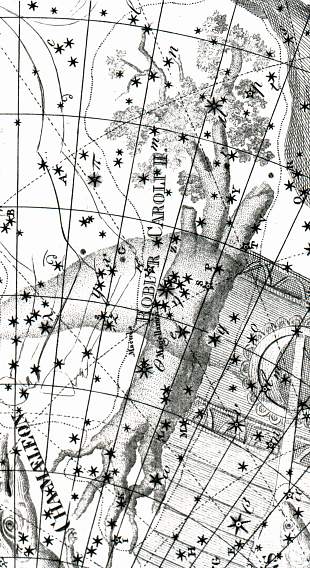
But I have a special suspicion ... there is one sign, which is really strange, the "Herz Carl's II."

Image


Who the heck is Carl II? In history there are naturally more than one "Carl II", "Karl II" or "Charles II". I searched for a Carl II with some relevance in the time of Seni, who's death year is given with 1656, though one knows not much about his late life (at least I don't know), just the condition, that he was attacked by murders in Vienna in 1643, who left him for dead. Born in Padova, he died in Genova (close to France) during a plague in 1656
"Am 1. April hat in Wien, auf S. Stephan´s Freihoff, Herr Biboni, Königlicher Polnischer Resident, einen Astrologum, welcher hiebevorn bei´m Hertzog von Friedland gewesen, wegen etlicher Wort, zweymal durchstochen, und ihm hernach viel Wunden und Stich, durch seine Diener, geben lassen, daß er für todt weggetragen worden, weßwegen die Kayserliche May. für dessen Logament Wachten stellen lassen. Damit gedachter Resident nicht ausgeht, und die Diener, so Hand mit angelegt, bekommen werden möchten."

http://www.koni.onlinehome.de/kurzbiographien/seni.htm

For the attacker Biboni is this note:
http://www.30jaehrigerkrieg.de/biboni-baron-francesco/

Back to the unknown Carl II.
Here is a Charles II, son of the English king Charles I, and he fits the condition to have lived in Seni's life time
http://en.wikipedia.org/wiki/Charles_II_of_England

According ...
http://books.google.de/books?id=5nI01wR ... &q&f=false
... Charles II spend a lot of his time in Paris, a place, in which he easily might have found the wandering astrologer Seni in search for a new sponsoring Wallenstein.

June 1646 - June 1648
January 1649 - September 1649
October 1651 - July 1654

Background for these long stays in Paris is the monarchy crisis in England, which started around 1640, or already in 1625, when Charles I. (father of Charles II) started his reign. Since c. 1640 the crisis got the dimension of a civil war. Charles II, who had a military commission in 1445 (15 years old), fled finally in this year to France. The father was executed in January 1649. Charles II became king in exile and attempted to get his kingdom by force, which was finished by a battle in September 1651, after which the young king had to hide within an oak tree. The story is told here:
http://www.historyextra.com/news/king-c ... first-time

28 years later after this story the astronomer Halley (1679; Halley also responsible for the name "Halley's comet) got the idea to name a star constellation, which he had in mind, after the oak, which saved the king, "Charles oak" or "Robur Carolinum", as reported here:
http://en.wikipedia.org/wiki/Former_constellations
http://www.ianridpath.com/startales/robur.htm
http://www.pa.msu.edu/people/horvatin/A ... olinum.htm

Image


Image


***********

Well, the deck presents a heart of Charles II, not an oak. But it has happened not too often, that somebody still living got his name remembered as a star constellation. That this operation appeared twice for one and the same person without a relation between the both actions looks not probable.

In the situation of 1649/50/51 a dramatic action (an English king executed !!!!) took place, which might have triggered strong responses. There was a party of royalists, which expected that the young new king should do something about the situation ... which he did. Inside the preparations of his military actions the plan might have existed to use star constellations to celebrate the expected glorious victory. Well, a good idea, but the victory didn't take place immediately and was finished inside an oak tree for long years.
Finally he became a king, but the plan was out of the minds. .... but 28 years later somebody remembered it.

This might be the story. Paris in the 1640s had been full of new ideas for playing card decks. The same creativity followed some time later in Nuremberg, and the fashion also went to England and also went to London. We can't expect, that we know about all the experiments with playing card decks.

It's possible, that Seni followed this trend, and that the story was indeed so, as the old lady told it.

****************

I've searched for "Carl II" and "heart". I found nothing.

Curiously a lot of hearts in 1649

Posted: 22 Apr 2014, 23:15
by Huck
In my research I stumbled about a modern work "Imitatio Crameriana", which is made about a work, which appeared in Nuremberg 1649, so precisely the year, where one might expect, that the symbol of the "heart of Carl II" might have played a role. This edition of 1649 is described by the accompanying text:
In 1649 Hieronymus Ammon, a town lawyer in Nuremberg, published a sophisticated bilingual emblem book in Latin and German under the title Imitatio Crameriana. The book is a compilation of forty heart emblems, imitations of Daniel Cramer's Emblemata Sacra. At this time Nuremberg was a centre of economic and political power, and boasted a thriving culture. The town's poets had a serious interest in rhetoric and poetics, and they showed an appreciation for the vernacular culture that was being promoted by the Sprachgesellschafften. In this context the notion of imitatio is important as a theory of learning and translation. Imitating classical patterns was considered a means to develop style through independent variation. Cramer's heart emblems were considered by Ammon and his friends as an ideal model. Even more so because they adhered to orthodox protestant dogma. Thus these emblems fulfilled the expectations of erudition and wit, while satisfying protestant principles of scripture. Most of the biblical mottoes were texts used for daily sermons in the Lutheran church. The substantial introduction is followed by a list of Ammon's Latin mottoes which are juxtaposed with their source mottoes in Cramer's emblems and accompanied by English translations; there is also a second list of the key motifs in the emblem pictures.

http://books.google.de/books?id=Tr2fAAA ... ume&q=carl

I don't see more of this edition.
Added later: I found something, which might be similar, though given as from 1647
http://books.google.de/books?id=xllXAAA ... &q&f=false
...with preview and pictures.
But following the lead "Daniel Cramer: Emblemata sacra" I get a lot of hearts, just by images from Google and between them also a list with pictures...


http://alchemyfraternitas.ru/media/phot ... s/SEmblem/

So I assume, that Daniel Cramer ...
http://en.wikipedia.org/wiki/Daniel_Cramer
http://de.wikipedia.org/wiki/Daniel_Cramer
... created a specific fashion "with hearts" in 1624, which reappeared to the surface in 1649 (the year after peace was concluded in 1648 , which finished 30 years of bloody war) and somehow possibly had something to do with the researched heart of Carl II.

Oberon, Titania and the unavoidable Puck (not Huck)

Posted: 23 Apr 2014, 12:23
by Huck
In the text of the "Imitatio Crameriana" appears in a laudatio the not avoidable Harsdörffer, who was object of my attention during the studies of card production in Nuremberg after the 30-year-war.

http://en.wikipedia.org/wiki/Georg_Philipp_Harsdorffer
http://de.wikipedia.org/wiki/Georg_Phil ... C3%B6rffer


******************

The text (the 1647 version) opens with an interesting "Fame" mixed with a Gallus, possibly indicating a sort of French influence.

Image


There are 40 "Meditatio" ... mostly "with heart", but also some without. I've selected a few with heart.

Image


Image


Image


Image


The comments are Latin and German, the whole has usually religious elements (protestant, I would assume).

**************

How this heart development from Nuremberg relates to the "heart of Carl II of England" isn't really clear, but England and the very dominant religious situation (England as part of the protestant camp, but with kings, which had Catholics tendencies ... Stuarts) possibly knew alliances, which we've difficulties to discover from our perspective.

**************

Another English factor in the deck, made by Seni (according the description): Oberon and Titania (given by the publishers as "Nebenmonde des Uranos", which is naturally nonsense, cause the time of Seni didn't know Uranos as
a planet) ... and naturally also didn't know his moons - the moons Oberon and Titania were discovered by William Herschel at 11 January 1887 at one day and Herschel had also discovered Uranos before in 1781). Oberon is given with the symbol of a butterfly and Titania is given with a rosary, a crown and a veil (Protestants don't use rosaries).


http://en.wikipedia.org/wiki/A_Midsumme ... %27s_Dream

Oberon, Titania and Puck (also called Robin Goodfellow) appear all in Shakespeare's "A Midsummer Dream"(written around 1595). The wikipedia description states for the historic development of the play ...
Performance history / 17th and 18th centuries

During the years of the Puritan Interregnum when the theatres were closed (1642–60), the comic subplot of Bottom and his compatriots was performed as a droll. Drolls were comical playlets, often adapted from the subplots of Shakespearean and other plays, that could be attached to the acts of acrobats and jugglers and other allowed performances, thus circumventing the ban against drama.
When the theatres re-opened in 1660, A Midsummer Night's Dream was acted in adapted form, like many other Shakespearean plays. Samuel Pepys saw it on 29 September 1662 and thought it "the most insipid, ridiculous play that ever I saw ..." ...
http://shine.unibas.ch/translators.htm
... reports no relevant translations of the "Midsummer night dream", so Oberon-Titania might have been just an English phenomenon. Oberon had some earlier appearance in literature ...
http://en.wikipedia.org/wiki/Oberon
... but a combination Oberon-Titania seems not to have existed before Shakespeare.

The theater prohibition in Englan happened just in the critical time, which interests us, a clear sign, that theater was identified with the exiled king, so with Carl II.
Perhaps the scene, that the king was saved by an oak tree in 1651, contributed to the choice of Oberon and Titania as kings of the fairies (which would date the original deck to after 1651). If we assume, that indeed Seni contributed to the production, we would have then the time 1651-56 as time of production.

Here's a report about the (somewhat wild) exile of the king ...
http://extra.shu.ac.uk/emls/si-15/smitjour.htm

Somehow it's interesting, that Charles II got some more attention in German wikipedia than in the English wikipedia. Well, he spend a year or so in Cologne, and also his greater lover, Lucy Walter, had been here.
http://en.wikipedia.org/wiki/Charles_II_of_England
http://de.wikipedia.org/wiki/Karl_II._%28England%29
http://en.wikipedia.org/wiki/Lucy_Walter
http://de.wikipedia.org/wiki/Lucy_Walter

Astrology was still a theme in England in the tome of Chares II
http://www.skyscript.co.uk/gadbury.html

Chaos

Posted: 24 Apr 2014, 08:34
by Huck
So, let's see, if we get the chaos sorted ...

Here's a list of the titles used in the deck, I give them, as the titles are and in the row of the numbers ...

1 Die Sonne
2 Der Mond
3 Sternbild des Großen Bären
4 Sternbild der Zwillinge
5 Sternbild der Schlange (Hydra)
6 Sternbild des Hundes (Sirus)
7 Der Planet Merkur
8 Sternbild der Krone (Gemma)
9 Der Ring des Saturn
10 Die Milchstraße
11 Sternbild der Fische
12 Planet Pallas (Schild)
13 Sternbild des Scorpions
14 Planet Mars (Fahne)
15 Sternbild des Hasen
16 Planet Merkur (Brief)
17 Sternbild des Bechers
18 Sternbild des Schiffes
19 Sternbild des Castors und Pollux (Hände)
20 Sternbild des Fuhrmanns (Peitsche)
21 Sternbild Herz Carls II
22 Sternbild der Jungfrau (Spica)
23 Planet Venus (Schnäbelnde Tauben)
24 Sternbild des Wagens
25 Der Mond Titan (Schwerter)
26 Sternbild der Ziege
27 Planet Juno (Spiegel)
28 Der Abendstern
29 Der Komet
30 Wolken
31 Planet Pallas Athene (Eule)
32 Planet Neptun (Dreizack)
33 Planet Jupiter (Blitze und Lanze)
34 Sternbild des Drachen
35 Planet Ceres (Aehren)
36 Planet Veste (Das Feuer)
37 Der Morgenstern
38 Erda
39 Uranus
40 Sternbild des Pegasus
41 Das Haus des Himmels
42 Sternbild der Lyra
43 Sternbild des Stiers
44 Nebenmond Dione (Vogel mit Zweig)
45 Nebenmond Hyperion (Geld)
46 Sternbild der Krippe
47 Sternbild des Löwen
48 Sternbild des Schwan
49 Die Himmelsleiter
50 Sternbild der Andromeda
51 Sternbild Medusenhaupt
52 Sternbild des Schützen
53 Sternbild des Perseus (Kranz)
54 Sternbild des Krebses
55 Sternbild der Plejaden (Siebengestirn)
56 Sternbild der Henne (Glucke)
57 Sternbild der Triangel
58 Sternbild der Wage
59 Das südliche Kreuz
60 Sternbild der Wega (Lilie)
61 Sternbild des Widders
62 Nebenmond des Saturn: Thetis (Füllhorn)
63 Sternbild des Wassermann (Anker)
64 Nebenmond des Uranus: Titania (Rosenkranz, Krone und Schleier)
65 Der Regenbogen
66 Das W der Kassiopeia
67 Nebenmond des Uranus: Oberon (Schmetterling)
68 Planet Saturn (Sichel)
69 Nebenmond des Mars: Deimos (Kreuz) ... [likely a typo (or a joke), the picture shows no Kreuz, but a "Krug"]
70 Sternbild des Walfisches
71 Nebenmond des Mars: Phobos (Fackel)
72 Sternbild der Keule

The Chaos:

Planets
There are planets, which are usually not called a planet. Here is the full list of those objects:

1 Die Sonne
2 Der Mond
7 Der Planet Merkur
9 Der Ring des Saturn
12 Planet Pallas (Schild)
14 Planet Mars (Fahne)
16 Planet Merkur (Brief) ... [Mercury again]
23 Planet Venus (Schnäbelnde Tauben)
27 Planet Juno (Spiegel)
28 Der Abendstern ... [that's actually planet Venus]
31 Planet Pallas Athene (Eule) ...[second time Pallas]
32 Planet Neptun (Dreizack)
33 Planet Jupiter (Blitze und Lanze)
35 Planet Ceres (Aehren)
36 Planet Veste (Das Feuer)
37 Der Morgenstern ... [that's actually planet Venus, again]
38 Erda ... [not called planet; the usual German word is "Erde" ... "Erda" was used by Wagner]
39 Uranus ... [not called planet]
68 Planet Saturn (Sichel)

Star pictures [39 pictures, the usual collection has 48; even Steinbock (capricornus) is missing]

3 Sternbild des Großen Bären
4 Sternbild der Zwillinge
5 Sternbild der Schlange (Hydra)
6 Sternbild des Hundes (Sirus)
8 Sternbild der Krone (Gemma)
11 Sternbild der Fische
13 Sternbild des Scorpions
15 Sternbild des Hasen
17 Sternbild des Bechers
18 Sternbild des Schiffes
19 Sternbild des Castors und Pollux (Hände)
20 Sternbild des Fuhrmanns (Peitsche)
21 Sternbild Herz Carls II
22 Sternbild der Jungfrau (Spica)
24 Sternbild des Wagens
26 Sternbild der Ziege
34 Sternbild des Drachen
40 Sternbild des Pegasus
42 Sternbild der Lyra
43 Sternbild des Stiers
46 Sternbild der Krippe
47 Sternbild des Löwen
48 Sternbild des Schwan
50 Sternbild der Andromeda
51 Sternbild Medusenhaupt
52 Sternbild des Schützen
53 Sternbild des Perseus (Kranz)
54 Sternbild des Krebses
55 Sternbild der Plejaden (Siebengestirn)
56 Sternbild der Henne (Glucke)
57 Sternbild der Triangel
58 Sternbild der Wage
59 Das südliche Kreuz
60 Sternbild der Wega (Lilie)
61 Sternbild des Widders
63 Sternbild des Wassermann (Anker)
66 Das W der Kassiopeia
70 Sternbild des Walfisches
72 Sternbild der Keule

Moons

25 Der Mond Titan (Schwerter)
44 Nebenmond Dione (Vogel mit Zweig)
45 Nebenmond Hyperion (Geld)
62 Nebenmond des Saturn: Thetis (Füllhorn)
64 Nebenmond des Uranus: Titania (Rosenkranz, Krone und Schleier)
67 Nebenmond des Uranus: Oberon (Schmetterling)
69 Nebenmond des Mars: Deimos (Kreuz)
71 Nebenmond des Mars: Phobos (Fackel)
Well, one might count the usual moon of Earth to them

Specials

10 Die Milchstraße
29 Der Komet
30 Wolken
41 Das Haus des Himmels .... [possibly the 10th house]
49 Die Himmelsleiter .... [possibly meant as the ascendent]
65 Der Regenbogen

Summary for Seni deck

Posted: 25 Apr 2014, 11:36
by Huck
I bought once a book, I think, it was in the late 1970s. Distributor: Bärmeier&Nikel, producer unknown.

It's probably the same edition, as offered by this antiquariat:
http://www.abebooks.co.uk/book-search/t ... bx/page-1/

This source gives the date "Bärmeier & Nikel um 1975., 1975", which means c. 1975.

The book claims to be based on a game-book-deck construction made by Seni, astrologer of Wallenstein, in French language and left at a French castle, likely a Western France chateau, on the German attacking line during the French/War 1870.

***************

The book uses a specific system of divination, which is used (later than 1975, as far I could get information) by various decks in the WWPCM museum, occasionally 6x6-form, mostly in 5x5 and then in connection to "Runes".

I reported recently ...
viewtopic.php?f=11&t=1015
There's a strange system, mostly called "Runes" and in one case "Slavonic Runes" spread in Russia ...

In the Museum ...
http://a.trionfi.eu/WWPCM/decks02/d00504/d00504.htm
http://a.trionfi.eu/WWPCM/decks02/d00302/d00302.htm
http://a.trionfi.eu/WWPCM/decks02/d00511/d00511.htm
http://a.trionfi.eu/WWPCM/decks02/d00854/d00854.htm
http://a.trionfi.eu/WWPCM/decks07/d05454/d05454.htm
http://a.trionfi.eu/WWPCM/decks/d00200/d00200.htm
http://a.trionfi.eu/WWPCM/decks/d00197/d00197.htm
http://a.trionfi.eu/WWPCM/decks06/d04036/d04036.htm
http://a.trionfi.eu/WWPCM/decks05/d02313/d02313.htm
... and some more

... all with 25 cards. The decks are all of a younger date (plausibly produced since c. the year 2000).

Some Western producers seem to have imitated it. Or did the many Russian productions imitate a Western interest with some enthusiasm?
Maybe that's just a lucky accident with the 25 cards, once in the spread of Zaira and then those in the "modern" Runes deck.

In the modern esoteric times Runes appeared on the book market in the 1980s.

Image

http://www.bewitchingways.com/runes/runes.htm


I couldn't detect an earlier use of the divination system (laying down the 6x6 or 5x5 form and turning the pictures, which fit together and using the lot book to interpret them) before the Seni deck (assumed to be from 1975). So we have here (possibly) the case of an "origin of a card game type".
As we have here all a lot of experience with the search for the "origin of Tarot" I assume, that everybody knows, what "origin of a card game type" means. Naturally the Seni deck is not so famous as the Tarot.

I found other later editions of the Seni deck, too. The oldest, that I remember, was from 1985, from the Eichborn Verlag, Frankfurt, a publisher with similar "satirical ambitions" as the Bärmeier&Nikel (also in Franfurt).

**************

Curiously I found a remarkable sentence in an article of the "Spiegel", an important political magazine in Germany from 3 February 1975.
Aus einem alten Kartenspiel, das einst Wallensteins Leibastrologe Seni besessen und Hitler von einer französischen Schloßherrin zum Geschenk bekommen haben soll, las er, an einem 13., die günstige Konstellation ab. Fortan, so Devrient, "war er intensiv bei der Sache".
http://www.spiegel.de/spiegel/print/d-41561080.html

The sentence notes, that Hitler used a card game, which once was used by Seni, the astrologer of Wallenstein, which Hitler got as a present from French lady, owner of a French chateau. In the further context this event is dated to the year 1932, when Hitler had lost his voice and took advice of Devrient for a longer period, who was an opera singer of some fame.
Devrient had died in 1973 and his son desired to publish his memories. A book appeared in May 1975 and I saw notes, which claimed, that 50.000 copies had been printed. The text possibly has further details to the card deck, I didn't look for it.

There's the contradiction between the both sources, that the Bärmeier&Nikel edition speaks of a Reserveoffizier in 1870/71, who got the deck from the chateau owner, and that Hitler claims to be the one, who got it, but otherwise there are enough similarities to assume, that both sources speak of the same deck.
But Bärmeier&Nikel is known for satirical productions (they published "pardon", which for some time was called the most important satirical magazine in Europe). It might be well, that the whole enterprise "Seni deck" was a satirical production, just a reaction on the Devrient memories and other Hitler or Nazi mythology, which was on its way already then (more or less impossible to say, what's true or wrong).

So I found in ...
http://studgenpol.blogspot.de/2012/07/d ... adolf.html
http://studgenpol.blogspot.de/2012/07/d ... lf_07.html
... variously "Hitler ist auf der Suche nach seinem "Seni"" or similar (Hitler on the search of his Seni), which finally was found in the astrologer Karl Ernst Krafft ...
http://en.wikipedia.org/wiki/Karl_Ernst_Krafft
Hanussen and Wulff and Unglaub are other astrological names, which appear in this context.

For 1932 (the year, which interests us) this report has also the very interesting notes ...
31. März 1932: Hitler fühlt sich Wallenstein verwandt

Am 31. März 1932 heiratete Baldur von Schirach Henriette geb. Hoffmann in München. Trauzeugen waren Adolf Hitler und Ernst Röhm. In der Wohnung der Schirachs hing damals das Gemälde "Seni vor der Leiche Wallensteins". Hitler soll in der Folgezeit häufiger vor diesem Gemälde gestanden haben und dabei auch geäußert haben, daß er sich Wallenstein verwandt fühlen würde (1, S. 179). Ob das Hanussen-Horoskop vom 25. März und die nachfolgenden wechselnden Voraussagen von Hanussen Hitler das haben aussprechen lassen? Und ob ein solcher Seni nicht tatsächlich am 30. April 1945 vor der Leiche Hitlers stand, der noch wenige Tage vor seinem Tod den Astrolgen Unglaub zu sich gerufen haben soll (s. 3. Teil)?

13. April 1932: Hitler benutzt das Kartenspiel von Wallensteins Astrologen

Und ausgerechnet wenige Tage später, Anfang April 1932, beginnt der Schauspieler und Opernsänger Paul Devrient bei Adolf Hitler mit einer Rednerschulung. Und was berichtet Devrient über diese seine erste Begegnung mit Adolf Hitler ("Schmerzhaftes Quetschlaute", in: Der Spiegel, Nr. 6, 3.2.1975)?

Hitler nahm die Lehren Devrients an; freilich, nicht ohne vorher die Sterne zu befragen.. Aus einem alten Kartenspiel, das einst Wallensteins Leibastrologe Seni besessen und Hitler von einer französischen Schloßherrin zum Geschenk bekommen haben soll, las er, an einem 13., die günstige Konstellation ab. Fortan, so Devrient, "war er intensiv bei der Sache".

Dieses Zitat ist einem Vorabbericht über die von Werner Maser herausgegebenen Tagebücher Devrient's entnommen (Werner Maser (Hg.): Paul Devrient. Mein Schüler Adolf Hitler. 1975; Ludwig Verlag 1982 (303 S.) (Google-Bücher)). (Universitas 2003, 185 S.) Dieser Vorabbericht enthält Fehler (nämlich die Datierung dieses Gesprächs und der Rednerschulung auf die Jahre 1929/30 (vgl. pdf)).

link http://www.meinfuehrer-derfilm.de/downl ... rund_8.pdf
my note: this text notes an error, but the error seems to be erased

Insofern ist er auch bezüglich der zentralen, hier zitierten Aussage noch einmal mit der eigentlichen Buchveröffentlichung abzugleichen. Auf Google-Bücher jedenfalls ist in der eigentlichen Buchveröffentlichung dieses Zitat mit keinem relevanten Suchwort wiederzufinden.

link http://books.google.de/books?id=vwIbAAA ... CDAQ6AEwAA

Womöglich hat Maser diese Aussage in seiner Veröffentlichung - aus welchen Gründen auch immer - nicht gebracht (?). Sie ist aber auch von anderen Autoren aufgegriffen worden (siehe unten).
The first passage tells, that for a wedding at 31 March 1932 between Baldur von Schirach and Henriette Hoffmann in Munich Hitler saw the picture "Seni at the Dead Body of Wallenstein" and was deeply impressed. Hitler had thn the function of a Trauzeuge, together with Röhm.

The picture, already shown ...

Image

http://de.wikipedia.org/wiki/Datei:Karl ... ty_001.jpg

... was once made in 1855 by Karl Theodor von Piloty and it made his way to Ludwig I. How it should have happened, that it found its way in the private household of Hoffmann (perhaps it was only a copy) in 1932 (before 1933), is a riddle to me.

http://en.wikipedia.org/wiki/Baldur_von_Schirach
http://en.wikipedia.org/wiki/Henriette_von_Schirach
Father of the bride ...
http://en.wikipedia.org/wiki/Heinrich_Hoffmann
... Heinrich Hoffmann, a photographer, Hitler's official photographer.

Eva Braun, Hitler's liaison later, became acquainted to Hitler, when working as a 17-year-old assistant for Heinrich Hoffmann (October 1929). So all the connected persons were rather close to each other.
Hoffman's publishing house gained occasionally 300 cooperators later. After the war Hoffmann had 6 Million Reichsmark, between them 278 pieces of art.

Hitler is said to have visited the painting variously later and is said to have expressed, that he felt close to Wallenstein ... so says the requested internet text.
The date of the wedding (31 March 1932) is just 6 days before the day, when Devrient saw Hitler for the first time (6 April 1932; the date is noted in the connected pdf-file).

In the second part the internet article speaks of the Seni deck note, also observed by the author in the Spiegel article (as I did). But the author found the book at books.google.com as a snippet-view (which I didn't). There he found, that it seems, that the passage about the Seni horoscope was (likely) deleted in the text, which was finally published in May 1975, but it should been present in the "Vorankündigung" present to the author of the Spiegelartikel. I repeated his experiments (the second link), and also found nothing about Seni.

The author mentions "Womöglich hat Maser diese Aussage in seiner Veröffentlichung - aus welchen Gründen auch immer - nicht gebracht (?). Sie ist aber auch von anderen Autoren aufgegriffen worden (siehe unten)."

The internet author said, that also other authors had written about the Spiegel passage and points to "below". I looked for the other authors at "below" and didn't find them ...

Re: Oracle of Seni, astrologer of Wallenstein

Posted: 25 Apr 2014, 18:44
by Huck
Geniewahn: Hitler und die Kunst
Birgit Schwarz
Böhlau Verlag Wien, 2009 - Genius - 397 pages
http://books.google.de/books?id=QGiU-zv ... ni&f=false

.... reports three versions of the Seni picture in the possession (or in the house) of the Hoffmann family. The Hoffmann lived in the socalled Defregger house in the lower part (Munich, Königinstrasse 31 ... according other information Nr. 27), above them lived the Piloty-family (descendants of the painter ?). The painter family likely explains the presence of so many copies of the picture (if all them were copies). The description of the house and the pictures follows notes of Henriette Schirach herself.
The author of the book assumes, that Hitler bought such a picture.

Defregger-Haus
http://www.wenner.net/?artikelid=G26246 ... 0&block=10

Well ...
The involvement of the Seni picture and the Piloty family is naturally strange. The Seni picture in 1855 became the object, how Piloty became famous and soon got the position of an Professor (1856) and finally Director (1874) of the Münchner Akademie der Bildenden Künste. If there was indeed an object (book and cards) involving Seni, then it had good chances to meet the attention of Piloty himself or his family ... and so might have come to Adolf Hitler, who knew Hoffmann already since 1920.
Well, Hitler might have gotten this information or book, when he visited the house for the first time and was enthusiastic about the pictures. Which might be at the day of the wedding, so indeed short before he met Devrient (6 days later).

Generally the book is about Hitler's hunt for art. Hitler himself started as a painter.

The picture of Seni had this detail ...

Image


Somehow strongly reminding the type of cards.

Re: Oracle of Seni, astrologer of Wallenstein

Posted: 26 Apr 2014, 07:48
by Huck
Finally ...

Seni Horoskop 1919
http://books.google.de/books/about/Seni ... edir_esc=y

Seni-Horoskop c. 1925, 1928 (with 30 cards ?), 1960, 1960
http://www.worldcat.org/search?q=ti%3As ... dblist=638

My speculations about a satirical forgery in 1975 are gone with it. But possibly the Vorankündigung of the Hitler-book (Spiegel article) caused, that somebody searched for this item and found it interesting to reproduce it.
The "30 cards" might be just a worldcat error.

************

It existed already 1907 ...

Image


... when it is criticized by "Zentralblatt für Okkultismus, Volume 1" in 1907 (only snippet view)
http://books.google.de/books?ei=9kpbU7n ... ume&q=seni

************

Further in 1908 (as it seems) ...

Image


Heidehexe: Novellen
Nataly von Eschstruth
P. List, 1908 - 431 pages
in the Paul-List-Verlag, who in 1919 and 1925 produced the Seni Horoskop (connected List-Verlag)
http://books.google.de/books?ei=9kpbU7n ... ume&q=seni
(snippet-view)

***********
1899

Google Snippet: "... Autors) die Astrologie vom physikalischen und okkultistischen Standpunkte aus zu verteidigen suchte. Nebenbei sei noch bemerkt, dass die Verlagsbuchhandlung Paul List in Leipzig ein „Seni-Horoskop" mit 36 Tafeln herausgegeben hat."
noted about:
Internationale Literatur- und Musikberichte, C.F. Müller, 1899, S. 339 - Music

********

Das ist für den Moment der Anfang des Spiels.

Re: Oracle of Seni, astrologer of Wallenstein

Posted: 26 Apr 2014, 09:00
by Huck
.... :-) ...
I detected the Seni Orakel as a computer divination ...

ONLINE

It doesn't work for my computer, perhaps somebody else has more luck
http://www.villashay.de/games/seni/seni.html

Re: Oracle of Seni, astrologer of Wallenstein

Posted: 27 Apr 2014, 09:17
by Huck
With the help of Ingo Bading, author of the long articles to Hitler and his astrological connections ...
http://studgenpol.blogspot.de/2012/07/d ... adolf.html
... the following information was found ...
http://d-nb.info/576159883/about/html
... which notes for the edition 1928 the production numbers 34.000-39.000, which would make for the period 1899-1928 more than 1000 decks sold in each year.

*************

This link offers a deck and book of the "1. Auflage" (first edition) "um 1900" (estimated not totally correct, as I found a first note for 1899, but plausible this is near to the first edition).
http://www.zvab.com/refreshSearchPrefer ... =184899707
It are then already 36 cards and again 80 pages, likely more or less with the same content and changes only in the cover to the version, that I once bought in the 1970s.
(.... :-) ... which told me, that I was running for something, which was well known otherwise; if I had the right title of the work, it would have been easier)

************

This was the cover in 1928 ...

Image