Banner

Tarot History Forum

Tarot History Forum - 600 years of history in 78 cards

Re: Casa del Petrarca

91
mikeh wrote: 14 Nov 2022, 11:56 I cannot see where they claim that their catalog is exhaustive.
(...)
I notice that the 2016 Dal Ponte catalog fails to list Schubring, Callman, or Ortner in its bibliography.
In the "Prefazione" on page 9, Cecile Hollberg says that the catalogue is "complete" -
Il catalogo della mostra offre, tra l'altro, un repertorio completo dei dipinti oggi riferibili al pittore e un regesto di tutti i documenti sin qui noti che lo riguardano, inoltre la presenza di alcune opere di attribuzione non unanimente condivisa, vuole accrescere gli spunti e le riflessioni critiche.

The exhibition catalog offers, among other things, a complete repertory of paintings attributed to the painter today, and a register of all documents hitherto known concerning him. Additionally, the presence of some works of not unanimously shared attribution is intended to increase critical insights and reflections.
I think that Ada Labriola refers to it on page 66 of her paper "Da Padova a Firenze: l'illustrazione dei Trionfi," in Francesco Petrarca, I Trionfi. Commentario, Florence, 2012, pp. 59-115, where she follows Miklós Boskovits in the attribution to a "Master of Charles III of Durazzo."
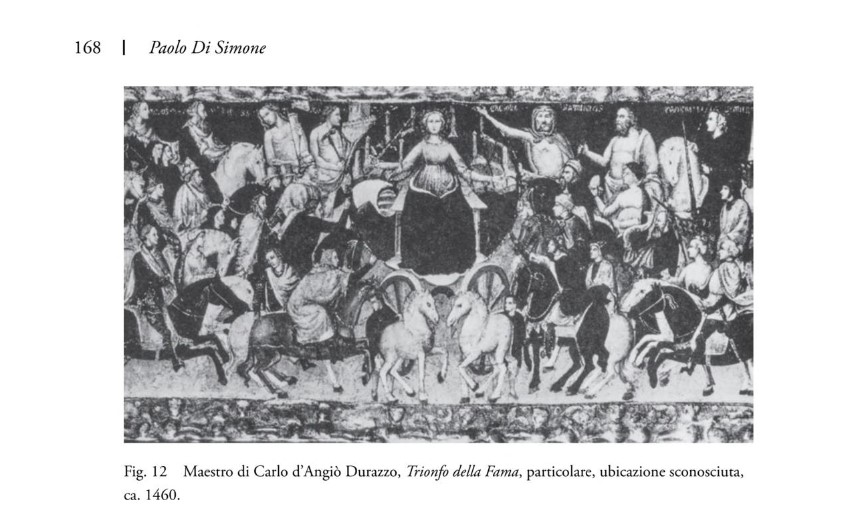
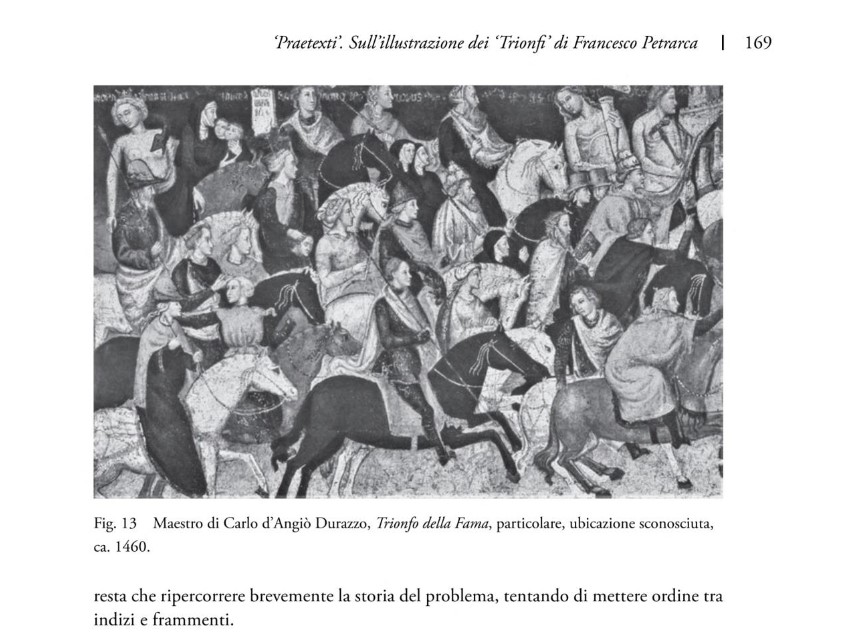
Ad un momento di poco successivo risale la raffigurazione con il Trionfo della Gloria, dipinta sulla tavola frontale di un cassone fiorentino (un tempo a Monaco in collezione Mog). La tavola è stata attribuita ad un pittore ancora anonimo, il Maestro di Carlo III di Durazzo, la cui bottega a Firenze detenne un vero e proprio monopolio nella produzione di pannelli dipinti per cassoni (o forzieri, così come vennero chiamati nei documenti dell’epoca), tra gli ultimi decenni del Trecento e i primi vent’anni del Quattrocento. (10)

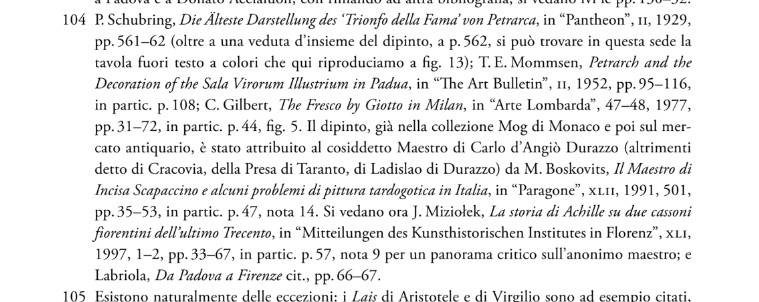
(10) Il pannello con il Trionfo della Gloria è stato attribuito al Maestro di Carlo III di Durazzo da Miklós Boskovits. Cfr. Boskovits 1991, p. 47 nota 14. Per l’attività dell’anonimo artista, si veda Sbaraglio 2010, pp. 107-109.

To a slightly later time [than turn of 14th century] dates the depiction of the Triumph of Glory, painted on the front panel of a Florentine cassone (once in Munich in the Mog collection). The panel has been attributed to a yet anonymous painter, the Master of Charles III of Durazzo, whose workshop in Florence held a veritable monopoly in the production of painted panels for cassoni (or coffers, as they were called in documents of the time), between the last decades of the 14th century and the first two decades of the 15th century. (10)

The panel with the Triumph of Glory was attributed to the Master of Charles III of Durazzo by Miklós Boskovits. See Boskovits 1991, p. 47 note 14. For the activity of the anonymous artist, cf. see Sbaraglio 2010, pp. 107-109.
https://www.academia.edu/36171892/Da_Pa ... _pp_59_115

The Boskovits 1991 reference is to the general bibliography at the end of the book, so I'm not sure what it is.

UPDATE:

Okay, it's the same cassone painting, definitely attributed to the Master of Charles III Durazzo, but now dated 1460! (is that a typo done twice?). Found it all, including the Boskovits reference, in a footnote to Paolo di Simone's essay "'Praetexti'. Sull'illustrazione dei 'Trionfi' di Francesco Petrarca," in Maria Antonietta Terzoli, Sebastian Schütze, eds., Petrarca und die bildenden Künste: Dialoge, Spiegelungen, Transformationen, Walter de Gruyter, 2021, pp. 167-169
Image
Image
Image
https://books.google.fr/books?id=G5Y9EA ... 22&f=false

Re: Casa del Petrarca

92
.... still in work

Mont Vetoux
https://www.google.com/maps/@44.1739221 ... 608!8i2304

Here is a useful timeline by petersadlon ... petrarch.petersadlon.com is generally of interest.
https://petrarch.petersadlon.com/timeline.html

I found a German article about Petrarca out of a sort of private wikipedia, I guess. I don't know, if all the details are correct .... ?
https://wiki.edu.vn/wiki16/2021/01/04/p ... wikipedia/
automatic translation
https://wiki-edu-vn.translate.goog/wiki ... r_pto=wapp
Petrarch was born on July 20, 1304 in the Tuscan city of Arezzo. He was the son of Ser Petracco and his wife Eletta Canigiani. His first name was Francesco Petracco, which was Latinized to Petrarch. Petrarch's younger brother [Gherardo, death year is unknown] was born in Incisa in the Val d'Arno in 1307. Dante Alighieri was a friend of his father.
Eletta Canigiani (c1280-1318)
https://www.tandfonline.com/doi/abs/10. ... 0000000021
Stemma Canigiani
https://it.wikipedia.org/wiki/Canigiani ... iani_2.jpg

Ser Petracco (1267—1326)
https://en.wikipedia.org/wiki/Ser_Petracco

Gherardo Petrarca (brother, 1307 - mentioned in Petrarca's will 1370, then still living)
https://www.internetculturale.it/direct ... /25-a.html
automatic translation ... https://www-internetculturale-it.transl ... r_pto=wapp

Petersadlon ...
1311: Family goes to Pisa to meet the new Emperor Henry VII.
1312 : Family moves to Avignon. But because it is now the home of the Pope there is no housing and the family lives in Carentras, a small town just outside the city.
https://www.internetculturale.it/direct ... /25-a.html
Petrarch spent his early childhood in the village of Incisa, near Florence. He spent much of his early life in Avignon and near Carpentras, where his family followed Pope Clement V, who moved there in 1309 to begin the Avignon Papacy. Petrarch studied law at the universities of Montpellier (1316–20) and Bologna (1320–23) with a lifelong friend and schoolmate named Guido Sette. Since his father worked as a lawyer (notary), he insisted that Petrarch and his brother also study law. However, Petrarch was mainly interested in writing and Latin literature and considered these seven years wasted
Guido Sette, a friend, (1304 -1367/68), archbishop of Genoa from 1358 until his death
https://en.wikipedia.org/wiki/Guido_Sette
Lodewijk Heyligen, another friend, nickname "Socrates" (1304 - 1361), master of music from Belgium
https://en.wikipedia.org/wiki/Lodewijk_Heyligen
Angelo Tosetti, another friend, "Lelio", "Stefano Romano" (?), (1300/10 - 1360/63)
https://www.treccani.it/enciclopedia/an ... rafico%29/
automatic translation ... https://www-treccani-it.translate.goog/ ... 0Angelo%20(Lello%2C%20Lelio,molto%2C%20del%201304%3B%20cfr.

Petrarca Museum in Fontaine-de-Vaucluse
https://www.google.com/maps/@43.9220631 ... 080!8i3040
Image


Avignon - Mont Ventoux - Carpentras - Fontaine-de-Vaucluse
https://www.google.com/maps/dir/Mont+Ve ... 922443!3e2

******************
Added:
Important list for a biography of Petrarca
https://d-nb.info/361282532/04
Last edited by Huck on 17 Nov 2022, 13:09, edited 1 time in total.

Re: Casa del Petrarca

93
Ross wrote,
In the "Prefazione" on page 9, Cecile Hollberg says that the catalogue is "complete" -
Il catalogo della mostra offre, tra l'altro, un repertorio completo dei dipinti oggi riferibili al pittore e un regesto di tutti i documenti sin qui noti che lo riguardano, inoltre la presenza di alcune opere di attribuzione non unanimente condivisa, vuole accrescere gli spunti e le riflessioni critiche.

The exhibition catalog offers, among other things, a complete repertory of paintings attributed to the painter today, and a register of all documents hitherto known concerning him. Additionally, the presence of some works of not unanimously shared attribution is intended to increase critical insights and reflections.
Thanks for including the second sentence. It seems to me that Hollberg is only claiming completeness for the works definitely attributable to Dal Ponte. Having done so, she goes on to say that the catalog also includes "some works" for which attribution is not unanimous: "some" is different from "all". She is not claiming that the catalog includes all the works for which attribution is not unanimous. In any case, she is the director of the Accademia, not one of the Dal Ponte experts that curated the exhibition and wrote the rest of the catalog (Sbaraglio and Tartuferie). If you find anything in the curators' part excluding the Triumph of Fame cassone, let us know.

Ross cites Labriola that the work was done by the Master of Charles III: she says "The panel has been attributed to a yet anonymous painter, the Master of Charles III of Durazzo." She in turn cites Boskovitz, 1991. On Boskovitz, in my previous post I linked to an old post by me quoting one historian's summary dismissal of Boskovitz, at least regarding the artist. I reproduce it below, with the relevant passage highlighted in bold, from Jerzy Miziolek, n. 89 of "Cassoni istoriati with 'Torello and Saladin': Observations on the Origins of a New Genre of Trecento Art in Florence", Studies in the History of Art, Vol. 61, Symposium Papers XXXVIII: Italian Panel Painting of the Duecento and Trecento (2002), pp. 442-469:
Among the earliest cassoni istoriati are two almost identical representations of The Triumph of Fame (the whereabouts of both are unknown). One of them is reproduced in Mina Gregori, "Biennale Internazionale dell'Antiquariato, Firenze: Dipinti e sculture," Arte illustrata 2 (1969), 110, the other in Dorothy C. Shorr, "Some Notes on the Iconography of Petrarch's Triumph of Fame," Art Bulletin 20 (1938), 100-107. See also Rosa Prieto Gilday, "Politics as Usual. Depictions of Petrarch's Triumph of Fame in Early Renaissance Florence" (Ph.D. dissertation, University of Pittsburgh, 1996), cat. 6, fig. 4, with wrong dating. There is an early chest (c. 1390), presently housed in the Bargello, depicting The Expedition of the Argonauts, reproduced in Schiaparelli 1983, 2:pl. 156a. All three are ascribed by Boskovits and Fahy to the Master of Charles III (or Ladislas) Durazzo. It appears that none of them is by him but rather by another Florentine anonymous painter active at the turn of the fourteenth century; see Jerzy Miziolek, "The Origins of Cassone Painting in Florence," in Center 19. Record of Activities and Research Reports, June 1998-May 1999, National Gallery of Art, Center for Advanced Study in the Visual Arts (Washington, 1999), 100-104.
In this case, Boskovits and Fahy, and the others he cites (except the poor Ph.D. student), at least got the time period right. As for Callman and Schubring, who had a different opinion, they are ignored.

The other work you cited later, and gave a screen-shot of, cites more works, but fails to note that some of them made different attributions, e.g., Schubring and I assume Miziolek.

What I would like to see from the art historians, when there is some disagreement among published authorities (regardless of when they wrote) is a little more modesty, as well as a few actual arguments that acknowledge the breadth of divergent views. If there is more information now not available then, they need to say what it is. Otherwise, question marks after attributions are permitted. Truth is not necessarily with the historian of the latest publication date, the most biased bibliography, or the strongest degree of self-certainty.

Re: Casa del Petrarca

94
Written at 1 Feb 2013 ....
Ross G. R. Caldwell wrote: 01 Feb 2013, 10:24 Thanks for taking the time to extract those references, Mike. This is very good - now we're getting somewhere.

In addition to noting Florence and Venice as copying centers of the text, there seems to be an increase in the number beginning in the 1420s. These seven are probably too few to be used to draw firm chronological conclusions, but we could test this tendency when we get other such lists -

Late 14th
1400
1424
1426
1427
1431
1431


It definitely "takes off" in the mid-1420s. When you say these are "not nearly in the quantity we see after 1440", can you give a rough estimate for those after that date found in Webb?
This became in the development a sort of basic line, based on the studies of Webb by Mike ....
However .... before this we had collected a few things, which I had summarized with ...
Michael, do you know of other Trionfi editions "before 1441" beside those, which we have already mentioned (fragments in 1439, 1414 and one "first quarter in 15th century", possibly the not confirmed version in 1418 in Medici hands)?
Perhaps we should save these notes in a thread of its own ... "Trionfi editions before 1440". So, that one finds it , when new things appear. The popularity of the Trionfi poem is an important factor.
Recently I became aware, that Leonardi But if it is true, than it tells, that the Trionfi weren't very popular. Bruni didn't note the "Trionfi" in his Dante-Petrarca-biography of 1434 or 1436. I'm not sure, if this is correct. I need to check it with more patience.

Vita Dante and Petrarca ... the search engine don't recognize trionfi or triumphi or similar. But the text is difficult to read, so the search engine might err.
https://archive.org/details/LeViteDiDan ... 7/mode/2up

**************************
Michael, do you know of other Trionfi editions "before 1441" beside those, which we have already mentioned (fragments in 1439, 1414 and one "first quarter in 15th century", possibly the not confirmed version in 1418 in Medici hands)?

1439 was Barzissa in Milan ...
Ross in 2009: viewtopic.php?p=4834#p4834
in further discussions ...
search.php?st=0&sk=t&sd=d&sr=posts&keyw ... 9&start=10

******************

1414 started here ...
Mike in 1412: viewtopic.php?p=12920#p12920
did find two writers commenting on it as a source of illuminations pre-1440. J. B. Trapp, on p. 67 of "Petrarch's Laura: The Portraiture of an Imaginary Beloved" (Journal of the Warburg and Courtauld Institutes, 2001, vol. 64, pp. 55-192) says that the first illuminated manuscript of the Trionfi was in 1414. No source given, no indication of where.
The text is (or was) cod. it. 81, Bayerische Staatsbibliothek. It has 2 pictures ...
Image

Image
https://www.bsb-muenchen.de/sammlungen/ ... up-c3429-3
https://www.bsb-muenchen.de/sammlungen/ ... up-c3429-1

dated to 1414 and to Bologna

*******************

1418 started here, with Lorredan ...
viewtopic.php?p=12862#p12862
.... and came to Ross ...
viewtopic.php?p=12886#p12886
... and in this thread.

********************

"The first quarter of 15th century" is rather irrelevant, as it seems to be a humble 27 line quote from the text to the Trionfo of death.

It was given here ...
viewtopic.php?p=12887#p12887

The Marston MS 99, Italy, s. XV 1/4 is described here ...
https://pre1600ms.beinecke.library.yale ... ars099.htm
... and the note to the Trionfi text is ...
4. f. 134v [L]a nocte che segui l'orribel caso/...Ance che giorno gia uicin
n'agiunga.

Francesco Petrarca, Triumphi, Triumphus mortis II, vv. 1-27; F. Neri,
ed., Rime, Trionfi, e poesie latine (Milan and Naples, 1951) pp. 523-24.
... 27 lines of text ...
Last edited by Huck on 15 Nov 2022, 12:20, edited 9 times in total.

Re: Casa del Petrarca

95
mikeh wrote: 15 Nov 2022, 09:29
Thanks for including the second sentence. It seems to me that Hollberg is only claiming completeness for the works definitely attributable to Dal Ponte. Having done so, she goes on to say that the catalog also includes "some works" for which attribution is not unanimous: "some" is different from "all". She is not claiming that the catalog includes all the works for which attribution is not unanimous. In any case, she is the director of the Accademia, not one of the Dal Ponte experts that curated the exhibition and wrote the rest of the catalog (Sbaraglio and Tartuferie). If you find anything in the curators' part excluding the Triumph of Fame cassone, let us know.
Wow, you've really moved the goalposts here. Since your unspoken demand was for everything ever attributed to Giovanni dal Ponte by anybody, let me ask you for an example of such a catalogue. Can you refer me to a catalogue of ALL the misattributed works of an artist? I'd like to see what you are thinking of.

In this case, Boskovits and Fahy, and the others he cites (except the poor Ph.D. student), at least got the time period right. As for Callman and Schubring, who had a different opinion, they are ignored.

The other work you cited later, and gave a screen-shot of, cites more works, but fails to note that some of them made different attributions, e.g., Schubring and I assume Miziolek.
Miziolek is here -
https://www.nga.gov/content/dam/ngaweb/ ... ter-19.pdf

He is not dismissive of Boskovits, he merely posits that it's an unknown cassone painter (page 104):
There appears to be a missing person in this story, a cassone maker living at the end of the fourteenth century whom Donatello might have assisted. This unknown artist ran a workshop in which numerous chests were produced.
This is also Labriola's opinion.

In any case, Miziolek is not keeping the door open for Giovanni dal Ponte here, since he was born in 1385. It might be that the dating "1420" for the Trionfo della Gloria was made precisely to allow Giovanni to have painted it. But the current consensus, including Labriola and Miziolek, is that it is much earlier, around 1400.

Giovanni's earliest works in the catalogue are three Madonna with Child panel paintings (numbers 29, 32, 93; see the analytical list at the end of this post - viewtopic.php?p=24699#p24699), after 1405. Boskovits himself is the source of one of the attributions. Another is "doubtful."

Personally, I don't see anything in the Gloria that screams "Giovanni dal Ponte!" If not the Master of Charles III Durazzo, then I'm content with an anonymous artist who was NOT Giovanni dal Ponte.

Re: Casa del Petrarca

96
Ross: So "current consensus" includes 1999 and 2012 but not 1998 (Ortner)? And Dal Ponte is competent to paint a cassone in 1420, when he is 35 years old, but not earlier, when, for example, he is 25, in 1410, or 20, in 1405? And the experts of 1999-2010 (as opposed to 1999) can date a cassone, not assuming a particular artist in advance, to "ca. 1400" as opposed to "ca. 1405," "ca. 1410," or even "ca. 1420", given that particular styles can persist for decades? I do not think that art history is that exact a science, even today, especially when all it has is old black and white photographs to work from.

I do not say that those who date the cassone to 1400 as opposed to 1420 are wrong, but I think arguments are needed, beyond asserting that it is similar to other works whose provenance is also unknown. What are the similarities that uniquely associate them (I mean, that are not in common with other works not so identified), and how do we know when they were made? They may have done so, but without seeing the arguments I can't say if they overcome my skepticism.

Re: Casa del Petrarca

97
Ross G. R. Caldwell wrote: 15 Oct 2012, 15:28 So now we have other names associated with the early transmission of the Trionfi -

Francescuolo da Brossano
Lombardo della Seta
Giovanni Boccaccio
Giovanni Dondi
Ross added then also a note of the web (now lost) ...
"The Triumphs were probably undertaken around the mid-thirteenfifties and the writing took a long time: from 1357 to 1374. Nevertheless, they were not written in final draft and they did not circulate, not even partially, during Petrarch's life. Shortly after his death, Giovanni Boccaccio first and Giovanni Dondi later, asked both to Francescuolo da Brossano and Lombardo della Seta for news about the work, as they were in charge of Petrarch's writings and had to take care of its first circulation."
This was in 2012 and in this thread "Casa del Petrarca" ....

------------------
Forum search Lombardo della Seta
search.php?st=0&sk=t&sd=d&sr=posts&keywords=seta

Italian wiki (wiki article not available in other languages)
https://it.wikipedia.org/wiki/Lombardo_della_Seta
Italian wiki translation
https://it-m-wikipedia-org.translate.go ... r_pto=wapp

treccani.it Lombardo della Seta
https://www.treccani.it/enciclopedia/lo ... rafico%29/
Treccani.it translation
https://www-treccani-it.translate.goog/ ... r_pto=wapp
-------------------
Forum search Francescuolo da Brossano, son-in-law, husband of Petrarca's daughter
search.php?keywords=brossano

English wiki
https://en.wikipedia.org/wiki/Francescuolo_da_Brossano

treccani.it Francescuolo da Brossano
https://www.treccani.it/enciclopedia/fr ... rafico%29/
treccani translation
https://www-treccani-it.translate.goog/ ... r_pto=wapp
-------------------
Forum search Giovanni Dondi
search.php?keywords=dondi&t=868&sf=msgonly

English wiki
https://en.wikipedia.org/wiki/Giovanni_ ... 27Orologio
this and also other language wikis contain not much about his relation to Petrarca

treccani.it Giovanni Dondi
https://www.treccani.it/enciclopedia/gi ... ografico)/
treccani translation
https://www-treccani-it.translate.goog/ ... r_pto=wapp
Petrarca is noted 37 times in this text
---------------------

Boccaccio died (16 June 1313 – 21 December 1375) relative soon after Petrarca (20 July 1304 – 18/19 July 1374).
Boccaccio is said to have asked for the Trionfi manuscript after the death of Petrarca. Is there any information about this ? Or about a letter between Petrarca and Boccaccio, in which the Trionfi manuscript is mentioned?

Re: Bartolomeo Fonzio

98
mikeh wrote: 02 Feb 2013, 05:14 228. ca. 1470-80. Script attributed to Bartolomeo Fonzio. illum. Florentine, written for Francesco Sassetti of Florence (d. 1491).
In the complete works of Mattio Boiardo

"IX. Pastorale • Carte de’ Trionphi” (edited by Cristina Montagnani and Antonia Tissoni Benvenuti) the authors refer to 'capitoli' dedicated to Ercole d'Este by Bartolomeo Fonzio in which the mythological origins of a game of cards is given, in which the traditional suits are placed under the tutelage of certain gods. Hercules presides over the suit of Batons, Mars over Swords, Mercury over Coins, and Bacchus over Cups.

The reference is :
Laura Leonardi, Il codice Campori 187, in «La Bibliofilia», lxxxV (1983), pp. 3-25.

Are there any more details on this? Does Leonardi give any more details, folio numbers? codice Campori 187 is online at the Estense Digital Library here:

https://edl.cultura.gov.it/media/ricerc ... oli&page=1

Re: Casa del Petrarca

99
How interesting.

Here is Laura Leonardi's article. She has transcribed the poem on pages 19-25. https://www.jstor.org/stable/26207371

APPENDICE
41. Hercole di Bartolomeo Fontio allo excellentissimo Herc. Duca di Ferrara

Giove principio dell'antiquo ludo
fu delle carti: Tu del mio lavoro
Hercol victorioso in togha et scudo.

Quale imperio è maggior di forze et d'oro
si dubitò gran tempo in celo e'n terra:
Mercurio et Bacco volsono el tesoro,

le forze Hercole et Marte e ciascuno erra:
Mercurio e richi seguon et Marte e feri,
onde ne nacque alfin contesa et guerra.

Ciascun di lor victoria par che speri,
tanta furia accendeva i cori adversi
per le richeze et per le forze alteri.

Non potre' ma' ritrarne in prosa o 'n versi
gli habiti e facti e modi di ciaschuno
dal'extremo occidente agl'Indi a' Persi;

pur nominar mi si conviene alchuno
de' sommi imperadori accesi in vista,
per non parere o invido o digiuno.

Marte, perché l'imperio non s'aquista
sanza armi, tutto armato havea in mano
l'ornata spada, et drieto ad una lista

seguiva el forte greco e'1 fier troiano
et Alexandre, e'1 fondator di Troia
col nipote victor del gran romano.

Col fiero tergo et con l'inculta chioma
colle saette e la pesante clava,
che con un frusto '1 mondo non si doma,

Hercole invicto imperioso andava
inanzi agli altri nella prima schiera
che le spade e 'bastón per segno dava.

Nella seconda sua leggiadra altera
danar Mercurio et Bacco coppe invergha;
Mercurio alato i piedi et gli omeri era,

in man portava la dorata verga
colla qual, quando vuol quiete et posa
ne' corpi stanchi de' mortai asperga.

Era l'ardita più che valorosa
schiera d'oro et d'argento et geme armata;
e '1 tener Bacco sopra tigri posa,

di pampini la fronte incoronata
le corne d'oro et drieto venie solo
quel che la patria di Giunone odiata

vide da Hercole arsa et poi el figliuolo,
che quando l'ebbe assai più bella exstructa,
la vide incender del nimico stuolo;

et quel che tardi s'affatica et lucta
contro al suocero suo, ma nulla valse
onde fu Roma in servitù condocta;

et chi fece el gran ponte all'onde salse
contr'a Greci et fuggissi in picciol legno:
o speranze degli uomin vane et false!

Et quel che ebbe di Lidia el richo regno
e M(arco) Crasso, che da' Parti morto,
vide di sua cupidità il fin degno

nell'oro, ove credè trovar conforto,
vaghi piacer, diletti, posa et gioia,
amarissimo assentio gli fu porto.

Pochi armati menomo e Greci a Troia,
in Grecia Serse et in Italia il (pr)egno
d'odio Hanibal, che a' Roman dié gran noia,

rispecto a quanti pien d'ira et di sdegno
a difender suo parti erano accolti
insieme di lontan paese et regno,

onde se non che i santi ochi ebbe volti
il Sommo Padre a rimirar la terra
sempre carca d'errori obscuri et folti,

seguiva el dì più lamentabil guerra
che quando uccise Tamir Ciro in Scitie
o che'l superbo Ilion cadde in terra.

Giove veduto degli dei l'inscitie
et degl'huomin, con suo' fulguri ardenti
tonando sparse l'horribil militie.

Nessun vi fu che a l'horror non paventi,
sentendo Eoi ferin le terre et l'aque,
irato e '1 cel cogli arabiati venti.

Al sommo imperador non poco spiaque
delli dei et degli huomini el furore
che mai si spense et sempre in terra giaque;

combattea seco con giustitia amore
se perdonava o se puniva el giorno
tanto commesso temerario errore.

Era di sol vestito e stelle addorno,
lo scietro eburno al sinistro tenea,
le veloci saette al dextro corno;

Giunon gelosa a'ilato li sedea,
degli eroi, degli huomini et de' divi
innumerabil torma intorno havea;

tra gli altri excellentissimi erano ivi
Neptunno e Dite con '1 bifronte Iano
et la casta inventrice de l'ulivi,

Diana, Appollo, Cerere et Vulcano,
Cybele, Isyde, Vener bella e'1 figlio,
Vesta, Satiri, Nyphe, Muse et Pano.

Sedeva Jove col turbato ciglio
in modo tal chi nel pensar paventa
nonché chi era presso al gran periglio:

pauroso ciascun, tacito e 'ntento
come chi di futuro male el fine
misero aspecte, anzi il tormento,

stava 'spectar colle ginochie inchine.

Cap. II

Turbato insieme et serenato il mondo
Giove con viste gravemente altere,
rimirato ciaschuno a'ttondo a'ttondo,

incominciò: — Qual furiai megere
delle divine leggi usciano fore,
come vo' gente barberesche et fere!

Fie 'ncatenato el vostro empio furore,
miseri, stolti, insuperbiti, ingrati:
conveniente pene segue errore.

Ad che tanti lontan paesi armati
havete, donde il sol si leve et absconde,
non ben contenti di secondi stati?

A chi pari'io? Nessun di voi risponde!
che aspect'io da costor, che con suo risse
hanno turbato il cel, le terre et l'onde! -

Tremavan colle luce in terre fisse
colle ginochie e colle mente quivi;
ma' simil cose più si lesse o scrisse.

Quatro superbi et gloriosi divi,
tanti duci, regnanti, imperadori,
in un momento d'ogni sperar privi.

O ceco mondo, pien d'inganni, errori,
di varie opinion, d'imagin false
ad che tante richeze et forze onori?

Ad che va' tu solchando l'onde salse
per aquistar potentie, oro e terreno
s'a'ccolor poco, anzi niente valse?

Qual sì grande è che non venisse meno?
Non ch'io, che tener novamente vegno
cantar materia di cothurni a pieno!

O Polymnia, ora inalza '1 basso ingegno,
et guidami a buon porto, troppo ardito
a solchar sì gran mare in picciol legno.

né innanzi alle cataste horribil volto
Creso né Cyro, quando al suo fin reo
sangue setendo, beve sangue molto;

Fuggendo ancor non ben dal sonno excito,
in un momento di chathene avolto,
Syphace re non restò sì smarrito;

né al duro saxo del propheta hebreo,
il gran gigante nelle valle obscure,
come ciaschun davanti al sommo Ideo.

Mercurio al fin deposto la paura
humilemente lagrimoso et mesto,
come che desperato s'assicura:

- Quanto il commesso error ci sia molesto -
dixe - non è che ad te, però ancora è stato
a l'universo chiaro et manifesto.

No' non neghiam di non havere errato,
ma il fallir nostro che ci duole et pente,
per dmprudentia fu, non per peccato.

Non ira o sdegno cecato ha la mente,
non furia, ma desio d'esser maggiore
che gli altri mosse a noi similemente.

Se Hercole et Marte volsono el valore
superare le richeze, è ben ragione
mantener quelle di ch'i' son datore:

quinci el principio del futuro agone
perché era necessario ad ogni parte
difender la sua ferma opinione:

ad Hercole le corporee forze et Marte,
a Bacho et me l'argento e '1 nobil ostro,
né per questo tuo legge son sparte.

Et se pur son, non sendo el fallir nostro,
misericordie c'ognun brama et chiede
da te, infinite non aresti mostro.

Chi glorioso in alte cime siede,
magior laude è mostrar quanto far puote,
chi dannar chi si pente et si ravede:

et le menti diventon più divote
de' riceventi gratie et per pietate
si rendono alfin d'insanie vote.

Tu quanto maggior è tua potestate,
tanto più lascie memorando accepto
di perdonar l'altrui fragilitate.

Per te luce el sol nostro et per te (è) spento:
o padre, non obliar l'amor paterno!
miserere del nostro amar tormento! -

Il gran Pluton di Tartaro et d'Averno
poco placò di Calliope el figlio,
rispecto a quel di Maia il padre eterno.

Col parlar dolce, asserenato il ciglio
lucido più che orientale stelle
non come innanzi di color vermiglio,

dolce-mente rispose: - Vostre belle
intentione e'1 dir soave et pio
dall'ardente iustitie mi divele,

ma perché '1 vostro bene amo et desio,
seguitando el pechato pene eterne
nessun più preterischa el voler mio.

Come le forze o l'or non si discerne,
l'un l'altro vincha nell'uman contese:
giuoco dipinto lascierò in quaderne. -

Così disse et in man le carte prese
da l'un de' lati solamente impresse,
sì che quel dentro di fuor non s'intese.

Ne' bastoni Hercol, Marte in spade messe
Bacho in coppe, in danar di Maia il seme,
poi el giuoco a tutti delle carte expresse,

qual, Hercol, tacerò; non ch'ai dir teme,
ma il cantar cose aperte in ciascun loco,
noie chi dice et chi l'ascolte insieme:

vince chi vuol fortuna et caso, il giuoco.

Re: Casa del Petrarca

100
Thank you Ross, I spent quite a while trying to track this down online - my search skills failed me this time!

A summary of the poem:

Fontio stages a full blown cosmic dispute among the gods: what truly rules the world, strength or wealth?

Hercules and Mars represent force and arms. Mercury and Bacchus stand for money and pleasure. The conflict escalates toward war until Jupiter intervenes.

But instead of deciding the issue, he does something unexpected.

He invents a game of cards.

Each suit is assigned to a god:

batons to Hercules
swords to Mars
coins to Mercury
cups to Bacchus

And then comes the punchline. Not strength. Not wealth.

“The game is won by fortune and by chance.”

That is the resolution.

This is not a moral condemnation like the Steele Sermon, where cards and dice are inventions of the devil and the trumps form a ladder to hell. It is the exact opposite. Fontio dignifies card play, embedding it in a classical myth of competing powers held in balance by Fortuna.

Curious to hear if anyone here has worked on Fontio, or sees connections (or tensions) with other early interpretations of cards.

Of Fonzio Leonardi wrote: "Regarding the chapters on Hercules by Fonzio, I have not been able to find other references to the work, but it could be part of the humanist's poetic experimentation during his youthful years spent at the court of Ferrara."

Fonzio was born and mainly resided in Florence, but resided in Ferrara from 1469 to 1471, returning to Florence after the death of Duke Borso. The heading "allo excellentissimo Herc. Duca di Ferrara" confirms the date is 1471 or later, as Ercole assumed the title of Duke that year.

Fonzio was a Latinist, these verses are in Italian (Terza Rima). This choice honors the "Borsian" tradition of vernacular courtly literature while satisfying Ercole’s appetite for Herculean iconography. It suggests that even under the more educated Ercole, the social context of playing cards required the accessible Italian language rather than scholarly Latin.

Fonzio describes Hercules as "invicto imperioso," leading the first rank of gods. By identifying the Baton suit specifically with Hercules, by such Herculean flattery Fonzio turned every card game at the palace into a subtle tribute to Ercole d'Este’s power. Fonzio wasn't just describing existing cards, but "re-branding" them to give them a pedigree worthy of the Duke of Ferrara.

For biography see:
https://www.treccani.it/enciclopedia/ba ... rafico%29/