Page 5 of 6

Re: Collection Fournier

Posted: 16 Aug 2010, 09:43
by mmfilesi
Sound of Silence

In 1465, Acanio, Francesco's son, was appointed "Commendatore" (who receives the money) of Chiaravalle. Perhaps this explains the silence of Corio :-$ .

Commendatore: http://it.wikipedia.org/wiki/Abate_commendatario

++++
ascanio.gif ascanio.gif Viewed 831 times 55.12 KiB
Michele Caffi. Dell' abbazia di Chiaravalle in Lombardia.

Re: Collection Fournier

Posted: 16 Aug 2010, 11:11
by mmfilesi
ANTOTHER POSIBILITY:

Bembo or Bianca are inspired in the Clares (as Kaplan said in vol. II)


Santa Chiara d'Assisi
chiara_1.jpg chiara_1.jpg Viewed 826 times 333.33 KiB
Piero della Francesca. 1460-1470

http://it.wikipedia.org/wiki/File:Piero ... assisi.jpg

+++
chiara_2.JPG chiara_2.JPG Viewed 10965 times 34.36 KiB
Simone Martini, (Siena, 1284 – Avignone, 1344)
http://it.wikipedia.org/wiki/Simone_Martini

+++
st_clare.jpg st_clare.jpg Viewed 807 times 88.62 KiB
Giotto. Saint Clare (detail)
1325
Fresco, 230 x 70 cm (whole fresco)
Bardi Chapel, Santa Croce, Florence

http://www.wga.hu/frames-e.html?/html/g ... index.html

+++

Material about St. Chiara.

http://www.franciscan-archive.org/matriarcha/index.html

Re: Collection Fournier

Posted: 16 Aug 2010, 16:09
by mmfilesi
At least exist one convent of Clares in Cremona, the city where lived Bembo. Bianca's favorite city.
clarisas_encremona.jpg clarisas_encremona.jpg Viewed 817 times 45.21 KiB
(I only can read this).

*

Two clarisse interesting:

Catherine of Bologna (Catarina Vigri)


1413-1463
Poor Clare from Bologna. Daughter of Giovanni Vigri of Ferrara and Benvenuta Mammolini from Bologna. She received a courtly education at the court of the princes of Este in Ferrara (letter (both vernacular and Latin, probably through a tutor of aristocratic children at court) music, and painting), where her father was employed, and where Catarina served as personal servant of Niccolò d’Este’s daughter Margarita. Around 1427/28, she came under the spiritual influence of a religious women called Lucia Mascheroni, who lead a community of young women in Ferrara that was in the process of changing from a community under Augustinian rule towards a community of Observant Poor Clares. During this period, Catarina experienced a religious crisis, and seems to have suffered ‘diabolical’ illusions. In the early 1430s, Catarina became responsible for the training of novices in the now reformed Poor Clare convent. In 1456, she established a new convent of Poor Clares in Bologna (Corpus Domini convent), which also followed the Regula Prima of Clare, and remained there as Abbess until her death on 9 March 1463. During her adult life, Catarina received many visions and revelations, and became renowned for her sanctity, her art works (such as her paintings and the breviary produced and illustrated by her own hand) and her spiritual writings. Her most important work seems Le armi necessarie alla battaglia spirituale (1483), composed for female novices. Yet Catarina also composed a number of sermons (held before the nuns under her care, which for a long time did not receive any attention. Catarina was canonised in 1712 by pope Clement XI. Under her leadership, and through her own work as author, book illuminator and religious painter, the Bologna Poor Clares reached high levels of culture (see the works of Martinelli Spanò , Gabriella Zarri et. al.). This shows in the literary production of her fellow sisters and is also visible in the late medieval library holdings of the monastery, as revealed in studies by Serena Spanò Martinelli and others.
http://franwomen.sbu.edu/franwomen/woma ... D=3&Sort=C

see too:

http://it.wikipedia.org/wiki/Caterina_da_Bologna

---

ILUMINATA BEMBO (+1496) - 18 DE MAIO
Filha do Senador de Veneza, Lourenço Bembo. Recebeu uma ampla cultura humanística, era de inteligência vivaz e vontade férrea. Deixou o luxo e as atrações da corte para abraçar a vida religiosa em 1430, no Mosteiro de Agostinianas Corpus Christi de Ferrara. Cooperou com Santa Catarina Vigri de Bolonha na passagem para a Regra de Santa Clara. Escreveu a biografia de Catarina com o título “Espelho de Iluminação”, obra que revela sua grande cultura e educação. Fez parte do grupo de fundadoras de Bolonha em 1456. Foi eleita Abadessa três vezes a partir de 1463. Morreu em 1493.
http://bemaventuradasclarissas.blogspot.com/

*

An interesting article about the clares and art:

http://www.thefreelibrary.com/Breaking+ ... a017097853

Re: Collection Fournier

Posted: 16 Aug 2010, 17:01
by mmfilesi
:)

Sta. Caterina:
Santa Caterina de Vigri.jpg Santa Caterina de Vigri.jpg Viewed 10954 times 33.95 KiB
http://shambala25.wordpress.com/2010/07 ... a-bologna/

Re: Collection Fournier

Posted: 17 Aug 2010, 16:21
by Ross G. R. Caldwell
Hi Marcos,
mmfilesi wrote::)

Sta. Caterina:
Santa Caterina de Vigri.jpg
http://shambala25.wordpress.com/2010/07 ... a-bologna/
That is Catherine of Bologna (1413-1463), not the same St. Catherine as the Guglielmites painted.

Re: Collection Fournier

Posted: 17 Aug 2010, 16:46
by mmfilesi
Yes, friend. I know, thanks. Sorry, maybe I made a confusion. Now I explorer another posibility (Kaplan II, pag. 162). Bembo (or Bianca) is inspired in Clares (without Maifredas or Giovannas). [ONLY for the iconography. The concept would be the Church].

Now I need:

1 - Compare the dress of the popes PMB with the clares < Done, OK result.
2 - Check if there were convents of Clares in Cremona < Done, OK result.
3 - Check if women or convent clare are famous about 1450 < Done, OK result.
4 - Learn Bianca's relationship with Clare. I'm working on this.

Re: Collection Fournier

Posted: 17 Aug 2010, 16:51
by mmfilesi
Now I see ... I changed my argument without explaining that argument was shifting. I feel the confusion.

Now I edit the post Yesterday, 10:11

Re: Collection Fournier

Posted: 18 Aug 2010, 10:23
by Ross G. R. Caldwell
mmfilesi wrote:The document original of Puricelli we need find:
det_man.gif
http://books.google.es/books?id=qFcvAAA ... li&f=false
It was first published in its entirety by Felice Tocco, "Il processo dei guglielmiti", Rendiconti della R. Accademia dei Lincei. Atti della classe di scienze morali Series 5, vol. VIII (Rome, 1899), pp. 309-342, 351-384, 407-432, 437-469.

Fortunately this volume has been scanned, accessible at Internet Archive and via Google Books -
http://www.archive.org/details/rendicon ... 11filogoog

However, Tocco did not translate it.

The new edition of reference is Marina Benedetti, ed., Milano 1300: I processi inquisitoriali contro le devote e i devoti di santa Guglielma (Milano, Libri Scheiwiller, 1999). This is accompanied by an Italian translation.

Benedetti is the text I quoted in this thread -
viewtopic.php?f=14&t=581&start=10#p8395

Giovanni Puricelli never published the manuscript. He left a manuscript summary of it, with his own observations, to the Ambrosiana in 1676. This summary was itself summarized by Ludovico Muratori in his Antiquitates italicae medii aevii (6 vols., 1738-1742). A 1778 edition of this is available here -
http://www.archive.org/details/antiquitatesital12mura
- columns 451-455.

Re: Collection Fournier

Posted: 18 Aug 2010, 11:21
by mmfilesi
Thanks friend.

+++
Giovanni Puricelli never published the manuscript. He left a manuscript summary of it, with his own observations, to the Ambrosiana in 1676. This summary was itself summarized by Ludovico Muratori in his Antiquitates italicae medii aevii (6 vols., 1738-1742). A 1778 edition of this is available here -
We can read it too in italian in:

http://www.classicitaliani.it/muratori/dissert60.htm

But Muratori dont explain where Puricelli found the manuscript.
Truovasi descritta questa sporchissima setta da varj antichi scrittori ed ultimamente dal Bernini nel tomo III della Storia delle Eresie. La maggior parte degli Autori Milanesi riferiscono a questa setta i delirj della Guglielmina, la quale circa i medesimi tempi, dopo avere infettati non pochi di quel popolo, si guadagnò fama di santità presso la stolta plebe, talmente che dopo morte tenuta fu per Santa, e da’ suoi seguaci empiamente era onorata per tale. Ma non s’ha a confondere la setta fantastica di Guglielmina coi Fraticelli. E perciocché poca conoscenza di questa famosa femmina hanno avuto gli scrittori della Storia, ed io ho potuto leggere nella celebre Biblioteca Ambrosiana il processo autentico d’essa, formato l’anno 1300, e la storia de’ suoi errori, compilata dal Puricelli e scritta a penna; non rincrescerà ai Lettori di riceverne da me una breve contezza, meritando ben essa di passare ai posteri, acciocché niuno si lasci giuntare dai sogni ed inganni delle donnicciuole in avvenire.

Re: Collection Fournier

Posted: 18 Aug 2010, 11:55
by Ross G. R. Caldwell
mmfilesi wrote: But Muratori dont explain where Puricelli found the manuscript.
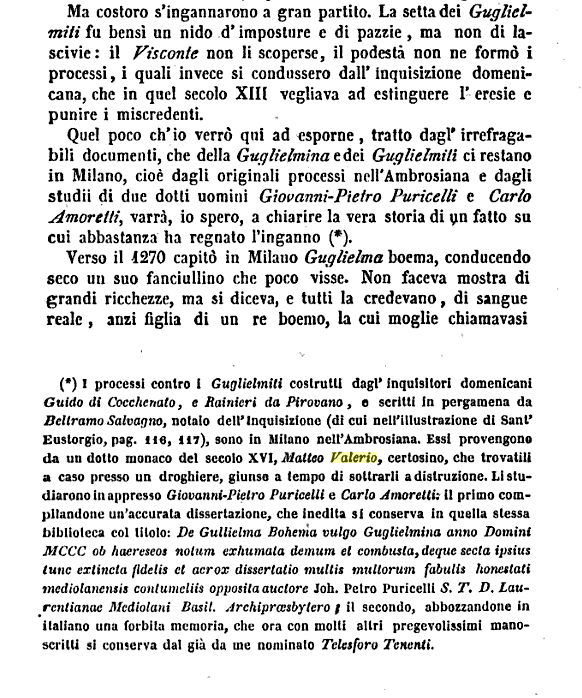
The only knowledge we have of it is in the account of Michele Caffi, Dell'Abbazia di Chiaravalle, p. 91 and note.

He says that the Carthusian prior Matteo Valerio found it in a Pavese droghiere, or grocer's shop. Valerio died (?) in 1645, presumably giving it to Puricelli sometime before that.


This is cited in Benedetti, Newman, etc.

Michele Caffi, Dell'Abbazia di Chiaravalle
http://books.google.com/books?id=CFEOtg ... io&f=false