Phaeded wrote:
Huck,
Of course CY is Milanese (my point was the "Anghiari" deck provides the oldest and thus probable origin - Florence - with Ferrara the number of trumps and Milan the subject: the Virtues). Filippo also loved his "celestial gods" card game - so if you are going to jump from chess to the CY shouldn't you first explain how Filippo's 16 gods/heroes deck wiuth odd bird suits fits your chess theory?
I also get the 16 card suits vs 14 trump subjects disjunction in the CY deck, but I've proposed an explanation for that in regard to the CVI Lovers card in the thread above (3 couples in CVI Love card, which I posit as original to the Anghiari deck, both being Florentine, which is replaced in the CY and PMB by a single couple - was compensated for in the CY deck by 3 "couples" in terms of 3 female royals for 3 male royals in the court cards). Would love to hear your thoughts on that.
Phaeded
The Michelino deck likely took up some influences, things which are similar and clearly belong to an earlier time.
1. The Michelino used the concept of the "12 Olympian gods", which it posits at No. 1-12 or 16-5 in the used hierarchical row of the trumps. Poggio discovered the Manilius text during the council of Constance, which used the 12 Olympian gods for its internal scheme for his astrological concept. The papal delegation around Martin, to which Poggio belonged, visited Milan in 1418. One may assume, that new detections during the council were discussed then. The Manilius concept later took strong influence on the iconography of Palazzo Schifanoia.
The Michelino deck used another composition of the 12 gods as the Manilius, but its detection surely raised the attention of the many astrologers around Filippo. Martiano da Tortona was also called an astrologer
2. Evrart de Conty wrote a very large work "eschecs amoureux" (Chess of lovers) with about 1000 pages, which likely was ready in 1398. In this he presented 32 allegories (mainly taken from the "Roman de la Rose"), from which each was related to a specific chess figure of 32 figures (the "female" chess figures differed from the "male" chess figures). In this context he presents also "16 gods" ... partly other gods as those in the Michelino deck. In later editions of this work the 16 gods found an iconographic representation (usually they used 24 pictures, 16 of them the gods).
The text has 1000 pages written in old French. We didn't found a clear list, which would tell us, which god would present which figure. W hadn't the energy and time to clear the question, if there is some relation indicated "somewhere". Actually it would be logical, that it is "somewhere" indicated.
The text was disputed at the French court of Valentia Visconti (sister of Filippo Maria Visconti) in 1402. It played a part in the writings of Christine de Pizan, who attacked it.
It isn't known to us, if Filippo Maria had such a work, but it seems not likely, that he totally overlooked its existence.
3. Before Michelino left Milan (around 1403), he decorated a genealogy of the Visconti. In this genealogy concept Jupiter and Venus were ancestors of the Visconti. When Michelino da Besozza returned to Milan (1418) he got between 1418-25 the commission for the playing card deck, in which Jupiter and Venus got their roles.
4. It seems, that the Michelino deck used 60 cards in the game (from the courts only kings are mentioned). A comparable 60 cards deck was presented by Johannes of Rheinfelden, who had 10 numbers with professions for each suit (comparable to the Hofämterspiel) and 5 courts: Kings, Queens, Ober (Marshall), Unter (Marshal) and a Maid as assistance for the Queen. The most of the longer Johannes text (1377) is about this deck, which seems o have been a court deck, and the very probable court to which it belonged, likely had been the Bohemian court of Emperor Charles IV. (reigned 1346 - 1378). The Hofämterspiel is also given to the Bohemian, though much later (this deck is shortened to 48 cards, and it has "somehow" 6 courts: Kings, Queens, Ober (Hofmeister), Unter (Marshal). a Maid (Junckfrawe) and a Fool (either male or female). 4 of the courts were also used as number cards 10 Hofmeister, 9 Marshal, 6 Junckfrawe and 1 Fool.
The Bohemian court and the Visconti traded the duke title for Giangaleazzo in 1395, with a Visconti delegation in Prague. This was a greater event of some importance, actually the case presented a major argument, why King Wencelas was was abdicated in 1400. For the delegation in Prague it seems plausible, that also a major cultural exchange took place, and that the court of Milan got some Bohemian playing cards. Decembrio noted, that Filippo Maria Visconti had playing cards already in his youth. In 1395 Filippo Maria was 3 years old.
It seems plausible, that Filippo Maria took the 60 cards model from this earlier deck.
Johannes of Rheinfelden also saw a relationship between chess and playin cards.
5. We recently heard about a book project already before 1350, which later was realized for one of the Visconti. It had a 16-elements composition, 7 virtues + theology, 7 artes liberalis + philosophy.
viewtopic.php?f=11&t=862
This also had a hidden "chess-character".
This 7 + 1 problem was also repeated in eschecs amoureux, who used the 7 gods of the planets + Minerva.
Well, you seem to wish to see a possible Chess analogy to the Michelino deck. This is given:
and this is also given (Cessolis)
Farmer - Rook pawn King's side
Smith - Knight's pawn King's side
Barber - Bishop's pawn Kings side
Lawyer - King's pawn
Physician - Queen's pawn
Innkeeper - Bishop's pawn Queen's side
Doorkeeper - Knight's pawn Queen's side
Messenger - Rook pawn King's side
Cessolis text had very much influence. Naturally Filippo Maria knew about it.
The first 4 (Michelino) are Jupiter, Juno, Minerva, Venus.
It's not avoidable to claim, that Jupiter should be the king.
Jupiter = King
It's not avoidable to claim, that Juno should be the queen.
Juno = Queen.
In the Michelino row follow now Minerva and Venus. As trumps they have a high position. So somehow they MUST be "chess officers".
The most plausible suggestion seems to be, that these are bishops. This would form a Jupiter court: Jupiter and three women (which appear as team in the Paris myth).
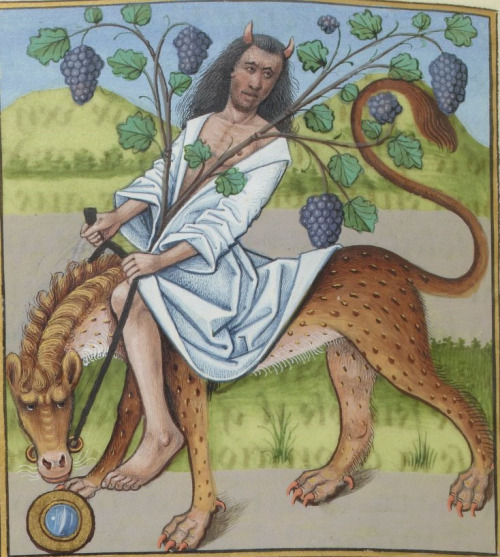
For the next 4 ... Apollo, Neptun, Diana, Bacchus (5-8) ... we have the condition, that all 4 are Chariot (= horse) related. Apollo drives with a chariot at heaven as Sun god. Diana drives with a chariot at heaven as Moon goddess. Bacchus has a Trionfo, which leads him from India to Greek. Horses are attributed to Neptun.
From Cessolis iconography we know, that Knight and Rook were presented as horse related.
If I assume, that these are Rooks and Knights, I would get the most attractive solution, the the group (1-8) at the Michelino deck would be all Chess officers. If I follow the suggestion, that Minerva and Venus were bishops, the whole looks like a system. So would be the row of the chess officers at a chess board.
(5-8) - (5-8) - (3-4) - 1 - 2 - (3-4) - (5-8) (5-8)
I don't care for the moment, which should be the correct positions (Queen's side or King's side) of Venus-Minerva-Apollo-Neptun-Diana-Bacchus. I just look first at the pawns.
The Farmer, who shall be this ... clear answer, that's Ceres, goddess of agriculture.
The Messenger ... who else than Mercury could be this.
So let's look at the overview: Ceres has position 12 and Mercury position 9 (in the Michelino deck). In the Cessolis model they are the outside Rook pawns.
(5-8) - (5-8) - (3-4) - 1 - 2 - (3-4) - (5-8) - (5-8)
(9-12)-----------------------------------------(9-12)
Just following the scheme the other both of group (9-12, Mars and Vesta) MUST be arranged this way:
(5-8) - (5-8) - (3-4) - 1 - 2 - (3-4) - (5-8) - (5-8)
(9-12)-(9-12)-------------------------- (9-12-(9-12)
Otherwise there would be missing harmony. And as consequence the last 4 in group (13-16; Hercules, Aiolus, Daphne, Amor) MUST be here:
(5-8) - (5-8) - (3-4) - 1 - 2 - (3-4) - (5-8) - (5-8)
(9-12)-(9-12)-------------------------- (9-12-(9-12)
------------(13-16)(13-16)(13-16)(13-16)----------
Well, that looks nice, somehow with the charm of a Jupiter-square.
Cessolis offers the Smith and the Doorkeeper for Mars and Vesta. Mars can be only compared to the Smith, as he needs weapons for his fights. Vesta is the goddess of fire. Fire was needed to alarm from castle to castle, to announce the approach of enemies. One might call this alarming system "doorkeeping".
Stay the other four: Hercules, Aiolus, Daphne and Amor and at the Cessolis side the barber, the "lawyer" as the king's pawn, the innkeeper and physician as the Queen's pawn.
Close to these four on the officer line are Athena, Jupiter, Juno, Venus. It's not easy to decide, if Athena or Venus are the king's side bishop, but generally Athena is more male than Venus. So I give heer to the side of Jupiter, cause she jumped out of his head. Then Venus is the bishop beside of Queen Juno. Amor belongs usually to Venus. So he is in front of Venus, and there's usually the innkeeper. I don't know, if Amor loved this, but that's life.
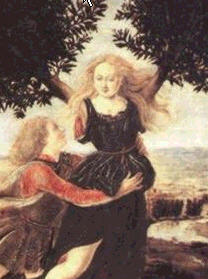
Daphne belongs before the Queen, cause ...
... they earlier played short assize versions.
http://en.wikipedia.org/wiki/Short_assize
There was a close connection between the Queen and the Queen's pawn in the ideological explanation of the game. The Queen and the Queen's pawn opened the battle, that had a sort of tritualistic meaning. So Daphne is the Qeen's pawn. The barber cares for the hair and the hair is a part of the body, which reacts most on the wind. So ... Aiolus plays the barber. Stays Hercules as the last son of Zeus in front of Zeus.
Stay Bacchus, Neptun, Apollo and Diana as Rooks and Knights as undefined as their position. Apollo and Diane are are a natural pair and so I think, that both would be either rooks of knights. And I decide for the knights, and as Diane is female, I claim her for the position of the knight at the Queen's side. Apollo becomes so the person behind the Smith (Mars), and Apollo gets angry, cause Mars stimulates such things.
Neptun (ships) fits well with Mercury, cause Mercury is the messenger. So Neptun becomes the Queen's side rook, and Bacchus gets the position at the King's side rook, behind Ceres and there he's lucky, cause he can do well with her.
But Apollo is angry and makes a nasty mockery comment to Amor, who is unlucky as innkeeper, and he thinks, that this would be a good position for Hebe, but she makes holidays. So Amor gets angry, too, and shoots Apollo with one of his famous arrows and promptly Apollo falls in love with Daphne. But Amor is really angry and shoots Daphne with an arrow with an antidot, so that Daphne would love perhaps everybody, but in any case not Apollo. That was a tragical event ... and finally Daphne turned in a piece of would, in other words a chess figure.
Bacchus had so much fun about it, that he finally declared, "okay, okay, I make the innkeeper today, and Hercules gets Hebe, to have some peace around here" (cause Hercules, always ready or a good fight, looked dangerous) and finally we see, that a trumpet blowing Amor sits on a Tower playing "Last Judgment" and the rook in the game of chess.
.... :-) ... well, I don't think, that this is the only way to tell the story, and maybe there a good other interpretations. But in no way it's impossible to correlate the Michelino deck and chess.
*******************
I think, that the 3 pairs at the lover card of Charles VI come from Alberti's Philodoxus (1424).