
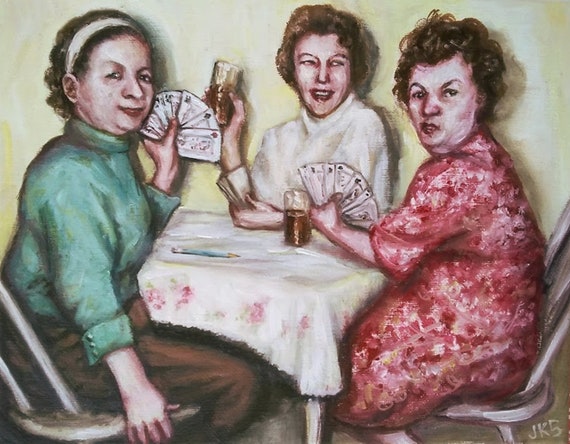
If you don't believe it, go to Google pictures and type "Bridge Club". Or "Chess Club".

The main reason I think that the face of the Charles VI Emperor was based on Sigismund is because the face of the Pope in the same deck really does look very much as if it was based on Eugene IV, who was pope at the time when Sigismund was emperor. It looks like a matching pair of portraits.Ross Caldwell wrote: 02 May 2022, 14:27 I'm not even sure if I'd consider any of them as portraits of Sigismund, or the empress Barbara of Cilli (or Celji). But he did have a distinctive beard, which his successor Frederick III did not have, so maybe the Tarot Emperors are idealisations of how an emperor looks, based to some extent on Sigismund, especially Visconti di Modrone, even though he was dead possibly five years already.
I take this as a starting point. So the main question is the “VIII” – first of all, note that it is roman numerals as you will find them later on Tarot cards and minchiate cards. There is an order in these imperadori, it is not “8 imperarodi”. This order is very probably additive, as roman numerals are.Ross Caldwell wrote: 29 Apr 2022, 15:47 I think Imperatori was Imperatoris was Kaisersspiel was (essentially) Karnöffel.
[...]
What does the hapax "VIII" in "VIII Imperadori" mean? In line with the above, I might interpret it as a variant of Karnöffel with eight "trumps" [...]
[Cardano is very interesting for other information, e.g. for fraud and treachery in card games, for the difference between taro and tarochi [if you read the English version translated by Gould, then beware of the two translation errors], etc.].[...] and triumphus [surpasses everything else] in prudence and imitation of human life. So it is more fitting for the wise man to play at cards than at dice and at triumphus rather than at other games; so it is agreed (but it is not in use) that this is a sort of midway game played with open cards, very close to the game of chess. It has an end when nothing further can be done and every game makes its own end. It is played with nine cards (for this is a satisfactory number) and is the mean between the great and the small; when the cards are placed on the table one begins to play, as one is accustomed to do with hidden cards. Since this is a most ingenious game, I am very much surprised that is has been neglected by so many nations.
vh0601,vh0610 wrote: 03 May 2022, 21:33 I take this as a starting point. So the main question is the “VIII” – first of all, note that it is roman numerals as you will find them later on Tarot cards and minchiate cards. There is an order in these imperadori, it is not “8 imperarodi”. This order is very probably additive, as roman numerals are.
My personal perspective is in short:
Kaiserspiel or Karnöffel was invented at the Council of Constance (This is Huck’s idea at trionfi.com) [Council of Constance is a perfect place to invent the game due to several reasons, of which the main is the Evil Carnival of Basel 1376 and the pope being “beaten by the devil” when falling out of his car in the snow of the Arlbergpass].
It is then transferred over the Alps to the south....
This aspect is important for keeping the name Kaiserspiel in its Italian form “imperadori” (Kaiserspiel can be plural in the sense of game of the emperors), since the kings of the resting three coulors can be trumped over by emperors only. The emperors are evidently the Emperor of the Holy Roman Empire (who is higher than kings, e.g. the Bohemian one), the Pope (who has the clothing of a Roman Emperor after the Donation of Constantine and is higher than the Holy Roman Emperor , since he crowns him) and the Devil, who is an Emperor of the Hell (as Dante wrote in his commedia). The last emperor is the Carnival emperor as in the Roman Saturnalia, carnivalian chaos even beats the well ordered hell
Interesting in this context is an overlooked remark by Arne Jönsson, in his 1998 essay on JvR in Schweizer Spielkarten 1. It suggests that something like the disruptive social symbolism in Karnöffel was already present in a card game in 1377 -vh0610 wrote: 03 May 2022, 21:33
My personal perspective is in short:
Kaiserspiel or Karnöffel was invented at the Council of Constance (This is Huck’s idea at trionfi.com) [Council of Constance is a perfect place to invent the game due to several reasons, of which the main is the Evil Carnival of Basel 1376 and the pope being “beaten by the devil” when falling out of his car in the snow of the Arlbergpass].
(Arne Jönsson, “Der Ludus cartularum moralisatus des Johannes von Rheinfelden,” in Detlef Hoffmann, ed., Schweizer Spielkarten 1. Die Anfänge im 15. und 16. Jahrhundert, Schaffhausen, 1998, pp. 135-147; 141, 143)Johannes einige allgemeine Überlegungen an. So vergleicht er das Kartenspiel in verschiedenen Zusammenhängen mit einem Krieg zwischen mehreren Parteien, und der Spieler, der die Mehrzahl der Karten gewinnt, ist der Sieger. An einem andern Ort weist Johannes darauf hin, dass einige Karten Edelleute vorstellen, andere aber Gewöhnliche, und ihre Begegnung in der Schlacht verläuft so, dass manchmal die Edelleute, manchmal die Gewöhnlichen den Sieg und den Triumph davontragen [Isti sic congrediuntur in loco certaminis quod aliquando nobiles, aliquando communes et populares victoriam obtinent et triumphum]. Hier mag beigefügt werden, dass nach Johannes der untere Marschall elf Punkte zählt, die Magd der Königin zwölf, der obere Marschall 13, die Königin 14 und der König endlich 15 Punkte.
Grund für die Verschlimmerung der Welt ist natürlich die allgemeine Verdorbenheit des Menschen.
Genau dieser Zerfall wird vom Kartenspiel aufgezeigt und dargestellt, denn "die Figurenkarten, welche vornehme Personen bedeuten, übertreffen an Wert die Karten mit gewöhnlichen Leuten, und dennoch verlieren sie oft im Spiel dermassen an Achtung, dass eine der Karten mit gewöhnlichen Leuten mehr wert ist und höher geschätzt wird als eine Karte mit den Edelleuten eines der Königreiche [Cartule ymaginum, que inportant <...> personas nobilium, excellunt cartulas popularium et tum frequenter in ludo sic vilescunt, quod una de cartulis popularium plus valet et amplius appreciatur quam aliqua de cartulis nobilium unius regni]".
Just two corrections here.vh0610 wrote: 03 May 2022, 21:33 Remember furthermore that in Roman times, the triumph was granted only to emperors.
As we know from Ross Caldwell, in Ferrara there is this order of c. 1422, that people should play cards in the old fashion, not in the new one. And then there is the note in the same Ferrara 1423 with "VIII Imperadori".
My translation:Obviare volentes sceleratis machinationibus et falatiis quibus multi, presertim adolescentes quotidie seducuntur a perfidis deceptoribus in praticam ludendi cum cartexelis ad numerum petendum, ut puta, de prima, tertia, quarta vel per equipolentum modum et aliquando, qui recipiendo carteselas attingunt ad numerum signorum, quod nuncupatur ludus de triginta vel ad aliquem consimilem ludum, unde compertum est multos et potissimum adolescentes maleversari pariterque summe falaciter reddi et sepissime proinde denum ad peiora deduci, utilitate pensata reypublice,
providerunt et ordinaverunt et provident et ordinant quod decetero nullus cuiusvis status et conditionis existat audeat vel presumat in civitate vel ducatu Mediolani aliquo modo ludere nec ludi facere ad aliquem ex predictis vel consimilibus ludis nec ad aliquem ludum carteselarum nisì dumtaxat secundum antiquum et rectum modum, videlicet iactando foras figuras et alia signa pro tali signo et tali figura, nominando enses vel bachulos et tale signum contra tale signum et hec omnia sub pena florenorum decem cuilibet contrafacienti auferenda.
I like your basic idea here. It does seem very plausible that the ruling class would want to remove, or at least moderate, the aspect of carnivalesque social disruption in the game of Karnöffel/Imperatori, and this could have been done effectively in the manner you describe, by creating dedicated trump cards instead of repurposing the existing suit cards.vh0610 wrote: 03 May 2022, 21:33 My perspective is that people ignored the order and continued to play imperatori – which was easy since it is implicit in the card deck. So the officials and the Este family had only one chance to get out of the situation – make the implicit explicit (this is an idea also MikeH had – as a Platonist, I prefer to say that the same idea had us both..).
Hence an additional trump suite was created for the explication. By doing so, one had to keep the trumping principle and at the same time one wanted to take the chaos out of the game – and make the game a moral one.
https://en.wikipedia.org/wiki/Amerigo_VespucciIn April 1507, Ringmann and Waldseemüller published their Introduction to Cosmography with an accompanying world map. The Introduction was written in Latin and included a Latin translation of the Soderini letter. In a preface to the Letter, Ringmann wrote
I see no reason why anyone could properly disapprove of a name derived from that of Amerigo, the discoverer, a man of sagacious genius. A suitable form would be Amerige, meaning Land of Amerigo, or America, since Europe and Asia have received women's names.
8 Figures .... Links to the pictures at this page ...Grammatica Figurata (1509)
The Grammatica Figurata was first published by Mathias Ringmann in 1509. This work was an attempt to enliven Donatus' Ars Minor by printing up illustrated card sets for each grammatical rule. Apparently the children would have a card set. The rules are not explained at length, but a few hints are scattered here and there in the work. The final section on "Exclamations" has a sentence on how to figure out which student has won. Each card represented a part of speech, a gender, a case, or a tense, etc. Depending upon the teacher's questions a student would play the appropriate card or cards. Long believed to be lost, one copy of Grammatica figurata was found and reprinted in 1905.[8][9
A biography of this man (from 1884) ....Die Idee, ein grammatikalisches Kartenspiel herauszugeben, war übrigens nicht von Ringmann ausgegeben, sondern von Walter Lud, Sekretär des Königs René II von Lothringen (Kinf René II had died 1508) und Kanonikus von St. Dié.
Nathaniel wrote: 04 May 2022, 10:15 So I would hypothesize that the reason these little retinues are found on nearly all the eight personages, but on none of the other tarot trumps, is because those eight personages were the "VIII Imperatori," and in the Imperatori deck, all the trumps except the Hanged Man had their special rank marked out by the addition of these little attendant figures.


