Re: 1487 Lucrezia's wedding / Boiardo's Tarocchi poem
21delete
Last edited by Huck on 19 Jul 2016, 07:50, edited 1 time in total.

I think 'signifies' is a close enough translation: but I don't think it is 'singe', but 'finge' = fingere - pretend, fake, simulate, imagine: to be understood as akin to the use of the synonym 'simula' (simulare)* in the previous sentence:Ross wrote: E.g. "Nella seconda (trionfo) tracta el principato della ragione laquale singe per persona di Madonna Laura"
which I take to mean "In the second Triumph he treats the principle of Reason, which he signifies through the person of Lady Laura"
I'm just guessing at the reading "singe" and the meaning "signifies".
Δάφνη (Daphne) as a name is transliterated in translation not translated. That is, in translations of Ovid, including Latin and Italian, the name remains Daphne, not Laure. If Boairdo had meant Ovid's Daphne, he would have wrote Daphne.Huck wrote: For the case of Laura-Daphne and Ovid the "perverse Cupido" is a natural part of the story.
btw ... I think, that "Daphne" is just the Greek word for the Roman "Laura"
https://en.wikipedia.org/wiki/Daphne_(plant)
He repeats much the same thing, using 'fingendo' in reference to Amore, and reason beneath the veil of Laura:Ross G. R. Caldwell wrote:Thank you very much, Steve. From this edition it is clearly "finge", which isn't so clear in my edition.



Boiardo read Petrarch's Laura as a personification of Reason, that triumphed over the 'perverse child Cupid', the bestial appetite that is 'perverse' in as much that it acts against reason( "l'appetito sensitivo è contrario alla ragione" = [perverso] Cupidito contrario Laura).Huck wrote:If I would follow your conclusions, I would get, that Boiardo took the relation of Petrarca to his Laura as a sign of a perverted Cupido.
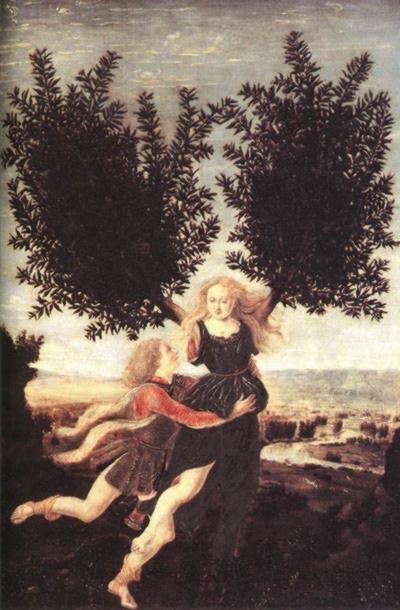
Daphne into a laurelHuck wrote: "Daphne in Laurum", states this edition.
"Daphne in laurum conversa" has a version in British library.
Yes it is, her name in both is still Daphne. And Daphne changed into a tree is very different to Daphne was changed into another person called Laura. The Laura/Daphne = Laurel wordplay is a Petrarchian motif. You're right that Daphne becomes Laura isn't far, in as much, as has already been explained, it happens with Petrarch."Daphne is (or becomes) Laura" isn't far.
Re: my posts above perverse Cupid contra Reason which fits perfectly well in terms of Boiardo's verse without any reference to Laura as Daphne; but in as much as Petrarch identified Laura with Daphne, it is possible to bring Daphne into it as well.It stays, that Laura (in the poem) without Daphne in the background wouldn't do much..
Possibly Lapini's commentaries were themselves the impulse behind Boiardo's production. The first printed edition was in 1475, however it was also produced in manuscript (there are 9 manuscripts still extent), and likely it was in luxurious and illustrated manuscript form that it was presented to the Duke of Modena, Borsa d'Este, to whom it was dedicated, giving a terminus of 1471*. The commentary includes reference to the death of the Duke of Milan, and it also contains some literal references that rely on an Italian translation of Bruni which make it post 1466. Lapini was in Ferrara from 1469*, he is included among of list of masters ennobled or knighted by the Emperor Frederick III in February that year in Ferrara, to whose entourage Boiardo was assigned during his visit.SteveM wrote:


Sommario: Struttura dei «Tarocchi» di Matteo Maria Boiardo (pp. 77-85); Iconografia del mazzo di Boiardo secondo l’«illustrazione» di Pier Antonio Viti (pp. 85-90); Il mazzo di Boiardo (pp. 90-95); Iconografia e struttura dei tarocchi (pp. 95-102); I trionfi dei «Tarocchi» e i Trionfi di Petrarca (pp. 103-106); Bibliografia (pp. 106-108).

Antonio da Montefeltro (1445–1508) was an illegitimate son of Federico III da Montefeltro, duke of Urbino.
He was born at Urbino, an inherited the title of count of Cantiano after the premature death of his brother Buonconte in 1458. In 1464 he abandoned the studies for the military career, following his father against the papal army led by Alessandro Sforza. In 1470 he took part in the battle of Mulazzano and, two years later, he took part in the siege of Volterra, always as lieutenant of Federico III. The two were both at the service of Alfonso V of Aragon in the Kingdom of Naples in 1474.
His wife was Emilia di Carpi, the daughter of count Marco II of Carpi and Sassuolo; she was perhaps portrayed by Raphael in 1504-1505. Antonio da Montefeltro died at Gubbio in 1508, likely of syphilis.
