Banner

Tarot History Forum

Tarot History Forum - 600 years of history in 78 cards

Re: Jewish-Christian interactions in Italy before 1500

121
mikeh wrote: Huck wrote, back when I went to bed:
... :-) ... I don't understand, what you're doing there.
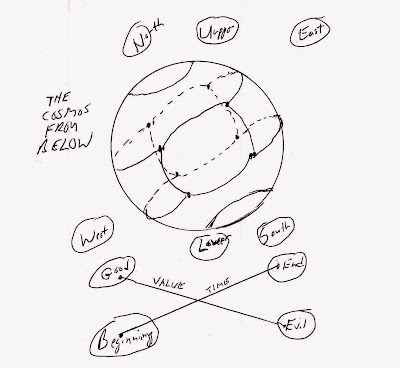
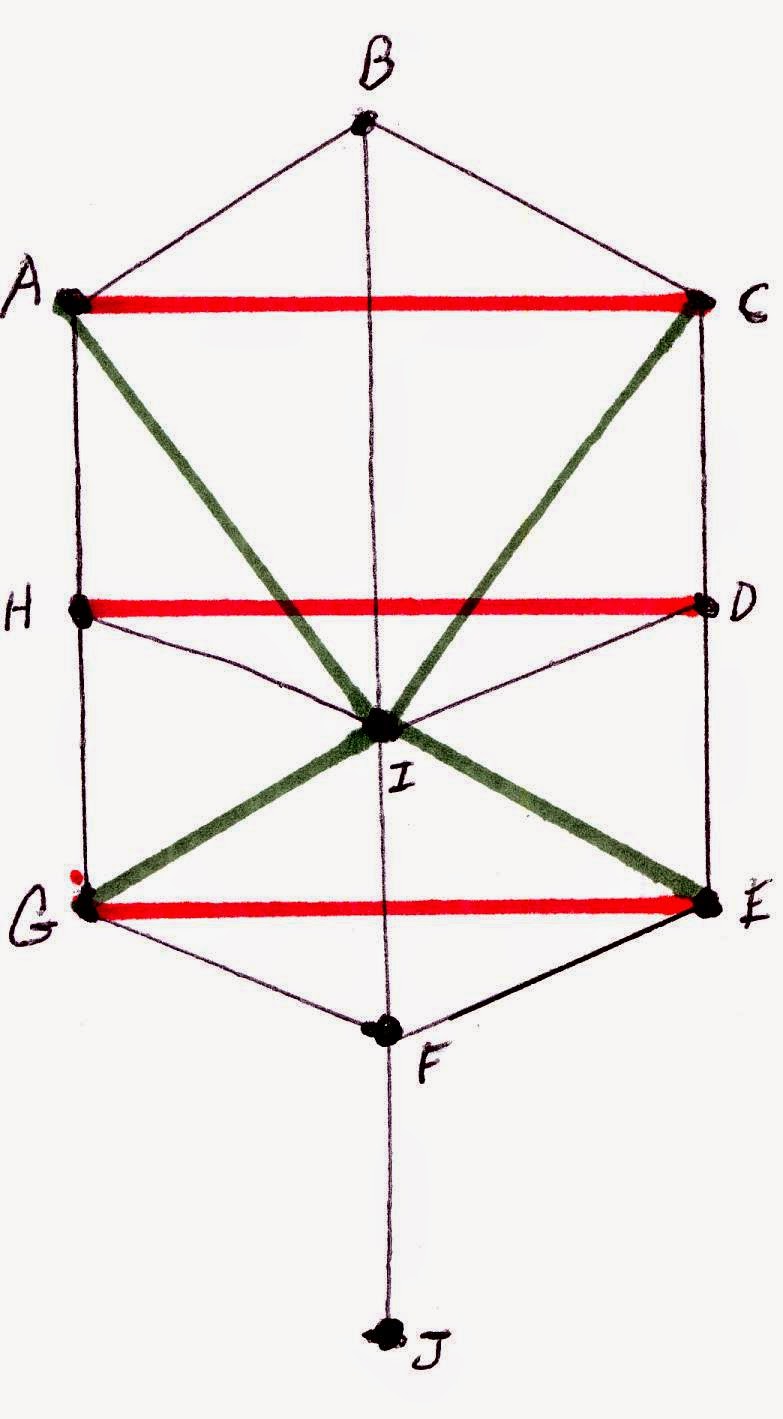
Are you referring to my diagrams? I assume so, since Steve's are rather clear. If mine aren't clear, I have to explain them better; we can't discuss them if we don't understand what they are. They look straightforward to me. What parts don't you understand?
... :-) ...

Image

I have many questions about your various models, Huck (I mean octohedron and the sphere divided up your way), but I will put them off. They look like a wild goose chase to me. But right now I have too many models in my one little head.
There are 5 platonic bodies ...

Image

http://en.wikipedia.org/wiki/Platonic_solid

If you mark the 6 centers of all 6 faces of the cube and draws lines between them, then you get an octahedron from that.
If you mark the center of the 8 faces of the octahedron and draws lines between, then you get a cube from that.

Similar is the relation between Dodecahedron and the Icosahedron.

Make a center at all faces of a Dodecahedron and draw lines between them, then you get an Icosahedron.

Dodecahedron has 12 faces and 5 corners for each face. But each corner is used for 3 faces. 5x12/3 = 20.

Icosahedron has 20 faces and 3 corner for each face. Each corner is used for 5 faces. 3x20/5 =12.

Make a center at all faces of a Dodecahedron and draw lines between them, then you get an Dodecahedron.

That's a little bit puzzling, but it works.

A cube is made from 6 faces, 8 corners and 12 lines. 6 + 8 + 12 = 26
An octahedron is made from 8 faces, 6 corners and 12 lines. 6 + 8 + 12 = 26

A Dodecahedron is made from 12 faces, 20 corners and 30 lines = 12 + 20 + 30 = 62 .... (12x5/2 = 30)
An Icosahedron is made from 20 faces, 12 corners and 30 lines = 20 + 12 + 30 = 62 ... (12x3/5 = 30)

Well, it's a puzzling question, if the Octahedron could have a mystery, which isn't mirrored in the cube, similar as the Octahedron couldn't have any quality difference to this figure ...

Image


And the cube lines also could be interpreted as belonging to a globe. All deciding points (8) have the same distance
from the center, and this forms not only a cube, but also a globe or a sphere.

Well, it's a good question, if the "26" in cube and octahedron has anything to do with the choice of YHVH (10 + 5 + 6 + 5 = 26).
Re: Jewish-Christian interactions in Italy before 1500

122
Thanks, Huck. I'll read what you wrote. Meanwhile I have prepared a response to Steve.

SteveM wrote,
I'm not sure what is 'unnatural' about it. Kabbalah is full of pythagorean number and geometric symbolism - I take it that the directional seal YHV is no accident -- that it is a triangular number I take as significant:

*
**
***
**** = 10 = Y
***** = 15 = YH
****** = 21 = YHV

And the symbolic geometric progression of emanation that goes from the point of zero dimensions, to the line, to the triangle, goes on to the tetrahedron (the space filling complement of which is the octohedron), not the square or cube:
etc. (that is, download/file.php?id=1535)
I didn't mean that 2d "tree", which I don't see in the SY at all. I meant http://3.bp.blogspot.com/-ka1W5NuxG1E/V ... quare5.JPG.

SteveM wrote
It just requires, as Kaplan points out if my memory recalls right, facing the four directions and tracing the letter Beit, and taking the signs in order, top, right edge, bottom - this both follow natural zodiac sequence, while also place cardinals top, fixed middle and mutable bottom.
Yes, I see what you mean. It's elegant from the standpoint of the division between cardinal, fixed, and middle. But I don't see that distinction in the SY; what is elegant about the cube model is that from it you can easily transition to the "2d" model that I indicated (http://3.bp.blogspot.com/-ka1W5NuxG1E/V ... quare5.JPG). The cube model governs chapter 1 and the "2d" model with rhombuses governs chapters 3 on.

SteveM wrote
The fact is that the SY is a 3d model and can't be made to fit the familiar 2d models.
But it can, easily, from the cube to the one I indicated (the three rhombuses, using the cube model where the sefirot are behind the globe of the universe (as opposed to being the vertices of lines), and the diagonals are the rombuses formed by the faces when projected into two dimensions. Also, the "tree" it is a schematic diagram, not a faithful projection of three dimensions onto two dimensions. The spheres behind the universe become points connecting diagonals, and the direction lines become verticals. For me, that's the whole point of the cube model, the only reason I consider it: it makes for an easy transition to the "trees".

SteveM wrote
The SY is clear that the 12 diagonals (the Hebrew words by the way usually refer to the lines of a triangle) connect to directional sephiroth, not the first four - they do not equate to the 12 diagonals of the 2d tree.
I have re-read all the places I would expect that to be said, and I can't find it. I did a word-search for "sefir" in the various online versions and couldn't find anything about sefiroth connecting to diagonals. The word only occurs in chapter 1, which pertains to the "3d" model. I did a word-search for "diagonals" and only found it in chapters 5 and 6, which pertain to the "2d" model. The SY doesn't mix its apples and oranges in the way we do. But they do have to be mixed, somehow, in order for the chapters to be part of the same book. One way is to project the later stuff back into the earlier, making 6 of the sefirot into vertices of the diagonals. That's what the octohedron does. (I'm not sure what you do with the verticals and horizontals, and putting the diagonals in a circle as yet makes no sense to me, as reflecting a prnciple in the SY.) Another way is to project back just the diagonals, leaving them disconnected from the sefirot, convert that to a "tree", and put the sefirot, horizontals and verticals into that. That's my way, the way of the cube. I'm not yet sure which the early Kabbalists did.

p. s. In the 2d model, the diagonals are not only the sides of rhombuses, but also of triangles, since the rhombuses are all bisected by the central vertical line.

pps. (added later): How can the sefirot be vertices of the diagonals, in the picture of chapter 1, if the sefirot are at a higher level of reality than the sphere of the fixed stars? The lines are the zodiacal constellations. How they connect to the sefirot is a mystery. The sefirot are not objects in time, space, or valuation; they are, or perhaps create time, space, and valuation. They are also in the "depth" of the various directions, which I take to be not the end of an infinite line (Kaplan), which would be nonsense to the Kabbalists, but outside those frameworks altogether, somehow the conditions for their existence, which is why they are in chapter 1.
Last edited by mikeh on 18 Feb 2015, 09:48, edited 2 times in total.

Re: Jewish-Christian interactions in Italy before 1500

123
Huck, I think I see. Picturing SY chapter one's 6 directional sefirot as points in the middle of a cube comes to the same thing as picturing chapter one's 6 directional sefirot as the vertices of an octohedron. I understand that now. But when you list the lines, however (UN, NE, etc. you will come up with different sequences, and so, perhaps, different versions of SY lists. Well, I will stick with the cube and the short version. Other people can go with others if they like.

Then there's this little bit that you wrote:
And the cube lines also could be interpreted as belonging to a globe.
You didn't say how that worked. I will see if I can figure it out. If the lines are 90 degrees apart, that makes 4 above and 4 below the equator. That's 8. So it must be an octohedron that is mapped onto the sphere. And then you convert that to the lines of a cube. Yes, that comes out to just what I have. That's a good explanation of what I have; I just pushed the center-points of the cube outside the sphere (not attached to anything, just floating there, along with four others in different dimensions). And one more thing: I projected the cube, instead of your octohedron, out onto the surface of the sphere. Your sphere lines are those of a projected octohedron. Mine are of a projected cube. Capisce?

Relative to mapping the diagonals of chapter 5 onto the solid of chapter 1, they all come to the same thing, except for for the sequencing. The octohedron works better for including the verticals and horizontals from chapter 4. The cube works better for converting the array to a recognizable "tree" diagram. The sphere encompasses them both. The sphere is the reality they were dealing with, the 9 spheres around the earth. if the sefirot count as part of the cosmos.

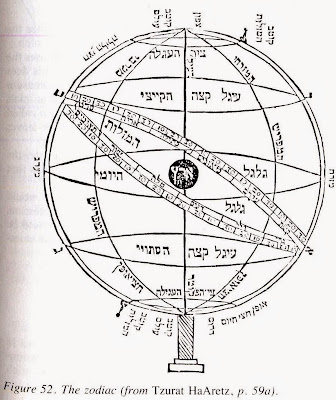
found in Kaplan, p. 211, a picture (not one of his) that might help explicate the "globe" model further.

Image


The only problem is that I don't know my astrology/astronomy. I can't find an English equivalent of that picture. In all the versions of the SY, the zodiac starts in the "eastern" part of the sky and leads to Gemini as its 3rd sign. Aries, I find out, is where the ecliptic crosses the equator in the spring. So my question is, where is Gemini on that star map? Is it to the right or left of where the ecliptic crosses the equator? And then where is Cancer? If I knew, maybe I could figure out which of the versions, if any, corresponds to this map best. From a picture of the sky on one website, it seems that Taurus is to the left of Aries. But is this from the north or from the south, or what? I will assume it's from the south, as the normal orientation these days is north up, south down. But then how could all the versions of the SY have Taurus and Aries (and Gemini) in the east?

So I don't get it. If I knew, maybe I could figure out what the "globe" model comes to.

Re: Jewish-Christian interactions in Italy before 1500

124
MikeH wrote:
What is most relevant. it seems to me, is how the standard Bahir/Gikatilla "tree" develops out of it, or relates to it, with its 3 horizontals, 7 verticals, and 12 diagonals
You shouldn't mix Bahir with Gikatilla ... :-) ... "3 horizontals, 7 verticals, and 12 diagonals" is just later decoration, nothing real. I don't know ... was just Gikatilla the one, who invented the "3 horizontals, 7 verticals, and 12 diagonals"?

http://en.wikipedia.org/wiki/Joseph_ben ... _Gikatilla

Image


The picture at his Latin translation looks not so. He invented the idea of channels on the life-tree, that's my information (if this is right or wrong I can't say).

Wiki states ...
Gikatilla at times criticizes the Sefer Yeẓirah and the Pirḳe Hekalot. The seven heavens (Ḥag. 12a) are identified by him with the seven planets. He holds Maimonides in great esteem even when he opposes him, and quotes him very often. Other authorities quoted by him are Ibn Gabirol, Samuel ibn Naghrela, and Abraham ibn Ezra. Isaac ben Samuel of Acre in his Me'irat 'Enayyim severely criticizes Gikatilla for too free usage of the Holy Name.
Is the attribution of the 7 planets really invented by him? Or were there somebody earlier with it?

"7 heavens, 7 earths" are mentioned by Ranke Graves/Patai in Hebräische Mythologie (1963/64 and 1986; btw. a interesting book). The author have a long list of references (likely to very early sources). A reference to "7 planets" is not given, so might be written before astrology became a great fashion (since c. 150-200 BC).

I remember dark, that Scholem speculated, that Moses de Leon knew Gikatilla.

Well, I find this ...

Rabbi Joseph Gikatilla's Hermeneutics
Elke Morlok
Mohr Siebeck, 2011 - Philosophy - 360 pages
https://books.google.de/books?id=aACAr- ... ls&f=false

Image


The idea is a watering system, something, with which people of his time had practical experiences with.

... :-) ... This one has more about channels ... Gikatilla himself

https://books.google.de/books?id=u6fXjw ... ls&f=false

Well, take care, that you are not drowned in the channels. The SY hadn't them ... :-)

Re: Jewish-Christian interactions in Italy before 1500

125
mikeh wrote: Then there's this little bit that you wrote:
And the cube lines also could be interpreted as belonging to a globe.
You didn't say how that worked. I will see if I can figure it out.
1 corner is the north pole
the opposite corner is the southpole
3 corners are in 30 degree distance to the aequator from the north side
3 corners are in 30 degree distance to the aequator from the south side.

The 3 from the north are NOT at the same longitude as the 3 from the south side, the 6 overall positions jump in 60 degree distances (6x60 = 360).

Well it looks like my I-Ching sphere, but not with 64 positions, but only with 8. Naturally the corner points present the 8 trigrams of I-Ching.
[/quote]

Re: Jewish-Christian interactions in Italy before 1500

126
Huck wrote
Well, take care, that you are not drowned in the channels. The SY hadn't them ... :-)
True. I was just referring to the Tree, not its use as channels.

And OK, I will just say "Gikatilla". Or whatever you want. I haven't studied the Bahir. I thought it had a tree. It talks about a tree, in one of the quotes on this thread.

And I thought I made it clear that I did not see the Bahir/Gikatilla Tree in the SY. I thought I said it over and over. That's later, of course. The one on the cover of Portae Lucis is wrong. The designer of the cover didn't read the book. Gikatilla has a very clear tree, except when it comes to the top, with Da'at and Keter and En Sof somehow mixed together. But his channels flow in accordance with the 22 lines on the "tree". The book is translated into English, and I've read it. I don't remember what it says about planets. Not much, or I think I'd remember. That was something that interested me at the time I read it. But he wrote another book, Gates of Justice, still untranslated.

I meant to be just talking about the shape of a tree, not a whole doctrine

If I said "Lurianic tree", I would be right, sort of (I couldn't count his letter attributions), but that would be too late. What would you suggest I call the one that looks like this:
http://2.bp.blogspot.com/-hV3sC3OrrXQ/V ... quare4.JPG. Give me a name, and I'll use it. Anything to get back to what we were discussing.

Huck wrote,
1 corner is the north pole
the opposite corner is the southpole
3 corners are in 30 degree distance to the aequator from the north side
3 corners are in 30 degree distance to the aequator from the south side.

The 3 from the north are NOT at the same longitude as the 3 from the south side, the 6 overall positions jump in 60 degree distances (6x60 = 360).
It seems to me that there are many ways of projecting a cube onto a sphere. I do not see your way in the SY. I was projecting one that had two of its faces' centers in the north-south line, two in the east-west line, and two in the up-down line. That is because one sefira is in the "depth of above",another is in the "depth below", etc.Yours only have north and south. How are the rest east, west, above and below? And they are ten "of nothingness", "which have no end". I take it they are outside of space, if not both time and space.

Re: Jewish-Christian interactions in Italy before 1500

127
mikeh wrote:I haven't studied the Bahir. I thought it had a tree. It talks about a tree, in one of the quotes on this thread.
For "Tree" in Bahir see ...
viewtopic.php?f=11&t=1056&p=16103#p16103
And I thought I made it clear that I did not see the Bahir/Gikatilla Tree in the SY. I thought I said it over and over. That's later, of course. The one on the cover of Portae Lucis is wrong. The designer of the cover didn't read the book. Gikatilla has a very clear tree, except when it comes to the top, with Da'at and Keter and En Sof somehow mixed together. But his channels flow in accordance with the 22 lines on the "tree".
Do you have the passage? Or the link? Is it in this "Gate of lights?

Huck wrote,
1 corner is the north pole
the opposite corner is the southpole
3 corners are in 30 degree distance to the aequator from the north side
3 corners are in 30 degree distance to the aequator from the south side.

The 3 from the north are NOT at the same longitude as the 3 from the south side, the 6 overall positions jump in 60 degree distances (6x60 = 360).
It seems to me that there are many ways of projecting a cube onto a sphere.
Not limited possibilities. But if you make a decision, you can declare the point as North and then at least South is also fixed. And the other six corners can't be on the middle line. 3 are above, and 3 are below.
I do not see your way in the SY. I was projecting one that had two of its faces' centers in the north-south line, two in the east-west line, and two in the up-down line. That is because one sefira is in the "depth of above",another is in the "depth below", etc.Yours only have north and south. How are the rest east, west, above and below? And they are ten "of nothingness", "which have no end". I take it they are outside of space, if not both time and space.
A cube has 8 corners. The faces North-South-East-West-Upper-South are only 6. They can only refer to the 6 faces of the cube, not to the 8 corners. Or more precise: two opposites of North-South-East-West-Upper-South can meet 2 corners, the other 4 are necessarily NOT on the 6 other points (otherwise it wouldn't be a cube).

Re: Jewish-Christian interactions in Italy before 1500

128
mikeh wrote:Huck, I think I see. Picturing SY chapter one's 6 directional sefirot as points in the middle of a cube comes to the same thing as picturing chapter one's 6 directional sefirot as the vertices of an octohedron.
The SY clearly says diagonal boundaries ( the hebrew words used in fact, as I posted previously, were usually used in context of the diagonal lines of a triangle) . Does a cube model give you diagonal boundaries? I know the octohedron does... but when I imagine myself in a cube I don't see diagonal boundaries -- say for example facing east I see a square and I see horizontal top and bottom {EU EB}, vertical side pillars -- maybe it's a lack of imagination.visualization skills, though while I can see it with the octohedron easily I can't with the cube...? As I visualize it cube horizontal and vertical boundaries (i.e. NO diagonals - considering the faces as E W N S A B), octohedron 12 diagonals... the octohedron thus seems most natural to me.
Last edited by SteveM on 18 Feb 2015, 23:33, edited 3 times in total.

Re: Jewish-Christian interactions in Italy before 1500

129
mikeh wrote: I will assume it's from the south, as the normal orientation these days is north up, south down. But then how could all the versions of the SY have Taurus and Aries (and Gemini) in the east?
Aries is the east sign, and those that follow it '(taursu.Gemini) easterly'. The wheel of the zodiac can appear odd to those unfamiliar with astrology/astronomy. On a zodiacal wheel Aries the east sign is on the left opposite libra )(west) on the right. Cancer (North) at the bottom opposite Capricorn (South) at the top...

ps: I was confused by your reference to Bahir/ Gikatillai tree of seven verticals 3 horizontals and 12 diagonals - unaware there were such? Have you reference?

Re: Jewish-Christian interactions in Italy before 1500

130
mikeh wrote: The only problem is that I don't know my astrology/astronomy. I can't find an English equivalent of that picture.
It's a pretty standard representation, nothing you can't find in English -- try a search on 'zodiac globe' or 'astrological globe'.