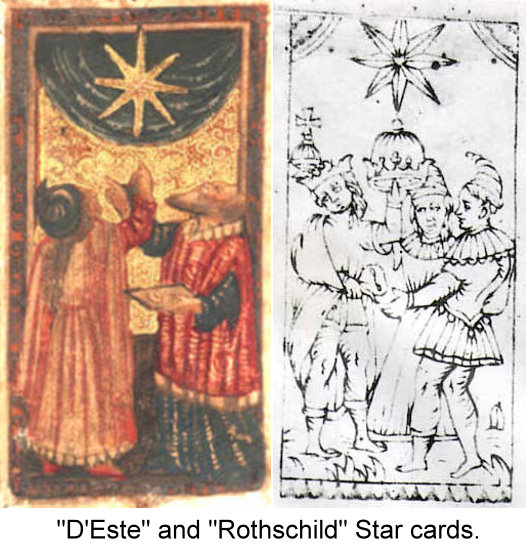
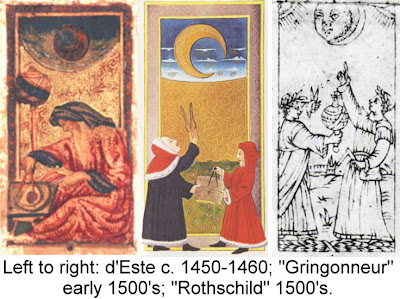
Steve:.Your interpretation of the celestials in relation to units of time makes more sense than mine, as we head toward the end of time and Eternity. It strikes me that the sequence could have been interpreted both ways; and yours makes more sense from a more informed point of view.
Huck: Yes, wings are a Venetian specialty. In the depiction you showed from Venice, all the virtues have wings. There needs to be a principle for singling out just one. That is how, to the extent that Ferrara and Venice influenced tarot in Lyons, we have an explanation for Justice with wings. It gets wings in Venice and Ferrara from being on the upper side of death and so an angel. Then in the Lyons-influenced Vieville (
http://www.tarot-history.com/Jacques-Vi ... ce-web.jpg), Justice has wings, too, even though it is no longer on the far side of Death, due to copying that design.
You may be right as to the structure of
Caos; but it needs more working out, not just a few chapters.
SteveM wrote:
Questioning the existence of a popesse is not the same as questioning the existence of what she represents in this case.
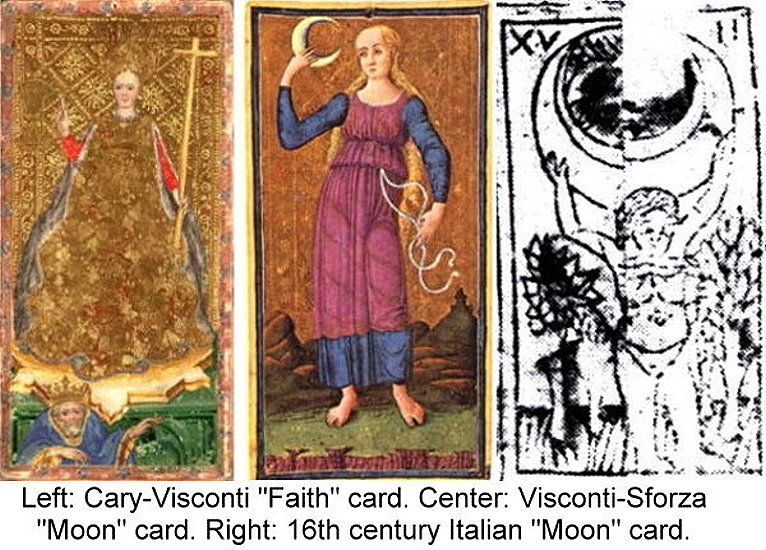
I don't understand your point. Folengo says "Popess (if there is one)". He does not say, mean, or imply "the Faith (if there is one)". Ergo the the Popess does not symbolize the Faith. It is simply a female Pope. Here is a parallel example. Someone says "x may or may not exist" while holding and looking at an apple and saying "this apple exists". Could x represent that apple? I don't see how. Similarly, Folengo says that the Popess is something that may or may not exist. We can suppose that if asked he would assert that the Catholic Faith exists. If so, the Popess does not represent the Catholic Faith.
A false analogy: I question whether a certain pope existed. I do not question the existence of the Catholic Faith. It does not follow that I am questioning whether that Pope represented the Catholic Faith. This is a false analogy because a particular Pope does not represent the Catholic Faith in the way that a symbol represents that for which the symbol stands. In a general sense, Popes represent the Catholic Faith. So do priests. But that does not mean that when I see a picture of a Pope, i can say, that represents the Catholic Faith, and when I see a picture of a priest, that does, too.
SteveM wrote,
The Hanged Man it seems to me is an exemplar of Shame illustrated by a shameful death, an exemplar of that to be feared and avoided. It is the fear of Shame that is a spur to overcome it, to do the right/honourable thing. Shame/Fame is a common pairing of machismo, militaristis, honour bound cultures. The Fear of Shame as a spur to honour should be greater than the fear of death, it is not wrong for the condotierre to fear death, but his fear of the shame of being thought of as a coward, in this life or as his reputation/good name following his death, should spur him on to overcome it. It is as representing the fear of shame, as a spur to virtue and desired for glory, that places it in the train of Chastity. So yes I agree, it represent the overcoming of shame, in as much as it is the fear of shame (and the desire for glory/a good name, reputation, fama) by which one overcomes it.
I agree with you up to a point. But I do not think that this card is about a machismo desire to avoid having one's name and reputation ruined
simpliciter; if the loss of reputation is based on misunderstanding, or one has the shame of being thought a coward when one is not in fact a coward. It is about avoiding or overcoming shame due to doing the wrong thing, or failing to do the right thing, regardless of what people may think. It is not about avoiding a shame painting or a death in that position, because Muzio Attendola has virtue and honor for doing what he did regardless of the shame painting. The shame painting, and the card, serve to remind us not to do anything shameful, because if one does, not only will will we have to face God and our conscience, but also our family, friends, and nation. At the same time it was thought important, by Italian Renaissance writers, to emphasize rising above the shame-based culture. People do reckless, foolish things in the name of not being thought a coward. There is the passage in Shakespeare:
Good name in man and woman, dear my lord,
Is the immediate jewel of their souls.
Who steals my purse steals trash...
But he that filches from me my good name
Robs me of that which not enriches him,
And makes me poor indeed.
It is said by Iago to Othello for the ultimate purpose (although not the immediate purpose) of goading him into doing rash deeds for the sake of his honor. The story was originally Italian.
I am going to proceed on to Devil and Tower. Here is Dummett on the Devil: He has just said that Death presents no special problems.
Lo stesso dicasi per il Diavolo. Il modo di ritrarre il soggetto è assai vario, ma, nella maggior parte dei casi, il disegno mostra soltanto la figura del diavolo in rappresentazioni più o meno convenzionali. La carta del Tarocco di Marsiglia, del Tarocco di Besangon e degli altri modelli derivati, è insolita in quanto raffigura due diavoletti in aggiunta al soggetto principale; non è chiaro, almeno per me, perché siano incatenati al ceppo su cui il diavolo sta ritto.
(The same applies to the Devil. The way of portraying the subject is varied, but, in most cases, the design shows the figure of the devil in only more or less conventional depictions. The card of the Tarot of the Tarot of Marseille, Tarot of Besancon and other models derived from it is unusual in that it depicts two little devils in addition to the main subject; it is not clear, at least to me, why they are chained to the stump on which the devil is standing.
Dummett at least recognizes that the Tarot de Marseille adds something new, the two devils bound to the "stump" on which the Devil stands. This seems to me an extension of the Cary Sheet image of the souls in the sack on the Devil's back. It is probably a result of a medieval representation of these souls as tied to the devil, as seen, for example, in a column in France that had been posted by Fauvulus at
viewtopic.php?f=14&t=278&hilit=column&start=30#p3890 that Marco recently drew to my attention. The Devil is standing on a pedestal, as another church, I presume French, shows:
viewtopic.php?f=14&t=278&hilit=column&start=40#p3905).
The real mystery about this card, it seems to me, is why it follows immediately upon either Death or Temperance/Fama. Dummett refuses to deal with this question, claiming that it is unknown what the "original order" was; but in every order it has the same place, allowing only for the variation in the position of Temperance. The early accounts in the Discourses by Piscina and Anonymous very much concerned themselves with this question, and give different answers. Piscina makes it a matter of what lies between the earth and the celestial bodies. I will start with his discussion of Temperance (the Italian is at
http://www.tarotpedia.com/wiki/Piscina_Discorso_5):
Then Temperance comes: a most beautiful virtue that moderates us in the pleasures of the body, according to the law, and that can [19] here be interpreted as any other virtue, that does not fear the strikes of Death, nor the inconstance of Fortune: on the contrary, virtues make men immortal, according to the opinion of the Poet^, they take the man out of the grave and preserve him for a long and immortal life. Since the Author thought to have discussed enough images and examples of mortal things, he moves to place figures of more worthy things, that is to say, celestial. But since Nature does not allow changes that are too quick, nor that one moves from one extreme to the other without the due mean, before ascending to celestial things as the extreme end of earthly things he places examples of Demons: because, as Melito said answering Socrates' question, they are sons of the Gods but are neither earthly nor celestial. It has been the opinion of many, in particular the Platonists, that the Demons are Spirits that are in the air & that they are somehow in the middle between Gods and men.
Melito was the Athenian state's prosecutor against Socrates in Plato's
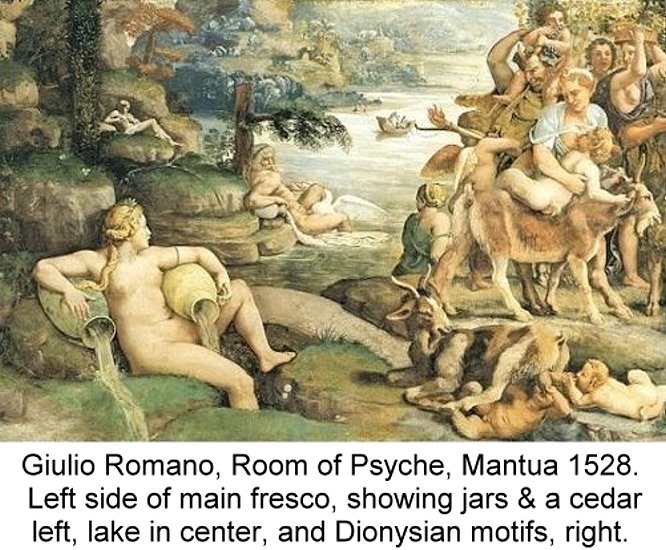
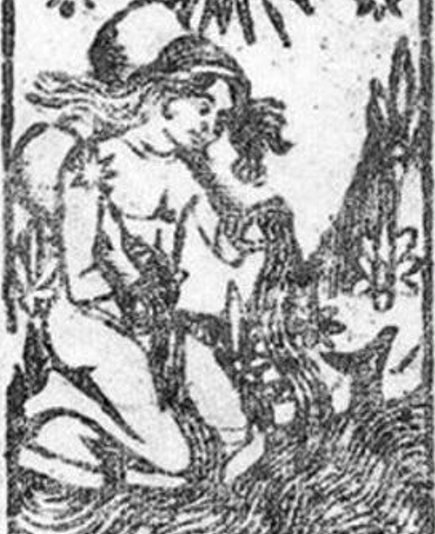
Apology. Piscina seems to be using Temperance to represent all the virtues, the possession of which overcomes Death. But between the extremes of mortality and immortality is a mean, namely, a part in between. I think he is referring to the medieval cosmograph, with its successive circles of earth, water, air, and fire. He only applies it to the last two. Yet it seems to me that Death, which triumphs over the body, is at one extreme, earth. Then Temperance has the two pitchers, with water between them. Then comes air, where the demons are. Fire of course is next. The only difficulty will be with the Star, which seems out of place whether representing a planet or something in the Fixed Stars, as the next circle in the cosmograph after Fire is the Moon. There are various ways of accounting for this discrepancy, which I will get to in another post. With the cosmograph came a doctrine of the soul's ascent to the Empyrian, which can be contemplated also in this life through meditation. The idea, I think, is that the virtuous soul is assailed on all sides by demons. They lie in wait for the soul ready to capture it and drag it to hell, even if it had some good works. It was thought necessary to pray for the souls of the dead for a certain period after death, as an aid to its passage. Then if it manages to elude the demons, there is also the realm of Fire to contend with. Dante described this journey in his Divine Comedy. He put the demons in Hell, which is where they drag souls to, then the purifying fire is in Purgatory. But they were represented in the air often enough, for example in a famous 14th century "Triumph of Death" (the title came later) in Pisa (
http://en.wikipedia.org/wiki/File:Buona ... co_001.jpg), in which, on the upper right, winged demons and angels fight each other for the possession of souls.
Another interpretation of why the Devil comes next is that of Anonymous:
After these, the Hunchback, the Traitor, Death and the Devil follow. The Hunchback, who is none other than Time, demonstrates that all those things are vain and transitory. Therefore loving and desiring them so intensely, thinking of nothing else, is the greatest foolishness, because in a short time Old Age comes together with all its miseries; then people begin to understand the deceptions of the murderous World, which are put before their eyes by the traitor. But since they have gotten so used to their bad habits, it is difficult to get free of them; they do not depart from their usual habits. It is difficult to get free of them; they do not depart from their usual errors. Suddenly Death comes, in the horror of which the Devil, who is the cause of all this, takes them away in fright and despair. This is the miserable end of human actions, speaking of those who are completely immersed in the vain and lascivious delights that the World promises and can give; they follow foolishness as their guide, without regard to their end and to God, upon whom the greatest good and all perfect and permanent happiness depend.
Here the idea is that unvirtuous souls, who sacrifice virtue to strive after the things of this world, are in the clutches of the Devil after death. A problem with this interpretation, as a description of the soul's journey after death, is that Hell is a final destination, once there one cannot ascend higher. So there is a sharp break between this card and the one following. The narrator is asking one to consider another ending. There are two alternative endings to the story, not one narrative. If there are two endings, but only one sequence of triumphs, then one has to be done after the other, with a break in between. Dummett's examination of the orders did not have a break at this point: every order does the sequence from Death through Sun in exactly the same way, as though this was all one group. If there is a break here, with two endings, it is one that the designers of all three orders must have understood as such. as a series of two endings; or else this part of the sequence came at a later time than the rest, and two merely copied the precise order of the third.
Anonymous accomplishes the leap from Devil to the Heavens (he has no Fire, just "cieli") through what I think is an act of contemplation. it is by contemplating the heavens that we come to see the power of God. (Here I have altered Caldwell, Depaulis, and Ponzi's sentence structure slightly, to conform with that of the original, even though it is awkward in English, and changed one preposition.)
His contemplation is wisely presented by the Author in the following seven figures by means of his marvelous and beautiful works, so that knowing him, we love him. So that, by [not for] his infinite goodness and mercy, he delivers us from the Devil at the end of our lives, making us co-heirs with him of the true glory and the happiness of Heaven. Therefore we rise with our eyes and intellects to the Heavens, the Star, the Moon, and the Sun, the supernatural works of God, the World [meaning "Cosmos"], so in the fixed stars as in the moving Planets, of which each depends on its own intelligence which is the Angel, who governs and moves them in accordance with the first Mover, who is the great and immortal God, represented by Justice. because at Judgment Day he will be a most righteous and severe Judge, repaying everyone according to their deeds.
So from contemplating the Devil, our eyes rise upwards to the Heavens, seeing there God's works, the planets and fixed stars of the Cosmos (which is a better translation of "Mondo" into English than "World"), each acting in conformity with the will of the Creator, thus reminding us of that same Creator at Judgment Day.
In Piscina's interpretation, however, it is all one sequence. From a contemplation of the demons in the air, we are led upwards to higher and better things. The course is like the "imitatio Christi", in which, just as Christ descended into Hell, so do those in imitation of him. confronting demons, to their greater glory.
Because of the close connection, visually and verbally, between Devil and the next card, Fire or Lightning, in its early cards and titles, I will deal with it in this post. Dummett says:
Fra tutti i trionfi la Torre non ha soltanto il maggior numero di nomi alternativi, ma anche la più grande varietà di illustrazioni. Esse possono essere divise in due classi. Sulla carta delle Minchiate vediamo un diavolo che emerge dalla bocca dell’inferno per trascinarvi dentro una donna. La carta di Catelin Geoffroy mostra una scena confusa e piena di fumo e con un edificio sullo sfondo; in primo piano v’è un diavolo che trascina via una donna con un braccio levato al cielo in segno di disperazione o di preghiera. Sul trionfo XVI del mazzo parigino anonimo, chiamato ‘la Fovdre' un diavolo esce dalla bocca dell’ìnfemo mentre una figura si accuccia al suolo davanti a lui. Queste tre carte formano la prima delle due classi: su tutte c’è un diavolo e il disegno si presta a nomi come ‘la Casa del Diavolo’ o l'Infemo’ — nome questo usato da Lollio e da Imperiali. La seconda classe è più numerosa e si adatta a nomi come ‘la Saetta’, ‘il Fuoco’ e ‘la Foudre’ (‘il Fulmine’). Nel mazzo di Viéville e nei mazzi del Tarocco belga in genere, vediamo un fulmine che colpisce un albero; non si scorgono edifici. In tutte le altre versioni c’è una torre o un altro edifìcio; in tutte, tranne la siciliana, l’edifìcio è in fiamme e di solito colpito da un fulmine. Nell’unica versione dipinta a mano pervenutaci, quella del gruppo ‘Carlo VI’, non ci sono figure umane; vi compare un grande edificio in rovina con la parte superiore in fiamme, ma senza fulmine. La versione sul foglio Rosenwald assomiglia molto al disegno ‘Carlo VI’, sebbene semplificato; ancora una volta non ci sono figure, ma un grande sole nell’angolo superiore sinistro della carta sprigiona raggi che, apparentemente, appiccano fuoco all’edificio. Il disegno [end of 423] bolognese, quale appare nel foglio della collezione Rothschild e in mazzi successivi, è simile, salvo l’aggiunta di due figure a terra. Nel ‘mazzo Budapest’ non ci sono figure, ma un’alta torre è incendiata dai raggi dì un sole. La carta del foglio Cary, chiara antenata del disegno del Tarocco di Marsiglia, non è intatta; mostra una torre cilindrica la cui sommità appare illesa e che, per quanto si può vedere, non è in fiamme, ma potrebbe essere colpita da un fulmine dal lato sinistro, che è mancante. Il Tarocco di Marsiglia mostra una torre colpita dal fulmine, con la cima che si sgretola e due figure che precipitano.
Per parecchie ragioni sarebbe allettante supporre che la prima classe di disegni e il nome ‘la Casa del Diavolo’ rappresentino il significato originario della carta. Essa lascia infatti trasparire un’idea più precisa di quella espressa dai disegni di un edificio in fiamme e da nomi come ‘il Fuoco’. Inoltre, questo spiegherebbe perché la carta è invariabilmente collocata in posizione immediatamente superiore al Diavolo; presumibilmente lo strano nome lla Maison Dieu’ deriva da un fraintendimento del nome ‘la Casa del Diavolo’. Tuttavia, le prove contraddicono questa teoria. Il nome fornito nella fonte più antica, il sermone 'De Ludo', è «la Sagitta»; i disegni che mostrano un diavolo sono più rari e posteriori a quelli che mostrano un edificio in rovina. Inoltre, i disegni della prima classe sembrano chiaramente derivati da quelli della seconda. Sulla carta delle Minchiate il diavolo emerge da un edificio merlato e le fiamme lo colpiscono dall’angolo superiore della carta. È solo nelle due versioni francesi — la carta di Geoffroy e quella del mazzo parigino anonimo — che le fiamme provengono dalla bocca dell'infemo e solo nella più tarda, nel mazzo anonimo, che è scomparsa ogni traccia di edificio. Conviene piuttosto notare che in tutti i disegni della seconda classe, compresa la carta siciliana e con la sola eccezione del Tarocco di Marsiglia, la porta è un tratto di particolare rilievo nell’edificio (la carta sul foglio Cary è troppo frammentaria per poter decìdere). Potremmo pertanto ricostruire una linea di sviluppo nel modo seguente: un edifìcio in fiamme; un edificio in fiamme con figure che precipitano; un edifìcio in fiamme con un diavolo che esce ad afferrare una vittima; la bocca dell’infemo da cui esce un diavolo.
Se l’ipotesi è corretta, l’associazione di questa carta con il [end of 424] diavolo non faceva parte dell’intensione originale, ma fu il risultato di un’interpretazione imposta alla carta nel XVI secolo, o forse ancora prima. Il disegno bolognese e quelli ‘Carlo VI’ e Rosenwald, tuttavia, non suggeriscono che l’edificio fosse in origine una torre, ma piuttosto una fortezza; né, a giudicare da queste carte, pare che il fulmine fosse la causa originaria della deflagrazione. Si è portati a supporre che il disegno del Tarocco di Marsiglia derivi da un adattamento di uno precedente, per ragioni locali. Nel 1521, quando i Francesi erano ancora in possesso di Milano, una delle torri del Castello Sforzesco, eretta sotto il duca Francesco Sforza, crollò uccidendo molti soldati francesi. Comunemente si credette che fosse stata colpita da un fulmine a del sereno; il prodigio preannuncio davvero la rapida e definitiva espulsione dei Francesi dalla città.
(Among all the triumphs, the Tower has not only the greatest number of alternative names, but also the greatest variety of illustrations. They can be divided into two classes. On the Minchiate card we see a devil emerging from the mouth of hell to drag in a woman. The card of Catelin Geoffroy shows a confusing scene full of smoke and a building in the background; in the foreground is a devil who drags a woman with one arm raised to the sky as a sign of desperation or prayer. On the deck of the anonymous Parisian, triumph XVI, called 'la Fovdre’, a devil comes out of the mouth of hell while a figure crouches on the ground in front of him. These three cards form the first of two classes: first of all there is a devil, and the design lends itself to names such as' The House of the Devil 'or ‘L’Infemo' - the name used by this Lollio and Imperiali. The second class is the most numerous and it fits names such as 'Lightning', 'Fire' and 'Foudre' ('Lightning'). In the Viéville deck and Belgian Tarot decks in general, we see lightning hitting a tree; no buildings can be seen. In all other versions, there is a tower or another edifice; in all but the Sicilian, the edifice is on fire and is usually struck by lightning. In the only handpainted version to come down to us, that in the 'Charles VI' group, there are no human figures; there appears a large building in ruins with the top on fire, but no lightning. The version on the Rosenwald sheet is very similar to the 'Charles VI' design, although simplified; Once again, there are no figures, but a large sun in the upper left corner of the card emanates rays that apparently set fire to the building. The Bolognese design, [end of 423] which appears in the sheet of the Rothschild collection and in subsequent decks, is similar, except for the addition of two figures on the ground. In the 'Budapest deck' there are no figures, but a high tower is set on fire by the rays of a sun. The Cary sheet card, the clear ancestor of the design of the Tarot of Marseilles, is not intact; it shows a cylindrical tower whose top appears unharmed and that, as can be seen, is not on fire, but could be hit by a lightning bolt from the left side, which is missing. The Tarot of Marseille shows a tower struck by lightning, with the top that crumbles and two figures that fall.
For several reasons, it would be tempting to assume that the first class of designs, and the name 'The House of the Devil' represent the original meaning of the card. It does in fact reveal a more precise idea of the one expressed by the depictions of a burning building and with names like 'Fire'. Also, this would explain why the card is invariably placed in a position immediately above the Devil; presumably the strange name ‘la Maison Dieu' stems from a misunderstanding of the name 'The House of the Devil'. However, the evidence contradicts this theory. The name provided in the oldest source, the 'Sermon de Ludo', is "Sagitta"; depictions that show a devil are rarer and go back to those that show a ruined building. In addition, the designs of the first class seem clearly derived from those of the second. On the Minchiate card the devil emerges from a crenellated building, and the flames hit him from the top of the card. It is only in two French versions - the card of the Geoffroy deck and the anonymous Parisian - that the flames come from the hell mouth and only later, in the anonymous deck, in which every trace of the building has disappeared. Rather, it is of note that in all the depictions of the second class, including the Sicilian card and with the exception of the Tarot of Marseilles, the door is a trait of particular importance in the building (the card on the Cary sheet is too fragmentary to decide). We can therefore reconstruct a line of development in the following way: an edifice in flames; a burning building with figures that fall; a devil in an edifice with flames coming out to grab a victim; the hell-mouth from which comes a devil.
If the hypothesis is correct, the association of this card with the [end of 424] devil was not part of the original intention, but was the result of an interpretation imposed on the card in the sixteenth century, or perhaps even earlier. The designs of Bologna, the 'Charles VI', and the Rosenwald, however, do not suggest that the building was originally a tower, but rather a fortress; nor, to judge by these cards, does it seem that lightning was the original cause of the explosion. One would assume that the design of the Tarot of Marseilles is derived from an adaptation of a previous one, for local reasons. In 1521, when the French were still in possession of Milan, one of the towers of the Castello Sforzesco, built under Duke Francesco Sforza, collapsed, killing many French soldiers. It was commonly believed that it had been struck by lightning out of the blue [fulmine a del sereno, "out of the serene", a colloquial expression for “unexpectedly”]; the prodigy foreshadowing the really quick and final expulsion of the French from the city.
But of course on the "Charles VI' card, which surely is before 1521, there is already lightning hitting a tower (if it is a fortress, it is also a tower). And the term "Sagitta", meaning lightning, is used in the Steele Sermon, also surely before 1521. At best the collapse of the Sforza Castle tower could give a reason for having at least one man falling from the top of the tower, instead of losing his balance at its foot, as the Bolognese card shows. However men falling from towers was already in use long before, for example in the illustration to Lydgate's
Fall of Princes, which also has a devil in the doorway. And Boccaccio's description of the fall of the Tower of Babel, if it is anything like Lydgate's adaptation, also included men falling. A similar example is on Amiens Cathedral, 14th century France (right image at
http://4.bp.blogspot.com/_Lu-6PwakMv0/S ... gCathA.jpg).
Dummett claims in this case to get at an original version of the Tower:
We can therefore reconstruct a line of development in the following way: an edifice in flames; a burning building with figures that fall; a devil in an edifice with flames coming out to grab a victim; the hell-mouth from which comes a devil.
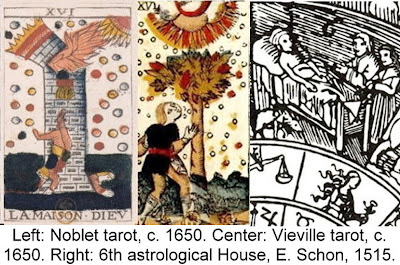
But we don't know whether the "edifice in flames" came first, or a building in flames with people falling from it. Artists copy not only from other tarot cards, but from many sources. Amiens Cathedral shows a building with people falling from it. All the artist had to do was add flames. Similarly, buildings falling down were depicted in art earlier, and all an artist had to do was add flames. Also, he doesn't distinguish between flames and lightning, an important distinction given the different names on the cards, with lightning first. Finally, lightning-struck towers with devils in them and men falling were already depicted in art before the first known evidence of the card (e.g. the Lydgate). It could just be a matter of a designer picking which features to include and which not. However it may be that the devil come out of the building is later than having him stay inside.At least I have not seen any of that type--devil emerging from building, especially a tower--before the tarot image. If it is a devil emerging from a hell-mouth, I would think there had been plenty of those around.
It remains of interest how the name "Maison-Dieu" got attached to the card. The theory that it is a mistake derived from "Casa del diaualo" is too much of a stretch, in that "a" and "e" don't look much alike, and there is also the rest of the word. "Maison-Dieu" is not a strange word in French. According to
Le Grand Robert its primary meaning was to refer to the Temple of Jerusalem. The Temple of Jerusalem would have been a prime exmple of the meaning of the card, namely, a destructive act from God, designed either as punishment for rejecting Christianity or to remind us not to trust in the things of this world. If the early meaning of the card was in any way lost, it would have been by emphasizing the former of these interpretions rather than the latter. In the Bible, lightning comes from God for both reasons: in Genesis's account of the Tower of Babel, it is the former, in the Book of Job, it is the latter. In the Book of Revelation, it seems to be both, since sometimes is not tied to any misdeeds. Since this book is the only one that mentions hail, corresponding to the circles on the card, probably the primary reference of the Tarot de Marseille and Cary Sheet card is to that event. That would fit the Vieville as well, which does not even have a tower.
Another meaning of the term "Maison-Dieu".
Robert says, was to designate the chief hospital of a town,
Robert says. It even had the meaning of "hospital" (as well as "poorhouse") in English, the Oxford English Dictionary tells us. That would fit the interpretation of the card as reminding us to detach from the things of this world. This interpretation is supported by a woodcut series by Edward Schoen, in which, if all the astrological Houses correspond to triumphs, as they seem to, the one for the house of sickness and health, showing a man in bed being visited by others, could only correspond to this card (
http://2.bp.blogspot.com/_Lu-6PwakMv0/S ... vSchon.JPG)
The term "Maison-Dieu" also meant 'House of God". That interpretation to the card would seem to be covered by the application to the Temple of Jerusalem, hospitals, and poorhouses. Churches might also be included it was no doubt true that churches, because of their steeples, were particularly susceptible to hits by lightning. Bosch has a vivid example in [iThe St. Anthony Triptych[/i] (
http://uploads2.wikiart.org/images/hier ... y-1516.jpg), possibly tarot-inspired.
But the main problem with Dummett's account is his refusal to account for its place in the sequence, despite the fact that every order has it immediately after the Devil and before the Star. I return to Piscina:
After the Demons, comes Fire, as the due mean between the stars, that are celestial, and mundane things: it is, as affirmed by Naturalists or Philosophers, the [20] element that is found before the Moon, the Sun and any other Star.
It would make sense, after being captured by the Devil, for the soul to be in the house of the Devil. But in that case the drama would stop right there, instead of being, as Piscina has it, an intermediary place, where the highest is that of Paradise. So "House of the Devil" fits Anonymous's scenario but not Piscina's. Piscina's seems to me more the fire of Purgatory (Dante had a ring of fire near the top) than of Hell, and the House of the Devil only in so far as sins are of the Devil. They must be burned away before the soul can enter Heaven. And it is not even sin that has to be burned off, but attachment to material things generally. Thus in the Book of Job, Job's sons have their houses and sheep destroyed by Satan's angels,with the approval of God. Even the Tower of Babel is sinful only in the sense of trying to protect oneself from God's will. In Boccaccio and Lydgate it is presented as a king's attempt to avoid God's punishment of a flood by building towers high enough to be above it. No devil is mentioned, but the illuminator still interprets the intent as devil-inspired in the illumination to Lydgate, which puts a devil in the tower's doorway. This attempt to evade God's will of course needs to be punished; so God sends lightning, just to show that he does not merely have floods as his disposal. It is a humbling reminder that we are not in charge of our destiny. The Book of Revelation is more of the same, in which hail and fire descend from heaven at God's will, against the good and the bad alike, as a prelude to the Last Judgment. It is a this-life (or more exactly, an imagined this-life) equivalent of Purgatory, the purging of the attachment to matter.
So also, getting sick enough to go to a hospital, or poor enough to go to the poorhouse, is another wake-up call to be ready for Judgment. Such calamities are reminders not to put stock in this world, but rather to attend to the next.
Is all this part of the "surface" meaning of the card? I do not know. But it is what is needed if it is to be part of a sequence with the Devil just before it and a Star just after. Alternatively, there is a break in the sequence here, as for Anonymous, and the card, whatever it is called, serves to direct our attention to the heavens and the supernatural power that created them. Even in depictions where the heavens are not shown, where what is happening seems to be an earthquake, our attention is drawn to the source of such power, the same source that created the "supernatural" objects that follow in the sequence.