
Who's "Marcin" ... Martin Luther ?
"Marcin" is Polish for Martin. From the Italian perspective Martin Luther might be "nearly Polish", coming east from the Elbe.
Well, it's 1526/1527 in the Triperuno, perhaps a little earlier. There were lots of religious fights in Germany.
Luther left the cloister life, as Folengo did.
Re: Dummett's "Il Mondo e L'Angelo" & More
102I am going to add four more cards, hopefully less controversial than the Popess. But if you want to continue that discussion, feel free.
Here is what Dummett says about the Love card:
In the Tarot de Marseille design, the third person on the card is made more ambiguous. We don't know if it is male or female, but it looks more female. This affords new interpretations. It couild be the choice of Hercules, a popular subject of art then and since the 15th century, and one that would have appealed to the secret societies as a subject for an initiation (so the blindfold is off, with Cupid a kind of executioner if the person makes the wrong choice). Or she could be a priestess and the scene a pagan marriage. Ricci did a painting very similar to this card with the third person as a Maenad and the marriage that of Bacchus and Ariadne (http://en.wikipedia.org/wiki/Catullus_6 ... ci_008.jpg). This again is a theme that had been popular since the 15th century, and especially with Alfonso in Ferrara. I think all we can do is take note, without saying what is an error and what is not in this new circumstance.
Another thing that needs explaining is how Love between a man and a woman triumphs over, or in any way follows after, the Pope. The usual explanation is that another story starts here. Since this break also coincides with the purely formal division between the first and second sections common to the A, B, and C orders, this is a reasonable explanation. The previous story was about the "ranks of men", a popular topic, as evidenced by the "Tarot of Mantegna" and also an early frontispiece to Petrarch's De Remidiis. To please the ladies, instead of the middle ranks it includes the female equivalents of the two highest. I can think of two other possibilities. First, the earlier story was one that came from the game of Emperors. What comes next has a different organizing principle. The second possibility is that ( we are not to interpret the cards here, meaning from the beginning through at least this Love card, as an ascent, as it were, up a ladder, each triumphing over the one before, but as a descent, starting from God and descending into material life, a descent from the most spiritual to the least spiritual. Decker takes this approach in his recent book, giving the sequence a 7x7x7 structure. It might be objected that this is not how the orders divide. But that just means that if it was the original structure, the others didn't understand it. Or else it was originally something else, and developed into this structure by the time of the Tarot de Marseille order. Decker favors the former, of course.
Let us move on to the virtues. Dummett is on familiar ground until he gets to the wings (p. 418f):
Dummett does not go into why Prudence was omitted; he has his theory, which I cannot object to, that it turned into the Popess. Another theory is that Prudence is an intellectual virtue, and the others moral virtues, considered more important for the purpose of the tarot.
He does not discuss is the order in which the virtues occur, of course (since he is only dealing with them individually). One particular order rather than another is sometimes given as a reason for preferring it as "original". In the Republic Plato discussed them in the order Temperance, Fortitude, Wisdom, Justice; and that is the order they come in the A and B orders. The C order follows Cicero; Augustine used both orders (http://en.wikipedia.org/wiki/Cardinal_virtues). Aquinas had the C order (http://catholicism.about.com/od/beliefs ... irtues.htm), but again, it probably depends on what you quote from him.
In Game of Tarot Dummett suggested a particular meaning for Justice when it is next to the Angel, that it refers to God's Justice. We might also ask whether there is a special meaning when Temperance comes after Death. Some see a reference to the Eucharist in the mixing of water and wine: the sacraments triumph over death. But if so, why does the Devil follow? For Decker (and many others) this is another break.The Devil card starts a new story. The problem here is that Dummett's purely formal examination of the orders has the break between the Hanged Man and Death. Presumably this is another place the people who came after didn't understand. In my view, given that the formal break happens between Hanged Man and Death, it is better, in the sense of giving the later designers more credit, to have a story that at least goes from Death to the Sun, and better if it also includes Angel and World.
In the A orders, the virtues come one right after the other. In the B order Temperance and Fortitude are separated by two cards, and Justice is second from the end. In the C order each is separated from the one preceding by two cards. Having the three together might mean that in life all three must be practiced at all times. A separation might suggest that different virtues are more important at different times. I would have thought that Temperance would be associated with Love, Justice with the Chariot (as triumphator, but Temperance if it is Chastity), and Fortitude with the Wheel (when adverse) or Hanged Man. The B order fits this except for Justice. The C order fits except for Temperance.
Here is what Dummett says about the Love card:
But why is the CY image definitive? Is it then a misrepresentation if someone leaves off the banners at the top of the card, or the dog at the bottom? Or Cupid's blindfold? These are all part of the meaning of that card. In some versions, there is a priest. Those cards are saying something about love, that it expresses itself in marriage. Is that a misinterpretation, or simply a new way of presenting the image with a more clearly defined meaning, considering that some cards, of which the "Charles VI" is an example, seem not to connect it with marriage? The CY seems to present love in terms of the families being joined, via their heraldics. Are we disregard the heraldics in understanding that card? These are rhetorical questions.Non occorrono molte spiegazioni per l’Amore. In tutte le versioni c’è una coppia di innamorati e Cupido in alto che punta con l’arco su di loro. A volte ci sono altre figure, a volte no. La terza figura che compare sulla versione del Tarocco di Marsiglia non sembra esìstesse nella carta incompleta del foglio della collezione Cary.
(We do not need much explanation for Love. In all versions there is a loving couple and cupid above with a bow pointing at them. Sometimes there are other figures, sometimes not. The third figure that appears on the version of the Marseilles Tarot card does not seem to exist in the incomplete Cary collection sheet.)
In the Tarot de Marseille design, the third person on the card is made more ambiguous. We don't know if it is male or female, but it looks more female. This affords new interpretations. It couild be the choice of Hercules, a popular subject of art then and since the 15th century, and one that would have appealed to the secret societies as a subject for an initiation (so the blindfold is off, with Cupid a kind of executioner if the person makes the wrong choice). Or she could be a priestess and the scene a pagan marriage. Ricci did a painting very similar to this card with the third person as a Maenad and the marriage that of Bacchus and Ariadne (http://en.wikipedia.org/wiki/Catullus_6 ... ci_008.jpg). This again is a theme that had been popular since the 15th century, and especially with Alfonso in Ferrara. I think all we can do is take note, without saying what is an error and what is not in this new circumstance.
Another thing that needs explaining is how Love between a man and a woman triumphs over, or in any way follows after, the Pope. The usual explanation is that another story starts here. Since this break also coincides with the purely formal division between the first and second sections common to the A, B, and C orders, this is a reasonable explanation. The previous story was about the "ranks of men", a popular topic, as evidenced by the "Tarot of Mantegna" and also an early frontispiece to Petrarch's De Remidiis. To please the ladies, instead of the middle ranks it includes the female equivalents of the two highest. I can think of two other possibilities. First, the earlier story was one that came from the game of Emperors. What comes next has a different organizing principle. The second possibility is that ( we are not to interpret the cards here, meaning from the beginning through at least this Love card, as an ascent, as it were, up a ladder, each triumphing over the one before, but as a descent, starting from God and descending into material life, a descent from the most spiritual to the least spiritual. Decker takes this approach in his recent book, giving the sequence a 7x7x7 structure. It might be objected that this is not how the orders divide. But that just means that if it was the original structure, the others didn't understand it. Or else it was originally something else, and developed into this structure by the time of the Tarot de Marseille order. Decker favors the former, of course.
Let us move on to the virtues. Dummett is on familiar ground until he gets to the wings (p. 418f):
As I have said, one could hardly mistake the rounded back of the chair of Temperance, in the PMB and "Charles VI" rounded in the center, and in the Cary Sheet rectangular, for wings. All I can think of is that he has confused Temperance with the Empress. In fact the virtues were sometimes represented as winged, e.g. in Venice (viewtopic.php?f=11&t=71&hilit=Venice+vi ... t=30#p1798). The only mystery is why one particular virtue--Temperance, in the Tarot de Marseille, but Justice in a few other French representations. Looking at traditional discussions of the four virtues, it seems (following Aristotle) that moderation was considered one thing that underlay the others; justice was, too (following Plato). Another possibility is that when it appears after the Death card, the virtue is more of a divine being than if it occurs before, and so likely an agent of God (as well as Temperance as a way of taking care of the physical body to stave off death). In the case of Temperance, that would mean God's grace. If the non-Tarot de Marseille representations of Justice owed something to Ferrara, which had Justice second from the highest, then that might be the explanation there as well, as God's justice (even though in these sequences she was 14th). This explanation explains both sets of wings.La Giustizia, la Fortezza e la Temperanza rappresentano, naturalmente, tre delle quattro virtù cardinali. La scelta di queste tre virtù, insieme alla Prudenza, quali virtù da cui dipendono tutte le altre è dovuta a Platone. Fu presa molto sul serio dai teologi della morale cattolica. Per costoro si tratta delle virtù naturali, il cui manifestarsi non dipende necessariamente dalla grazia; le sette virtù principali consistono in que-[end of 418]ste più le tre virtù teologali di Fede, Speranza e Carità indicate da San Paolo e per le quali è essenziale la grazia. Rappresentazioni simboliche delle virtù — molto spesso queste sette, ma talvolta con omissioni o con raggiunta di un’ottava, per esempio la Costanza — erano, naturalmente, assai comuni nel Medioevo e nel Rinascimento in Italia e altrove: un tardo esempio lo si trova nelle finestre a vetri decorati di Sir Joshua Reynolds nella cappella del New College di Oxford. Le virtù sono sempre rappresentate come figure femminili identificate da vari attributi tradizionali. Un famoso esempio è fornito dagli affreschi di Giotto nella Cappella degli Scrovegni a Padova. Si trovano anche nel Battistero di Bergamo, sulle porte — le Porte del Paradiso — del Battistero di Firenze, nella palazzina di Schìfanoia a Ferrara, in tre luoghi diversi nel Palazzo Ducale di Venezia e in molte altre località. La loro iconografia è abbastanza uniforme. La Giustizia ha sempre una spada e una bilancia. La Fortezza e rappresentata insieme a un leone o a una colonna, spesso spezzata, o a entrambi. Sul mazzo Visconti di Mo-drone e sulle carte Visconti-Sforza, sul foglio Gary, sul Tarocco di Marsiglia e su tutte le carte prodotte fuori d’Italia, la figura è rappresentata accanto a un leone. Nel gruppo ‘Carlo VI’ e nei tarocchi d’Este, sul foglio Rosenwald e nel Tarocco bolognese, nel Tarocco siciliano e nel modello più tardo delle Minchiate, è rappresentata presso una colonna; nel modello più antico delle Manchiate, ci sono sia la colonna che il leone. Una figura nell’atto di versare da un recipiente in un altro era l’iconografia consueta della Temperanza e la si ritrova in tutte le versioni della carta. Una figura che rappresenta una virtù di solito non ha le ali e non è considerata un angelo. Le ali della figura della Temperanza sulla carta del Tarocco di Marsiglia ebbero quasi certamente origine nell’errata interpretazione, da parte di un fabbricante, dell’alto schienale arrotondato di un sedile. Sul foglio Cary la figura non ha le ali ed è seduta: ritroviamo esattamente lo stesso errore, in data successiva, in versioni lombarde e piemontesi della figura della Giustizia.
(Justice, Fortitude and Temperance are, of course, three of the four cardinal virtues. The choice of these three virtues, along with prudence, as the virtues from which all others depend, is due to Plato. It was taken very seriously by Catholic moral theologians. For them they are the natural virtues, whose occurrence does not necessarily depend on grace; the seven principal virtues consist in these [end of 418] plus the three theological virtues of Faith, Hope and Charity mentioned by St Paul and for which grace is essential. Symbolic representations of the virtues - these seven very often, but sometimes with omissions or reaching an octave, for example, Constancy - were, of course, very common in the Middle Ages and the Renaissance in Italy and elsewhere: a late example is in the stained glass windows by Sir Joshua Reynolds in the chapel of New College, Oxford. The virtues are always represented as female figures identified by various traditional attributes. A famous example is provided by the frescoes of Giotto in the Scrovegni Chapel in Padua. They are also found in the Baptistery of Bergamo, on the doors - the Gates of Paradise - of the Baptistery of Florence, in the Schifanoia Palace in Ferrara, in three different places in the Palazzo Ducale in Venice and in many other locations. Their iconography is fairly uniform. Justice has a sword and a scale. Fortitude is represented with a lion or a column, often broken, or both. In the Visconti di Modrone deck and the Visconti-Sforza cards, on the Cary sheet, the Tarot of Marseilles and all the cards produced outside Italy, the figure is shown next to a lion. In the group 'Charles VI' and in the Tarot d'Este, on the sheet Rosenwald and Bolognese Tarot, Tarot in Sicily and later in the model of the Minchiate, she is represented by a column; in the oldest model of Minchiate, there are both the column and the lion. A figure in the act of pouring from one container to another was the usual iconography of Temperance and is found in all versions of the card. A figure that represents a virtue does not usually have wings and is not considered an angel. The wings of the figure of Temperance card of the Tarot of Marseilles almost certainly originated in the mistaken interpretation by the manufacturer, of the high rounded backrest of the seat. On the Cary sheet the figure does not have wings and is sitting: we find exactly the same error, at a later date, in the Lombardy and Piedmont versions of the figure of Justice.
Dummett does not go into why Prudence was omitted; he has his theory, which I cannot object to, that it turned into the Popess. Another theory is that Prudence is an intellectual virtue, and the others moral virtues, considered more important for the purpose of the tarot.
He does not discuss is the order in which the virtues occur, of course (since he is only dealing with them individually). One particular order rather than another is sometimes given as a reason for preferring it as "original". In the Republic Plato discussed them in the order Temperance, Fortitude, Wisdom, Justice; and that is the order they come in the A and B orders. The C order follows Cicero; Augustine used both orders (http://en.wikipedia.org/wiki/Cardinal_virtues). Aquinas had the C order (http://catholicism.about.com/od/beliefs ... irtues.htm), but again, it probably depends on what you quote from him.
In Game of Tarot Dummett suggested a particular meaning for Justice when it is next to the Angel, that it refers to God's Justice. We might also ask whether there is a special meaning when Temperance comes after Death. Some see a reference to the Eucharist in the mixing of water and wine: the sacraments triumph over death. But if so, why does the Devil follow? For Decker (and many others) this is another break.The Devil card starts a new story. The problem here is that Dummett's purely formal examination of the orders has the break between the Hanged Man and Death. Presumably this is another place the people who came after didn't understand. In my view, given that the formal break happens between Hanged Man and Death, it is better, in the sense of giving the later designers more credit, to have a story that at least goes from Death to the Sun, and better if it also includes Angel and World.
In the A orders, the virtues come one right after the other. In the B order Temperance and Fortitude are separated by two cards, and Justice is second from the end. In the C order each is separated from the one preceding by two cards. Having the three together might mean that in life all three must be practiced at all times. A separation might suggest that different virtues are more important at different times. I would have thought that Temperance would be associated with Love, Justice with the Chariot (as triumphator, but Temperance if it is Chastity), and Fortitude with the Wheel (when adverse) or Hanged Man. The B order fits this except for Justice. The C order fits except for Temperance.
Re: Dummett's "Il Mondo e L'Angelo" & More
103I am back to Huck's charming image and question
As Ordine says in his book, there are negative asses and positive asses. This is the positive ass, like that of Balaam. Considering that the Pope is looking at an ass with an old man, I still think that the reference is to Balaam's, although the old man is probably Jacob.
Folengo may have finished with Boccalo, but he wasn't with the ass. He reappears toward the end of Caos of Triperuno. Nuccio Ordine's long footnote on Folengo goes on for another page, in which he quotes from the ass's long speech in Caos. It is very reminiscent of the Losbook image. You can read the whole speech (as opposed to Ordine's quote, which I link to at the end of this post) in context at http://www.folengo.com/Chaos%20with%20E ... 202014.pdf. Here is a sample (not the same as what Ordine quotes, but similar):Well, it seems, that Bocalo is finished by Coccai in chapter 23, transformed into an ass by some witches. Otherwise it seems rather sure , that Bocalo was modeled according card 1 of 22 in the Tarochi game ...
As far I remember, there was something like the Fränkische Losbuch, consisting of 22x22x22x22 elements, which united for the 22th figure composition the pope with a donkey.
viewtopic.php?f=11&t=663
Can we exclude, that Folengo knew about this composition? Folengo definitely relates to something of the Tarochi sequence. He definitely uses the word Tarochi, which in 1521 was still rather new. He had contact to Ferrara around 1506, if I remember correctly.


He says a little more, about how they don't, they ride the animals they most resemble, i.e. the haughty and grand ones. At that point his listeners interrupt him, saying that if he keeps on like this he's likely to get such a beating he won't be able to carry anything. The ass says he doesn't care, because his master is God. And continues in the same vein.161
Voglio che sappiàti (diceva quello) che gli Asini e gli Bovi anchor a hanno l’ontelletto; non che lo possono havere. Di che ve ne può far chiari Esaia quando dice,Conobbe il bove il sito possessore, e l’Asino lopresepio del suosignore. 60. E David, Non vogliati, dice, divenireCavalli e Muli, esoggiungevi la ragion, perché sono (dice) senza senno e senza alch uno advedimento.
Per che Christo, humile e mansuetissimo signore e obbedientissimo figliuolo al suo Padre, non volse montare suopra gli Cavalli né suopra gli Muli, superbissimi animali e oltre a modo ostinati, ma sivoluntieri si degnò ascender e suopra il mansueto Asinello.
O beati gli Asini e vie più ch’ogni altro animale felici.
O beati quelli che Asini divengono e sono degni di portare il Re de la gloria in Gierusalem, città de li Angioli e de tutti i Santi li quali sempre veggono il Sole de la Giustiti a che rasserena le nostre menti piene d’errori oscuri e folti e sempre mirano la divina e vera bellezza, la quale gli fa in eterno beati e giulivi.
Non posso io qui tacere la soperbia e ‘l fasto di coloro che servi di Christo suoi discepoli si fannochiamare, e temo forte che siano a guisa di quelli servitori dalli quali è luntano iloro signore.61 Ma se pur di così sacro nome si vogliono gloriare, perché essi con più pompa e con maggiore fasto cavalcano più richi Cavalli et più belli Mulli che Christo mai non fece? Et perche non cavalcono essi gli Asini, come ‘l loro Maestro e signore (come dicono) gli ha dato esempio?
(“I want you to know,” he said, “that asses and oxen actually have an intellect, not just that they can have one. Isaiah can clarify this for you when he says, “The ox knew his owner’s site and the ass[knew] the manger of his Lord.” And David, “Do not wish to become horses and mules” and he added the reason, “because they are (he said) without wisdom and without judgment.”
Because Christ, most gentle and humble lord and most obedient son of his Father, did not want to get on either horses or mules, very haughty animals and extraordinarily stubborn, but he consented very willingly to mount a gentle little ass.
Oh blessed are the asses, and happier than all other animals.
Oh blessed are those who become asses and are worthy of carrying the King of glory into Jerusalem, city of the angels and of all the saints who forever see the Sun of Justice that soothes our minds full of dense and dark errors and they ceaselessly see the divine and true beauty which makes them blessed and joyful for eternity.
I cannot be silent here about the hauteur and grandeur of those who have themselves called servants and Christ his disciples, and I am much afraid that they act like those servants whose master is far from them. But even if they wish to glorify themselves with such a sacred name, why do they with more pomp and more grandeur, ride richer horses and more elegant mules than Christ did? And why don’t these [disciples] ride asses, as their master and lord (as they say) gave them the example?...
As Ordine says in his book, there are negative asses and positive asses. This is the positive ass, like that of Balaam. Considering that the Pope is looking at an ass with an old man, I still think that the reference is to Balaam's, although the old man is probably Jacob.
Yes, love. It is the positive ass celebrated by Erasmus, Folengo, and Bruno, all three. The Pope is confronted with an ass. On the one hand, he's seeing his own reflection; on the other hand, the ass is wiser than he. It's all proto-Protestantism, in the sense that Petrarch is one, too (he says in De Remediiis. the popes aren't like the ones of old, in the early church). The ass has qualities of both the Bagato and the Matto. Both are point-getters, too, along with the World and sometimes the Angel. Illustrious company. As Ordine says, "it is interesting to observe the close relationship that emerged in the Middle Ages between the festival of the ass and that of madness" (in the page Huck posted, http://a-tarot.eu/p/2014/t2-bru-02.jpg). Here is the rest of this footnote: http://1.bp.blogspot.com/-Zpvgz4A1mu0/U ... ine250.JPG. It's a pretty good book. Eugenio Garin has an excellent introduction, too. Here's the first two paragraphs: http://2.bp.blogspot.com/-UHF0n5pDRng/U ... dineix.JPG, http://4.bp.blogspot.com/-6KIDzXgD6AI/U ... rdinex.JPG22. Von der libe
About love
Prophet Jacob
King - Pope
Animal: Esel (donkey)


Re: Dummett's "Il Mondo e L'Angelo" & More
104Well,
... well, the interesting question is, if Folenfo already with the Baldus intended to play with the number 22 and in relation to the Tarocci game.
Bocalus seems to have been constructed with regard on the Magician figure from the Tarocchi game. This earler attempt might have inspired Folengo to take the Tarot game as the basic structure for his Triperuno, in a personally modified manner, full with satire and irony.
Added: Generally one has to see, that the ass was connected to the Fool with ass-ear cap.

Already Boiardo mentioned the Fool on an ass.
Bocalus seems to be an innkeeper, who took both aspects, Fool and Bagatello. And occasionally Bacchus.
... well, the interesting question is, if Folenfo already with the Baldus intended to play with the number 22 and in relation to the Tarocci game.
Bocalus seems to have been constructed with regard on the Magician figure from the Tarocchi game. This earler attempt might have inspired Folengo to take the Tarot game as the basic structure for his Triperuno, in a personally modified manner, full with satire and irony.
Added: Generally one has to see, that the ass was connected to the Fool with ass-ear cap.
Already Boiardo mentioned the Fool on an ass.
But fools became around that a fashion, likely as a sidepath of the developing book market.Mondo, da pazzi vanamente amato,
Portarti un fol su l'asino presume,
Ché i stolti sol confidano in tuo stato.
Bocalus seems to be an innkeeper, who took both aspects, Fool and Bagatello. And occasionally Bacchus.
Last edited by Huck on 16 Jul 2014, 21:33, edited 1 time in total.
Re: Dummett's "Il Mondo e L'Angelo" & More
105It is true that Caos is more developed than Baldus, especially in a spiritual way. But if by "structure" you mean the division of Caos into 22 chapters, that is not in the original that I could find, or that Maroney could verify when I emailed her. It was added by a c. 1900 editor.
Re: Dummett's "Il Mondo e L'Angelo" & More
106Now I am going to proceed with discussing Dummett's presentation of the remaining four cards in his second section: Chariot, Hermit, Wheel, and Hanged Man.
On the Chariot card. Dummet says (p. 419):
This is not to deny that some versions of the card represented triumphators. It is just that some didn't, including the earliest known. Just as there is no single "game of tarot", as Dummett stated at the beginning of his book, there is no single meaning for this card. It is not that one version is a "misunderstanding". The tarot is not one thing, but many. Just as a word has a different meaning in different contexts, so does the card. Just as the meaning of a word sometimes becomes obsolete, so does the meaning of a card. It does not become "wrong"; it is just different. It is the same as with games. Games with different rules than the ones one prefers are not played "wrongly", but differently. This is not to say that anything goes. In illustrations of Petrarch's Trionfi, it would be wrong to say that all the chariots are of triumphators. In fact none is. The figures on top are all abstract qualities.
This is also not to say, also, that any of this made any difference to the players. To them, a chariot is a chariot, triumphator's or otherwise. But who is on the chariot does make a difference to what is depicted, regardless of whether it is necessary to know it to play the game. This content might contribute to the meaning of the sequence as a whole, as a sequence of "triumphs", one triumphing over another, for someone to contemplate at his leisure.
Dummett has analyzed the differences among games, all called "tarot" or "tarocchi" or "trionfi", and what games not so far documented might have been like, with great subtlety and awareness of alternatives. In my view he should have done the same with meanings.
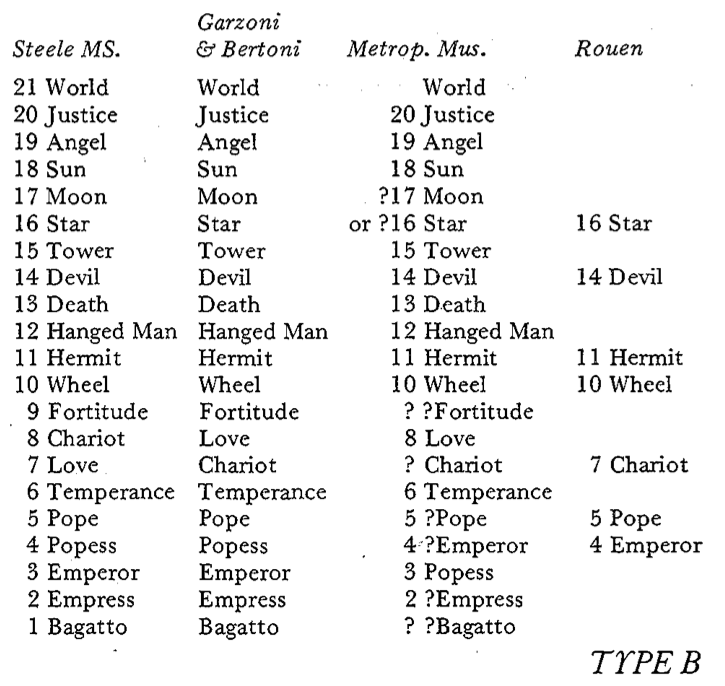
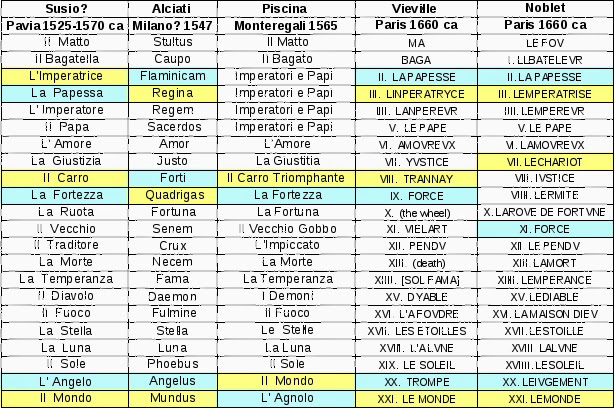
The Chariot is one of those cards that has widely different places in the order, although all within Dummett's second section. The Bolognese has Chariot before the virtues. The rest of the A or Southern order have it after (http://4.bp.blogspot.com/-YlU6F53x-_E/U ... .35+PM.png), but some are before the Wheel and some after. The Bs or Eastern all have it before the Wheel, but between Temperance and Fortitude (http://1.bp.blogspot.com/-1EdTAS9Qo6E/U ... .56+PM.png). The Cs or Western also have it before the Wheel, some before the virtues, others before all but Justice (http://2.bp.blogspot.com/-rEbZ-DxvUhs/U ... rders2.jpg). How do these variations affect the meaning? It might be to say that certain virtues are needed in order to triumph. Another might say certain virtues are needed after one triumphs. Or it is arbitrary. If the Chariot is after the Wheel, then the triumphator triumphs over fortune or because of fortune. If before, then fortune triumphs negatively over the triumphator because the next cards are unfavorable ones.
Next he discusses the Wheel of Fortune (p. 420f):
Next is the figure of an old man, called Il Gobbo or Il Vecchio in the early lists (p. 421).
While Dummett argues convincingly that the Hermit card originally was Time, that does not mean that the artist mistook an hourglass for a lantern. That would be quite an error, among people for whom attributes were immensely important. It is more likely just a different version of the card. The designer wanted to say something different at this point in the sequence. There are even different ealy titles: "time" sometimes, but more frequently "old man", to show the effects of time. But also with age might come wisdom
This is an important change, to be taken as it is presented to us. It makes the "old man" a wisdom figure when he carries the light, always a symbol of enlightenment in the sense of clarity and understanding. That is already the meaning in the B order 16th century "appropriati" that I quoted earlier (viewtopic.php?f=11&t=1019&start=90). Speaking of his heart, the poet says:
It of course was not a manufacturer's error to include the wings. "Time flies", Tempus fugit, is not a modern saying. On the 1440s Florentine cassonne lids the Triumph of Time typically has wings (http://commons.wikimedia.org/wiki/Petrarch%27s_triumphs).
Next is the Hanged Man (p. 422):
That is the end of the second section as Dummett defines it, so I will stop here.
On the Chariot card. Dummet says (p. 419):
Here Dummett has ignored the earliest known examples of the card. In the CY, the PMB, and the Issy, it is not a general or other military hero. It is a lady. As such there is a topical reference to a particular lady, such as Bianca Maria Sforza, but also an allegorical reference. Given that it follows the Love card in many orders, it could be Chastity,, as in Petrarch's poem, or a lady in whom Chastity triumphs. Dummett has already declared the Trionfi a reasonable hypothesis for inspiring the sequence. Given the wings on the PMB horse, I would think a reference to the chariots of gods and goddesses (in Plato's Phaedrus would be implied, and of such archetypal perfections as Temperance and Truth. With different colored horses, the colors might be meaningful, as the difference between dark and white are in Plato's myth.Il Carro rappresenta proprio un carro trionfale, sul quale c’è un re o un generale. Cortei trionfali, noti come trionfi, sul modello di quelli dell’antica Roma, erano fra gli svaghi preferiti nel Rinascimento italiano. Nella maggior parte dei casi, assumevano una forma puramente allegorica, talvolta religiosa, [end of talvolta secolare: elaborate raffigurazioni erano disposte su grandi carri da trainare lungo le strade. Talvolta, tuttavia, essi seguivano più da vicino il modello dei trionfi dell’antica Roma: Cesare Borgia mise in scena proprio un trionfo di questo genere dopo la presa di Urbino e re Alfonso entrò a Napoli, nel 1443, su un carro trainato da quattro cavalli bianchi e coperto da un baldacchino di tessuto d’oro. Fra le altre figure del corteo c’erano un carro con la dea Fortuna e le sette virtù a cavallo.
(The Chariot is just a triumphal chariot, on which there is a king or a general. Triumphal processions, known as triumphs, on the model of ancient Rome, were among the favorite pastimes in the Italian Renaissance. In most cases, taking a form purely allegorical, sometimes religious, [end of 419] sometimes secular, elaborate depictions were arranged on large wagons towed along the roads. Sometimes, however, they followed more closely the pattern of the triumphs of ancient Rome: Casare Borgia staged just such a triumph of this kind after the capture of Urbino; and when Alfonso became king in Naples, in 1443, on a chariot drawn by four white horses and covered by a canopy of cloth of gold. Among the other figures of the procession there were a chariot with the goddess Fortuna and the seven virtues riding.)
This is not to deny that some versions of the card represented triumphators. It is just that some didn't, including the earliest known. Just as there is no single "game of tarot", as Dummett stated at the beginning of his book, there is no single meaning for this card. It is not that one version is a "misunderstanding". The tarot is not one thing, but many. Just as a word has a different meaning in different contexts, so does the card. Just as the meaning of a word sometimes becomes obsolete, so does the meaning of a card. It does not become "wrong"; it is just different. It is the same as with games. Games with different rules than the ones one prefers are not played "wrongly", but differently. This is not to say that anything goes. In illustrations of Petrarch's Trionfi, it would be wrong to say that all the chariots are of triumphators. In fact none is. The figures on top are all abstract qualities.
This is also not to say, also, that any of this made any difference to the players. To them, a chariot is a chariot, triumphator's or otherwise. But who is on the chariot does make a difference to what is depicted, regardless of whether it is necessary to know it to play the game. This content might contribute to the meaning of the sequence as a whole, as a sequence of "triumphs", one triumphing over another, for someone to contemplate at his leisure.
Dummett has analyzed the differences among games, all called "tarot" or "tarocchi" or "trionfi", and what games not so far documented might have been like, with great subtlety and awareness of alternatives. In my view he should have done the same with meanings.
The Chariot is one of those cards that has widely different places in the order, although all within Dummett's second section. The Bolognese has Chariot before the virtues. The rest of the A or Southern order have it after (http://4.bp.blogspot.com/-YlU6F53x-_E/U ... .35+PM.png), but some are before the Wheel and some after. The Bs or Eastern all have it before the Wheel, but between Temperance and Fortitude (http://1.bp.blogspot.com/-1EdTAS9Qo6E/U ... .56+PM.png). The Cs or Western also have it before the Wheel, some before the virtues, others before all but Justice (http://2.bp.blogspot.com/-rEbZ-DxvUhs/U ... rders2.jpg). How do these variations affect the meaning? It might be to say that certain virtues are needed in order to triumph. Another might say certain virtues are needed after one triumphs. Or it is arbitrary. If the Chariot is after the Wheel, then the triumphator triumphs over fortune or because of fortune. If before, then fortune triumphs negatively over the triumphator because the next cards are unfavorable ones.

Next he discusses the Wheel of Fortune (p. 420f):
But is any of the meaning lost by portraying all three as animals? If animals connote stupidity, then the meaning is the same, to the extent they are portrayed as animal. In fact on the Tarot de Marseille II the top and downward-moving figures have human faces (examples at http://leefitzsimmons.com/esotericon/im ... Trumps.png), just as they do, with more human features, in earlier depictions. If the fourth on the ground, in the Metropolitan (see http://2.bp.blogspot.com/_Lu-6PwakMv0/S ... talian.jpg) is fully human, that means that to be fully human is to be without worldly ambitions.Depictions of the Wheel that fail to include the fourth figure do miss an important feature. Then if the one going up has the head of the ass, that means he is full of stupid ideas. If the one going down has a human head, that means he has learned something about ambition, if only he uses his head and not his lower parts. Ariosto wrote a poem (http://www.letarot.it/page.aspx?id=199&lng=eng):The Wheel of Fortune was an extremely popular subject in the Middle Ages and the Renaissance. The idea comes from the De Consolatione Philosophiae by Boethius. It is found in several medieval manuscripts; I saw it in high relief on the outer wall of a French church and, as frescoes, inside of two churches in England and one in Sweden. The oldest versions of the card, such as the Brambilla and Visconti-Sforza decks, are perfectly clear; the way they depict the subject agrees exactly with what is found in the Swedish church and in several manuscripts. La Fortuna is standing on her spinning wheel, to which are attached four human figures. One is rising at the left; one at the top, and wears the crown is at the height of his fortune; one on the right is in decline, and the fourth, down, reached the nadir. A rough Latin hexameter is located in at least two medieval sources and bears the words of the four figures in the above order: "Regnabo - Regno - Regnavi - Sum sine regno" ("I will reign – I reign - I reigned – I am without reign"). In the Visconti-Sforza card rolls containing these words come from the mouth of the four figures; the same happens in the 'Budapest' deck of popular Ferrara tarots (of which the Museum of Budapest and the Metropolitan Museum in New York have uncut sheets). The figure of Fortune appears only on the hand-painted cards; Despite her absence, the symbolism has been well preserved in the Bolognese Tarot and Tarot in Sicily. In the Tarot of Marseilles, on the other hand, it has been virtually destroyed. In older versions, the three top figures often wear the ears or tail of an ass; This is to symbolize the stupidity of their worldly ambitions, the satisfaction of which is transient. The intention behind this detail was not to represent the figures on the Wheel as non-human; [end of 420] unfortunately, the French manufacturers were misled and induced to transform them into animals of various species, making completely pointless the entire depiction.)


In that sense, only the Metropolitan card (of Ariosto's time and place) gets the full meaning. The original version only counsels as to the instability of power, and could just as well be a lesson to monarchs to be wary of those with ambition. The story of Filippo Visconti and his Wheel of Fortune, together with his beheading of his wife, when she used her position without consulting him, suggests such an interpretation.Quella ruota dipinta mi sgomenta
ch'ogni mastro di carte a un modo finge:
tanta concordia non credo io che menta.
Quel che le siede in cima si dipinge
uno asinello: ognun lo enigma intende,
senza che chiami a interpretarlo Sfinge.
Vi si vede anco che ciascun che ascende
comincia a inasinir le prime membre,
e resta umano quel che a dietro pende.
(That pictured wheel, I own, annoys me sorely,
Which every master paints in the same way,
And such agreement I believe is not a lie,
When that which sits aloft they make an ass.
Now everyone may understand this riddle,
Without the sphinx to interpret;
For, mark well, each, as he climbs,
begins to Assify his upper members,
Those below remaining human still.)
Next is the figure of an old man, called Il Gobbo or Il Vecchio in the early lists (p. 421).
In Petrarch's Trionfi poem, the Triumph of Time is the fifth of six, occuring almost at the end. In all orders of the tarot, hwoever, he occurs before the Death card. I do not think that counts against the idea that the card comes from the poem. Nor does it mean that the deck designer didn't really know the order of the triumphs there. It is merely a different interpretation of Time. It is not that which defeats Fame, but rather that which defeats the vigor of the military victor or young person triumphing over their passions, and is also the framework in which the Wheel operates, allowing her to perform her tricks. It is in the right place for that allegorical meaning.L’Eremita è la prima carta la cui interpretazione non è del tutto chiara. In tutte le versioni posteriori, la figura rappresenta un religioso, un eremita o un frate, talvolta con un rosario; in alcuni mazzi del Tarocco di Besangon è chiamato «le Capucin» (il Cappuccino). Questa idea non ha riscontro nei nomi dati alla carta nelle fonti quattro-cinquèncentesche. La figura è sempre anziana, come indica il nome ‘il Vecchio’, e ha sempre un bastone o delle grucce. Nella versione bolognese, già nel foglio Beaux Arts, ha le ali, ma questo tratto manca in tutte le altre versioni ed è forse dovuto a un errore da parte di uno dei primi fabbricanti. Su tutte le versioni dipinte a mano di questa carta che ci sono pervenute — quelle nei mazzi Visconti-Sforza, ‘Carlo VI’ e di Catania — il vecchio regge una clessidra. La reggeva anche nei modelli del Tarocco siciliano, sia nel modello più antico che in quello più recente, finché la ditta Modiano non la trasformò in una lampada a olio. Sulla carta del mazzo delle Minchiate, nei modelli più antichi così come in quelli posteriori, la clessidra non sta in mano alla figura, ma è sospesa, trafitta da una freccia, sopra le spalle del vecchio. In molte versioni, egli porta una lanterna invece di una clessidra: questo vale per il ‘mazzo Budapest’, per la carta antica milanese della Bibliothèque Nationale e per quella nel mazzo di Catelin Geoffroy, oltre che per il Tarocco di Marsiglia. Alcune versioni, come la bolognese, quella del foglio Rosenwald e quella del Tarocco belga, non presentano né la clessidra né la lanterna.
Presumibilmente, uno di questi due tratti era quello originario e cominciò presto ad essere scambiato per l’altro. Teofilo Folengo e Troilo Pomeran chiamano la carta «il Tempo»: se questo è il significato originario, allora il vecchio doveva reggere la clessidra. Ciò concorda con l’interpretazione nel mazzo classicheggiante della collezione Leber. Qui la carta mostra, un uomo barbuto con una falce, ritto con un piede sopra una clessidra. Si tratta presumibilmente di Saturno, l’equivalente romano del dio greco Cronos (identificato con chronos, il tempo), che aveva fra i suoi attributi la falce. Comunque, egli rappresenta il tempo, come indica la scritta «kerum edax», tratta [end of 421] dalla frase di Ovidio «tempus rerum edax» («il tempo, divoratore delle cose»). Questa interpretazione coglie esattamente l’idea da cui ebbe origine la carta: il Tempo rappresenta un soggetto molto meglio definito di un altrimenti ìmprecisato vecchio o anche di un eremita. Nel mazzo di Geoffroy del 1557 il vecchio porta il rosario alla cintura e quindi furono probabilmente i fabbricanti francesi ad attribuirgli per primi un carattere religioso; di questo non c’è alcuna indicazione nelle carte italiane prima dei mazzi settecenteschi derivati dal Tarocco di Marsiglia. È più facile scambiare una clessidra per una lanterna che viceversa: è proprio l’errore che ha commesso la ditta Modiano ài giorni nostri. Dal ‘mazzo Budapest’ e dalla carta della Bibliothèque Nationale, apprendiamo che Terrore era già stato commesso nel tardo Quattrocento; ma possiamo dare per certo che questa carta doveva, in origine, rappresentare il Tempo.
(The Hermit is the first card of which the interpretation is not entirely clear. In all later versions, the figure represents someone in a religious prder, a hermit or a monk, sometimes with a rosary; in some decks of the Tarot of Besancon he is called "le Capucin’. This idea is not reflected in the names given to the card in four 16th century sources. The figure is always old, as the name 'il Vecchio’ indicates, and always has a staff or crutches. In the version of Bologna, already in the Beaux Arts sheet, he has wings, but this part is missing in all the other versions and is possibly due to an error by one of the first manufacturers. On all hand-painted versions of this card that have come down to us - those in the Visconti-Sforza decks, 'Charles VI' and Catania - the old man is holding an hourglass. The holding is also in the models of the Sicilian Tarot, which is the oldest model in the more recent ones, although the so-called Modiano transforms it into an oil lamp. On the card of the Minchiate pack, in the older models as well as the later, the hourglass is not in the figure's hands, but is suspended, pierced by an arrow, above the shoulders of the old man. In many versions, he carries a lantern instead of an hourglass: this applies to the 'Budapest deck', for the old card of the National Library in Milan and the one in the Catelin Geoffroy deck as well as the Tarot of Marseilles. Some versions, such as that of Bologna, the one of the Rosenwald sheet and that of the Belgian Tarot, have neither the hourglass nor the lantern.
Presumably, one of these two traits was the original one, and they soon began to be mistaken for each other. Theophilo Folengo and Troilo Pomeran call the card "Time": if this is the original meaning, then the old man had to hold the hourglass. This agrees with the interpretation of the classical deck in the Leber collection. Here, the card shows a bearded man with a scythe, standing with one foot on an hourglass. It is presumably Saturn, the Roman equivalent of the Greek god Cronos (identified with chronos, time), which had among its attributes the scythe. However, he represents time, as indicated by the inscripton "kerum edax", taken [end of 421] from Ovid's phrase "tempus rerum edax" (time devourer of things). This interpretation captures exactly the idea from which the card originated: Time is a subject much better defined than an otherwise imprecise old man or even a hermit. In the 1557 Geoffroy pack the old man carries a rosary on his belt. and thus the French manufacturers were probably the first to attribute a religious character to him; there is no indication of this in the cards of the first eighteenth-century Italian decks derived from the Tarot of Marseilles. It is easy to mistake an hourglass for a lantern and vice versa: it is precisely the mistake that the Modiano company has committed in our day From the 'Budapest deck' and the card's Bibliotheque Nationale, we learn that the error had already been committed in the late fifteenth century; but we can be sure that this card was originally intended to represent time.)
While Dummett argues convincingly that the Hermit card originally was Time, that does not mean that the artist mistook an hourglass for a lantern. That would be quite an error, among people for whom attributes were immensely important. It is more likely just a different version of the card. The designer wanted to say something different at this point in the sequence. There are even different ealy titles: "time" sometimes, but more frequently "old man", to show the effects of time. But also with age might come wisdom
This is an important change, to be taken as it is presented to us. It makes the "old man" a wisdom figure when he carries the light, always a symbol of enlightenment in the sense of clarity and understanding. That is already the meaning in the B order 16th century "appropriati" that I quoted earlier (viewtopic.php?f=11&t=1019&start=90). Speaking of his heart, the poet says:
In the Tarot de Marseille, there are suns on his robe or in the window, setting or rising. The setting sun means the end of life, but the beginning of a new life after death. The rising sun is the new life, before or after death. In the context of secret societies, he could be an initiatory figure, leading the one undergoing initation toward his new birth. Here the variant spelling, on some versions of the Tarot de Marseille II (e.g. Conver) is significant: "L'Hermite" rather than "L'Ermite" deniably suggests a Hermetic (the cards are at http://www.tarotforum.net/showpost.php? ... stcount=10).Il Gobbo gli fa luce acciò la Ruota
Per forza lo conduce in man d'Amore...
.
(The Hermit [literally, hunchback] lights its path until the Wheel
with force leads it into the hands of Love...)
It of course was not a manufacturer's error to include the wings. "Time flies", Tempus fugit, is not a modern saying. On the 1440s Florentine cassonne lids the Triumph of Time typically has wings (http://commons.wikimedia.org/wiki/Petrarch%27s_triumphs).
Next is the Hanged Man (p. 422):
This intepretation misses an important fact about the first known version of the card, in the PMB, namely, that Muzio was not in fact a traitor, at least in the eyes of the Sforza family: he was unjustly accused by an anti-pope (or possibly a story was invented by Sforza's opponents, as some have speculated). His switching of allegiences helped to end the schism that had been plaguing the Church at that time. Moreover, Muzio was the honored grandfather of the ruling family of Milan, a figure of new life in that sense as well. These facts are suggested in the hole in which the Hanged Man's head hangs, like a seed about to be lowered into the ground, dying to bring forth new life. His head of hair suggests a halo, his legs are green, the color of fertility in these cards (e.g. the woman in the Love card and all the Baton courts). Moreover, the position of hanging upside down is that in which St. Peter, the rock upon which the Church was built, was crucified. All of this tends to make the Hanged Man a positive figure. There is also the form that the legs take, tentatively suggesting a cross. I do not know if there is a meaning. Most "shame paintings" I know about do not have or mention this feature. And in France, where they were unknown, it probably have been taken as a symbol of Christ. That this symbolism was understood in this way and passed on in the later versions of the card is suggested by the continuation of just these particular features (not shared by the 'Charles VI' version), in the Tarot de Marseille, and in addition, in the Tarot de Marseille II the presence of 12 notches on the poles beside him, suggesting the 12 apostles.(More cautiously, the Tarot de Marseille I only has 11, I think to suggest that the hanging one is Judas; see http://www.tarotforum.net/showpost.php? ... stcount=11.) Indeed the number 12 is itself ambiguous: it can represent the 12th disciple, i.e. Judas, or it can represent the 12 disciples as a group, with Christ in their center. Usually it was the 12th card of the sequence; in the A cards in fact it was the 13th. It is this ambiguity, between Jesus and Judas, that gives the Tarot de Marseille card its mysterious quality, I think. However in most A and B cards he is unambiguously Judas, identified by the title "traditore" and the money bags that he clutches and that weigh him down, pointing him toward hell rather than heaven. In the Charles VI, he does not even have his legs crossed. The mystery is absent.L’Impiccato è parso a molti il più ambiguo e affascinante di tutti i trionfi; è stato ritenuto profondamente misterioso il fatto che, in tutte le versioni tranne la siciliana, la figura sia appesa per il piede anziché per il collo. Il simbolismo, tuttavia, sarebbe stato immediatamente comprensibile per qualsiasi italiano del Rinascimento, data la consuetudine di vituperare i traditori dello stato ritraendoli proprio in questa posizione, cioè appesi per un piede: talvolta, infatti, dopo l’esecuzione, il corpo del traditore veniva appeso in questo modo. Ciò spiega il nome «il Traditore» frequentemente usato nelle fonti antiche. Il papa ordinò che Muzio Attendolo, il condottiero padre di Francesco Sforza, fosse ritratto in questo modo su tutti i ponti e cancelli di Roma con una scritta che lo definiva un traditore. Analogamente, i muri del Bargello di Firenze erano spesso pavesati di ritratti di nemici dello stato appesi a testa in giù; alcuni, ricordati dal Vasari, furono dipinti da Andrea del Castagno e gli valsero l’appellativo di «Andrea degli Impiccati». Gli studi preparatori per questi dipinti si trovano ora alla Galleria degli Uffizi; anche in Botticelli ricorre questo tema. Allo stesso modo, Ludovico il Moro, l’ultimo duca di Milano della famiglia Sforza indipendente da potenze straniere, commissionò un ritratto da esporre sui muri del Castello, in cui Bernardino da Corte, che lo aveva tradito con i Francesi, è raffigurato impiccato per il piede.
(The Hanged Man has seemed to many to be the most ambiguous and fascinating of all the triumphs; the fact that in all versions except the Sicilian, the figure is hanging from the foot rather than by the neck, was felt to be deeply mysterious. The symbolism, however, would be immediately understandable to anyone of the Italian Renaissance, given the customary dishonoring their own state traitors by portraying them in this position, that is, hanging by one foot: sometimes, in fact, after the execution, the body of the traitor was hung in this way. This explains the name "Traitor" frequently used in the ancient sources. The pope ordered that Attendolo Muzio, the leader Francesco Sforza's father, be portrayed in this way on all the bridges and gates of Rome with an inscription describing him as a traitor. Similarly, the walls of the Bargello in Florence were often adorned with portraits of enemies of the state hung upside down; some, mentioned by Vasari, were painted by Andrea del Castagno and earned him the nickname 'Andrea of the Hanged". The preparatory studies for these paintings are now in the Uffizi Gallery; Botticelli also uses this theme. Similarly, Ludovico il Moro, Duke of Milan, the last of the Sforza family independent of foreign powers, commissioned a portrait to be exhibited on the walls of the castle, in which Bernardino Court, who had betrayed him to the French, was depicted hanged by the foot.
That is the end of the second section as Dummett defines it, so I will stop here.
Re: Dummett's "Il Mondo e L'Angelo" & More
107Not sure about 'Luna' being interpreted Lunatic (lunatico/lunatica) there, it seem a rationalization, an interpretation based on trying to make sense of an ambiguous, difficut to parse line. I think it is more along the lines of 'the popesse will ensure the moon' (which I rationalize / try to make sense of as meaning the Pope(sse) will favour or ensure by his/her actions victory or advantage to the Turks).
But these popes and emperors that I have
make so that my Papesse wants to be
a Lunatic, and I want to hang myself.
Re: Marcin -- it is Polish for Martin, but I was taking it as an unusual form of 'Marci', St. Mark, a reference to Venice (considering Falcone may be Grifalcone of Venice). It could be Martin, though I wonder why the Polish version, if considering the Pope may be more concerned with countering Martinism than the Turks?
Re: Hanged Man as 'shame painting' -- in Petrarch 'fear of shame' is part of Chastity's train (as well as desire for honour - temperance as Fama?)
Bella Accoglienza, Accorgimento fore,
Cortesia intorno intorno e Puritate,
Timor d'infamia e Desio sol d'onore,
Gracious Geniality and Forsight at her side,
Courtesy and Purity all around,
Fear of shame and Desire for only honour,
re: 'Time' -- in Petrarch's poem itself (rather than illustrations thereto) the symbol for Time is the Sun -- so if we consider the Sun trump (or Star, Moon & Sun) as the symbol(s) for the Triumph of Time, then there is room for the 'old man' to reflect another nuance.
The Poet as an Old Man, reflecting upon Time as symbolized by the endless wheel of the Sun, and who comes to see himself as 'in a mirror', maybe taken as a symbol of 'foresight/prudence', and thus with with the virtues (and the traitor as 'the fear of shame') belongs with the Triumph of Chastity, as in the first of the three lines above.
But he that thoughtfully considers it
will see it so. Why did I not, of old?
Wherefore I now am wroth against myself.
I followed then my hopes and vain desires,
But now with mine own eyes I see myself
As in a mirror, and my wanderings,
Considering now the brevity of life,
And striving to make ready for the end:
This morn I was a child, and now am old.
...
And now I see how fleeting is my life?
Nay more, the life of all--and in the flight
Of the Sun the manifest ruin of the world.
Take comfort, then, in your imagined tales,
Ye that are young: give yourselves many years!
A wound that is foreseen brings lesser grief.
It may be that I spend my words in vain,
But I declare that ye are suffering
From perilous and deadly lethargy.
For days and hours and years and months fly on,
Nor can the time be far away when we
Must all together seek out other worlds,
Pray harden not your hearts against the truth
As ye are wont to do; and turn your eyes
While ye may yet amend your sinful ways.
Delay not, as most mortals do, until
Death shall transfix you with his fatal dart:
Infinite, truly, is the throng of fools.
[Trans. by ?]
SteveM
Last edited by SteveM on 18 Jul 2014, 08:26, edited 5 times in total.
Re: Dummett's "Il Mondo e L'Angelo" & More
108MikeH wrote:
Here's the edition of 1546. Maybe there's a way to make the intersections in a different way. At least the Selva are rather clear.
Possibly one has to go through it in detail.
Ann E. Mullaney should be the name the worthy translator ... :-) ... I also tend to write it wrong.
She has made a webpage to Folengo:
http://www.folengo.com/
Steven wrote
And we don't know, how Italians perceived people from the NorthEast of Germany. Maybe 16th century Italians counted "East of the Elbe" to the states of the Deutscher Ritter Orden, from which parts indeed had become more or less Polish after the defeats at the begin of 15th century (Tannenberg 1408).
http://en.wikipedia.org/wiki/Battle_of_Grunwald
Even Bavarians still nowadays observe the region with suspicion ... :-) ... maybe cause of the Prussian-Bavarian war in the 1860s, but maybe also, that this has deeper routes going back to Roman times. ... :-) ... in Cologne the other side of the Rhine is still called the "schäl sick", which is a derogative statement for the less developed part. Thanks to the Romans the important cities are more or less all at the left (Roman) side of the Rhine, with the exception of Düssedorf. Specific viewing points can be rather enduring through the centuries.
But maye you're right. St. Markus is another possibility.
http://books.google.de/books?id=nyQ8AAA ... &q&f=falseIt is true that Caos is more developed than Baldus, especially in a spiritual way. But if by "structure" you mean the division of Caos into 22 chapters, that is not in the original that I could find, or that Maroney could verify when I emailed her. It was added by a c. 1900 editor.
Here's the edition of 1546. Maybe there's a way to make the intersections in a different way. At least the Selva are rather clear.
Possibly one has to go through it in detail.
Ann E. Mullaney should be the name the worthy translator ... :-) ... I also tend to write it wrong.
She has made a webpage to Folengo:
http://www.folengo.com/
Steven wrote
We don't know the possibly difficult situation of early Italians with a Protestant orientation. Perhaps Marcin was a hiding code word.Re: Marcin -- it is Polish for Martin, but I was taking it as an unusual form of 'Marci', St. Mark, a reference to Venice (considering Falcone may be Grifalcone of Venice). It could be Martin, though I wonder why the Polish version, if considering the Pope may be more concerned with countering Martinism than the Turks?
And we don't know, how Italians perceived people from the NorthEast of Germany. Maybe 16th century Italians counted "East of the Elbe" to the states of the Deutscher Ritter Orden, from which parts indeed had become more or less Polish after the defeats at the begin of 15th century (Tannenberg 1408).
http://en.wikipedia.org/wiki/Battle_of_Grunwald
Even Bavarians still nowadays observe the region with suspicion ... :-) ... maybe cause of the Prussian-Bavarian war in the 1860s, but maybe also, that this has deeper routes going back to Roman times. ... :-) ... in Cologne the other side of the Rhine is still called the "schäl sick", which is a derogative statement for the less developed part. Thanks to the Romans the important cities are more or less all at the left (Roman) side of the Rhine, with the exception of Düssedorf. Specific viewing points can be rather enduring through the centuries.
But maye you're right. St. Markus is another possibility.
Re: Dummett's "Il Mondo e L'Angelo" & More
109Yes,* she translates it 'little Mark', I presume then she is taking the final 'n' as a (affectionate?) diminutive (little) of Marci (Mark)?Huck wrote: Ann E. Mullaney should be the name the worthy translator ...... I also tend to write it wrong.
She has made a webpage to Folengo:
http://www.folengo.com/
I can't find any examples of Italians referring to Martin as Marcin.
In Folengo's final sonnet, Love and Death converse with one another, one saying to the other:
Per qual Giustitia (disse) a te si rese
Né Papa mai, né s’è, Papessa alcuna?
Rispose, chi col Sol fece la Luna
Tolse contra mie Forze lor diffese.
"By what Justice" (he said) “to you is rendered
Neither a Pope ever, nor hath any Papesse?”
He replied, “He who with the Sun made the Moon
Took their defense against my Forces."
It is not clear which is speaking, if it is to Love that neither the Pope(sse) submits, then I presume they are representing here Chastity? If it is to Death they do not submit, then Faith (in which one has eternal life)?
SteveM
*Note it is her draft translation online -- her time was then spent mostly on finalizing Baldus ready for publication.
Re: Dummett's "Il Mondo e L'Angelo" & More
110The conflation of Temperance with Fama would then explain its placement after death:SteveM wrote: Re: Hanged Man as 'shame painting' -- in Petrarch 'fear of shame' is part of Chastity's train (as well as desire for honour - temperance as Fama?)
Bella Accoglienza, Accorgimento fore,
Cortesia intorno intorno e Puritate,
Timor d'infamia e Desio sol d'onore,
Gracious Geniality and Forsight at her side,
Courtesy and Purity all around,
Fear of shame and Desire for only honour,
re: 'Time' -- in Petrarch's poem itself (rather than illustrations thereto) the symbol for Time is the Sun -- so if we consider the Sun trump (or Star, Moon & Sun) as the symbol(s) for the Triumph of Time, then there is room for the 'old man' to reflect another nuance.
The Poet as an Old Man, reflecting upon Time as symbolized by the endless wheel of the Sun, and who comes to see himself as 'in a mirror', maybe taken as a symbol of 'foresight/prudence', and thus with with the virtues (and the traitor as 'the fear of shame') belongs with the Triumph of Chastity, as in the first of the three lines above.
0-6 - Triumph of Love
Chariot/Virtues/Old Man/ Hanged Man (and possibly the Wheel as a theme of Vanitas/Fall of Princes) - Triumph of Chastity
Death - Triumph of Death
Temperance/Fama - Triumph of Fame
Star/Moon/Sun - Triumph of Time
Judgment (the death of death)/World - Triumph of Eternity