THE ALCHEMICAL HANGED MAN
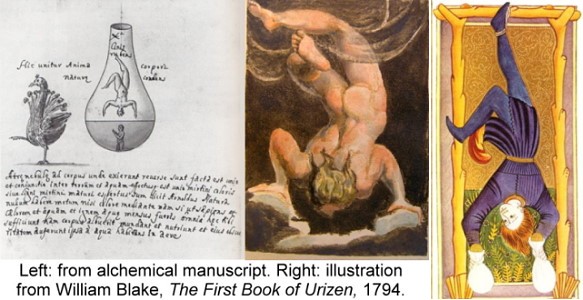
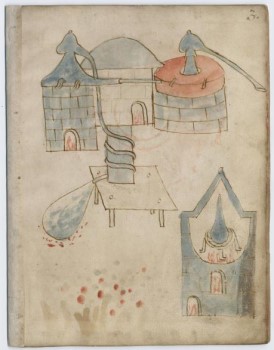
One early alchemical image (above left; Laurinda Dixon,
Bosch, from ms. 29, Wellcome Institute) associates the image of an upside down man with the process of distillation. The substance to be distilled was first in solution, then with heat converted to a gas. In non-alchemical contexts, the substance released was often alcohol, which cooled and collected in coiled tubing leading to a different container. The result was a higher concentration of alcohol in the liquid. For the alchemists, the process would have been purification through repeated attainment of the gaseous state. Anyone who breathed the alcohol-rich fumes was easily inebriated. A similar effect might have been produced by hyperventilating or hanging upside-down. Dixon associates the alchemical image with ones in Bosch's
Garden of Earthly Delights of men hanging upside-down and appearing in ecstatic states. Such a "high," without the alcohol but with whatever substance was in the berries his people are shown eating.
The alchemists' association with the gaseous state, i.e. entering the element of Air, seems to have been known by William Blake, who used a similar image to that of the alchemists in his personification of the element of Air in his
Book of Urizen (at least David Erdman,
The Illuminated Blake, p. 196, says it is what we are seeing, top of post, right). The personification is named Thuriel, one of the four "sons of Urizen."
The Charles VI Hanged Man's (at right above) adoption of the same leg positions may originally have derived from the same tradition, suggesting purification. But the addition of the money bags makes it something else, a Judas figure, which is alchemical only with great difficulty. I will discuss that view at the end of this post.
Now I want to built on some remarks of O'Neill's about some alchemical texts. Looking at the two poles as trees, he refers to images of alchemists in trees, or even becoming trees. He sees trees as maternal images; to be in or turning into a tree is then equivalent to Attis emasculating himself at the base of a symbol of the Great Mother. However, trees were a common medieval image; climbing a tree was like climbing a ladder, meaning a spiritual ascent.
O'Neill (
Tarot Symbolism p. 281) relates the Hanged Man to a short medieval poem, the "Epigram of the Hermaphrodite,} an alchemical allegory of about 1150. Jung quoted it in paragraph 89 of
Mysterium Coniunctionis and attributed it to Mathieu de Vendome (ca. 1150). Jung found it in Lorichius,
Aenigmatum libri III, fol. 23r, Frankfurt 1545:
When my pregnant mother bore me in her womb,
they said she asked the gods what she would bear.
A boy, said Phoebus, a girl, said Mars, neither, said Juno.
And when I was born, I was a hermaphrodite.
Asked how I was to meet my end, the goddess replied: By arms;
Mars: on the cross; Phoebus: By water. All were right.
A tree overshadowed the waters, I climbed it;
the sword I had with me slipped, and I with it.
My foot caught in the branches, my head hung down in the stream;
And I--male, female, and neither--suffered by water, weapon, and cross.
Since the poem has to do with the hermaphrodite, O'Neill, like Jung, considers it an alchemical poem. O'Neill connects it with an alchemical image of the alchemist confronting himself, or a fellow alchemist, hanging upside down in a tree (at left below). (Images from Johann Daniel Mylius,
Opus medico-chymicum, 1618. In de Rola,
Golden Game p. 144, or Fabricius,
Alchemy fig. 29, p. 20. De Rola's translation of mottos is on his p. 152.)
According to de Rola, the motto of the first image is "This knowledge requires a true Philosopher not a foolish one." The second image, like the first one, suggests peril, although oddly, the upside down alchemist seems to be doing well. The moral, according to the words around the circle is, "It is not for Man's industry alone, but in God's hands, to will and encompass All in All." In other words, success is up to God and not man.
O"Neill concludes that from an alchemical perspective
The Hanged Man basically represents the intensification of the blackening stage which began with the Hermit. The glory of the first coniunctio has faded into darkness and despair...Now at last he is ready for the total surrender which is implied in the Hanged Man. ... The Hanged Man is the stage of surrender which prepares the alchemist for the mystical death which follows" (p. 282).
What O'Neill, and Jung before him, had in mind is a kind of
imitatio Christi in which the alchemist experiences rejection and failure, leading to death. It is like Christ on the cross saying "My God, My God, why hast thou forsaken me?" The alchemical poem explicitly brings out the analogy, in saying that the hermaphrodite is dying on the cross. The cross of the crucifixion was commonly referred to as a tree.
I agree with this line of thinking. However it is a state of intense connection with the other world as well as despair in this one. It is like the state of the visionary melancholic that I discussed in connection with the Hermit, but more intense.
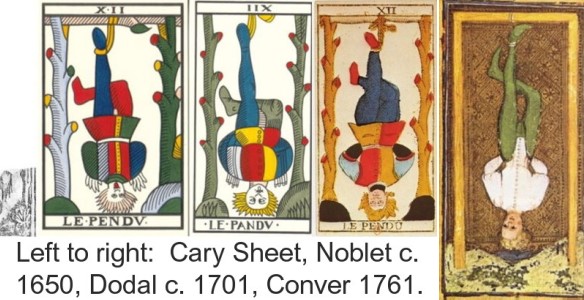
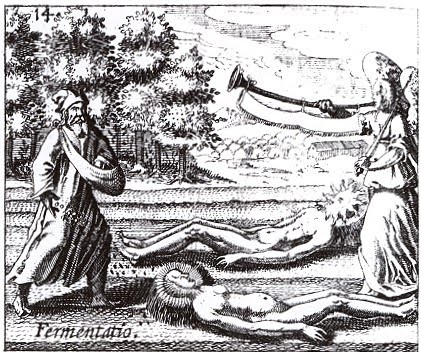
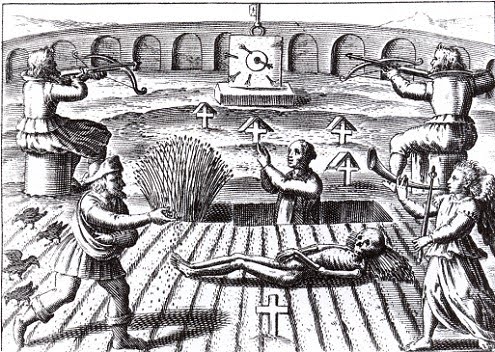
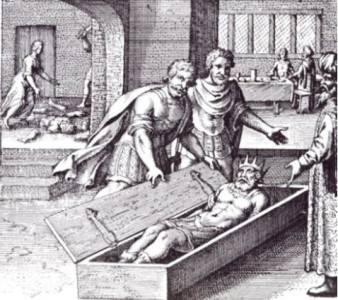
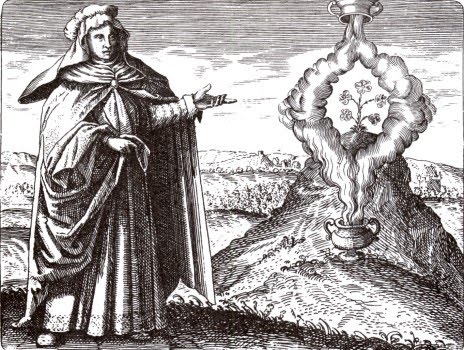
Along the same lines as O'Neill, another detail on the card interests me: the hole into which his head extends. This hole exists on all the Milan-descended images, from the PMB (at right above) to the Cary Sheet (at left, all that is preserved of it) to the various Marseille-style images (for Noblet and Dodal, I am using Flornoy's restorations, because I want to make a point later about the colors, which have faded on the originals). It seems to me that the Hanged Man is like a seed being planted in the earth. It is the death that will bear rich fruit. Alchemical images make this same comparison, for example (Upper image from Mylius,
Philosophia Reformata, 1622, emblem 14. In de Rola p. 171. Lower image from Michael Maier,
Tripus aureus 1618. In de Rola p. 122. De Rola's discussion is on his p. 125f).
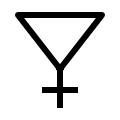
In both images, the stage of the work is that called "fermentation." A dead seed in the earth will bring forth new life, as something that will happen to it rather than its birthing itself by its own efforts. In the second image above, notice the shape of the crosses on the graves: a triangle on top of a cross. In alchemy a similar shape, but with the triangle inverted, is the symbol for sulphur, the masculine principle, to which the tarot Emperor also conforms.
The Hanged Man, if we consider just his legs and his torso, is merely the Emperor upside down--also younger and without the Emperor's beard, but usually, in the Marseille versions, with the same color leggings, including the same different colors when they are different from each other. Below I have situated the three "Marseille" Emperors in the same order as earlier I put the "Marseille" Hanged Men.
I looked up sulfur--the real chemical, not the "philosophical" one--on the Internet. It is a vital ingredient in plants, and the soil naturally does not have enough of it. Adding sulphur compounds to the soil promotes the development of the young plants. So there is a genuine chemical basis for the symbolism. Putting the Emperor in the soil brings about new life.
In the PMB, correspondingly, the Hanged Man has green leggings, the same green as on the PMB female Lover's sleeve, the Empress's, the Queen of Cups', and those of all the court figures in Batons. Green in the PMB is a fertility symbol.
In connection with these images, De Rola cites two biblical verses that connect well to this aspect of the Hanged Man:
"Verily, verily I say unto you, Except a corn of wheat fall into the ground and die, it abideth alone: but if it die, it bringeth forth much fruit." (John 12:24).
"Thou fool, that which thou sowest is not quickened, except it die: and that which thou sowest, thou sowest not that body that shall be, but bare grain, it may chance of wheat, or of some other grain: But God giveth it a body as it hath pleased him, and to every seed his own body." (I Corinthaians 15.36-38).
(One slight correction: The sense of the last three words should be "its own body," as in Douhay-Rheims and other translations since the King James.) De Rola observes that from these verses came the alchemical axiom, "No generation without prior corruption. " Even then, what happens is in God's hands. By ourselves, we are simply dead. Then the hermaphroditic Mercury impaled on the tree is a symbol not just of a tortuous death, but of the resurrection to come, made possible by Jesus's death, which is what the PMB figure is, with his green leggings, and the Marseille as well, more ambiguously.
I know that this card was the card of the traitor, the twelfth card for the twelfth apostle. But in the case of the PMB, there is a twist. This card was almost certainly made for the Sforza children, and their own grandfather famously had had a shame poster made for him, by the anti-Pope John XXII. {This was fairly clearly verified on a different thread on THF recently.) Sometimes the good guys get shamed. Jesus, too, was considered a traitor by the Sanhedrin. It seems to me that there are enough indicators on the "Marseille" cards to suppose that this interpretation was maintained in the transposition to France: the hole in the ground, the halo-like hair, sometimes a dead tree on one side and a living one on the other, sometimes green leggings, sometimes blood-like ends on the lopped off branches. One can even imagine, as Camoin does (
http://en.camoin.com/tarot/Jacobs-Ladde ... Tarot.html), boards held in place by the stubs of the branches, making a "Jacob's ladder" to the stars. But unlike in Camoin's story, in alchemy to go up you first have to go down.
The Charles VI, and the others who clutch their money bags, follow a different tradition, not of the Sforza: there is no hole in the ground either. I am not talking about these, which wish us to think of the Hanged Man as Judas. Their pieces of silver will not turn to gold. Despite the twisted leg, the relationship to the alchemical model has been broken. It is possible that by some Judas himself was considered a voluntary sacrifice for the redemption of humanity, by setting in motion Jesus's own sacrifice. But this would not have been a generally understood meaning, even among an esoteric group; it is too opposed to the dogma of the Church. It is one of those ancient heresies that Irenaeus had exposed (
http://www.gnosis.org/library/advh1.htm, XXXI.1).