
Thank you Lorredan, another great image from you!
Here there is a picture of this triumph of Death in its entirety.
I have found on this German page a transcription of the texts on the fresco:
The Old and Poor on the left: POI CHE PROSPERTITA/ CIA LASCIATI OMORTE/ MEDICINA AOGNI PENA VIECI/ ADARE OMAI LULTIMA CENA, (since prosperity has left us, oh death, medicine for all suffering, come and give us our last supper)
Death: IO NON BRAMO SE NON DI SPEGNER VITA E CHI MI CHIAMA LE PIUVOLTE SCHIVO/ GIUNGENDO SPESSO A CHI MI TORCIE IL GRIFO (my only desire is to extinguish life, and I ignore those who invoke me many times, I often go to those who try to avoid me)
The two Young and Rich men on the right: QUANTE DOLCIE MONDO CHI SA PAGASSE / TU DICI BENVERO SE PROSPERITA DURASSE, (First man: this world is so sweet to those who enjoy it / Second man: you would say the truth, if prosperity could last)
Christ: O TU CHE LEGGI PON CHURA AI COLPI DI CHOSTEI CH OCISE ME CHESO SIGNIOR DI LEI. (you who read, take care of the strikes of this one: she killed me even if I am her lord)
Re: Death
32Thank you Marco for that investigation and posting the enlarged picture and words.
I have two queries as a result. In your translation Christ calls Death "She". I have never heard that before.
The pamphlet date I have for the execution of the work is 1382 and your site says much earlier 1330-1340,
I am wondering which one is correct?
It is a wonderfully modern painting for whichever date and the Horse's eyes make it look like a warhorse for sure.
~Lorredan
Re: Death
33Hello Lorredan,Lorredan wrote:Thank you Marco for that investigation and posting the enlarged picture and words.
I have two queries as a result. In your translation Christ calls Death "She". I have never heard that before.
The pamphlet date I have for the execution of the work is 1382 and your site says much earlier 1330-1340,
I am wondering which one is correct?
It is a wonderfully modern painting for whichever date and the Horse's eyes make it look like a warhorse for sure.
~Lorredan
about the dates, I am afraid I cannot help, I don't have time to research the subject now. But the German site with the transcriptions also says "1351/1400".
Since "la morte" is feminine, in Italian art it is generally depicted as a woman. For instance in Petrarch's Triumph of Death she appears as "una donna involta in veste negra" ("a woman shrouded in a dress of black").


Death with bow (eventually with arrows)
38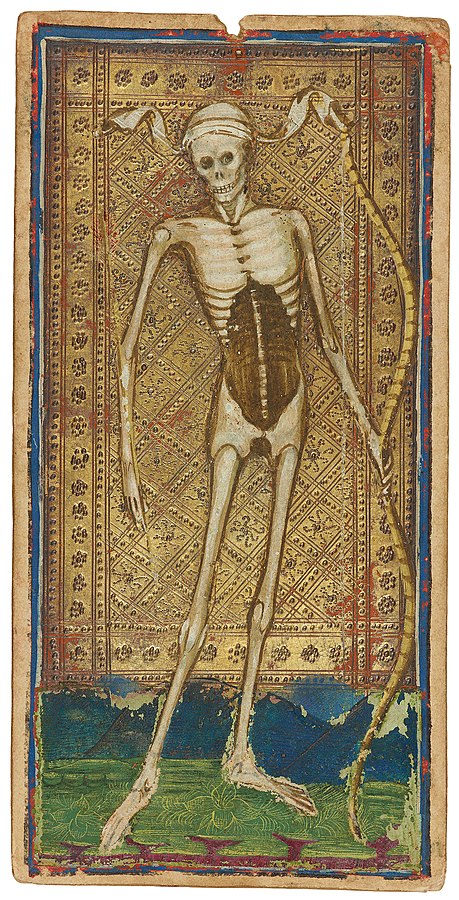
A book with a collection of texts, which also include the 6 "Trionfi" poems of Petrarca, has a Death picture with bow and arrows.
In the same text there is an Eternity figure, which presents the Final Judgment motif which is also part of the Pierpont-Morgan-Bergamo-tarocchi.
Compare ... viewtopic.php?f=23&t=403&p=26058#p26058
The book with the unusual Petrarca pictures was discussed in July-August 2023 in the thread "Petrarca Trionfi poem motifs in early Trionfi decks" post 87 ff ....
viewtopic.php?p=26053#p26053
The book is ... Manusript Barb.lat. 3954
https://digi.vatlib.it/view/MSS_Barb.lat.3954/0321
.... commentaries are given at ...
https://petrarch.mml.ox.ac.uk/item/1512
.... titled "Vatican City, Biblioteca Apostolica Vaticana, Barb. Lat. 3954"
.... also at ...
http://www.mirabileweb.it/manuscript-ro ... RDP_214673