Huck: My main requirement for a theory is plausibility, in relation to facts and good guesses based on facts. There are lots of facts, some are in documents, some are in art and literature, some are in the cards themselves. There is also general knowledge about the times and human nature. It gets complex. And the Renaissance loved complexity.
My reconstruction of how the decks could have evolved is just a story that I find plausible. If it isn't plausible, tell me why, and I will change it.
Speaking of facts, do you have any more about Lorenzo's interest in Hercules in 1465. Pollaiuolo's Hercules and the Hydra is c. 1475. Hercules and Deianira is c. 1470.I'm still trying to imagine how the "Strength" card could have been Lorenzo's idea in 1465. Did Pollaiuolo do them at Lorenzo's request, for example? I need more information
STAR, MOON, AND SUN
Meanwhile, here is my critique, of sorts, of your theory that Lorenzo purchased the Star, Moon, and Sun cards hurredly in Ferrara for Ippolita's wedding. The question that arises for me is, where did these new designs come from? They are very different from the d'Este cards that we see a little later in Ferrara, and also very different from the Moon and Sun cards in the Charles VI deck in Florence.
Let me start with the Star card. Here is the Ferrara card and also the earliest Bologna-style card, from the Rothschild collection at the Louvre (Kaplan Vol. 1 p. 129), since the Charles VI lacks a Star card:
In the d'Este, two men look up at a star. One is pointing at the star, the other in a more horizontal direction. One of the men carries star tables or a star map. I think what is going on is that the man on the right is deducing from the position of the star what direction they should travel. In the "Rothschild," probably from Bologna, there are three men. Again, they are deliberating. There is a cross on a globe at the left, just where the man had been pointing in the previous card. They are the Three Wise Men of the East, "following yonder star." One has a crown, one has a three-tiered tiara, and one, surprisingly, has the "Phyrgian cap" identifying him as Mithras or a follower! That is a detail that does not get repeated.
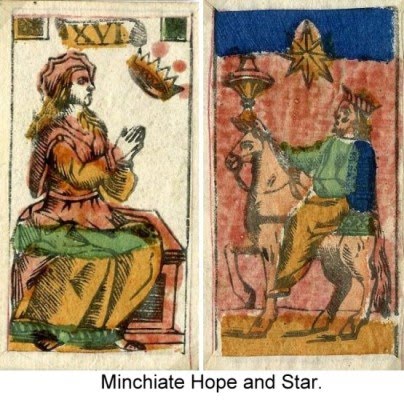
Now let us turn to the Milan cards, first the Hope card and then one of the new cards, called the Star:
There is a star at the top right of the Hope card, close to where it is in the Star card. The major difference is that the lady is kneeling in the one, standing and reaching out in the other. It seems to me that we can get the meaning of the Star card from the Hope card, and it is the same as for the Ferrara and Bologna cards: it is a reference to Jesus, either at the time of his birth in Bethlehem or as the "Bright Morning Star" of Revelation. But the way in which the idea is expressed pictorially in the PMB is similar to the CY and quite different from the d'Este and Charles VI.
Whoever designed the card had a new way of expressing the idea behind the Star card, less aligned with astronomy and more with the religious iconography of the CY Hope card. He had to have been familiar with the design itself, either from the card itself, from a similar card, or from an iconographic tradition of which I am not familiar.
But there is another mysterious aspect to the card. There is a cliff in the card. That detail comes from the original PMB's Death card, which also has a cliff. I suspect that it is a memorial to the death of Elisabetta Sforza in 1472. Someone would have had to be familiar with the original PMB's Death card to know to repeat it here.
The card's designer, then, would be someone who worked regularly for the Sforzas, had an opportunity to see the both the CY cards, or at least their type, and the original PMB, and had an interest in the theological virtues and the trump tradition of Star, Moon, and Sun.
In fact there is more than one candidate meeting these conditions. First, of course, would be Benedetto Bembo in Cremona, as the Bembos worked regularly for the Sforzas. But another one, I discovered to my amazement tonight, is none other than Piero del Pollaiuolo. In researching his work in response to Huck, I noticed that he did a series of paintings on Hope, Faith, Charity, Temperance, and Justice. Justice is more like the lady on the Charles VI World card than anything else in these decks. The other three are quite similar to the CY cards for these virtues. There is no star in his Hope card; she is merely looking up in the same direction as on the card, praying (
http://www.aiwaz.net/panopticon/hope/gi2251c203). The work was done in 1469-1470. He also did the famous non-resembling portrait of Galeazzo Maria Sforza (
http://www.aiwaz.net/panopticon/portrai ... gi2247c203). Based in Florence, he would have known Charles VI-style cards, including (I think) its Star card. So either he designed the new PMB cards, or he was inspired by them or the CY for his paintings.
Later on, the Minchiate, from Florence or Bologna, had both styles of card, one called "Hope" and the other called "Star." The earliest example I can find is a 18th century deck, probably from a 17th century original (
http://www.endebrock.de/coll/pages/i31.html). The "Hope" card is right where the Star card appears in the PMB sequence and everywhere else, after Temperance (if we ignore the Devil card, which is not in either the Charles VI or the PMB),and before the Moon The Minchiate Star card, similarly, shows someone following a kind of floating beacon, with a star overhead. He is following his Star, much as the Hope woman is following her Crown. So the Minchiate knew about the Hope-Faith connection, too.
Next comes the Moon. Whoever invented the progression Star, Moon, Sun had a good idea: the heavenly bodies come in progressively greater intensity. In the Milanese vision, however, they also recapitulate the old cards: first is the star of Bethlehem, our Hope; then Faith lights our dark world like the Moon; and finally Christ comes in full glory at the Second Coming, like the Sun. After that the destruction of the world comes in fire brighter than the sun, and then the New Jerusalem, shining so bright, according to the Book of Revelation, that the sun and moon are no longer needed (as Hurst eloquently expressed it in "Riddle of tarot,"
http://www.geocities.com/cartedatrionfi/Riddle.html).
In Ferrara and Florence we also have the Moon and the Sun, but expressed differently. The Ferrara-style Moon card, judging from the d'Este, showed an astronomer learning projective geometry from observing the moon. The moon's crescent is one circle intersected by the circumference of a larger circle, as the shadow of the earth cuts off the light of the sun. He is learning geometry, with all its potential, from the Moon. Thereby we may calculate not only the time of eclipses, but even the circumference of the earth (a matter of some import in this Age of Discovery). The theme seems to be the dispelling of ignorance with knowledge, or darkness with light.
And what is happening on the Charles VI card? Is the yellow object the moon in the earth's shadow, or the sun partially blocked by the moon ? It is probably an eclipse, but it could be either of the sun or the moon. Huck is right about correlating the card with the Florentine eclipse-predictors of the time. Symboliucally eclipses signify temporary darkness followed by greater light. On the Rothschild card, there are two suns on either side of the moon. Are these harbingers of the light to come, the Second Coming?
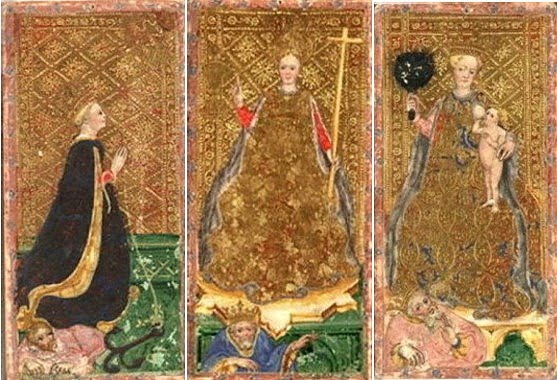
Now let us turn to the Milan cards, the CY Faith and the PMB Moon.
Again there is a similarity of design between the CY and the PMB. Instead of holding a finger up in the direction of Heaven, the lady holds the Moon itself. And instead of a cross, the PMB woman holds a bow, or perhaps bow and bowstring. In Petrarch, when Chastity overcomes Love, the virgins break Cupid's arrows. The bow is not mentioned, but it is shown as broken in numerous visual representations of this section of Petrarch's poem (e.g.
http://www.jstor.org/pss/861662.)
Bows are also identified with Diana. If the broken bow is hers, that would explain the dejected look on her face. In Chaucer's "parliament of fowls," broken bows symbolized maidens' regret at their wasted years in Diana's service (Complete Poetical Works of Geoffrey Chaucer, p. 346, in Google Books). A 16th century card in Kaplan's Encyclopedia of Tarot, Vol. 2, shows similar dejection but without the bow.
Let us think back to Michelino. The goddess Diana occurs on the list of gods precisely where Faith would be in the cards, the #7 spot. Although the virgins known for faithfulness were the Vestals, Diana was also a virgin, included in the suit of Turtledoves, which symbolize Faithfulness. If she is holding Cupid's broken bow, then perhaps Diana is the goddess corresponding to Faith and to the virtue of chastity, which as Faith in the Beinecke's ordering of the Cary-Yale would have been right where she was supposed to be, between Love and Death. In her new place, she is restored with Cupid's broken bow. However she does not look triumphant on the card; hence it is more likely that either she is regretting her years of chastity, or, or wht I think, is regretting giving them up for the sake of marriage. The latter would probably have been the case for 13 year old Elisabetta Sforza. In any case, this is not a Petrarchan image; but it is something that somebody who regretted forcing someone into marriage might have thought up.
Diana, whose cult center was Ephesus, was replaced by Mary, who had her cult center in the same place. John also was located there, as the place where he allegedly wrote the Book of Revelation. A Renaissance example combining Moon, Mary, and John is Bosch's St. John the Evangelist at Patmos.

Yes, Bosch was in Flanders. But Flemish artists and musicians often came to the Milanese and Ferrarese courts, and presumably went home again. They shared a similar perspective and iconography. The Moon is the image of the Virgin, who has replaced Diana as the image of feminine purity. Helped by his silvery angel, John is able to put the devil behind him in the light of the Virgin, our comforter as we wait for the Second Coming. The time of the moon is night, when it is not only visible but gives visibility to things in the darkness. It is a combination of darkness and light, and the resolution of doubt with faith. In dark times the Moon represents our faith and the paraclete, which after Christ's death and resurrection is brighter than a mere hope. (And thanks to her faith, Elisabetta is in a better place.)
My point in describing this mood of despair and faith in relation to the Moon card is to show how different the Milan card is from its equivalents in Ferrara, Florence, and Bologna. The Milan card is about faith and chastity; the others are about science and ignorance. And again there is the cliff, taken from the original PMB's death card.
Pollaiuolo's painting is a little different form its counterpart in the Cary-Yale (
http://www.aiwaz.net/panopticon/faith/gi2250c203). It is actually closer to the PMB Moon lady. His Faith stands proud and firm, with a sword where the CY has a cross and the PMB the strange bow, and a cup where the CY lady merely points her finger, but where the PMB woman has an equally round moon.
Above we see again the early 18th century Minchiate. There the Faith card replaces the Cary-Yale cross with what looks like a mirror, except that someone has dabbed it with red, making it a torch. It is the same mirror that is traditionally associated with the virtue of Prudence. The previous card is in fact Prudence, with the mirror in a different hand and a snake companion. We get "Faith" by subtracting the snake and adding a flame to shine in the darkness. The Star card is the scientist again.
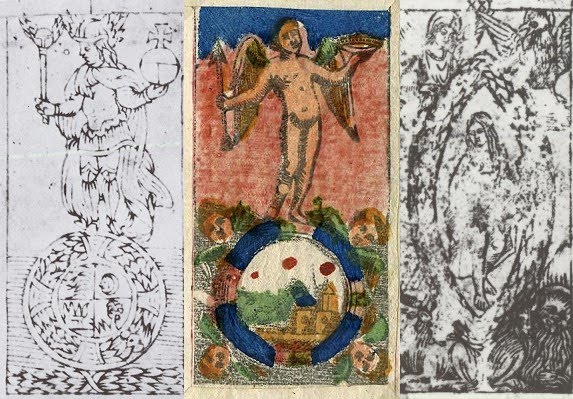
Finally let us the Sun card. Again, here is Ferrara, Florence, and Bologna:
I have already discussed these cards in the earlier post. Ferrara is Alexander asking Diogenes to be his court philosopher, and Diogenes telling Alexander to stop blocking his sun. Charles VI is Clotho spinning the thread of our lives. In Plato's "Myth of Er," she spins the entire physical universe, the 8 spheres from the moon to the fixed stars. The sun is perhaps related as the source of life and light, and also that by which we count the passage of time in our lives.

Again, the Milanese card shows quite different imagery, more related to its predecessor than to the cards of other cities. The Cary-Yale represents charity as a woman giving suck to an infant, defeating King Herod below, who slaughtered the innocents. She has given the child the gift of life and nourishment. She is also a symbol of God's overflowing charity. She holds a round object in her hand, probably a mirror. I am not sure of its significance: perhaps it a suggestion of prudence, of knowing one's limits and capacities. In the Sun card the infant has grown muscular, and he carries the round object, now become the sun. He is the "genius of the Sun," which give life and nourishment to all that lives, as an Italian mass-produced card from the 16th century also shows. But the sun is still that of God's charity, which allows us to become His children. The sun is brighter than the moon, just as God's charity makes up for our weak faith. And again, inexplicably, there is the cliff. These two cards, CY and PMB, are intrinsically related, much closer to each other than either is to the cards of the other cities. Yet at the same time there is a common thread linking them all: that of the child and the nourishment of new life.
Here Pollaiuolo's painting is similar to the CY Charity card, with the lone addition of a torch.(
http://www.aiwaz.net/panopticon/charity/gi2249c203). That torch shows up again in the Minchiate's Charity.
The Minchiate Charity card has the same woman as before, but with a larger torch. The card suggests the sun vs. the moon as much as charity vs. faith. The Sun card is a loving couple under the sun; this image is from a different tradition than the one we have been working in, the "Marseille" style cards as we know them from the 17th century. It resembles the Minchiate card for Gemini. To account for that pair, commonly seen at that time yet so unlike the Greek Gemini, would take us too far afield.
I am not sure what to conclude from all this, except that Pollaiuolo's paintings seem to derive from the CY, his Faith card is even halfway to the PMB Moon, and that he could possibly have designed the PMB "luminaries," having first seen the rest of the deck. But it seems to me that if he did so, he would have done it in consultation with the Sforzas. As I have said, they took their luxury cards seriously. And the Moon card is just too ideosyncratic to be a painter's own idea. Pollaiuolo painted Galeazzo in 1471, which is probably also when he did the "Apollo and Daphne." His Temperance is also quite like the PMB Temperance--as well as the Charles VI version and, I think, the CY's card. There isn't a Fortitude painting, but there is a Prudence. The cards still don't look like a rush job for Lorenzo to me, and they still look like a product of the 1470's. I will have to think about them and the paintings some more, as well as the PMB "Strength" card.

 ... it's ideal in a research situation, that you have to add NOTHING (and that's a very secure result). It's far more troublesome, if you have to reconstruct something to make it "somehow possible". In the case of the Cary Yale it's unavoidable to reconstruct. The deck is not complete, small arcana are missing.